

Workforce
Deploy AI Employees and Scale Your Team Faster


42 AI agents across 7 industries that deliver real business impact.
Workforce
42 AI agents across 7 industries that deliver real business impact.
A virtual AI college counsellor built by Bitontree for an Australian EdTech platform delivers personalized university matching, AI-driven essay evaluation, and real-time admissions guidance to students at scale. The system lifted student admission readiness by 80%, raised platform engagement by 40% over offline counselling baselines, cut manual counselling effort by 55%, and improved platform efficiency by 50% - letting the EdTech team support more students without proportional staff growth.
3 AI engineers + 1 conversation designer + 1 data engineer + 1 PM
Mid build ($40K–$120K Indian-market range)
Location: Australia
Industry:Education
Project Type:Marketplace
Duration:20 weeks
Services Used:AI Development,
AI Agent Development,
Custom Software Development
Team:3 AI engineers + 1 conversation designer + 1 data engineer + 1 PM
Pricing Tier:Mid build ($40K–$120K Indian-market range)
Our client is an Australia-based EdTech company building a digital admissions advisory platform for students applying to universities globally. The company helps students assess their academic and financial profiles, discover universities that fit their goals, prepare strong application materials, and access the test preparation resources they need to compete for admission.
Their previous model relied on human counsellors working one-on-one with students through scheduled video sessions. The model was high-touch and effective for the students who could access it, but the human counselling capacity could not scale with platform growth - leaving most students relying on generic college search tools and self-directed application prep. The client needed an AI college admissions counsellor that could deliver personalised guidance at platform scale, not just to the students who could afford one-on-one human sessions.
As the platform grew, the client faced three structural challenges that limited how many students they could genuinely help.
College admission criteria, acceptance rates, tuition ranges, scholarship availability, and application deadlines change frequently across thousands of institutions. Their existing tooling pulled from a handful of public datasets but had no automated way to keep recommendations accurate as institutional data shifted year over year. Students received stale or incomplete information at the worst possible moment in their application timeline.
Each student needed advice grounded in their unique academic record, financial position, location preferences, and career goals. The existing model delivered this through human counsellors, but human capacity capped the number of students who could receive personalised guidance. Adding more counsellors meant linear cost growth without solving the response-speed problem during application season peaks.
College selection is one of the most consequential decisions a student makes. A black-box recommendation engine that returns a list of universities without explanation would not earn the trust needed for students to act on it. The client needed an AI system that could explain its reasoning, show the data behind each recommendation, and feel more like a knowledgeable advisor than a search engine.
Students making poorly-informed college choices that led to financial strain, wrong-fit enrolments, or missed admissions opportunities. The platform losing user trust to better-resourced competitors with deeper personalisation. Counselling cost growth that eroded the business model. And ultimately, an inability to deliver on the company's mission to widen access to quality college admissions guidance for students who could not afford traditional human counsellors.
Bitontree partnered with the client's product and data teams to build the AI college admissions counsellor as a three-stage AI workflow: Assess, Match, and Counsel. Each stage delivers a piece of what human counsellors used to do manually, and the stages run continuously throughout a student's application timeline. The solution is anchored in our AI agent development practice and AI chatbot development expertise.
The system breaks the admissions advisory process into three discrete AI stages, each independently optimised. Assess profiles the student, Match generates university recommendations, and Counsel handles ongoing guidance through conversation.
Automated pipelines pull from College Scorecard, Common Data Set, the client's proprietary datasets, and institutional websites. College recommendations always reflect current acceptance rates, tuition, scholarship availability, and deadline data - not last year's snapshots.
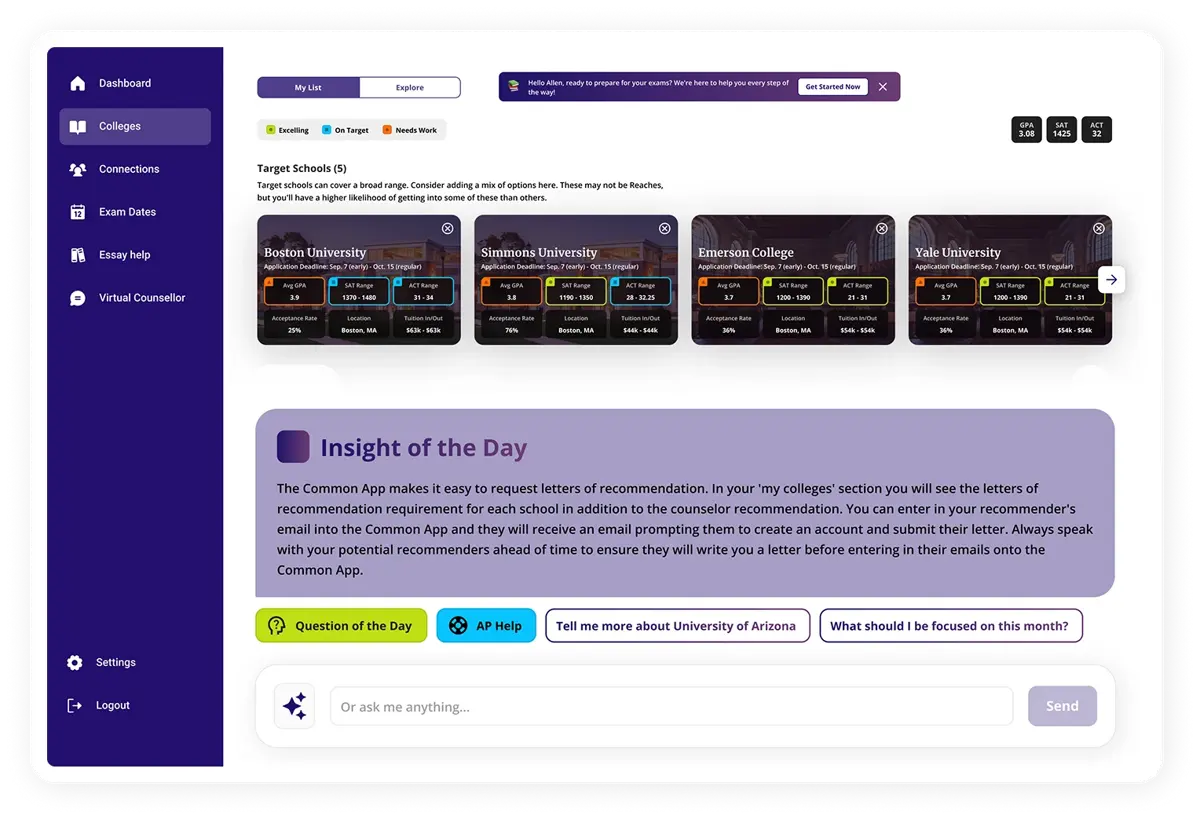
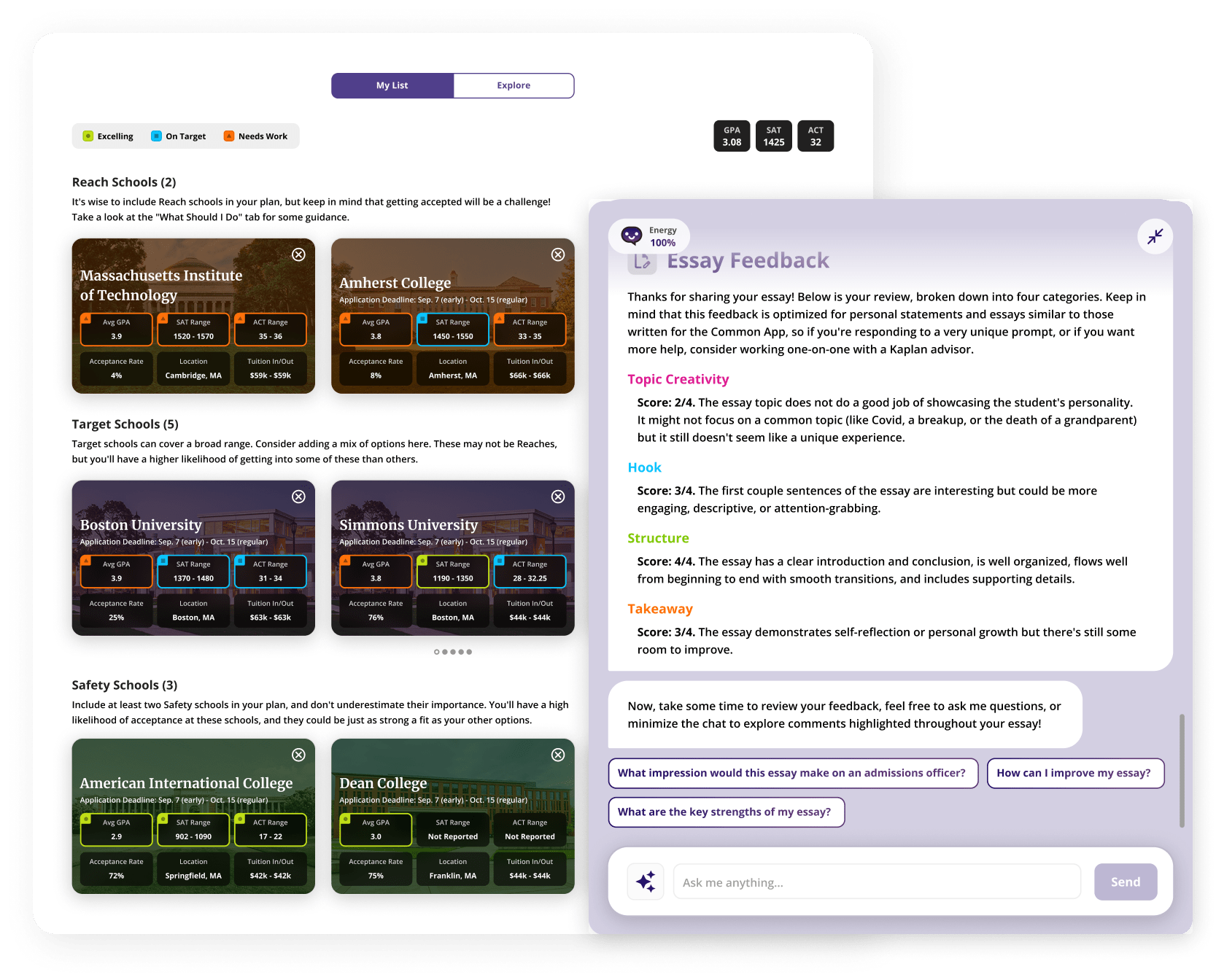
The matching engine classifies recommendations as safety, target, or reach schools and shows the academic, financial, and preference reasoning behind every recommendation. Students see why a college made their list, which builds the trust needed to act on AI advice.
The essay tool helps students draft application essays from scratch, evaluates submitted drafts against admissions criteria, and returns specific feedback on structure, tone, content, and grammar. Students refine essays through multiple AI-assisted iterations rather than waiting weeks for human feedback.
The chatbot remembers each student's profile, college shortlist, application progress, and prior conversations. Students do not re-explain themselves every session. The chatbot delivers the same continuity a human counsellor would, at a fraction of the cost per interaction.

A conversational AI counsellor that captures student data through natural dialogue, answers admissions-related questions in real time, and delivers personalised guidance grounded in each student's full profile. The chatbot remembers conversation history across sessions, so students continue where they left off without re-explaining themselves.
Analyses each student's academic record, financial considerations, location preferences, and career goals against public and proprietary university data to recommend a balanced shortlist of safety, target, and reach schools. Every recommendation comes with the reasoning behind it -acceptance probability, financial fit, programme strength, and student preference alignment.
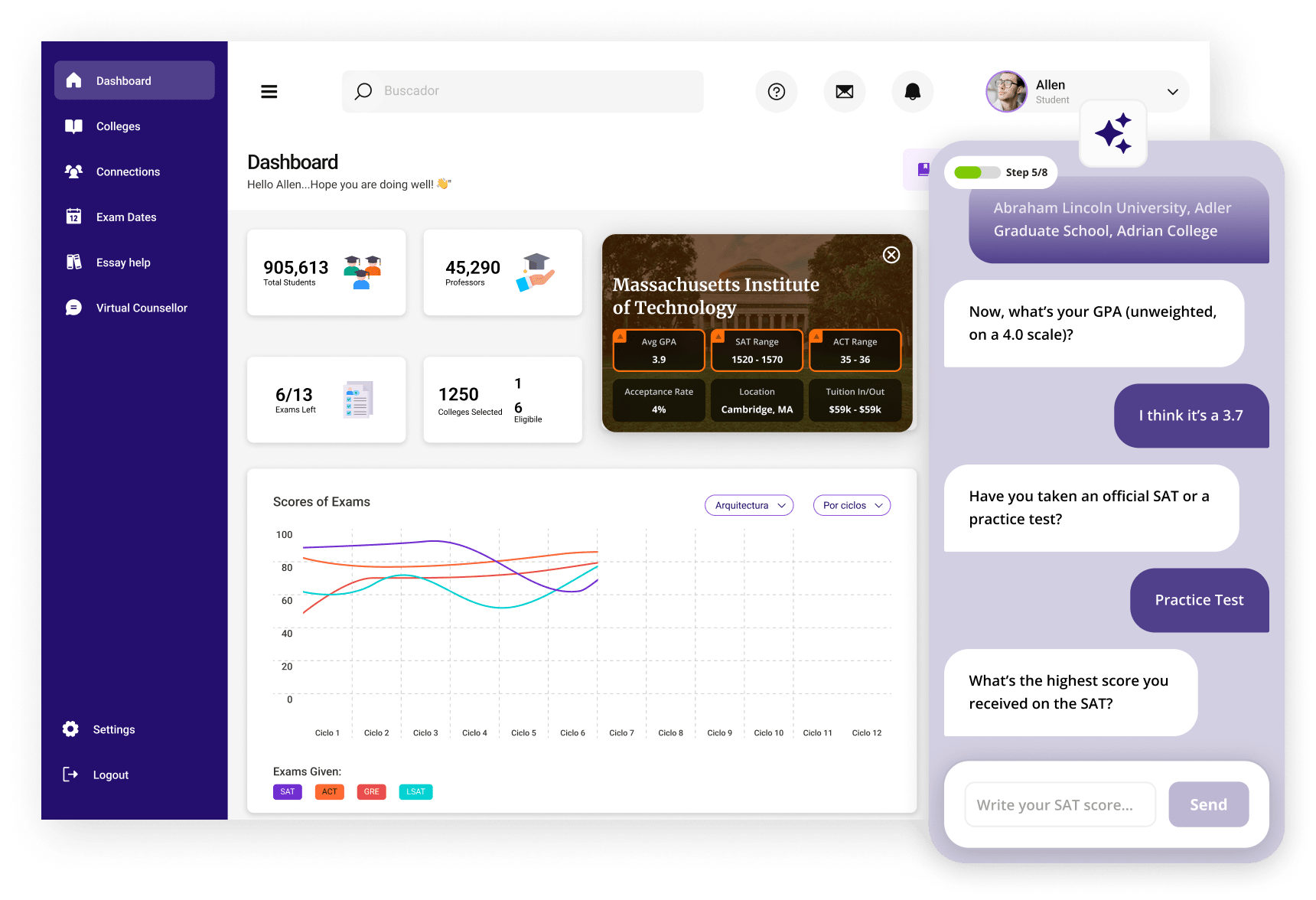
A unified dashboard where students manage their college shortlist, track application progress against deadlines, monitor essay drafts and feedback cycles, and access tailored recommendations for test preparation. The dashboard becomes the single source of truth for a student's entire admissions process.
Students draft application essays with AI assistance, submit drafts for AI evaluation, and receive detailed feedback on structure, tone, narrative strength, and grammar. The system grades essays against admissions criteria and surfaces specific revisions -turning a process that previously took weeks of human feedback cycles into days of self-directed iteration.
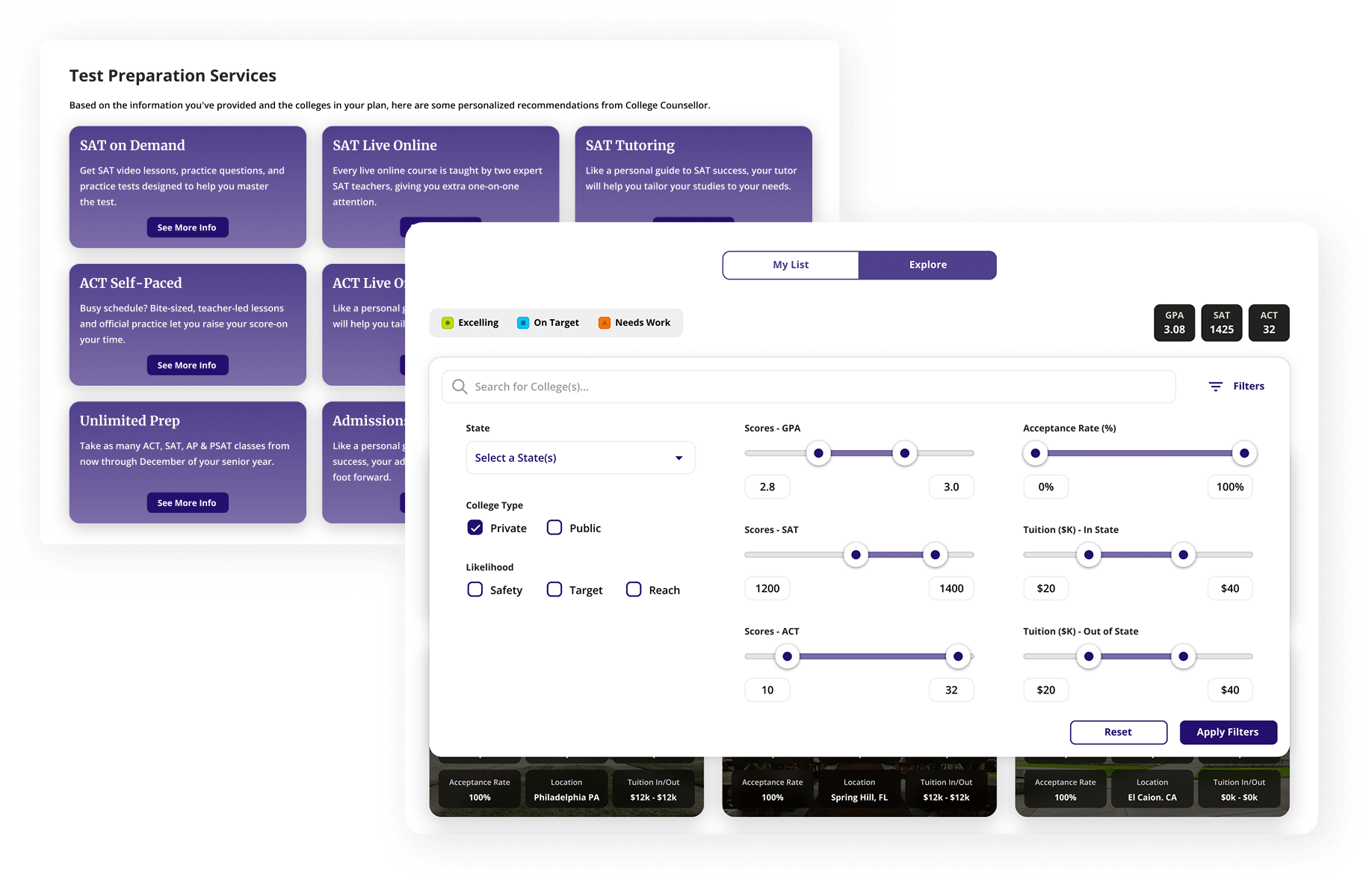
Beyond AI-generated recommendations, students explore the full college universe through an advanced search interface. Filters include geographic location, public versus private, admission likelihood given the student's profile, tuition ranges, scholarship availability, programme strength, and other customisable criteria.
The platform connects students directly to test preparation materials and courses tailored to the entrance exams required by their target colleges. Students no longer juggle separate tools for college matching, application support, and test prep - the full admissions workflow happens in one place.
| Dimension | Traditional Human Counselling | Virtual AI College Counsellor |
|---|---|---|
| Counselling availability | Scheduled video sessions only | 24/7 conversational access |
| Personalisation depth | Limited by counsellor capacity | Scales to thousands of concurrent students |
| College data freshness | Manual updates, often stale | Continuous ingestion, always current |
| Essay feedback turnaround | Days to weeks per draft | Minutes to hours per iteration |
| Recommendation explanation | Verbal, hard to revisit | Written reasoning, drillable to source data |
| Cost per student | High and linear | Low marginal cost at scale |
| Application tracking | Counsellor notes and spreadsheets | Centralised student dashboard |
| Access equity | Available to students who can afford it | Available to every student on the platform |
After deploying the AI college admissions counsellor, the client measured improvements across student admission preparation, platform engagement, manual counselling workload, and overall platform efficiency. Each metric below reflects the change from the pre-AI counselling baseline.
Higher Admission Readiness
More Student Engagement
Less Manual Counselling
Platform Efficiency Gain
The platform was engineered using production AI, data pipeline, and EdTech-grade integration technologies selected for accuracy, scalability, and student data protection requirements.
Tell us about your platform, your student population, the countries you serve, and the data sources you have access to. We will assess the highest-ROI automation opportunities and give you a clear estimate against the Indian-market pricing tiers above.

Bitontree built our virtual AI counsellor in under five months, and we now serve more students with better personalisation than we ever could with human counsellors alone. The matching engine recommends colleges with the reasoning behind every suggestion, students get essay feedback in hours instead of weeks, and our counselling cost per student dropped sharply. The AI did not replace our counsellors - it freed them to focus on the highest-value student conversations.
Don’t just take our word for it - our track record reflects our expertise and success.

An AI college admissions counselor is a digital advisor that uses artificial intelligence to guide students through the college selection and application process. It analyzes student profiles, matches them with best-fit universities, evaluates essays, and delivers personalized admission strategies through real-time conversational interactions, replacing or supplementing traditional in-person counseling.
AI matches students with universities by analyzing academic qualifications, test scores, extracurricular activities, financial preferences, and career goals against public and proprietary college datasets. The system generates curated lists categorized as safety, target, and reach schools, helping students make data-driven decisions instead of relying on guesswork.
Yes. AI evaluates college application essays by analyzing content, structure, tone, and clarity against admission standards. The system provides detailed feedback, grades essays on specific criteria, and suggests improvements. Students can iterate on essays daily with continuous AI feedback, dramatically improving final submission quality.
Production-grade AI college counselors deliver highly accurate recommendations by training on verified admission data from thousands of institutions. The system updates as admission criteria change, ensuring guidance reflects current requirements. In our deployment, students saw an 80% improvement in admission readiness through personalized AI recommendations.
AI college counseling complements traditional counseling by offering 24/7 availability, personalized recommendations at scale, and continuous essay feedback that human counselors cannot match. Our deployment showed a 40% increase in student engagement and 55% reduction in manual counseling effort compared to traditional offline methods.
Yes. AI college counselors scale to serve thousands of students simultaneously without performance degradation. The system delivers personalized recommendations, essay evaluations, and admission guidance to each student in real time, making it suitable for large EdTech platforms, school districts, and international student populations.
Yes. AI college counseling platforms are built with end-to-end encryption, role-based access controls, complete audit trails for student interactions, and compliance with education data regulations including FERPA and GDPR. Student profiles, essays, and application data remain protected with industry-standard security practices.
Development timeline depends on feature scope, data integration complexity, the number of universities in the matching database, AI capability depth, and compliance requirements. Every project receives a detailed timeline and milestone schedule during the discovery phase, based on your specific platform vision and operational requirements.
