








Bitontree Solution
Bitontree Solution
bitontreecardicon

Workforce

Deploy AI Employees and Scale Your Team Faster

user
email
growup

42 AI agents across 7 industries that deliver real business impact.

plse

A Financial Analytics Platform That Computes EBITDA, Working Capital, and Custom KPIs

financial-hero-imgfinancial-hero-img
financial-hero-img
financial-hero-imgfinancial-hero-img

PLSE, a custom financial analytics and reporting platform built by Bitontree for a US fintech company, organizes financial data into four analytical layers, computes advanced financial metrics that standard accounting tools cannot natively produce (EBITDA, Working Capital, Current Ratio, AP Days, AR Days), supports user-defined dynamic formulas, generates multi-page PDF reports, and gives growing businesses the advanced financial insight typically reserved for enterprise platforms like NetSuite or Workday Adaptive. The platform connects directly to QuickBooks to access the live financial data businesses already work with.

Location:

USA

USA

Industry:

Fintech

Project Type:

Marketplace

Duration:

38 weeks

Services Used:

UI/UX Designing,

Web Development,

Custom Software Development,

Support & Maintenance

Team:

4 full-stack engineers + 1 UX designer + 1 QA engineer + 1 PM

Pricing Tier:

Enterprise build ($120K+ Indian-market range)

Location:USAUSA

Industry:Fintech

Project Type:Marketplace

Duration:38 weeks

Services Used:UI/UX Designing,
Web Development,

Custom Software Development,

Support & Maintenance

Team:4 full-stack engineers + 1 UX designer + 1 QA engineer + 1 PM

Pricing Tier:Enterprise build ($120K+ Indian-market range)

About the Client

Our partner on this project is a US-based fintech company building advanced financial analytics and reporting tools for growing businesses. They serve mid-market companies that have outgrown standard accounting reports but cannot justify the cost or complexity of enterprise financial platforms like NetSuite, Workday Adaptive, or Sage Intacct.

The reason this project mattered: businesses hit a wall when they need to compute key financial metrics like EBITDA, Working Capital, Current Ratio, AP Days, or AR Days. Standard accounting platforms excel at bookkeeping but fall short on advanced analytics and multi-period analysis. Companies were exporting financial data to spreadsheets, building custom calculations manually every month, and losing dozens of hours to financial analysis that should be automated. Our client's vision was to fix this gap with a purpose-built analytics platform, branded PLSE, that integrates with the accounting systems businesses already use.

The Challenge: Building Advanced Analytics Beyond Standard Bookkeeping

The client faced four engineering challenges in building PLSE as a financial analytics platform that processes accounting data, integrates with QuickBooks, and supports user-defined financial calculations.

  • Organizing Accounting Data Into Multi-Layer Analytical Categories

    Accounting systems store financial data in chart-of-accounts hierarchies optimized for bookkeeping, not analysis. Building meaningful financial insight required reorganizing this data into multiple analytical layers (such as Accounts Receivable aging, Current Liabilities by type, working capital components) that standard accounting platforms do not expose natively. The data structure transformation had to preserve underlying accounting accuracy while creating new analytical views on top.

  • Supporting User-Defined Custom Financial Formulas

    Every business defines financial metrics differently. Some companies calculate EBITDA with specific add-backs; others compute working capital with custom inclusions or exclusions. The platform had to support user-defined dynamic formulas that compute against live accounting data while staying mathematically valid and audit-traceable. Building a flexible formula engine without sacrificing computational accuracy was a core technical challenge.

  • Aggregating and Comparing Financial Data Across Multiple Time Periods

    Real financial analysis lives in comparisons: this month versus last month, this quarter versus prior year, year-to-date versus trailing twelve months. Standard accounting tools support basic date-range filtering but do not natively compute period-over-period analysis or multi-period trend lines. The platform had to aggregate financial data across any user-defined time period and surface trend insights visually.

  • Building a Robust QuickBooks API Integration for Large Datasets

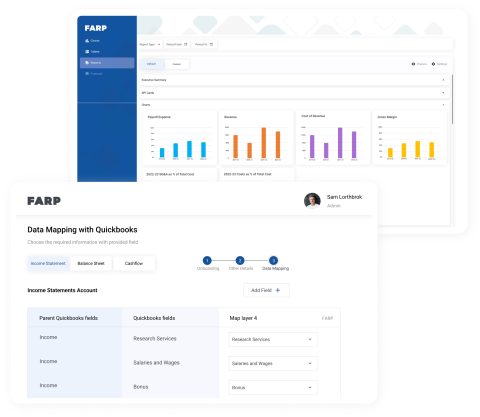
    QuickBooks accounts vary widely in structure, account naming conventions, and customizations. Building an integration that worked across thousands of QuickBooks Online and Desktop accounts required handling variable account structures, large dataset retrieval within API rate limits, OAuth token refresh, auto-reconnect on session expiry, and reliable incremental sync. Edge cases multiplied at scale.

What Was at Stake

Businesses making poorly-informed financial decisions because their accounting data sat in basic bookkeeping systems but their analytical needs lived in spreadsheets, hours of finance team time wasted on monthly close manual calculations, missed early warning signs of cash flow problems, and a market opportunity to serve hundreds of thousands of growing businesses who needed advanced analytics without the cost of migrating to enterprise platforms.

The Solution: A Multi-Layer Financial Analytics and Reporting Platform

Bitontree engineered PLSE, a custom financial analytics and reporting platform that delivers advanced financial analysis beyond what standard accounting tools natively produce. The platform connects to QuickBooks for live financial data and was built drawing on Bitontree's fintech industry expertise in financial data engineering, integration architecture for accounting platforms, and custom analytics dashboard development for SMB finance teams.

Architecture Decisions

  • Four-layer financial data categorization

    Raw accounting data is restructured into four analytical layers (general ledger, balance sheet categories, P&L line items, and working capital components). Each layer feeds different analytical views without compromising the underlying accounting accuracy. Users drill down from high-level financial health into specific account-level transactions.

  • Dynamic formula engine for user-defined metrics

    Users define their own financial formulas using a structured formula builder. The engine validates formula syntax, computes against live financial data, and traces every calculation back to source transactions. EBITDA, Working Capital, Current Ratio, AP Days, AR Days, and any custom metric a business needs all run through the same computation engine.

  • Multi-period analysis with rolling time windows

    The platform compares any time period against any other (month-over-month, quarter-over-quarter, year-over-year, custom date ranges, trailing twelve months). Time-series data flows into rolling analytics that surface trends, anomalies, and seasonal patterns automatically.

  • QuickBooks API integration with intelligent retry and auto-reconnect

    The integration handles variable account structures across QuickBooks Online and Desktop, respects API rate limits, automatically refreshes OAuth tokens, retries on transient errors, and reconnects silently when sessions expire. Users never see the integration plumbing.

  • Multi-page PDF report engine for stakeholder communication

    KPIs, charts, and tables compile into structured multi-page PDF reports that finance teams share with executives, boards, and investors. Reports are templated and customizable, with version control for tracking how financial views evolve across reporting periods.

Core Features We Built

Multi-Layer Financial Data Analysis

Multi-Layer Financial Data Analysis

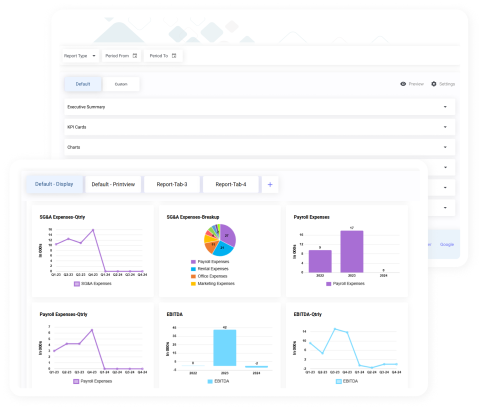
PLSE organizes financial data into four analytical layers (general ledger, balance sheet, P&L, working capital), enabling deep analysis across detailed categories like Accounts Receivable aging and Current Liabilities by type. Users drill from high-level financial health into specific transaction-level data, uncovering insights that surface-level accounting reports miss. 
Interactive Financial Charts and Visualizations

Interactive Financial Charts and Visualizations

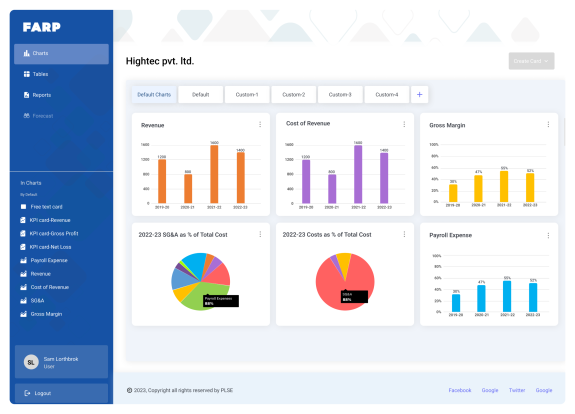
The platform supports bar charts, line charts, and pie charts for visualizing financial trends, growth patterns, seasonal fluctuations, and cash flow. Charts are interactive with drill-down support, time-period adjustment, and side-by-side comparison views. Visual interpretation replaces spreadsheet pivot tables for finance teams. 
plse-feature-1
Custom KPI and Table Builder

Custom KPI and Table Builder

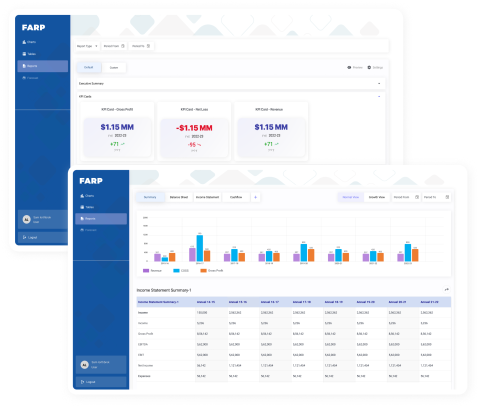
Users define personalized financial KPIs and build custom tables that match their specific business goals. KPIs update in real time as financial data syncs, and dashboards align with the metrics each company actually tracks instead of a generic out-of-the-box layout. 
Dynamic Formula Engine for Custom Metrics

Dynamic Formula Engine for Custom Metrics

Users write their own financial formulas using a guided formula builder. The engine computes Working Capital, EBITDA, Current Ratio, AP Days, AR Days, and any custom metric using live financial data. Every calculation is audit-traceable back to the underlying source transactions, with formula version history retained for compliance. 
plse-feature-2
Multi-Page PDF Report Generation

Multi-Page PDF Report Generation

KPIs, charts, and tables consolidate into multi-page PDF reports that finance teams share with executives, boards, investors, and lenders. Reports are templated, customizable, and exportable on demand or scheduled. Multi-page structure supports executive summaries, detailed financial views, and supplementary appendices in a single document. 
Real-Time QuickBooks Sync with Auto-Reconnect

Real-Time QuickBooks Sync with Auto-Reconnect

PLSE syncs with QuickBooks Online and Desktop continuously, maintains data accuracy through incremental updates, refreshes OAuth tokens automatically, and reconnects silently when sessions expire. Users never have to manually re-authenticate or trigger syncs. 
plse-feature-3

Traditional Analytics Platform vs PLSE Financial Analytics and Reporting Platform

Dimension Traditional Analytics Platform PLSE Financial Analytics and Reporting Platform
Setup time Months of data engineering and migration Direct accounting integration in minutes
Cost for growing businesses Enterprise pricing, often $50K+/year licensing Built-once platform with predictable cost
Accounting integration Requires custom data pipeline build Native QuickBooks API integration with auto-reconnect
Financial metric calculations Generic BI calculations on flat data Pre-built EBITDA, Working Capital, Current Ratio, AP/AR Days
Custom formula engine Requires SQL or scripting knowledge Guided formula builder with audit trail
Multi-period analysis Custom dashboard building per view Built-in rolling time windows with trend detection
Multi-layer financial views Requires data modeling and ETL Four pre-defined analytical layers, ready to use
Report generation BI dashboard exports, limited templating Multi-page templated PDF reports
Audit traceability Often manual or partial Every calculation traced to source transactions
Best fit Large enterprises with dedicated data teams Growing businesses with finance teams of any size

The Result

After deploying PLSE, the client equipped their customers with financial analysis capabilities that were previously only available in enterprise platforms. The platform delivered the following outcomes for finance teams.

70%

Faster Monthly Financial Close

10+

Hours Saved Per Finance User Monthly

60%

Less Time in Manual Spreadsheets

4-Layer

Financial Data Analysis Depth

Technologies Used

PLSE was engineered with production-grade financial software technologies selected for computation accuracy, integration reliability, and visual reporting quality.

Tech Stack
Tech Stack
Tech Stack
Tech Stack
Tech Stack
Tech Stack

Ready to Build Your Financial Analytics and Reporting Platform?

Tell us about your customer base, the financial metrics they need, the accounting platforms you integrate with (such as QuickBooks Online or Desktop), and the reporting outputs you want to deliver. We will assess the highest-ROI build opportunities and give you a clear estimate against the Indian-market pricing tiers above. 

What Our Clients Say

client image

Bitontree built PLSE as a true financial analytics platform, not just another report exporter. EBITDA, Working Capital, Current Ratio, AP Days, AR Days all compute automatically against live accounting data, with native QuickBooks integration for the businesses that use it. Our customers get custom KPI dashboards, multi-period comparisons, and executive-ready PDF reports. The four-layer data architecture and dynamic formula engine are the parts our finance team customers always call out as game-changing.

Jonathan ReedHead of Product

Looking For More Case Studies?

Don’t just take our word for it - our track record reflects our expertise and success.

Smart AI Invoice Processing System
LogisticsSingapore: Singapore

Smart AI Invoice Processing System

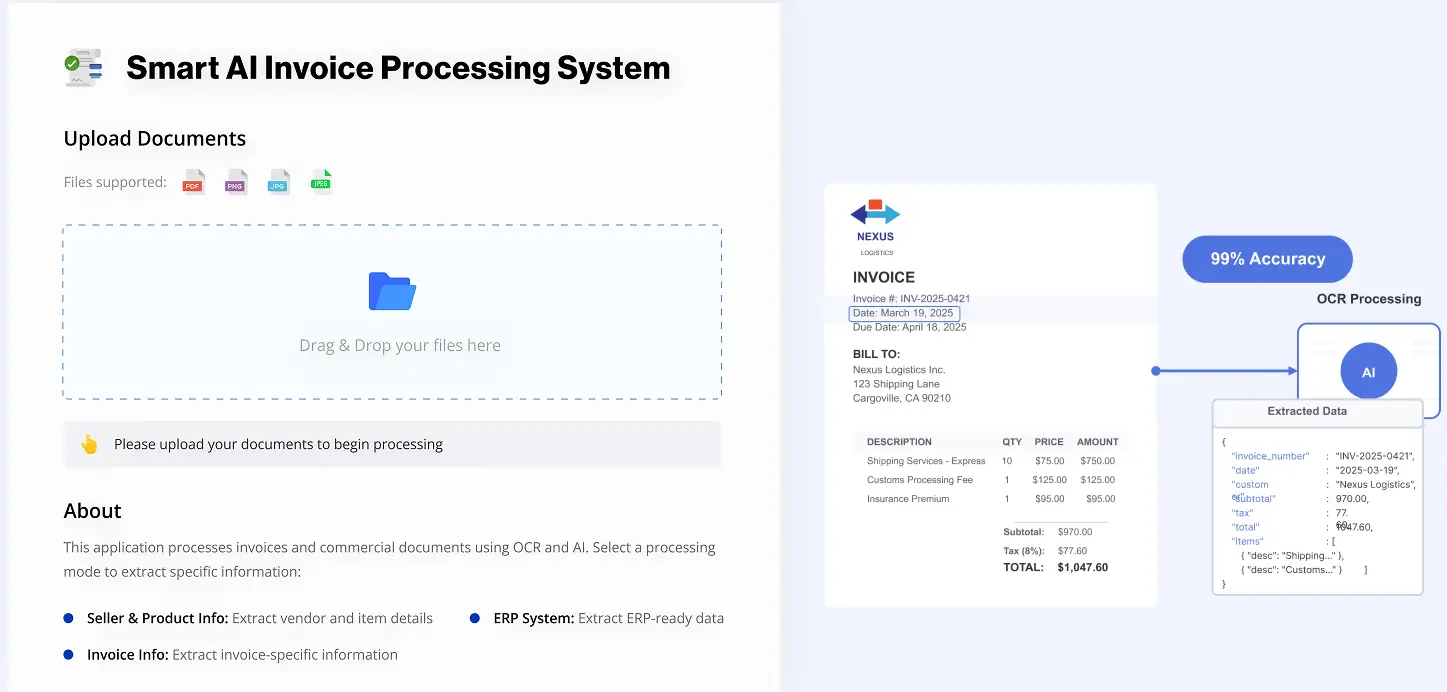
AI-powered invoice processing for a Singapore-based logistics enterprise. OCR and ML automate data extraction, validate against business rules, and process invoices end-to-end across multiple formats and currencies.

PythonLangGraphCrewaiStreamlitAzure
Educator Recruitment Platform
EducationCanada: Canada

Educator Recruitment Platform

A K-12 recruitment platform in Canada connecting educators with school boards-optimizing hiring, managing profiles, and simplifying job applications.

ReactBootstrap.NetAzureSQL
Healthcare Service Platform
HealthcareIndia: India flag

Healthcare Service Platform

We built a healthcare platform with appointment booking, lab tests, telemedicine, health content, assessments, & Medicare discounts.

NextjsTurboRepoNestAzureDocker

Frequently Asked Questions

A financial analytics and reporting platform for QuickBooks is an extension layer that adds advanced analysis capabilities QuickBooks lacks natively. It computes financial ratios like EBITDA and Working Capital, enables multi-period comparisons, provides custom KPI dashboards, and generates professional reports, turning QuickBooks accounting data into strategic insights.

QuickBooks alone falls short on financial analysis because it cannot compute key metrics like Working Capital, EBITDA, Current Ratio, AP Days, or AR Days natively. It also lacks multi-period comparison views, custom KPI dashboards, and advanced data visualization, leaving finance teams to rebuild reports manually in Excel every cycle.

A financial reporting platform integrates with QuickBooks through the official QuickBooks API to sync transactional data, chart of accounts, and historical records automatically. The integration supports auto-reconnect for token expiration, handles large dataset retrieval, and adapts to varying account structures across QuickBooks Online and Desktop deployments.

Yes. Users define custom formulas for any financial metric their business needs, including Working Capital, EBITDA, Current Ratio, AP Days, AR Days, and proprietary calculations specific to their industry. Custom KPIs and tables align the dashboard with business goals, supporting financial analysis that off-the-shelf tools cannot match.

Layered data analysis organizes QuickBooks financial data into four hierarchical layers, allowing users to drill into specific categories like Accounts Receivable, Current Liabilities, or Operating Expenses. This multi-level structure surfaces insights that flat data views hide, supporting targeted financial management and strategic decision-making.

Yes. The platform supports multi-period comparisons across months, quarters, and fiscal years, with accurate data aggregation and visualization. Users compare current performance against prior periods, identify trends, and spot seasonal patterns that single-period reports miss, all without manual Excel workarounds.

The platform generates structured, multi-page reports combining KPIs, charts, tables, and commentary into exportable PDF documents. Reports support board presentations, investor updates, and internal financial reviews, replacing manually compiled Excel reports with professional, shareable documents that maintain consistency across reporting cycles.

Development timeline depends on integration scope, the number of custom KPIs and formulas, report complexity, multi-period analysis depth, and visualization requirements. Every project receives a detailed timeline and milestone schedule during the discovery phase, based on your specific analytical needs and operational requirements.

Bitontree-logo

Looking for a career opportunity?

Mail

career@bitontree.com

FreightMynd

AI Chatbot Development

AI Agent Development

AI Consulting Services

Generative AI Development

MCP Server Development

AI Automation Development

RAG Development

MLOPS Development

Custom Software Development

Web Application Development

ERP Development

Mobile Application Development

Website Development

UI/UX Designing

Offshore Development

Support & Maintenance

About Us

Blog

Contact

Career

AI Development

AI Chatbot Development

AI Agent Development

AI Consulting Services

Generative AI Development

MCP Server Development

AI Automation Development

RAG Development

MLOPS Development

Software Development

Custom Software Development

Web Application Development

ERP Development

Mobile Application Development

Website Development

UI/UX Designing

Offshore Development

Support & Maintenance

Regarding Us

About Us

Blog

Contact

Career

Reach us out

location

305, Zodiac Square, Ahmedabad, India, 380054

phone

+91 972 2999 754

mail

sales@bitontree.com

Follow us on


Clutch
GoodFirms
Upwork
Clutch
Clutch
Clutch
Clutch

© 2026. All Rights Reserved by Bitontree

bg