


Workforce
Deploy AI Employees and Scale Your Team Faster


42 AI agents across 7 industries that deliver real business impact.
Workforce
42 AI agents across 7 industries that deliver real business impact.


A custom flat-pack furniture e-commerce platform built by Bitontree for a Netherlands-based retailer transformed the post-purchase customer journey into a fully self-service experience. Customers across multiple countries can now view their purchase history, track orders in real time, see refund status, and act on their orders directly through the platform. The build is powered by FLAGGA, a dynamic feature flag service that lets the retailer enable or disable features per country without code redeployment.
4 full-stack engineers + 1 UX designer + 1 QA engineer + 1 PM
Upper Mid build ($40K to $120K Indian-market range)
Location: Netherlands
Industry:E-commerce
Project Type:Marketplace
Duration:32 weeks
Services Used:Web Application Development ,
UI/UX Designing,
Support & Maintenance
Team:4 full-stack engineers + 1 UX designer + 1 QA engineer + 1 PM
Pricing Tier:Upper Mid build ($40K to $120K Indian-market range)
Our partner on this project is a Netherlands-headquartered flat-pack furniture and home goods retailer with a multi-decade history in ready-to-assemble furniture, kitchen appliances, home accessories, decoration, and home services. The company operates a major e-commerce presence serving customers across multiple countries.
The reason this project mattered: the post-purchase customer journey lacked self-service capability. Customers could not easily track their orders, reschedule deliveries, view purchase history, or initiate returns through the platform. Country-specific differences in currency, date format, language, and feature availability added complexity to every rollout. Our client's vision was to digitize the post-purchase experience and let customers act on their orders directly, with a platform architecture that could roll out features per country without engineering deployments.
The client faced three engineering challenges in building this platform.
The retailer operates in countries with different currencies, date formats, languages, delivery models, and feature availability. Building a single platform that adapts to each country without forking the codebase, while keeping the customer experience consistent, was the foundational architecture challenge. The platform had to render correctly for a customer in any supported market with no per-country code branches.
Some features (like assembly requests, buyback, or specific return flows) were only available in certain countries due to operational readiness. Hardcoding availability or maintaining country-specific deployments would have slowed every rollout and created configuration drift. The platform needed a dynamic feature flag service that operations teams could control through a UI, not through code changes.
A flat-pack furniture e-commerce platform that handles real customer orders cannot ship with bugs, edge case failures, or unhandled state transitions. The platform required comprehensive unit testing across every component, integration testing across the order state machine, and end-to-end validation of customer action flows before going to production in each country.
Bitontree engineered a custom flat-pack furniture e-commerce platform that gives customers full control over their post-purchase journey. The platform integrates with FLAGGA, a dynamic feature flag service that lets operations teams enable or disable features per country through a UI, with no code redeployment required. The build drew on Bitontree's e-commerce industry expertise in furniture e-commerce platform architecture, multi-country localization, and dynamic configuration systems for global retail.
FLAGGA is a UI-driven feature flag service that changes the behavior and appearance of the platform without requiring new updates or deploys. Operations teams enable or disable features (order rescheduling, order tracking, purchase history, currency, date format, language) globally or per country through a configuration UI.
Every order moves through a defined state machine (placing order, order received, order picked, order being prepared, order on the way, order delivered). The state machine drives the customer-facing tracking view, the eligibility logic for self-service actions, and notification triggers.
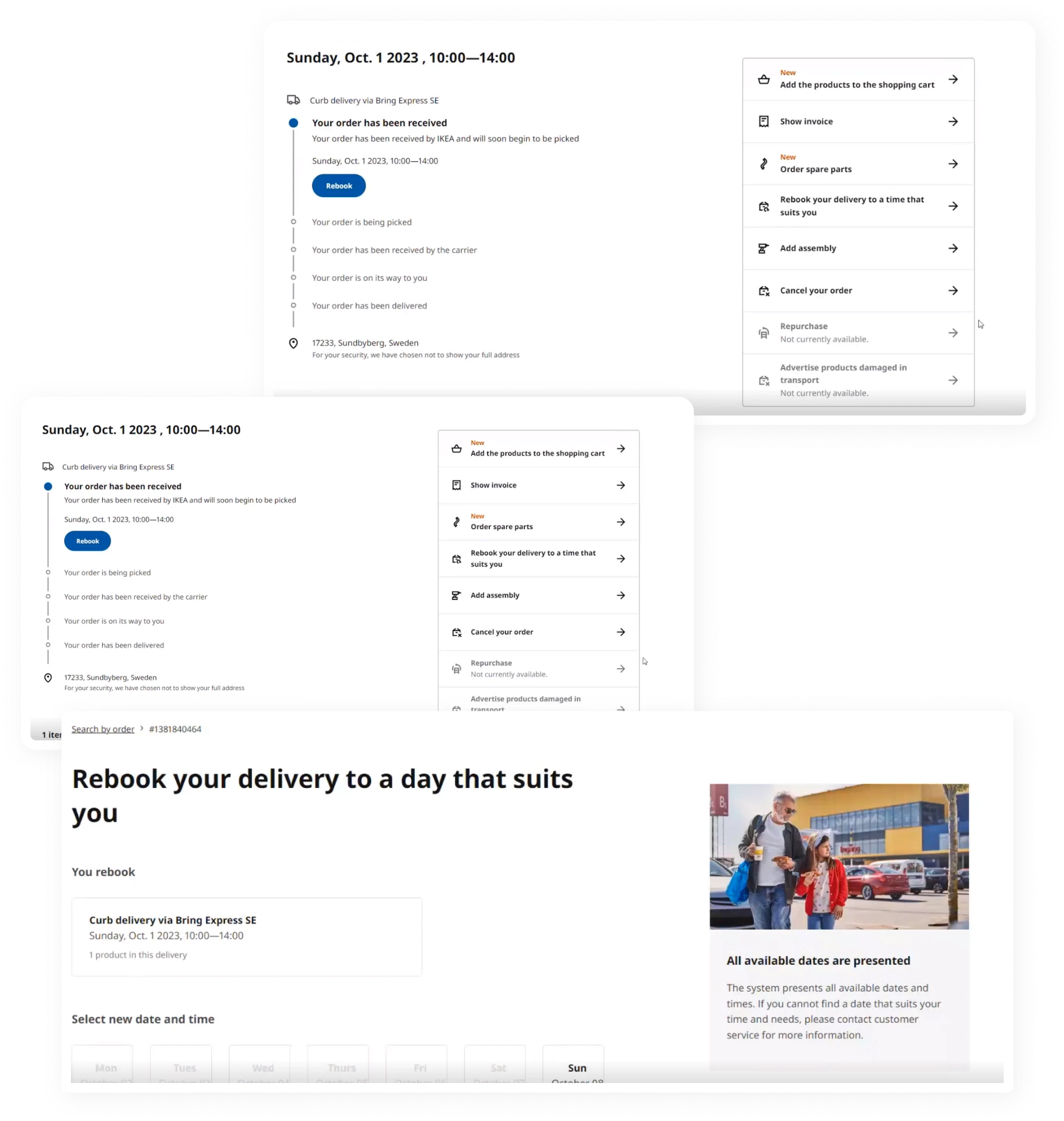
Each action has its own workflow, validation rules, and integration with backend systems, accessible from the customer's purchase history and order detail pages.
The platform handles currency display, date formatting, language localization (i18n), and country-specific feature availability dynamically. A customer in any supported country sees prices, dates, and content in their local format without separate codebases.
Every component, state transition, and customer action is covered by unit tests, integration tests, and end-to-end test cases. The test framework runs in CI on every commit, blocking merges that fail coverage thresholds.

Customers track their orders from placement through delivery with real-time status updates at every stage: order received, order picked, order being prepared, order on the way, order delivered. Status updates are state-machine-driven, ensuring accurate eligibility logic for downstream actions. Notifications trigger at every state change via email and SMS.
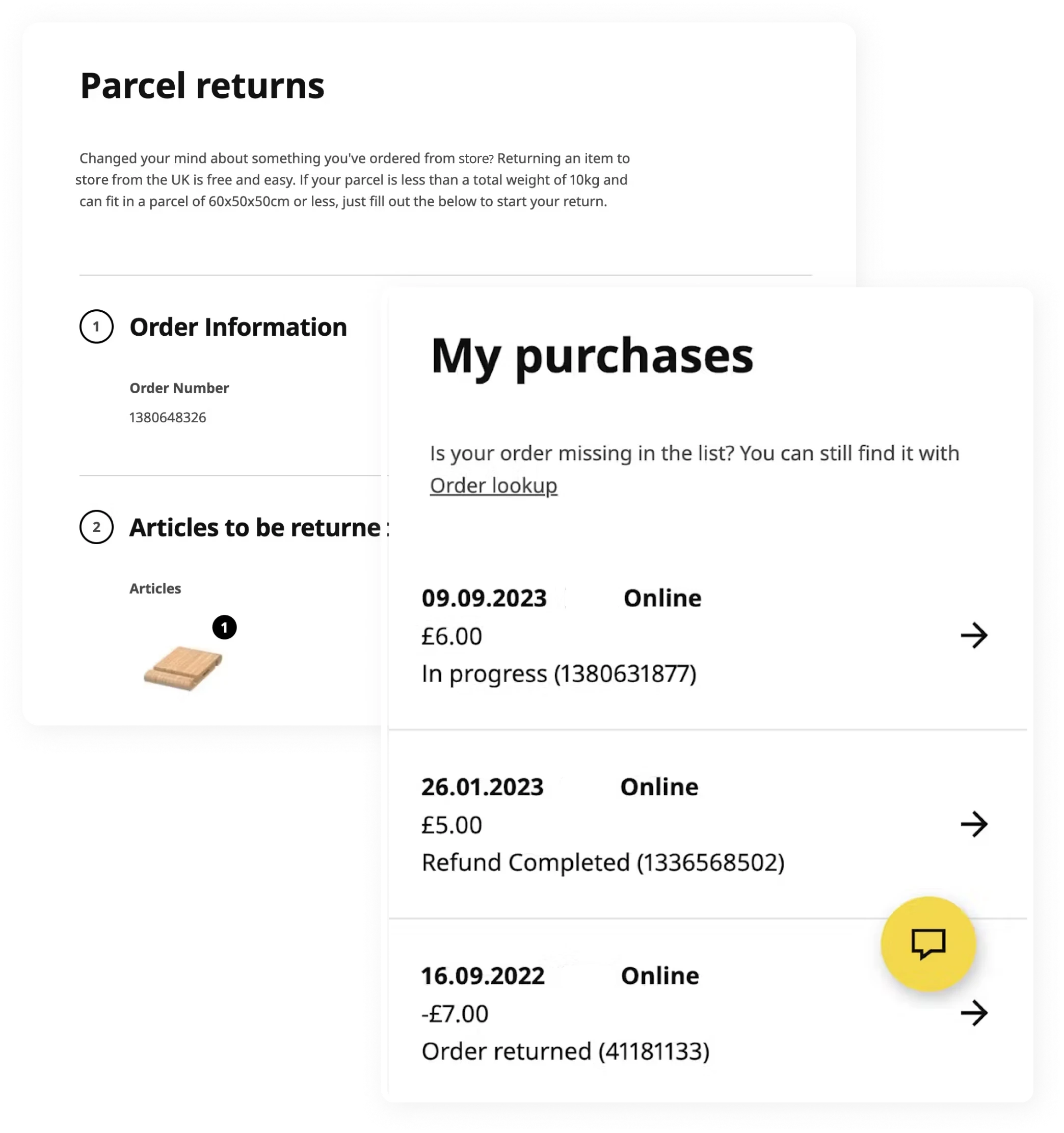
Customers retrieve any order quickly using order reference numbers, with clear lookup flows that guide them to relevant information without friction. The lookup page handles edge cases (canceled orders, orders in dispute, orders with partial deliveries) with clear messaging and next-step guidance.
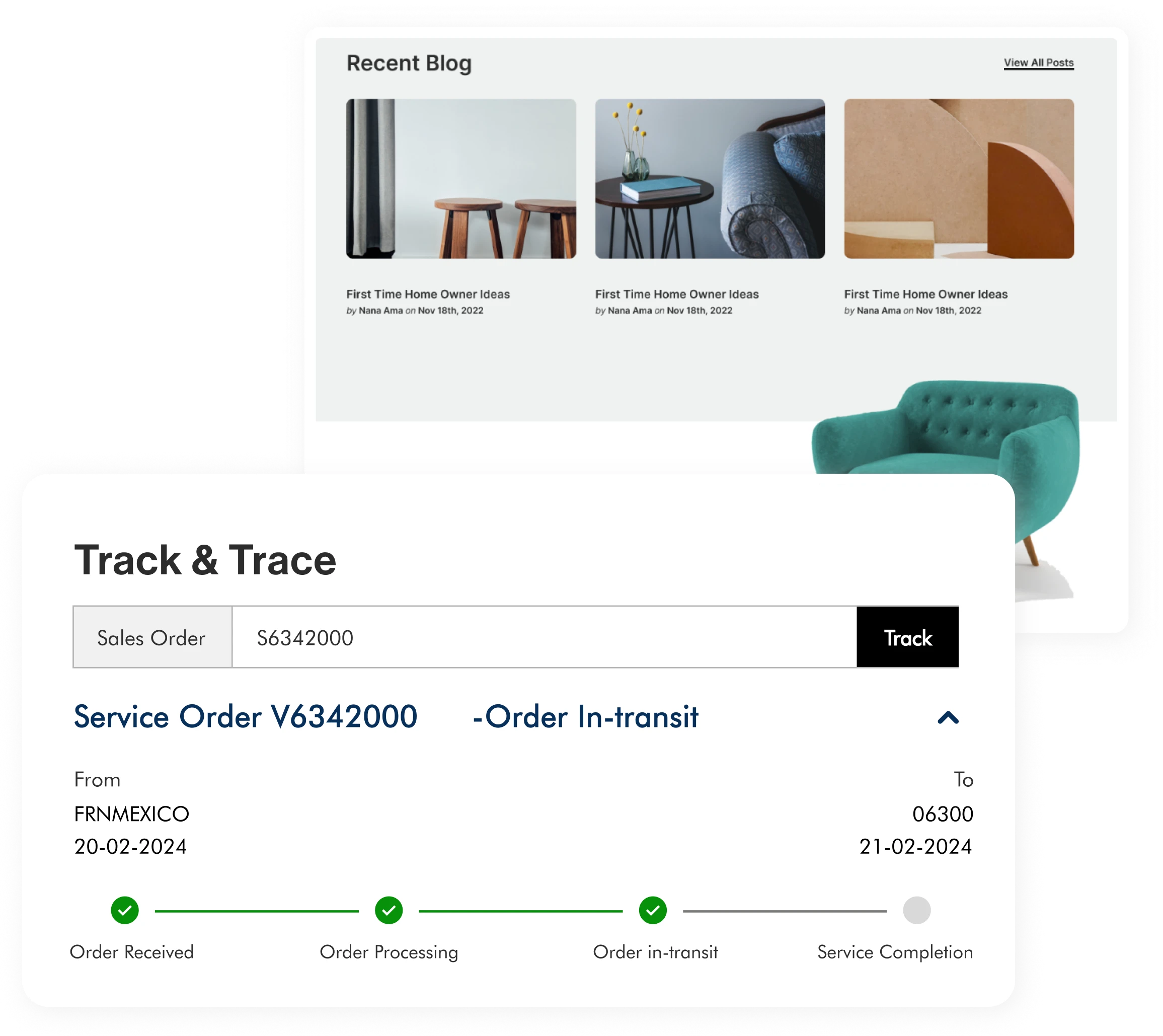
Each purchase has a dedicated detail page showing items purchased, prices, quantities, delivery address, payment method, current status, available self-service actions, and a complete history of state transitions. The detail page is the central hub from which customers initiate any self-service action.
A purchase history list page provides a clean overview of all past orders, organized chronologically with filters for date range, order status, and product category. The page is built for fast scanning and quick navigation, letting customers find any past purchase in seconds.
All customer data (delivery addresses, payment preferences, communication settings, country-specific settings, and saved items) is stored in a secure data vault with encryption at rest, role-based access controls, and audit logging. Customers manage their own data through a dedicated profile section that complies with GDPR and country-specific data protection regulations.
Active refund states display directly on the purchase history list page, so customers get a quick view of refund status without drilling into individual orders. The refund tracker shows initiated, processing, approved, and completed states, with clear estimated dates.
| Dimension | Limited Post-Purchase Experience | Flat-Pack Furniture E-Commerce Platform |
|---|---|---|
| Order tracking visibility | Static or limited status views | Real-time state-aware tracking |
| Order rescheduling | Not available to customer | Self-service date picker |
| Order cancellation and returns | Manual process, no automation | Self-service initiation with refund tracking |
| Spare parts and assembly requests | Manual lookup and bookings | Automated request flows in the platform |
| Country-specific features | Hardcoded, requires deployment | FLAGGA feature flag UI, no redeployment |
| Multi-country localization | Separate codebases or per-country builds | Single platform with dynamic currency, date, language |
| Purchase history visibility | Minimal or no view | Dashboard with filter, search, and detail pages |
| Refund status visibility | Not surfaced to customer | Live refund tracker on purchase list |
| Code quality and reliability | Manual testing, regression-prone | Comprehensive unit, integration, and end-to-end tests in CI |
After launching the platform, the client digitized the post-purchase customer journey across multiple countries with a single codebase and a dynamic feature configuration layer.
Reduction in Operational Overhead
Higher Market Reach and Customer Engagement
Operational Cost Reduction via FLAGGA Service
Countries Supported with Multi-Country Localization
The platform was engineered with production-grade e-commerce technologies selected for multi-country scalability, dynamic configuration, and code reliability.






Tell us about your customer-facing post-purchase experience needs, the countries you operate in, and the order management or fulfillment systems you need to integrate with. We will assess the highest-ROI build opportunities and give you a clear estimate against the Indian-market pricing tiers above.

Bitontree built the post-purchase customer journey we wanted: customers see their purchase history, track orders in real time, view refund status, and act on their orders directly. FLAGGA is what made this work across countries. We can roll out features per country through a UI without engineering deployments. Multi-country localization, real-time tracking, and a refund tracker that customers actually use.
Don’t just take our word for it - our track record reflects our expertise and success.
Furniture retailers reduce customer service costs by implementing self-service post-purchase platforms that let customers track orders, reschedule deliveries, cancel orders, request spare parts, and process returns without contacting support. In this deployment, self-service capabilities achieved near-zero dependency on customer care, freeing teams to focus on complex cases only.
A post-purchase customer journey platform handles every customer interaction after order placement: order tracking, rescheduling, cancellation, returns, refund status, spare parts requests, and assembly bookings. Unlike pre-purchase storefronts, post-purchase platforms focus on empowering customers to self-serve, reducing operational load and improving satisfaction without adding support headcount.
A feature flag service lets retailers toggle features on or off without deploying new code. Features like order rescheduling, tracking, and purchase history can be enabled by country, customer segment, or test group. This deployment used the FLAGGA service to control feature availability across markets without engineering releases.
Yes. Self-service platforms let customers reschedule deliveries, cancel orders, change addresses, and modify items within configured time windows directly from their account. Behind the scenes, the system validates eligibility, updates inventory, notifies fulfillment teams, and triggers any required refunds automatically, removing the need for customer service intervention.
Furniture platforms handle spare parts and assembly requests through dedicated self-service workflows. Customers identify the missing component or service needed, the system matches it against the original order and product catalog, generates a request ticket, and routes it to fulfillment or assembly partners, with full tracking visibility for the customer.
Multi-country e-commerce platforms manage regional differences through configurable settings for currency display, date formats, language, tax rules, and feature availability. Feature flag services like FLAGGA make these settings toggleable per country without code deployment, letting retailers launch in new markets faster and adjust regional behavior in real time.
Self-service order tracking displays real-time order status across the fulfillment journey: order received, picked, dispatched, in transit, out for delivery, and delivered. Customers see estimated delivery windows, courier details, and current location, with notifications at each stage. Refund status appears in the same interface for orders in progress.
Development timeline depends on the number of self-service actions, multi-country requirements, feature flag complexity, integration with existing fulfillment and inventory systems, and refund and returns workflow depth. Every project receives a detailed timeline and milestone schedule during the discovery phase, based on your specific operational requirements.

