September 20, 2026
How to Hire AI Engineers: What to Test, Which Hiring Model to Use, and Red Flags

Yash Vibhandik
CEO


Almost anyone can build an impressive AI demo in an afternoon. That is exactly why hiring AI engineers is so hard.
A candidate shows you a chatbot that answers questions about a PDF. It looks polished and it works in the meeting. What the demo does not tell you is whether that person can make the same system work on ten thousand real documents, stop it from inventing answers, keep it from leaking one customer's data to another, and keep the monthly bill predictable.
That gap between a working demo and working software is where most AI hires go wrong. This guide covers how to hire AI engineers who can close it: the AI engineer skills that actually predict production success, a practical AI engineer skills assessment you can run, the AI engineer interview questions that separate real experience from rehearsed answers, which hiring model fits your situation, and the red flags that should end the conversation. It works whether you are hiring AI engineers in-house, choosing a freelancer, or evaluating an AI development company.
What Does an AI Engineer Do? AI Engineer vs Machine Learning Engineer vs Data Scientist
"AI engineer" is one of the least precise titles in software right now, and the first step in how to hire AI engineers is deciding which role you actually need. The tests are different for each, and the AI engineer vs machine learning engineer confusion alone causes a large share of bad hires.
| Role | What they build | What to evaluate |
|---|---|---|
| AI application engineer | Products on top of existing models: agents, chatbots, RAG systems, automation | Evaluation discipline, retrieval, failure handling, integration |
| Machine learning engineer | Training, fine-tuning and serving models | Data pipelines, training infrastructure, model performance |
| Data scientist | Analysis, experiments, predictive models | Statistics, experimental design, business interpretation |
| MLOps engineer | Deployment, monitoring and versioning for models in production | Infrastructure, observability, rollback |
Most companies building AI features today need an AI application engineer, sometimes called an LLM engineer, not a machine learning engineer. You are rarely training a model. You are building a reliable system around one. Hiring a research-leaning ML engineer to ship a customer support agent is a common and expensive mismatch.
The rest of this guide focuses on AI application engineers, since that is the role most businesses are hiring for.
AI Engineer Skills: Six Things to Look For When You Hire AI Engineers
When you hire AI engineers, framework knowledge is the easiest thing to fake and the least useful thing to test. A candidate who has read the documentation can talk fluently about any orchestration library. These six skills are harder to fake, and they are what separates a system that runs from one that stays a prototype.
1. Evaluation Discipline
The single strongest signal. Ask how they know their system works.
A weak engineer tests by trying a few prompts and checking whether the answers look right. A strong engineer builds an evaluation set from real inputs, defines what a correct answer looks like, measures accuracy against it, and reruns it every time the prompt or model changes. For retrieval systems, that same discipline has to cover which documents were found, not only what the model said about them.
If a candidate cannot describe how they measured quality on a past project, they did not measure it. The same discipline decides whether you can later prove the system's return on investment.
2. Retrieval and Data Handling
Most business AI systems answer questions from company data, which makes retrieval the part that fails most often. Strong candidates talk about retrieval before they talk about models. They understand that a wrong answer usually traces to the wrong document being retrieved, not to the model reasoning badly.
Listen for chunking decisions, hybrid search, reranking, handling of tables and scanned documents, and how they keep an index in sync when source documents change. This is the core of RAG development, and it is where inexperienced builds break first.
3. Failure Handling
Demos run on the happy path. Production runs on everything else.
Ask what happens when a tool call fails, when an API times out, when the model returns malformed output, or when an agent gets stuck repeating the same step. Engineers who have shipped real systems have specific, slightly weary answers to these questions. Engineers who have only built demos tend to answer in general terms, because the failure never happened to them. Handling these cases well is most of the real work in AI agent development.
4. Security Awareness
AI systems introduce attack surfaces that traditional software did not have. The OWASP Top 10 for LLM Applications has become the shared reference for these risks, covering prompt injection, sensitive information disclosure, excessive agency and system prompt leakage among others.
A candidate does not need to recite the list. They do need to understand why an agent should never have more system permissions than its task requires, why user input must be treated as untrusted even when it arrives inside a document, and why a system prompt is not a safe place to store secrets. The consequences are real: the EchoLeak vulnerability, a zero-click flaw in Microsoft 365 Copilot that let attackers pull sensitive data without any user interaction, since patched, is the kind of failure a security-aware engineer designs against from the start.
5. Cost and Latency Awareness
An AI system that works but costs five times the budget is not a success. Strong engineers think about token usage, prompt length, model selection per task and caching as design decisions, not afterthoughts.
Ask a candidate to estimate the monthly running cost of a system they built. Someone who has run production AI can give you a rough figure and explain what drove it. Someone who has not will either guess wildly or say they never looked.
6. Production Operations
Who noticed when the system got worse? Accuracy degrades quietly when source data changes, when a model version updates, or when the mix of incoming requests shifts.
Look for engineers who log inputs and outputs, monitor accuracy after launch, version their prompts, and can roll back a change. Candidates who have only built prototypes usually have no answer here, because nothing they built ran long enough to degrade. The NIST AI Risk Management Framework organizes this kind of ongoing oversight around four functions: govern, map, measure and manage. You do not need a candidate who has read it. You do need one who behaves as if they had.
What to Test: A Practical AI Engineer Skills Assessment and Technical Test
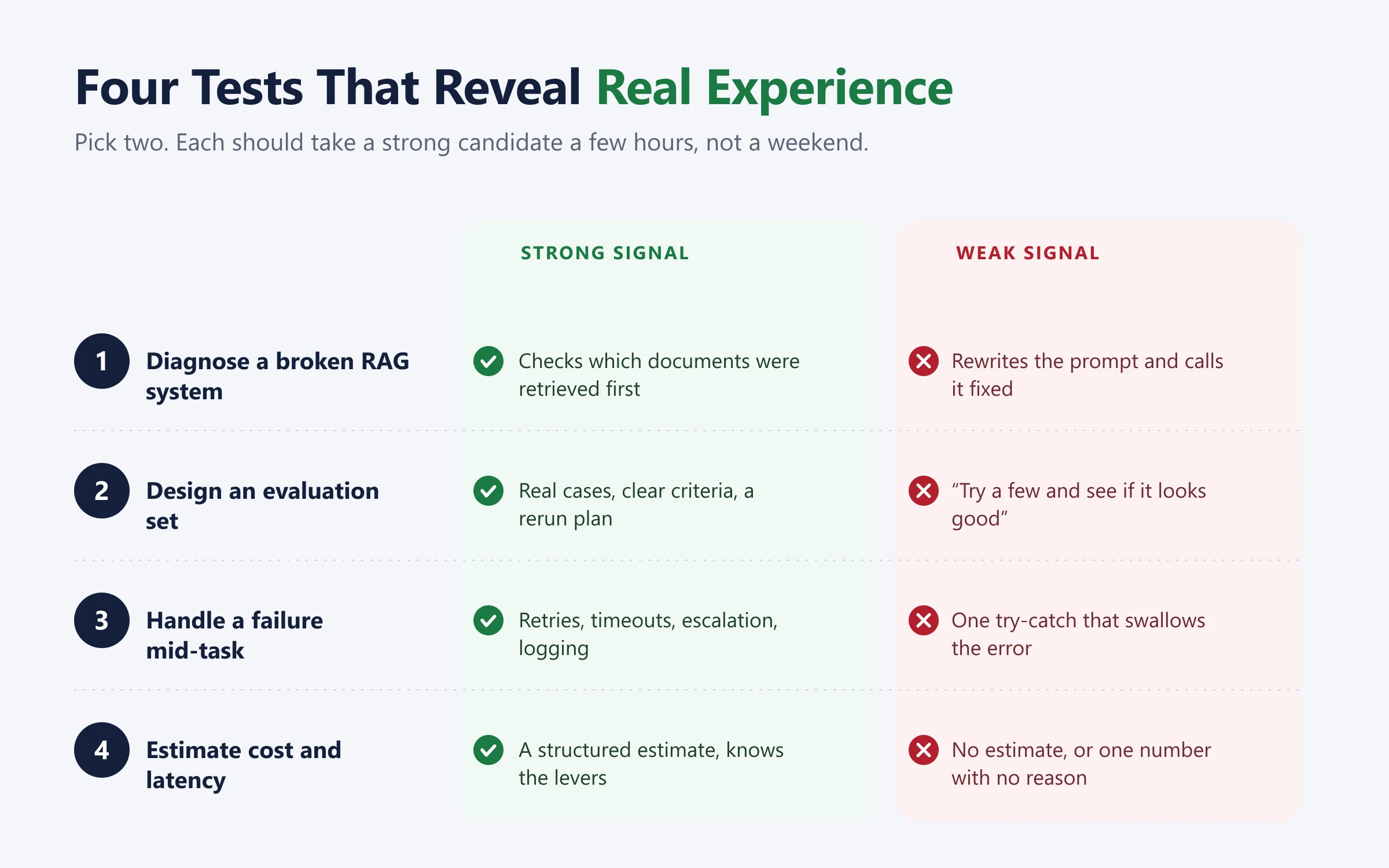
Generic coding challenges tell you almost nothing about AI engineering ability. These four exercises form a practical AI engineer technical assessment that tests the skills above directly. Pick two for any single hire and run them as an AI engineer take-home test or a live pairing session. Each should take a strong candidate two to four hours, not a weekend.
Test 1: Diagnose a Broken RAG System
Give the candidate a small working retrieval system and a list of questions it answers incorrectly. Ask them to find out why and propose fixes.
What good looks like: They check which documents were retrieved before touching the prompt. They find that some failures are retrieval problems and some are generation problems, and they treat them differently.
What weak looks like: They rewrite the prompt immediately and declare it fixed after trying a few questions.
Test 2: Design an Evaluation Set
Describe a real use case, for example a support agent answering questions about your product. Ask them to design how they would measure whether it works.
What good looks like: A set of test cases drawn from realistic inputs, clear criteria for a correct answer, attention to edge cases and failure modes, and a plan for rerunning it after changes.
What weak looks like: "I would test it with a few questions and see if the answers look good."
Test 3: Handle a Failure Mid-Task
Give them an agent that calls three tools in sequence, where the second tool sometimes fails. Ask them to make it reliable.
What good looks like: Retries with limits, timeouts, graceful fallback, a clear decision about when to stop and escalate to a human, and logging so a failure can be traced later.
What weak looks like: A single try-and-catch that swallows the error and continues.
Test 4: Estimate Cost and Latency
Describe a system handling a given number of requests per month. Ask for a rough monthly running cost and response time, and the biggest levers to reduce each.
What good looks like: A structured estimate with stated assumptions, awareness that retrieval context and prompt length drive cost, and concrete reduction ideas such as smaller models for simple tasks or caching repeated work.
What weak looks like: No estimate at all, or a single number with no reasoning.
One rule for every test: Let candidates use AI coding tools. Your team uses them. Banning them tests a skill nobody needs and hides the skill that matters, which is judgment about what the tool produced.
AI Engineer Interview Questions That Reveal Real Experience
These AI engineer interview questions work because rehearsed answers sound noticeably different from lived ones. The guidance under each describes what a strong answer includes.
"Tell me about an AI system you built that failed in production. What happened?" Strong candidates have a specific story, usually slightly embarrassing, with a clear cause and a fix. If someone claims nothing they built ever failed, either they have not shipped much or they are not being straight with you.
"How did you measure whether your last AI project was working?" Look for an evaluation set, a baseline and a number. Vague answers about user feedback are a warning sign.
"When would you choose not to use an LLM for a problem?" Good engineers know that a deterministic rule or a simple script is often cheaper, faster and more reliable. Candidates who want to solve everything with a model will overbuild.
"Walk me through how you would stop a customer-facing agent from being manipulated by a user." Listen for layered defenses: input handling, limited permissions, output validation and human review for sensitive actions. One-line answers suggest they have not faced it.
"Your system's accuracy dropped 15% last week and nothing in the code changed. Where do you look?" Strong answers mention changed source data, a model version update, a shift in the type of incoming requests, or a retrieval index that fell out of sync. This question separates people who have run systems from people who have built them once.
"How did you decide which model to use on your last project?" Good answers weigh accuracy, cost and latency against the specific task. "I used the most powerful one" is a sign they have not had to pay the bill.
Which Hiring Model to Use: In-House, Freelance, Dedicated Team or Development Partner
How you hire matters as much as who you hire. Each model fits a different situation, and choosing the wrong one creates problems no amount of candidate evaluation will fix.
| Model | Best for | Watch out for |
|---|---|---|
| Full-time in-house hire | AI as a long-term core capability, with enough work to keep an engineer busy for years | Slow and expensive to hire, and one engineer cannot cover every skill above |
| Freelancer | A small, well-defined, short project | Continuity risk, limited accountability after handover, variable security practices |
| Dedicated team | Sustained product work where you need several skills without building a department | Needs clear ownership on your side to direct the work |
| Development partner | A defined outcome you want delivered end to end, with handover | Choose on production track record, not on demo quality |
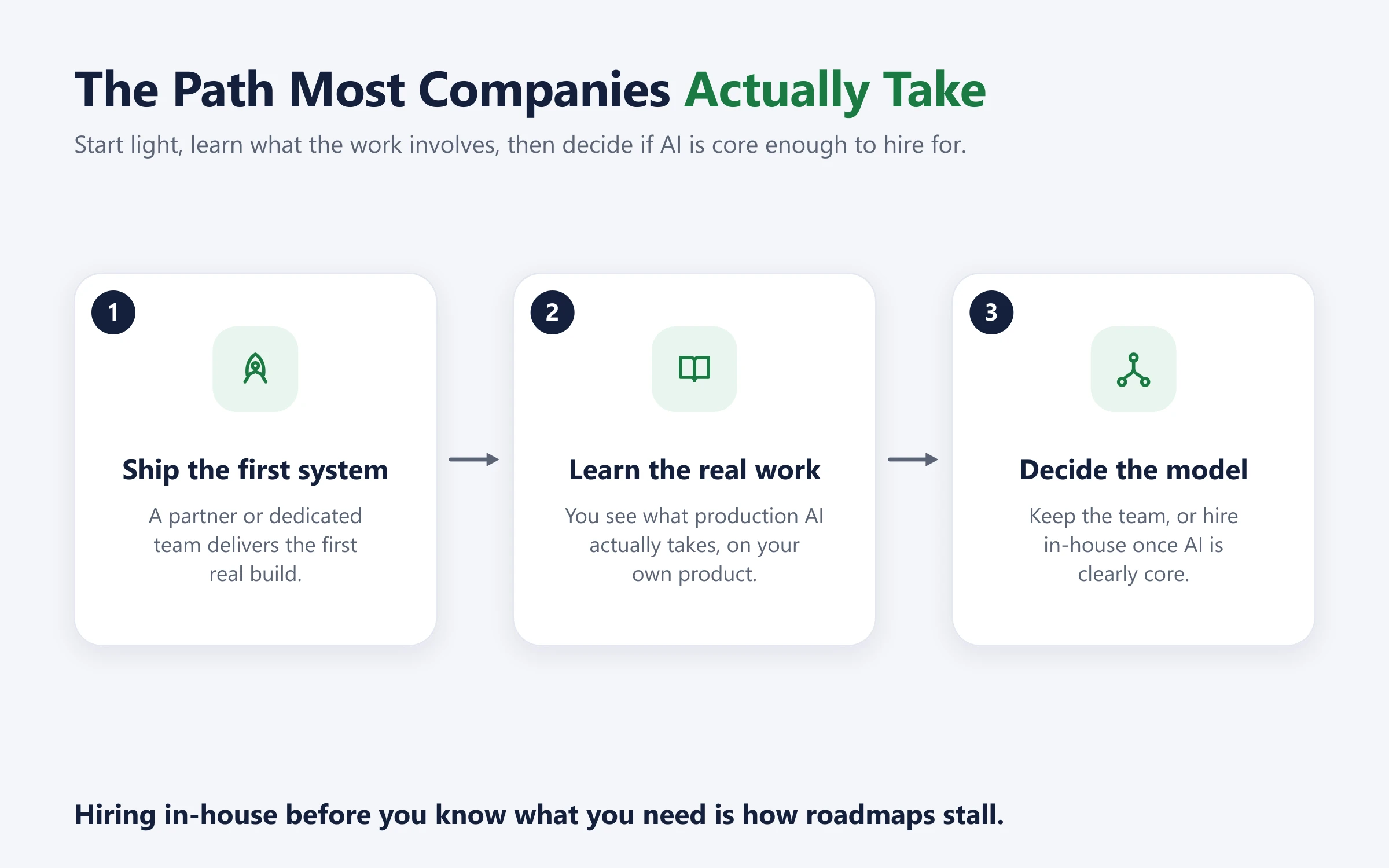
When deciding between an in-house AI team vs outsourcing, a pattern that works well for many companies is to use a partner or a dedicated AI team to ship the first system and learn what the work actually involves, then decide whether AI is core enough to justify full-time hires. Hiring in-house before you know what you need is how companies end up with one expensive engineer and a stalled roadmap.
If you want to hire AI developers as individuals rather than a full team, the route depends on the stack. You can hire AI ML developers for general production AI work, hire OpenAI developers for builds on the OpenAI platform, or hire Claude Code developers for work built on Claude. If you want the outcome delivered, our AI development services and AI partner agency model cover that route.
Where to Find AI Engineers
Once you know which hiring model fits, the next question is where to find AI engineers worth evaluating. Each channel below produces a different kind of candidate, and knowing what each one is good for saves weeks of screening.
Open-Source Contributions
The strongest signal available before you ever speak to someone. Engineers who contribute to AI tooling, evaluation libraries or retrieval projects on GitHub have public, reviewable work that shows how they write code, handle feedback and document decisions.
What to look for: merged contributions to projects other people depend on, not personal repositories that were created once and never touched again. A single thoughtful fix to a widely used library says more than twenty tutorial clones.
Model and Dataset Communities
Platforms such as Hugging Face show who has actually published models, datasets or working demos, and how others have responded to them.
What to look for: projects with real usage and discussion, and evidence the person understands evaluation rather than only fine-tuning.
Professional Networks and Referrals
Referrals from engineers you already trust remain one of the most reliable channels, because the person referring has seen the candidate work under pressure. Professional networks work well for reaching candidates who are not actively looking.
What to look for: specific descriptions of shipped systems in their profile, not a list of framework names. "Built a support agent handling tier-one tickets for a SaaS product" tells you far more than a row of logos.
Technical Communities and Meetups
Local AI meetups, engineering conference talks and technical forums surface people who are willing to explain their work in public, which is a useful proxy for how they will communicate inside your team.
What to look for: talks and write-ups about what went wrong and how they fixed it. Engineers who only present successes are rarely the ones who have shipped much.
Adjacent Engineering Talent
Some of the best AI application engineers were strong backend or data engineers eighteen months ago. They already know production systems, and the AI-specific layer is learnable.
What to look for: solid production engineering experience plus a real AI project, even a small one, that they can walk you through in detail. This pool is often overlooked and usually easier to hire from.
Dedicated Teams and Development Partners
If you need AI engineers quickly, or several skills at once, a partner that has already vetted its engineers removes the sourcing step entirely. The trade-off is less direct control over who is assigned, which is why the team continuity questions in the next sections matter.
What to look for: named engineers you can interview yourself, not a promise that the right people will be found later.
Which Channel to Start With
| Your situation | Start with |
|---|---|
| Hiring one senior engineer, no rush | Referrals and open-source contributions |
| Need to see real work before interviewing | Open-source and model communities |
| Hard-to-fill market or tight timeline | Adjacent engineering talent, or a dedicated team |
| Several skills needed at once | Dedicated team or development partner |
AI Engineer Red Flags: When to Walk Away From a Candidate
Any one of these should make you slow down. Two or more should end the process.
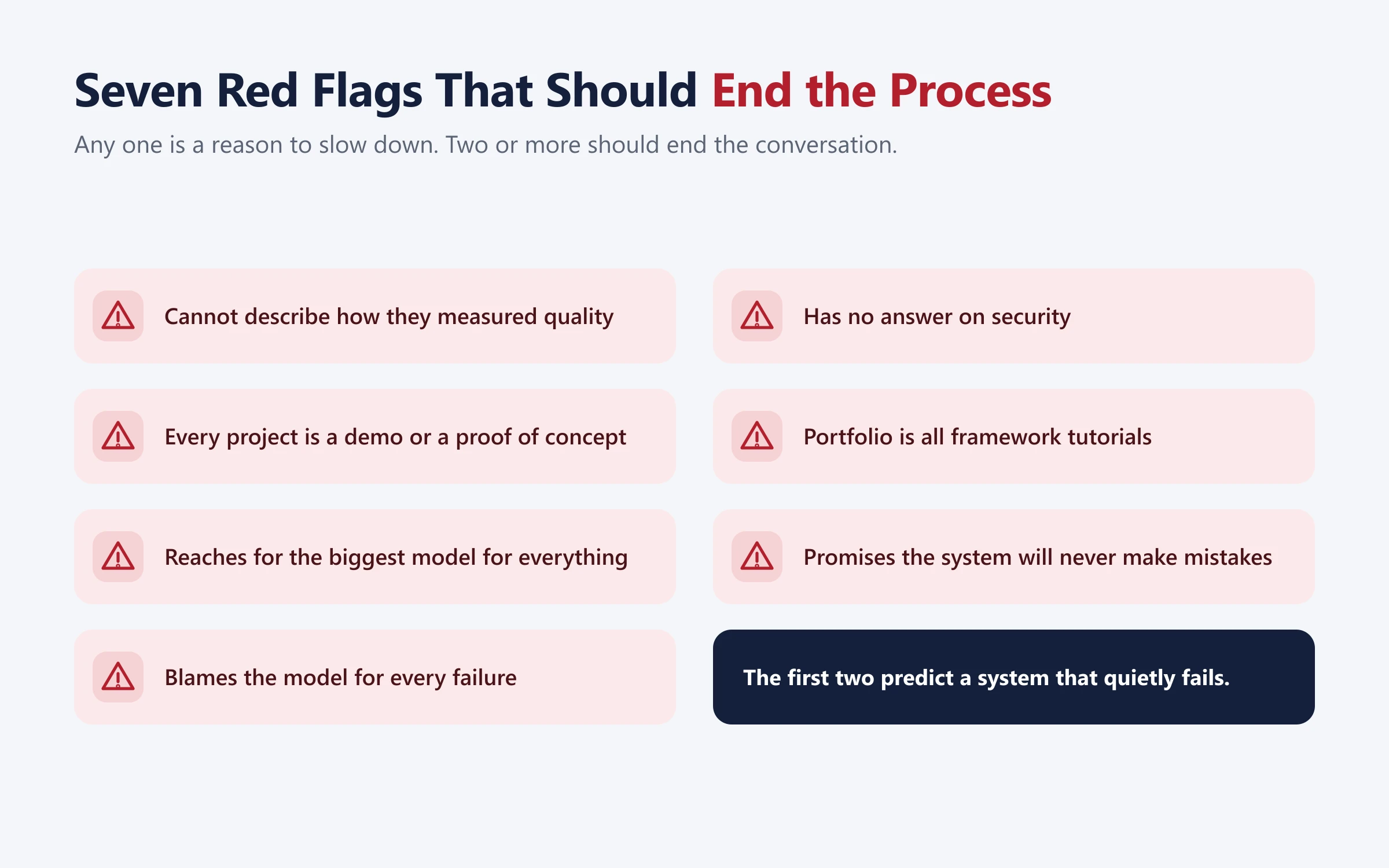
They cannot describe how they measured quality: No evaluation set, no baseline, no number. This is the most reliable predictor of a system that looks good and quietly fails.
Every past project is a demo or a proof of concept: Nothing wrong with prototypes, but if nothing has run in production with real users, they have never met the problems that matter.
They reach for the biggest model for everything: A sign they have not been accountable for running costs.
They blame the model for every failure: Wrong answers usually trace to retrieval, data or prompt design. Engineers who blame the model have not learned where the problems actually are.
They have no answer on security: An engineer who has not thought about prompt injection or permissions will build a system that is open to both.
Their portfolio is all framework tutorials: Following a tutorial proves they can follow a tutorial.
They promise certainty: Anyone guaranteeing an AI system will never make mistakes does not understand how these systems work. Good engineers talk about reducing error rates and handling the errors that remain.
Questions to Ask Before Hiring an AI Development Company
If you are evaluating a firm rather than an individual, the same principles apply at company scale, and knowing how to choose an AI development company comes down to a handful of questions. These do the most work in any AI vendor evaluation.
"Who exactly will work on our project, and can that change mid-project?" Many firms sell with senior engineers and deliver with junior ones. Ask for the names of the people who will do the work, and whether they are committed for the full engagement.
"What happens if the engineer assigned to us leaves?" You are looking for documentation, handover practice and a bench of people who already know the codebase, not reassurance.
"What happens after launch?" Look for a defined support window, documentation and handover. A code drop with no runbook means you inherit the problems.
"Who owns the code and the data?" You should own both, with full transfer on delivery.
"What will this cost to run each month, not just to build?" A firm that only quotes the build cost has either not thought about running cost or would rather you did not.
"When have you told a client not to build something?" A partner who has never turned work away is optimizing for billable hours, not your outcome.
We have written up how Bitontree compares to other AI agencies on these points, if you want a direct comparison.
AI Engineer Hiring Scorecard: A Simple Rubric
Score each candidate from 1 to 5 on each skill after the interview and assessment. Anything below 3 on the first two is a hard stop for a production role.
| Skill | 1 (weak) | 5 (strong) |
|---|---|---|
| Evaluation discipline | Tests by eyeballing a few answers | Builds evaluation sets, measures, reruns on every change |
| Retrieval and data | Blames the model for wrong answers | Diagnoses retrieval first, understands chunking and search |
| Failure handling | Happy path only | Retries, timeouts, fallbacks, escalation, logging |
| Security | No answer | Least privilege, untrusted input, output validation |
| Cost and latency | Never looked at the bill | Estimates cost, knows the levers |
| Production operations | Ships and moves on | Monitors, versions, rolls back |
Hire AI Engineers for Production, Not for the Demo
When you hire AI engineers, the best ones are not the people with the most impressive demo. They are the ones who can tell you exactly how their last system failed, how they found out, and what they changed. Evaluate for that, and most of the expensive mistakes in AI hiring disappear.
If you would rather skip the hiring process for your first build, we can help you decide what to build and whether a hire, a dedicated team or a delivered project fits your situation best.
I am the founder and CEO of Bitontree, where I lead embedded AI engineering teams that build and run production AI: agents, RAG and knowledge systems, document AI, and workflow automation for healthcare, logistics, legal, and SaaS companies. I write about what it actually takes to ship AI that survives contact with production.
Frequently Asked Questions
How do you hire AI engineers?

Decide first whether you need an AI application engineer or a machine learning engineer. Then assess the six skills that predict production success with practical exercises, use interview questions that reveal real experience, and choose the hiring model that fits the scope: in-house, freelance, a dedicated team or a development partner.
Where can I find AI engineers?
The most reliable channels are open-source contributions, model and dataset communities, referrals, technical meetups and experienced backend or data engineers moving into AI. If you need engineers quickly or need several skills at once, a dedicated team or development partner removes the sourcing step.
What skills should an AI engineer have?
For most business roles, evaluation discipline, retrieval and data handling, failure handling, security awareness, cost and latency awareness, and production operations. Framework knowledge matters far less than these, because it is easy to learn and easy to fake.
How do you test an AI engineer's skills?
Use practical exercises that mirror real work, such as diagnosing a broken retrieval system, designing an evaluation set, making an agent handle failures, or estimating running cost. Generic coding challenges reveal very little about AI engineering ability.
What is the difference between an AI engineer and a machine learning engineer?
An AI application engineer builds products on top of existing models. A machine learning engineer trains, fine-tunes and serves models. Most businesses building AI features need the former.
Should I hire an AI engineer in-house or use a development partner?
If AI is a long-term core capability with years of work ahead, in-house can make sense. If you need a defined system delivered, or you are not yet sure what the work involves, a partner or dedicated team is usually faster and lower risk. Many companies start with a partner and hire in-house later.
How long does it take to hire an AI engineer?
It varies widely by market, seniority and hiring model. Full-time in-house hiring is typically the slowest route, while a dedicated team or development partner can usually start far sooner because the vetting has already been done.
Should candidates be allowed to use AI tools during a technical assessment?
Yes. Your team uses them daily. The skill worth testing is judgment about what the tool produced, not the ability to work without it.