


- Home>
- Ai Voice Agent Development
AI Voice Agent Development Services
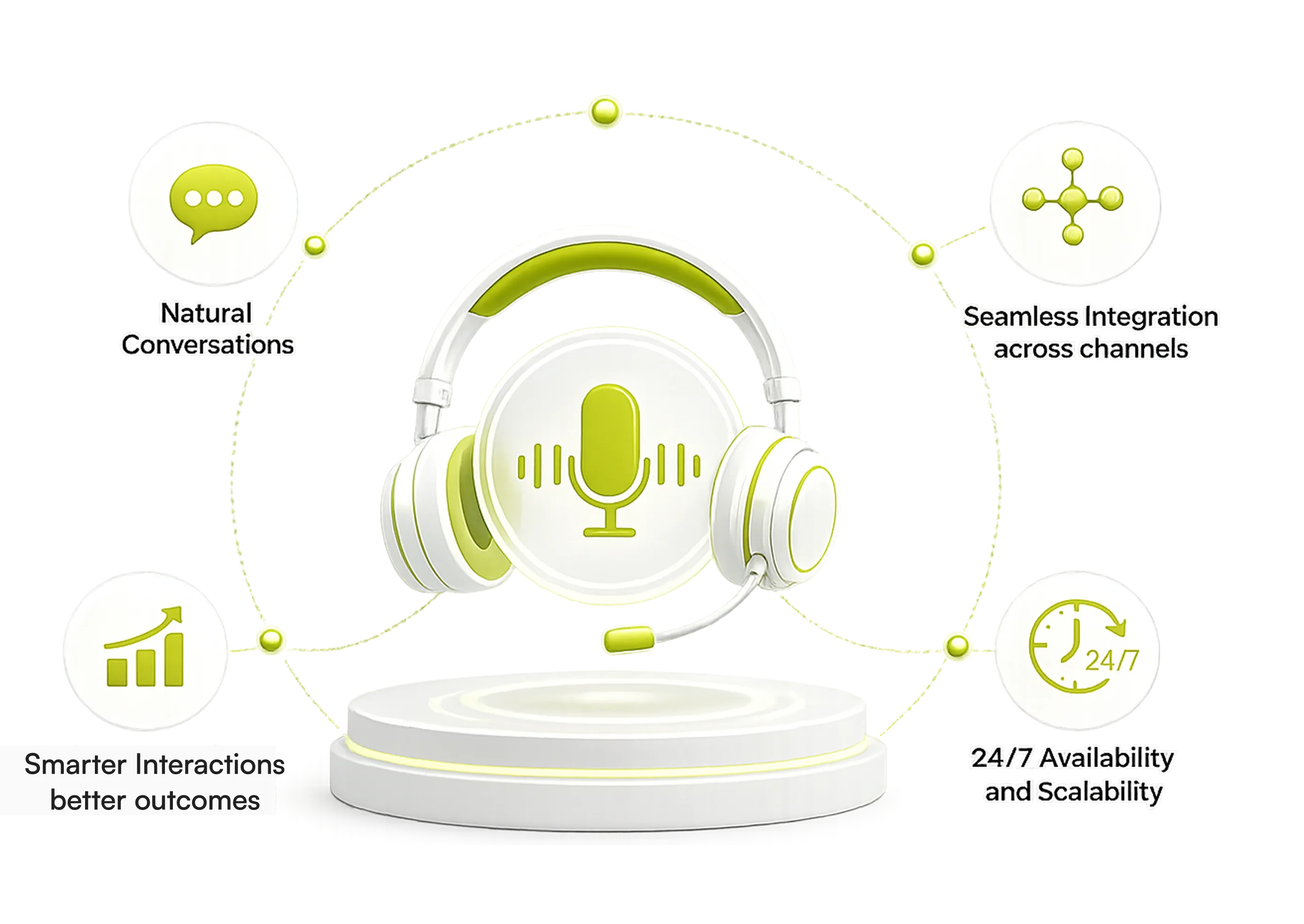
Clinics, logistics teams, and ops-heavy businesses lose hours every day to calls that follow the same script. We build AI voice agents that answer inbound calls, place outbound reminders, book appointments, and hand off to a human when it matters. Not prototypes: our voice agents place 200+ calls every night in production.
Most Voice AI Demos Fall Apart on a Real Phone Line
A scripted demo in a quiet room proves very little. Real callers talk over the agent, mumble, change their mind halfway through a sentence, and phone in from a truck cab with the window down. Building for that is a different job than building a demo.
We learned this by operating voice agents in production, not by reading about it. Our medication reminder system for a US healthcare provider places 200+ automated calls every night. We run it, watch it, and fix it when telephony misbehaves. That system lifted medication adherence by 32% and cut manual nursing workload by 40%, and it sits inside our broader AI development services practice with the same delivery discipline we apply to healthcare systems, where a wrong answer has consequences.
If you want a shorter overview of what a voice agent can do for a support line, start with our AI voice chatbot use case. If you want one built for your phone system, keep reading.
Voice Agents We Build
Voice agents earn their keep on repetitive, high-volume call types. These are the ones we build most often for clinics, logistics operations, and support-heavy teams.

Inbound Call Reception
The agent answers every call on the first ring, around the clock. It greets the caller, works out what they need, answers routine questions from your knowledge base, and routes anything unusual to the right person. No hold music, no phone tree, no missed after-hours calls.

Outbound Reminders and Follow-Ups
Reminder calls are where voice agents prove themselves fastest. Ours place 200+ medication reminder calls every night for a healthcare client, confirming adherence and flagging patients who need a nurse. The same pattern works for appointment reminders, payment nudges, and post-service check-ins.

Appointment Booking and Rescheduling
Callers book, move, or cancel appointments in one conversation. The agent checks live availability in your calendar or scheduling system, offers slots, confirms the booking, and sends a text summary. Your front desk stops playing phone tag.

Order and Shipment Status Calls
For logistics and e-commerce teams, the agent pulls live status from your TMS, carrier APIs, or order system and answers the "where is my order" call in seconds. It can also place proactive delay calls before your customers have a reason to be annoyed.

Escalation to Humans
Every agent we ship knows its limits. When confidence drops, a caller gets frustrated, or a restricted topic comes up, the call transfers to a human along with a summary of the conversation so far. Nobody repeats themselves, and nothing sensitive gets improvised.

Multilingual Voice Agents
One agent, several languages. The system detects what the caller speaks and responds in kind, with the same knowledge base behind every language. Useful for patient populations and customer bases your current phone staff can't fully cover.
The Stack: Chosen Per Project, Not Per Partnership
We are platform agnostic. Depending on latency needs, data constraints, and budget, we build on Vapi, Retell, or LiveKit, or wire telephony directly through Twilio. Speech recognition usually runs on Deepgram or Whisper. The reasoning layer runs on OpenAI or Claude models, picked per use case rather than by default.
Voice is one entry point into the same conversation logic. If your customers would rather type, that overlaps with our AI chatbot development work. And when a call should trigger something afterward, like updating a record or opening a ticket, that action layer comes from our AI agent development practice.
1
Voice platform
Vapi, Retell, LiveKit, or a custom real-time pipeline when latency and control matter.
2
Phone line
Twilio or your existing telephony stack, wired with transfer, retry, and logging rules.
3
Speech layer
Deepgram or Whisper for transcription, plus TTS tuned for pace, tone, and interruptions.
4
Reasoning and actions
OpenAI or Claude connected to calendars, CRMs, EHRs, ticketing, and workflow tools.
How We Get a Voice Agent Into Production
The process is built around one belief: the phone line is the only test environment that matters. Four stages, each with concrete deliverables.
01
Listen to the Calls
We start with your actual call recordings and logs, not assumptions. We identify which call types are frequent, scriptable, and safe to automate first, and which should stay human. You leave this stage with a scoped plan for one call type and clear success criteria.
Call type inventory with volumes
First automation target and success metrics
Integration and compliance checklist
Architecture and platform recommendation
02
Build the Voice Pipeline
We wire telephony, speech recognition, the reasoning model, and text-to-speech into one pipeline, then connect it to the systems the agent needs: calendars, EHRs, CRMs, order databases. Platform choice follows the requirements, not the other way around.
Working agent on a test number
System integrations with error handling
Escalation and guardrail rules
Version-controlled prompts and call flows
03
Test It Like a Rude Caller
Before launch we attack the agent: interruptions, background noise, accents, sudden topic changes, long silences, and questions designed to bait a wrong answer. Healthcare and other regulated builds also get a PHI handling review. It ships when it survives, not when the demo looks good.
Adversarial call test results
Latency and interruption benchmarks
Escalation path verification
Compliance review sign-off
04
Launch, Watch, Operate
We roll out gradually, often starting with after-hours or overflow calls, and we stay on the system after launch. Transcripts get reviewed, metrics get tracked, and the agent improves week over week. We operate what we ship. The 200+ calls our agents place nightly run on infrastructure we still maintain.
Gradual production rollout
Call analytics and transcript review
Alerting for failures and anomalies
Ongoing tuning and support
Voice and Conversational AI Systems in Production
Real deployments, real numbers. Here is what our voice and conversational AI work looks like once it is live and carrying actual call and support volume.


Frequently Asked Questions
How long does it take to get an AI voice agent into production?

Most voice agents go live in 6 to 12 weeks. A single call type with one integration, like appointment reminders, sits at the shorter end. Multiple call flows, EHR or ERP integration, and compliance review push toward the longer end. We give you a concrete timeline after a scoping call.
How do you handle HIPAA for healthcare voice agents?
We build HIPAA-aware voice systems: BAA-covered vendors in the call path, encryption in transit and at rest, PHI kept out of prompts where it is not needed, access controls, and full audit logs. We are not a certification body, but we design the architecture to pass your compliance review, and our production healthcare voice system runs under these constraints today.
What happens when the AI can't answer a caller's question?
It hands the call to a human. Every agent we build ships with escalation rules: low confidence, an upset caller, or a topic on the restricted list triggers a warm transfer with a summary of the conversation attached. After-hours calls that need a person get logged and queued for a callback. The agent never bluffs its way through a question it cannot answer.
How do you handle latency and interruptions on calls?
We build on streaming speech-to-text and text-to-speech so the agent starts responding while the caller is still finishing a thought, and we tune barge-in handling so callers can interrupt mid-sentence the way they would with a person. Latency budgets are set per call type and tested on real phone lines, not in a browser tab.
Can a voice agent work with our existing phone system?
Yes. We connect through SIP trunking or providers like Twilio, so you keep your existing numbers and routing. The agent can sit in front of your current IVR, replace it entirely, or take only overflow and after-hours calls while your team handles the rest.
What languages do your voice agents support?
English plus the major languages covered by modern speech models, including Spanish, Hindi, French, German, and Mandarin. The agent detects the caller's language and switches automatically. Quality varies by language, so we test each one against real recordings before launch rather than trusting the vendor's list.
How do you measure whether calls are actually going well?
Every call produces a transcript and an outcome label. We track task completion, escalation rate, hang-ups, and call duration, and we run new agent versions against a test set of recorded scenarios before they ship. In the early weeks we also review transcripts by hand, which catches the problems dashboards miss.
Do you build on platforms like Vapi and Retell, or from scratch?
Both, depending on the project. Platforms like Vapi, Retell, and LiveKit get you to production faster, and we use them when they fit. When a project needs custom telephony behavior, strict data control, or self-hosting, we build closer to the metal with Twilio, Deepgram, and the model APIs directly. You own the result either way.
What do you need from us to start?
Call recordings or transcripts if you have them, the scripts or playbooks your team follows today, a list of the systems the agent must read from or write to, and an hour with someone who actually handles these calls. That is enough for us to scope the first call type.
What drives the cost of a voice agent project?
Effort, mostly across four things: how many distinct call types you automate, how deep the integrations go (a calendar is quick, an EHR is not), compliance requirements, and how many languages you need. A single well-defined call flow is a small project. We scope against your stack and give you a fixed plan before any commitment.
Let's scope your voice agent
Tell us about the calls you want off your team's plate. We'll come back with an honest read on what a voice agent can handle, what it can't, and the shortest path to production, usually within one working day.

7+
Years Of Experience

40+
Skilled Professionals

35+
Global Clientele Served

105+
Projects Delivered