

Hospitals, clinics, payers, and home-care networks continue to face ever-increasing operational costs, persistent staffing shortages, administrative burden, and pressure to deliver higher-quality care at lower costs. The American Hospital Association (AHA) reported that U.S. hospitals observed a $42.5 billion increase in labor costs. These pressures have demonstrated that traditional systems are not equipped to handle the needs of today’s patients.
On the other hand, AI from the top AI automation agency can solve many of the challenges that the medical and healthcare industry face. AI-based automation can expedite medical processes, enhance precision in diagnosis or treatment recommendations, and foster a more patient-centric approach to deliver patient care.
In this article, we will discuss 10 important benefits of using AI in healthcare and how it is solving some major concerns in the healthcare industry.
What Makes AI Automation Different From Traditional Hospital Automation
Hospitals have long relied on traditional automation based on rules. On the other hand, AI-driven systems by top medical software development companies work through recognizing patterns and learning to adapt.
Rigid Rules vs. Contextual Intelligence
Traditional automation, such as basic RPA, follows scripts that operate under specific conditions. The standard medical software development is designed to work according to structured, repetitive tasks like appointment reminders or billing. However, it often fails when dealing with unstructured data or unforeseen variables.
AI automation, in contrast, uses Machine learning (ML) and Natural language processing (NLP) to interpret and understand the context. It can read handwritten notes from a physician, gauge sentiment from a patient message, and manage complex triage without a predefined roadmap.
Static Execution vs. Continuous Improvement
Traditional medical systems are static and require manual reprogramming to adjust for new medical regulations or coding standards. Whereas AI systems are dynamic and continuously improve their accuracy as they process more data. For example, while a traditional system would flag a missing field in a claim, an AI agent can look at historical denial patterns to predict and fix a claim before it is even submitted.
Here’s a quick look at the key differences between traditional and AI-powered automation:
| Feature | Traditional Automation | AI-Powered Automation |
|---|---|---|
| Logic | Pre-defined rules & flowcharts | Neural networks & probability |
| Data Type | Structured (forms, spreadsheets) | Unstructured (clinical notes, scans) |
| Adaptability | Manual updates required | Self-learning from new data |
| Outcome | Task completion | Decision support & prediction |
Where AI Automation Fits Inside a Hospital Ecosystem
AI automation designed by the best medical software development company serves as the "connective tissue" in a hospital, transcending isolated functions to oversee the whole patient and operational journey. It operates in these key areas:
- Clinical Decision Support & Diagnostics: AI from a reputable AI automation agency sits inside the caregiver's workflow, processing large data sets at once to deliver insights.
- Radiology & Pathology: AI image analysis points out urgent pathologies (like strokes or fractures) for immediate physician review.
- Predictive Triage: Algorithms watch EHR data to foresee patient deterioration or sepsis hours before clinical symptoms show up.
- Operational & Administrative Flow: This back-office engine makes sure the hospital is running at full capacity without any manual bottlenecking.
- Capacity Management: AI sees patient inflow and discharge patterns for improved bed management and staff scheduling.
- Revenue Cycle Management: Automated coding, together with clean claim predictors cut down on insurance denials while speeding up reimbursements.
- Patient Engagement (The Digital Front Door): AI in healthcare runs the interaction layer, keeping the patients connected to their care plan.
- Ambient Scribing: AI Medical Scribe Software writes out consultations so that doctors can pay attention to their patients instead of screens.
- Smart Reminders: More than just texts, AI finds those most likely not to show up and gives them personalized prompts or rescheduling options.
Top 10 Benefits of AI Automation for Hospitals You Should Know
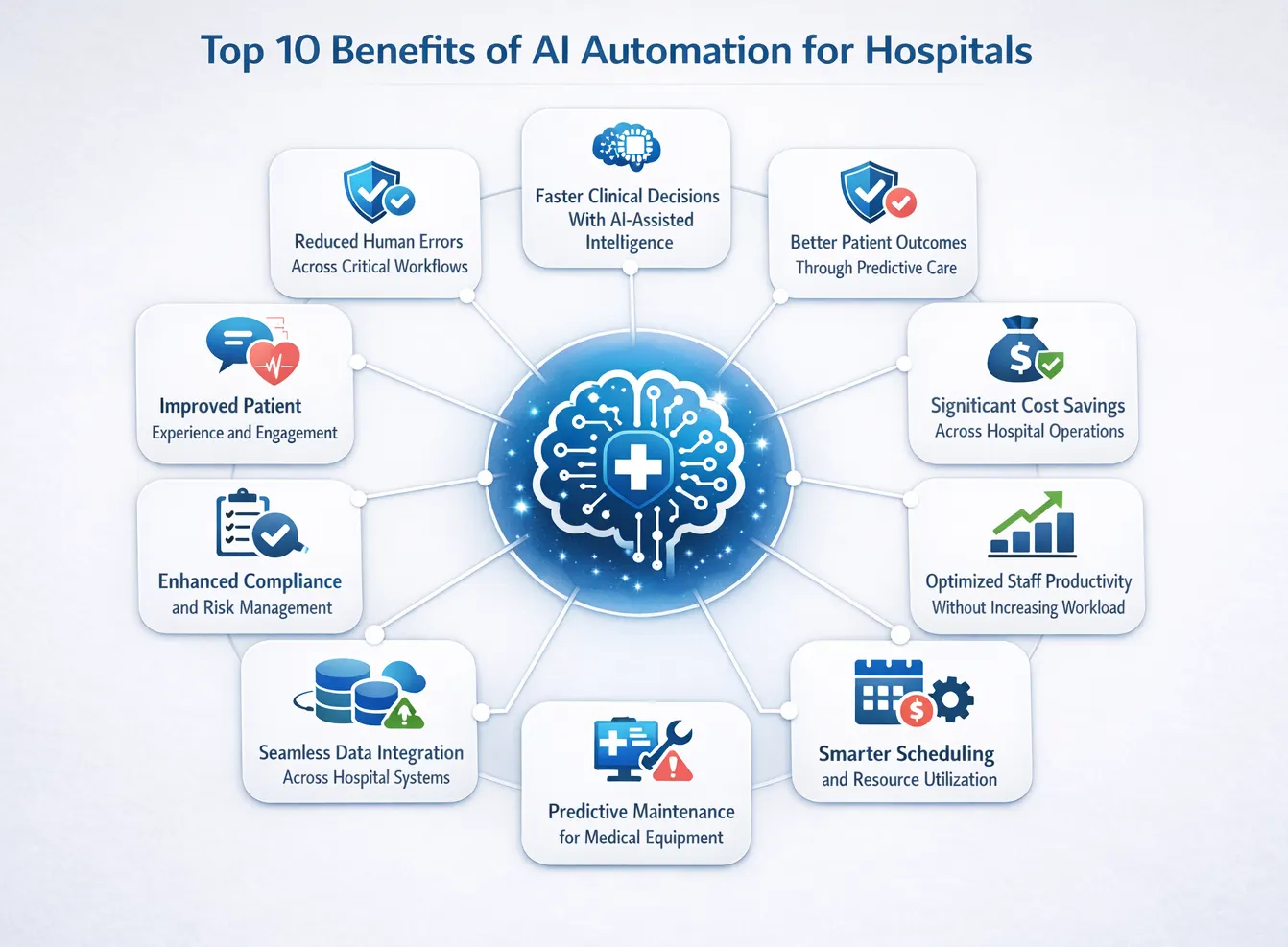
AI automation is no longer a futuristic vision; it has become the operational backbone of healthcare systems by 2026. Here’s how AI automation for hospitals has transformed the entire ecosystem:
-
Faster Clinical Decisions With AI-Assisted Intelligence AI-assistants can process large amounts of clinical data within seconds. From patients’ history, lab results, and imaging data to billing and payments data, AI systems can analyze information and assist doctors in making informed decisions quickly.
-
Reduced Human Errors Across Critical Workflows Manual data entry or communication gaps are a common source of errors in clinical workflows. AI automation helps in reducing human errors by validating data, identifying inconsistencies, and standardizing workflows.
-
Better Patient Outcomes Through Predictive Care Predictive care combined with AI automation in clinical coding can identify risks before they escalate. The intelligent AI models can predict infection risks, patient deterioration, and readmission probability. This helps teams to act proactively for a better patient outcome.
-
Significant Cost Savings Across Hospital Operations By optimizing billing accuracy, minimizing claim denials, and reducing administrative overhead, AI automation in healthcare can lead to significant cost savings across hospital operations. According to McKinsey, hospitals can achieve a 30% reduction in operational costs through automation and predictive analysis, resulting in annual savings of about $360 billion.
-
Optimized Staff Productivity Without Increasing Workload Ambient AI scribes from AI Medical Scribe Software and “digital nurses” do all the heavy lifting when it comes to documentation. Research has shown that AI tools create a 51.9% to 38.8% decrease in note-taking time as well as a decrease in after-hours work.
-
Smarter Scheduling and Resource Utilization AI can analyze when the busiest times for admissions are going to be and how patients will be discharged. This means hospitals can increase OR utilization by 10-20% and reduce avoidable days by up to 10%.
-
Improved Patient Experience and Engagement AI "Digital Front Doors" offer triage support around the clock. AI chatbots and personalized reminders help reduce appointment no-shows, while ambient technology lets doctors engage with patients efficiently.
-
Enhanced Compliance and Risk Management AI Medical Scribe software USA can perform automated audits and real-time monitoring of compliance with laws like HIPAA or the EU AI Act, so that every interaction with data is done safely and privately according to strict standards.
-
Seamless Data Integration Across Hospital Systems Hospitals often work with many disconnected systems, which can slow things down. AI automation connects EHRs, labs, imaging, pharmacy, and billing platforms into one unified flow. This gives clinicians real-time access to complete patient data, reduces delays, avoids duplicate tests, and enables smoother, more coordinated care across departments.
-
Predictive Maintenance for Medical Equipment The AI systems continuously monitor the medical equipment performance according to the usage patterns, sensor data, and predict equipment failures before it actually takes place. This can help reduce the chances of any unexpected breakdowns and extend the lifespan of the medical equipment.
Real-World Hospital Use Cases of AI Automation
Bitontree’s Healthcare Service Platform
To overcome challenges such as delays in appointment booking, poor real-time updates, disconnected lab-testing workflows, and other operational inefficiencies, Bitontree developed an integrated web application. It unified appointment scheduling, pharmacy services, lab testing, and virtual consultations onto a single, user-friendly platform. The results drove 89% increase in patient engagement in online consultations, and 70% users found the portal helpful in handling pharmacy.
AI-Powered Medication Calling System
To provide improved medication support services, Bitontree developed an AI-powered voice calling reminder system. Integrated with an AI-voice calling agent, it could establish calls to patients automatically to confirm whether the medication has been taken. The system could automatically reschedule for a follow-up if the intake is delayed. It also tracked the medicine intake in real time through advanced compliance monitoring capabilities. The solution improved medical adherence by 32% and reduced manual workload by 40%.
Predictive Patient Flow & Readmission Prevention in Kaiser Permanente
Predictive analytics are helping hospitals transition to proactive care management instead of reactive management. AI models use real-time vitals and historical data to forecast which patients are vulnerable to clinical deterioration or would be readmitted within 30 days. By incorporating the "Social Determinants of Health" (such as housing stability) into their AI models, Kaiser Permanente decreased readmission rates by 12% in 39 hospitals, and it raised their prediction accuracy to 84%.
Mount Sinai Health System Reduced ER Wait Times
The busiest place in a hospital is the ED. Artificial intelligence software development, when performed correctly, can see through the noise to prioritize patients. Mount Sinai Health System has created a portfolio of AI models capable of predicting patient ER admission hours before.
Accurate Diagnosis by Mayo Clinic
Mayo Clinic automates Study Protocoling with AI. Radiologists traditionally consume 1-2 hours of their day manually reviewing patient history to determine the specific MRI or CT protocols. Mayo uses AI to automate this process, so the correct scan is done initially.
Oncology & Precision Medicine at Cleveland Clinic & IBM Watson
AI automation is making oncology no longer about the standard of care, but personalized care. The Cleveland Clinic and IBM Watson use machine learning on large genomic and clinical data sets to develop individualized treatment plans for complex cancers.
Conclusion
AI is radically transforming the healthcare delivery model, providing unprecedented opportunities to enhance diagnostic accuracy, treatment personalization, operational efficiency, and patient outcomes. Ranging from advanced diagnostic systems to administrative automation, AI applications are not only solving the pressing needs of healthcare but also opening new opportunities in care delivery.
Bitontree understands the dynamic needs of contemporary healthcare provision and offers reliable AI automation development services for healthcare organizations. Contact us to design an AI-powered automation solution for your hospital or healthcare business today.

I am the founder and CEO of Bitontree, where I lead embedded AI engineering teams that build and run production AI: agents, RAG and knowledge systems, document AI, and workflow automation for healthcare, logistics, legal, and SaaS companies. I write about what it actually takes to ship AI that survives contact with production.
Frequently Asked Questions
What are the biggest benefits of AI automation in hospitals?
In hospitals, AI automation can enhance efficiency, decrease cost, enhance the accuracy and speed of diagnoses, provide customized treatment plans, decrease staff burden and burnout, and improve predictive analytics. These innovations result in superior, quicker, and more personalized patient care.
How does AI automation improve patient safety?
AI automation enhances patient safety by reducing human error through automated notifications of drug interactions, improving diagnostic accuracy. This is done by quick image analysis, promoting predictive analytics to identify risk sooner and automating workflow to spend more time on clinician-patient interactions.
Can AI automation reduce hospital operational costs?
AI automation reduces the costs of running the hospital by automating the functions, leveraging resources, improving billing, and projecting patient needs.
Is AI automation secure and compliant with healthcare regulations?
Yes, well-designed AI automation systems adhere to safe and privacy-compliant healthcare laws, including HIPAA and GDPR.
Which hospital departments benefit most from AI automation?
Hospital administration, clinical care, billing and payments, diagnostics, and patient engagement departments can benefit the most from AI automation.