November 6, 2026
Agentic AI Framework for Customer Support: How to Choose the Right One

Yash Vibhandik
CEO


Most agentic AI framework comparisons rank features. That is the wrong starting point for customer support automation, because the thing that decides whether your deployment survives contact with real customers is not which framework has the longest capability list. It is whether the system behaves the same way on Tuesday as it did on Monday.
There is published evidence for how hard that is. In 2024, researchers built a benchmark around exactly this problem: AI agents handling retail and airline customer service tasks, with real tools to call and a simulated customer on the other side. The best agent they tested, built on GPT-4o, completed fewer than half the tasks successfully.
The second finding matters more than the first. Instead of running each task once, the researchers ran it eight times and measured how often the agent got it right on every single attempt. In the retail domain, that agent succeeded on just over 60% of individual attempts. Its success rate for handling the same task correctly eight times in a row fell below 25%.
Put that in business terms. An agent that handles a refund request correctly most of the time will handle it correctly every time in fewer than one case out of four. Customer support is repetition. The same twenty questions arrive hundreds of times a day, from different people who each expect the same answer. Consistency is not a nice-to-have in this domain. It is the product.
The benchmark is published as τ-bench by Yao, Shinn, Razavi and Narasimhan, and the consistency measure they use is written as pass^k, meaning the probability that all k attempts at a task succeed. Models have improved since 2024, so today's absolute scores are higher. The gap between "worked once" and "worked every time" is the lesson that still applies, and it is what you should test for.
This article is about choosing an agentic AI framework with that reality in mind. It is organized around the requirements autonomous customer support actually imposes, rather than around a feature matrix. If you want the head-to-head breakdown of specific frameworks, we cover that separately in LangGraph vs LangChain vs CrewAI.
What "Agentic" Means in Autonomous Customer Support
The word is used loosely, which makes framework selection harder than it needs to be. Anthropic's engineering guidance on building effective agents draws a distinction worth adopting:
- Workflows: Systems where LLMs and tools are orchestrated through predefined code paths. The sequence is fixed by your developers in advance
- Agents: Systems where LLMs dynamically direct their own processes and tool usage, maintaining control over how they accomplish tasks. The model decides its own path
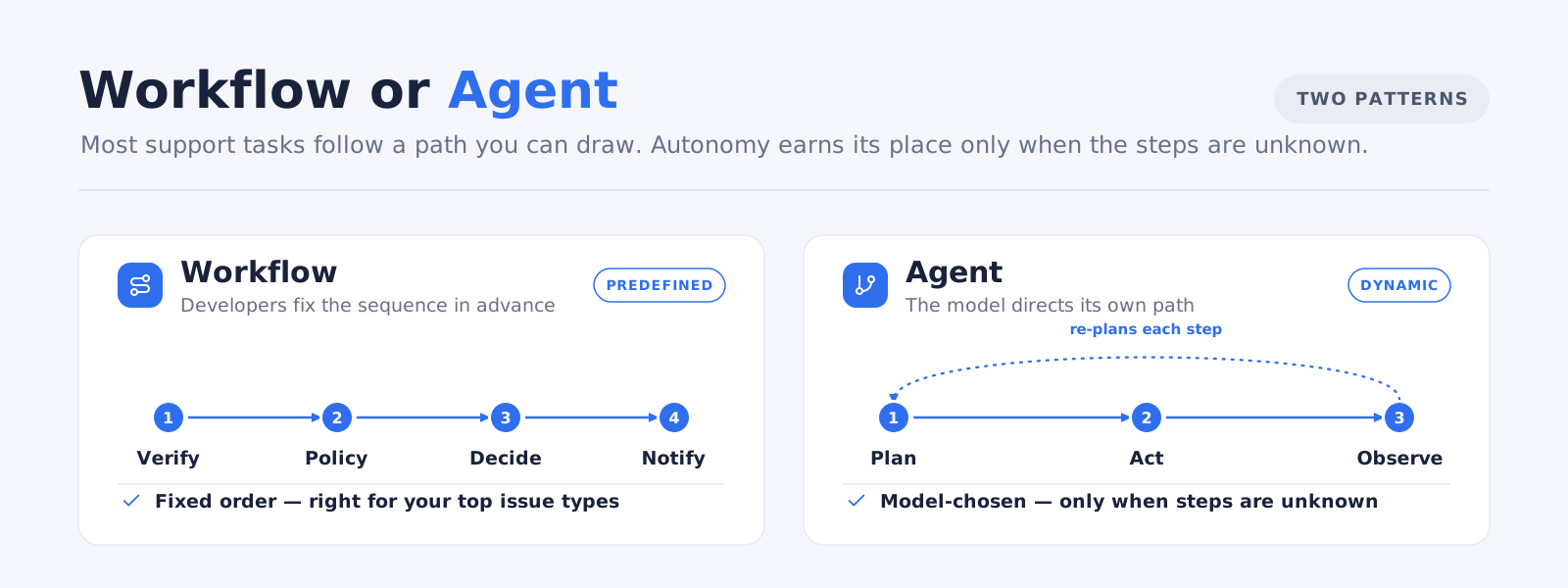
Most AI customer support deployments that describe themselves as agentic are actually workflows, and that is usually the correct choice. A refund request follows a known path: verify the order, check the policy window, confirm eligibility, process or decline, notify. You do not need a model deciding the order of those steps. You need it to understand the customer and fill in the parameters.
Genuine agentic behavior earns its place when the number of steps cannot be predicted in advance. A customer whose problem spans a delayed shipment, a partial refund and a replacement order under a warranty is not following a decision tree you can draw. That is the territory an AI agent for customer support is built for, and it is a smaller share of your contact volume than most vendors imply.
The practical consequence for framework selection:
- If your top twenty issue types each follow a knowable path: You need agent orchestration, state management and tool calling, not autonomy
- If a meaningful share of contacts are genuinely open-ended: You need a framework that supports dynamic planning without losing control of what the agent can do
Getting this wrong in the optimistic direction is expensive. The same Anthropic guidance notes that agentic systems often trade latency and cost for better task performance, and you should consider when that tradeoff makes sense.
Why Agentic AI Framework Choice Starts With Your Escalation Path
Here is the test we apply at the start of every AI agent development engagement in the support space.
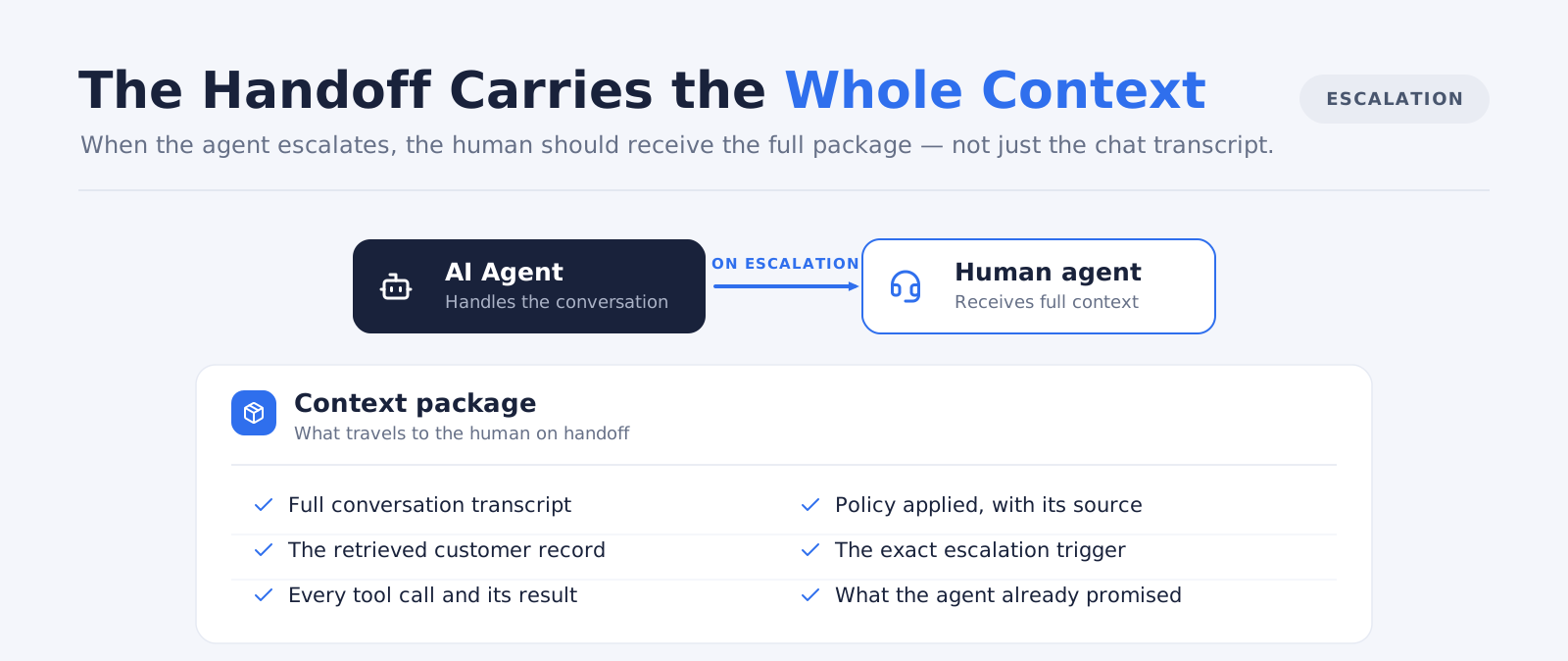
Draw the moment your agent hands a conversation to a human. That handoff is the single most important interface in the whole system. Then ask what the human receives.
If the answer is "the chat transcript", your framework choice barely matters, because you have built a chatbot with extra steps. If the answer is the full context package, you need a framework that can carry structured state through a conversation and expose it on exit. That package should contain:
- The conversation transcript: Including what the customer said before the agent escalated
- The customer record the agent retrieved: So the human is not re-querying the CRM
- Every tool the agent called and what each returned: Including the ones that errored
- The policy or knowledge article the agent applied: With a link to the source
- The specific trigger that caused escalation: A rule, a confidence threshold, or an explicit customer request
- What the agent has already promised the customer: The single most damaging thing to lose in a handoff
Design that structure before you evaluate anything. It is the clearest specification you will have, and it maps directly onto the state model each candidate framework imposes. The same handoff discipline shapes how we build a customer support AI assistant regardless of the underlying stack.
That single requirement eliminates more candidate frameworks than any other, and it is the one most evaluations skip because escalation is treated as a failure case rather than a designed path. In autonomous customer support, escalation is not failure. It is the feature that makes autonomy safe to deploy.
Nine Requirements That Decide Your Agentic AI Framework Choice
Score candidates against these rather than against feature lists.
1. Conversation State Your Support Agent Can Resume
Customer support conversations are not single sessions. A customer starts on chat, leaves, comes back two hours later, then emails about the same issue.
- What to check: Whether the framework treats state management as a first-class concern, with a persistable object, or as something you bolt on with your own database
- Why it matters: If state lives only in memory, every reconnection restarts the conversation, and customers repeat themselves, which is the single most common complaint about automated support
- What good looks like: Agent memory you can serialize, store, load and inspect, keyed to a customer rather than to a socket
2. Deterministic Escalation and Human Handoff in Customer Support
- What to check: Whether the framework supports a non-model-decided exit. You must be able to force escalation from code, not only by hoping the model chooses to
- Why it matters: Escalation triggers are often regulatory or commercial. A mention of legal action, a vulnerable customer indicator, or a high-value account should route to a human regardless of what the model thinks
- What good looks like: An interrupt or exit mechanism that fires from a deterministic rule and carries the full context package out with it
3. AI Agent Tool Calling Into Your CRM and Ticketing Systems
Support agents are only useful if they can read and write to the systems where the answers live. This is function calling, and it is the capability the benchmark above was measuring when it reported sub-50% task success.
- What to check: How the framework defines tools, how it handles a tool that errors or times out, and whether it retries blindly
- Why it matters: A support agent that cannot see order status is a FAQ bot. One that retries a failed refund three times is a liability
- What good looks like: Typed tool definitions, explicit error handling paths, and idempotency support for anything that writes
Where you are connecting to several systems, the integration layer becomes its own decision. Our work on MCP server development covers the protocol-level version of that problem.
4. AI Agent Approval Gates Before Irreversible Support Actions
Some actions cannot be undone: issuing a refund, cancelling a subscription, closing an account, dispatching a replacement.
- What to check: Whether the framework supports pausing mid-execution for human approval and resuming afterwards, without restarting the conversation
- Why it matters: OWASP's Top 10 for LLM Applications lists LLM06:2025 Excessive Agency as a distinct risk, and customer support is where it bites hardest, because the agent has write access to commercial systems
- What good looks like: A first-class interrupt that suspends the run, surfaces the proposed action with its reasoning, and resumes on approval
Human-in-the-loop review is often described as a product feature. For irreversible support actions it is an architectural requirement, and guardrails enforced in prompt text alone will not survive a determined customer.
5. Retrieval Grounding for Support Knowledge Base Answers
Most support answers come from documentation, not from the model.
- What to check: How cleanly the framework integrates retrieval, and whether you can inspect which sources informed an answer
- Why it matters: An ungrounded support agent invents policy, and invented policy becomes a commitment your business has to honor or publicly retract
- What good looks like: Retrieval as a step you control, with source attribution carried through to the response
One retrieval pitfall is specific to support. Conversations get long, and long contexts degrade. The "Lost in the Middle" research (arXiv 2307.03172) documents a U-shaped performance curve where models use information at the start and end of a long context far better than information in the middle. A forty-turn support conversation with the policy document stuffed in the middle is a predictable failure. Our guide to retrieval augmented generation covers the architecture that avoids it, and our RAG development services page covers how we implement it.
6. Latency Budget for Chat and Voice Support
- What to check: Whether the framework adds orchestration overhead per turn, and whether it supports streaming
- Why it matters: Chat tolerates two or three seconds. Voice does not. If voice is on your roadmap, a framework that adds 800ms of orchestration per turn has already failed
- What good looks like: Streaming support, minimal per-turn overhead, and the ability to run cheap deterministic steps without a model round trip
If voice is in scope, the constraints are tighter than most framework documentation acknowledges, which is why we treat AI voice agent development as a separate engineering problem rather than a channel toggle. Our guide to AI voice agent latency breaks down where the time goes.
7. Observability and Conversation Replay for Support Agents
When a customer complains that your agent told them something wrong, you need to answer within the hour.
- What to check: What the framework logs by default, whether you can replay a conversation step by step, and whether tool inputs and outputs are captured
- Why it matters: Without replay you cannot distinguish a model error from a stale knowledge base article from a tool returning bad data. Those have completely different fixes
- What good looks like: Structured traces per run, including every tool call with its arguments and response, retained long enough to investigate a complaint
8. Agentic AI Consistency Testing, Not Just Accuracy Testing
Reliability is not the same as accuracy, and testing that measures only accuracy will mislead you. This is the requirement the benchmark results above argue for most directly.
- What to check: Whether the framework makes it practical to run the same scenario many times and compare outcomes
- Why it matters: A single successful demo tells you almost nothing. The retail-domain drop from about 60% single-attempt success to under 25% across eight attempts is what happens between a demo and a deployment
- What good looks like: Deterministic test harness support, seedable runs where possible, and an output format you can diff across trials
Build your evaluation set around your twenty highest-volume issue types, and run each one at least eight times before anyone signs off. Capture where the AI agent and your human reviewers disagree, since that record is what tells you later whether a prompt or model change helped. We cover that discipline in chatbot feedback loops and learning systems.
9. Cost Per Resolved Support Conversation
- What to check: How many model calls the framework makes per turn, and whether it re-sends full history every time
- Why it matters: Orchestration layers that re-send conversation history on each step multiply token cost quadratically as conversations lengthen. Support conversations get long
- What good looks like: Visible control over what is sent on each call, plus caching support
Three Framework Shapes: Graph, Role-Based and Direct SDK
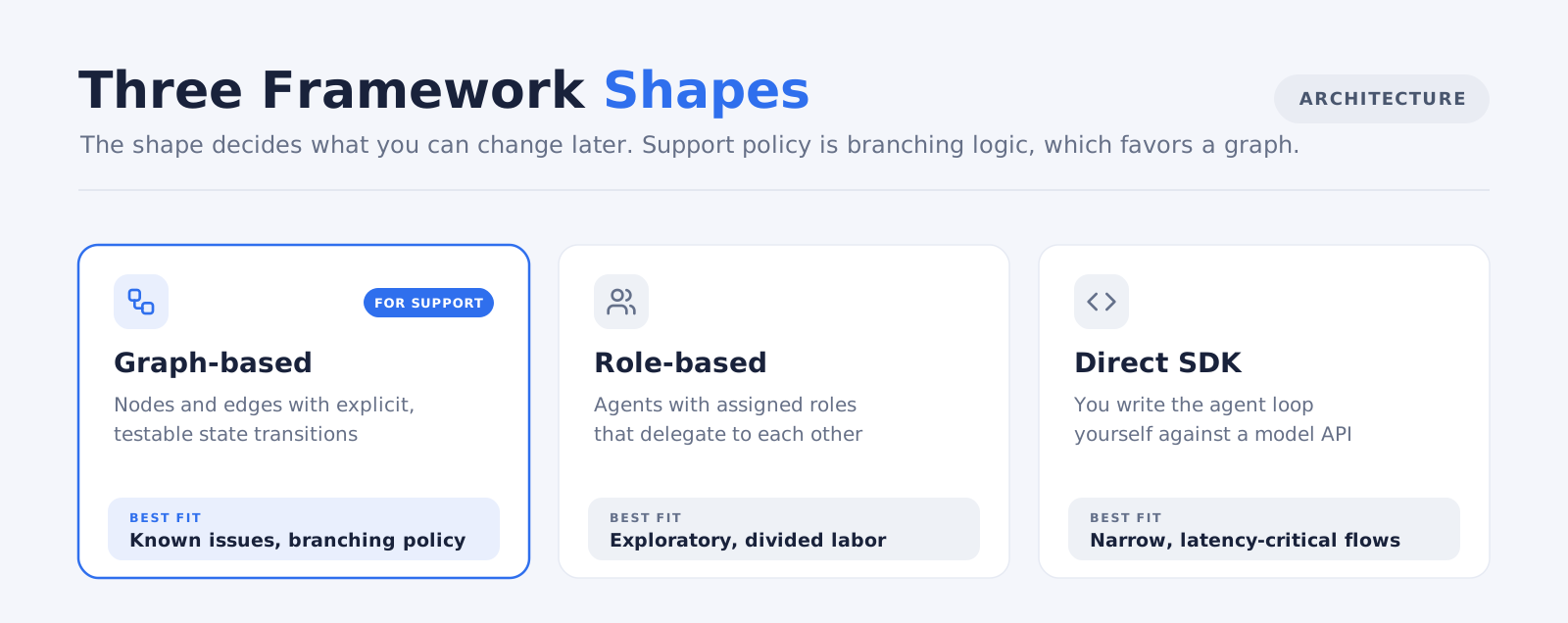
Rather than comparing products, it helps to compare architectural shapes, because the shape determines what you can and cannot do later. That difference outlives any feature gap.
| Graph-based | Role-based | Direct SDK | |
|---|---|---|---|
| Core idea | Nodes and edges with explicit state transitions | Agents with assigned roles that delegate to each other | You write the loop yourself against a model API |
| State handling | Explicit and persistable by design | Usually framework-managed, less transparent | Entirely yours |
| Escalation control | Strong, since exits are modeled as edges | Weaker, since control flow is emergent | Total, since you wrote it |
| Best fit in support | Known issue types with branching policy logic | Exploratory work where division of labor helps | Narrow, high-volume, latency-critical flows |
| Main risk | Graph complexity grows faster than the use case | Hard to predict or test control flow | You maintain everything a framework would have given you |
| Debuggability | Good, paths are inspectable | Hardest of the three | Good, nothing is hidden |
For autonomous customer support specifically, graph-shaped frameworks tend to win, for one reason. Support is governed by policy, policy is conditional logic, and conditional logic is easier to express, test and audit as an explicit graph than as emergent behavior between cooperating roles.
One thing no framework should do is make the single-agent versus multi-agent decision for you. A multi-agent framework can be the right answer, but it should be a choice you make rather than one the framework imposes. For support, a single agent with good tools is the honest default, because your issue types share one customer and one account, and every extra agent adds a handoff where context is lost. We cover that trade-off in Single-Agent vs Multi-Agent Systems: When and Why to Use Each. Whichever way you go, the architecture should stay yours to change.
The direct SDK option deserves more consideration than it usually gets. If your support automation covers six well-understood flows, a framework may add abstraction you will spend more time fighting than using.
Choose the Framework After the Requirements, Not Before
When You Do Not Need an Agentic AI Framework at All
Worth stating plainly, because the honest answer saves budget.
- Your support volume is concentrated in under ten repeating questions: A well-built retrieval chatbot covers that at a fraction of the cost. Our AI chatbot development work covers that case
- Your answers are all documentation lookups with no system actions: You need retrieval quality, not agency
- You have no tools to call: An agent without tools is a chatbot with a longer prompt and a higher bill
- Your escalation rate target is high anyway: If you are routing 70% to humans by policy, automation should handle triage, not resolution
- You cannot yet measure resolution: Without a baseline, you will not be able to prove the system worked, and you will not know when it degrades
Anthropic's guidance puts it directly: find the simplest solution possible, and only increase complexity when the simpler approach falls short.
How to Run an Agentic AI Framework Evaluation in Two Weeks
A framework decision made from documentation is a guess. This is the evaluation protocol we run.
- Pick your three hardest real issue types: Not your most common ones. The common ones work in every framework. The hard ones reveal the differences
- Write the escalation contract first: Define exactly what a human receives on handoff, as a data structure, before you write any agent code
- Build the same flow in two candidate frameworks: Timebox it to three days each. If one takes materially longer, that is a finding, not a setback
- Run each scenario eight times: Record success, failure and, separately, inconsistency. What you want to know is not whether it ever worked, but how often it worked every single time
- Break things deliberately: Make a tool time out, return malformed data, and return a permissions error. Watch what each framework does
- Test the escalation path under failure: Confirm the handoff still carries full context when the agent is mid-tool-call
- Measure cost and latency per resolved conversation: Not per model call, since that hides orchestration overhead
- Review the traces with someone who was not involved: If they cannot reconstruct what happened from the logs, your observability is insufficient
Two weeks of this is cheaper than six months of discovering a framework cannot do deterministic escalation.
Migration Risk: Outgrowing Your First Agentic AI Framework
Every framework choice is temporary. The question is what it costs to leave.
- Keep tool definitions framework-agnostic: Your CRM and ticketing integrations should be plain functions the framework calls, not framework-native constructs
- Keep prompts in version-controlled files: Not embedded in framework decorators or configuration objects
- Keep your evaluation set outside the framework: It should be able to test any implementation, so it survives the migration and proves the new one is no worse
- Keep state schema under your control: If your conversation state is defined by the framework's internal types, migration means rewriting your data model
Teams that follow those four rules typically migrate in weeks. Teams that do not usually rebuild.
Conclusion
The agentic AI framework market rewards whoever publishes the longest feature table. Autonomous customer support rewards something different: predictable behavior under repetition, a clean exit to a human, and the ability to explain after the fact what the system did and why.
Those three properties do not appear in most comparison posts, because they are hard to demonstrate in a demo and easy to discover in production. The benchmark evidence is unambiguous that single successful runs tell you very little. Choose for consistency, escalation and observability, and the feature differences stop mattering.
Start with your escalation contract. If a framework cannot carry a full context package to a human on demand, from a deterministic trigger, nothing else about it is worth evaluating. That one rule will shortlist your options faster than any feature matrix.
Bitontree builds AI agents for customer support on this basis. On a support chatbot for a US crypto trading platform, the escalation path was designed first: frustration or urgency hands the conversation to a human in the CRM with the full history attached. The client reported first-time resolution rising from 45% to 82%. We run the two-week evaluation described above before committing to a framework, we design the escalation path before the happy path, and we hand over the evaluation set alongside the system so you can prove it still works six months later. Where the honest answer is that you need a customer support AI assistant grounded in your knowledge base rather than an autonomous agent, we will tell you that first and scope the smaller build.
I am the founder and CEO of Bitontree, where I lead embedded AI engineering teams that build and run production AI: agents, RAG and knowledge systems, document AI, and workflow automation for healthcare, logistics, legal, and SaaS companies. I write about what it actually takes to ship AI that survives contact with production.
Frequently Asked Questions
What is an agentic AI framework?
An agentic AI framework, sometimes called an AI agent framework, is a library that orchestrates a language model's interaction with tools, state and control flow, so the model can take multi-step actions rather than answering a single prompt. In customer support it manages the conversation, the calls into your business systems, and the handoff to a human.
Which agentic AI framework is best for customer support?
There is no single answer, which is why this article is organized around requirements rather than products. Graph-shaped frameworks tend to suit support because policy logic is conditional and benefits from explicit, testable paths. The right choice depends on your escalation requirements, your latency budget and whether voice is in scope.
Is agentic AI reliable enough for autonomous customer support?
Published benchmarks suggest caution about full autonomy. In the 2024 benchmark cited at the top of this article, the best agent tested succeeded on under half of realistic support tasks. In the retail domain, it succeeded on all eight attempts at the same task less than a quarter of the time. Newer models score higher, but the gap between single and repeated success is still the thing to test. That argues for scoped autonomy with deterministic escalation, not for unsupervised resolution.
How long does it take to deploy agentic AI for customer support?
The AI agent itself is rarely the long pole. Integration with your CRM and ticketing systems, the escalation contract, the evaluation set and the observability layer are. Expect a scoped first deployment covering a handful of issue types rather than full coverage.
Do we need in-house engineers to maintain an agentic AI framework?
Someone needs to own the evaluation set and review escalation patterns as policy changes. Teams without that capacity internally often hire AI/ML developers for the build, then keep a lighter arrangement for ongoing tuning.
Can an agentic framework work with our existing helpdesk?
Generally yes, through its API. The more useful question is whether it can write back cleanly, maintain ticket state and hand over without duplicating records. That is an integration question rather than a framework one.