June 22, 2026
Agentic Commerce in 2026: How AI Agents Buy, Sell, and Pay Autonomously

Yash Vibhandik
CEO



Key Takeaways
- Agentic commerce moves AI from recommendation to transaction: agents can discover products, compare options, assemble carts, authorize purchases, and pay within defined rules.
- A2A, AP2, and x402 solve different layers. A2A handles agent communication, AP2 handles authorization and proof of intent, and x402 handles HTTP-native payment settlement.
- The market is early but no longer theoretical. Google, Coinbase, AWS, Stripe, Adyen, Mastercard, PayPal, Visa, and others are building infrastructure around agent-led commerce.
- Businesses should prepare their APIs, product data, payment controls, fraud checks, and audit trails before AI agents become a meaningful commerce channel.
Agentic commerce is commerce where AI agents act on behalf of a person or business to discover products, compare options, assemble carts, authorize purchases, and complete payments within defined rules and limits. For years, AI agents could do almost everything except the one thing that turns a task into a transaction: pay for it. An agent could research a flight, build an itinerary, compare hotels, and fill the cart, then stop and wait for a person to enter payment details.
That wall is coming down.
Agentic commerce is the shift from AI that assists shopping to AI that can transact within explicit rules. The agent does not merely recommend a product. It finds the product, checks constraints, negotiates or compares options, prepares the cart, confirms authorization, and completes payment through agent-ready infrastructure.
For companies already exploring AI agent development, this is the next frontier. Agents are moving from "act on my behalf" to "transact on my behalf," and that changes how ecommerce, APIs, subscriptions, data products, and B2B services will be discovered and bought.
What Is Agentic Commerce?
Agentic commerce is commerce conducted by autonomous or semi-autonomous AI agents on behalf of a person, business, or another agent. The agent may discover products, evaluate vendors, assemble a cart, request authorization, and pay for goods, services, data, or API access.
The distinction matters.
A chatbot that recommends a product is assisting commerce. An agent that finds the product, compares vendors, places the order, and completes the payment under a spend limit is conducting commerce. The first is a feature. The second is a new software behavior with financial consequences.
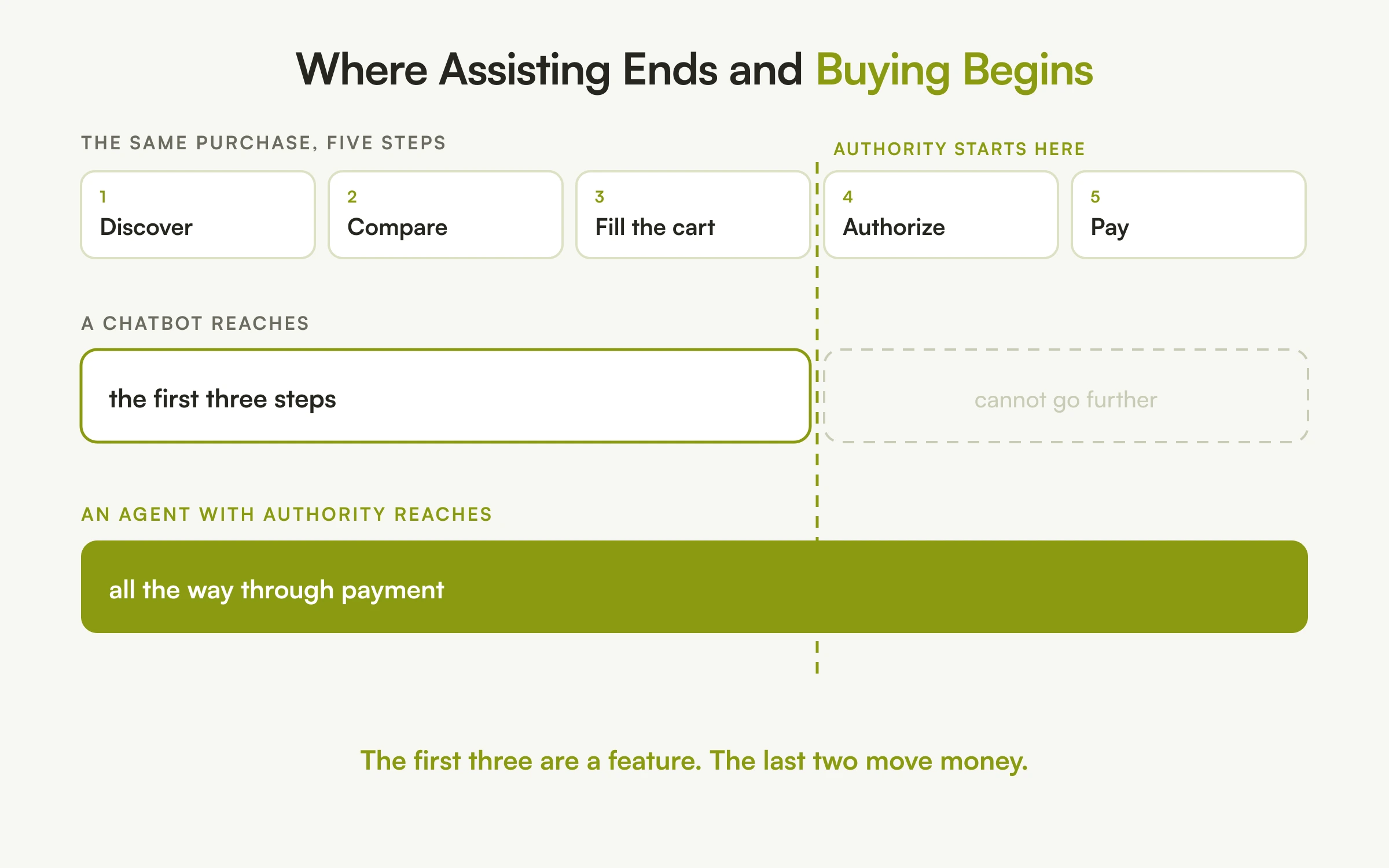
Traditional checkout assumes a human is present to log in, click confirm, complete two-factor authentication, and handle payment friction. Autonomous agents break that assumption. They need a way to prove authorization, respect budget limits, create an audit trail, and settle payment without pretending to be a human shopper.
That is why agentic commerce is not just a UI trend. It is an infrastructure shift across identity, payments, product data, APIs, fraud, procurement, and observability.
Why Agentic Commerce Is Taking Off in 2026
Three things changed at once.
First, agentic AI became more dependable. Modern agents can plan across steps, call tools, inspect results, and retry when the first path fails. That makes agentic commerce a natural extension of AI automation development, where workflows run across systems instead of sitting inside one chat interface.
Second, the standards layer started to form. Google announced the Agent Payments Protocol in September 2025 with more than 60 collaborators, including Adyen, American Express, Coinbase, Mastercard, PayPal, Salesforce, ServiceNow, and Worldpay. Coinbase launched x402 as a way to use HTTP 402 for stablecoin payments over standard web requests. The Linux Foundation launched the x402 Foundation in April 2026 as a neutral home for the protocol.
Third, the market signal became too large to ignore. McKinsey estimates that agentic commerce could influence $3 trillion to $5 trillion in global commerce by 2030, with up to $1 trillion in orchestrated US B2C retail revenue alone. That does not mean every business should rush into agentic checkout tomorrow. It does mean companies should stop treating agent commerce as science fiction.
The Three-Layer Stack: A2A, AP2, and x402
The easiest way to understand agentic commerce is to separate the layers. A2A, AP2, and x402 are often discussed together, but they do different jobs.
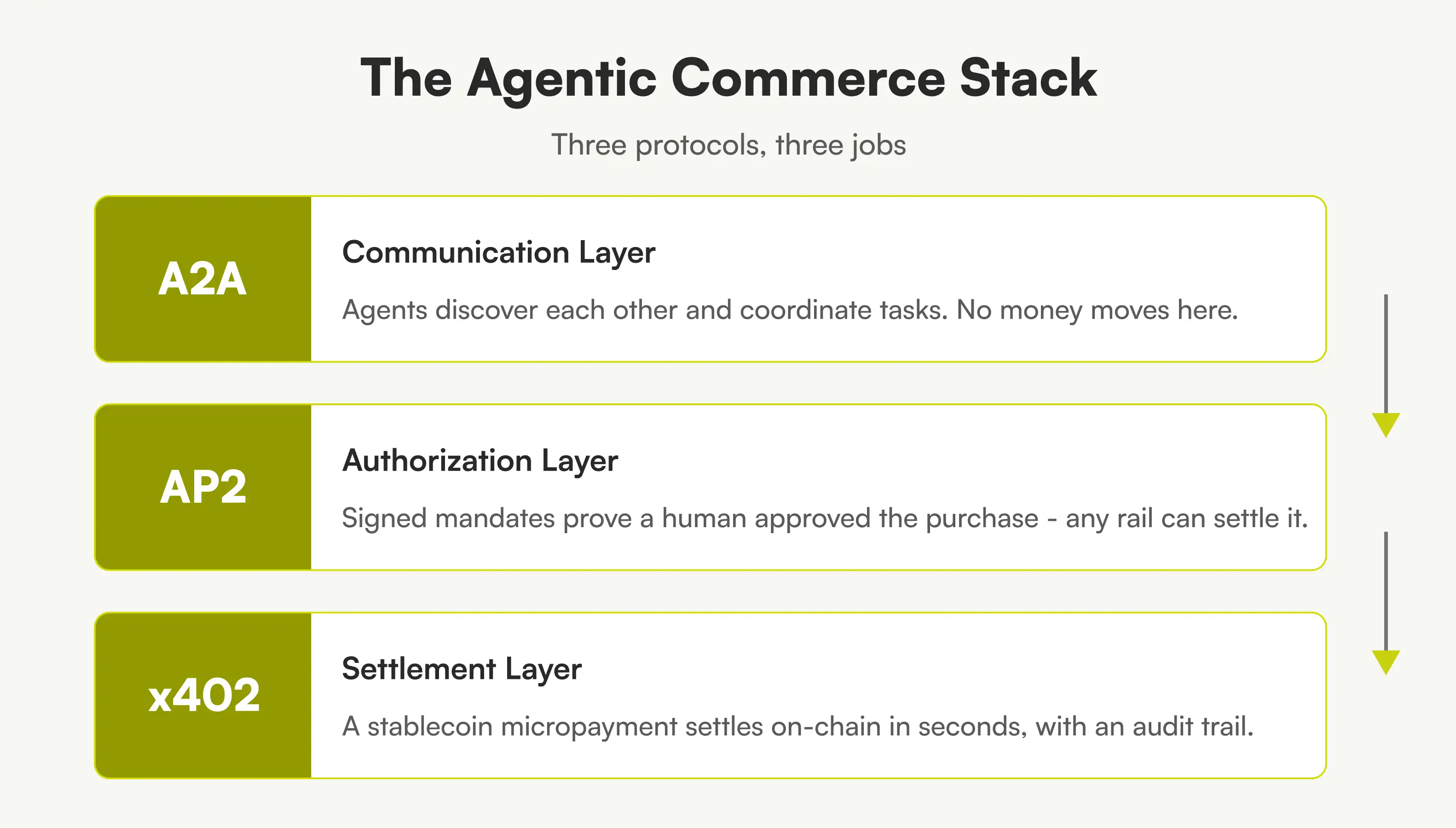
A2A is the communication layer
Agent-to-Agent protocols let agents discover each other, exchange structured messages, and coordinate tasks. In a commerce setting, that could mean a personal shopping agent communicating with a merchant agent, a logistics agent, or a payment agent.
AP2 is the authorization layer
Google's Agent Payments Protocol is designed to prove that a user or organization actually authorized an agent to make a purchase. AP2 uses tamper-resistant, cryptographically signed mandates to capture intent, cart details, and payment authorization. It is payment-method agnostic, so it can work with cards, bank rails, stablecoins, and other payment systems.
x402 is the settlement layer
Coinbase's x402 revives the HTTP 402 "Payment Required" status code and makes it usable for internet-native payments. A client requests a paid resource, receives payment terms, attaches a payment payload, and gets access once the payment is verified. x402 is especially relevant for paid APIs, premium data, metered services, and machine-to-machine micropayments.
A simple way to remember it:
| Layer | What it handles | Business question it answers |
|---|---|---|
| A2A | Agent communication | How do agents talk and coordinate? |
| AP2 | Authorization and proof | How do we know the user approved this? |
| x402 | Payment settlement | How does money move over the web request? |
This stack also sits above the tool-access layer many teams already know from MCP server development. MCP connects agents to tools and data. AP2 and x402 connect agents to authorized payment and settlement.
How an Autonomous Agentic Transaction Works
Here is a simplified version of an agentic transaction using x402-style settlement:
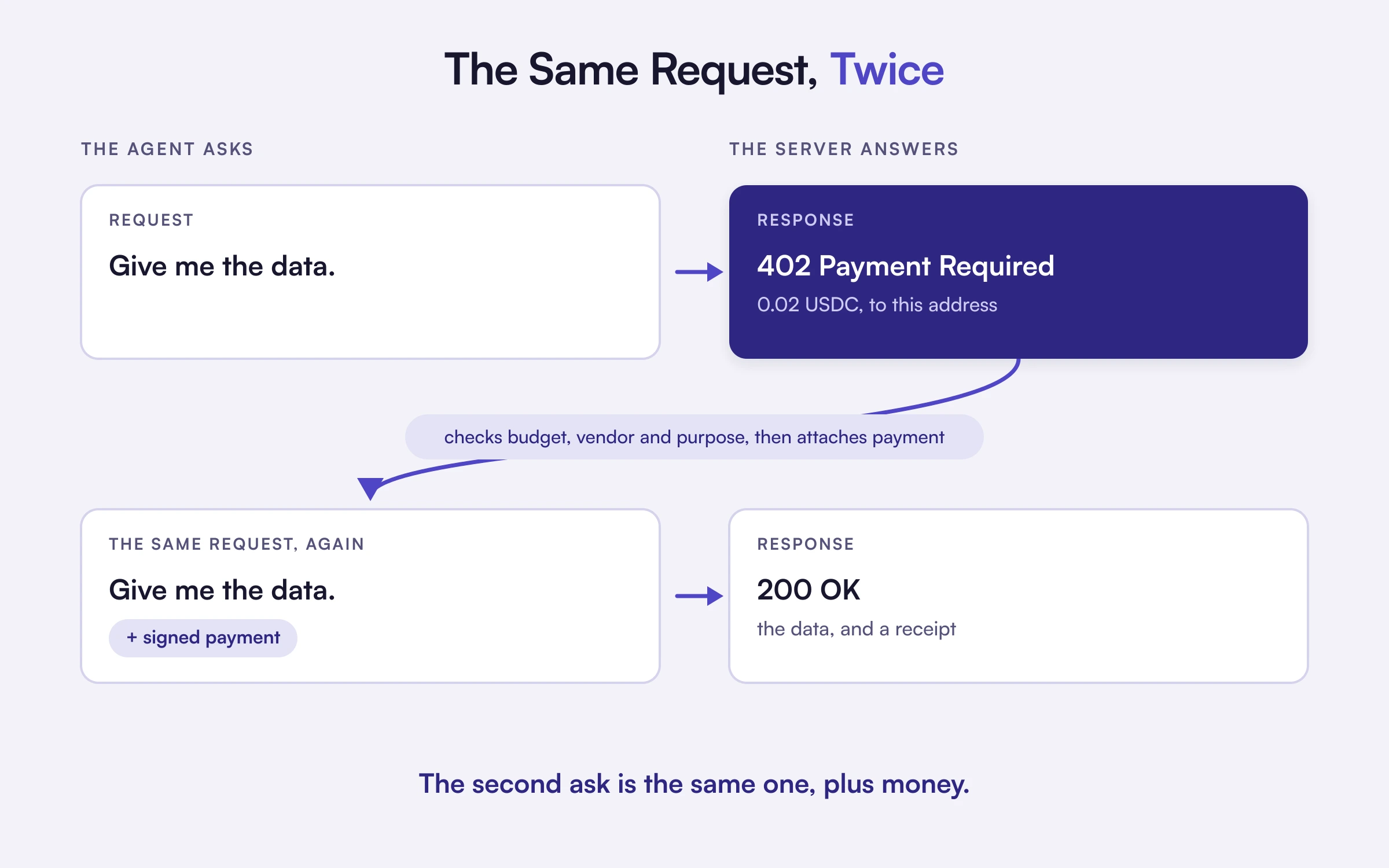
- The agent requests a paid resource, such as a premium data API.
- The server responds with HTTP 402 Payment Required and sends payment terms: network, token, amount, recipient, and accepted format.
- The agent checks its policy: budget, authorization, allowed vendor, allowed purpose, and audit requirements.
- The agent retries the request with a signed payment payload attached.
- A facilitator verifies the payment and triggers settlement.
- The server returns the resource and a payment response receipt.
When AP2 is layered on top, the payment can also carry proof that the user authorized the agent to act within specific conditions. That matters because a payment receipt alone only proves money moved. It does not prove the transaction was within the user's intent.
For production systems, this is where the engineering work gets serious. You need spend caps, vendor allowlists, scoped credentials, retry rules, fraud checks, human approval gates for sensitive purchases, logging, and observability. A misconfigured agent does not just produce a wrong answer. It can move money.
Where Agentic Commerce Actually Stands in 2026
Agentic commerce is early, but several building blocks are now live.
Google's AP2 defines a trust framework for agent-led transactions, using signed mandates to preserve user intent and accountability. Coinbase's x402 gives developers a way to monetize API calls, data access, and services through HTTP-native payments. AWS previewed Amazon Bedrock AgentCore Payments in May 2026, letting agents handle x402 negotiation, wallet authentication, stablecoin payment, and proof delivery with spending limits and observability.
Retail and payments companies are also moving quickly. Google's commerce work around agentic shopping and merchant readiness points to a future where product data, checkout, loyalty, and inventory need to be agent-readable. Stripe's agentic commerce guidance emphasizes interoperability across protocols such as ACP and UCP. Adyen announced Adyen Agentic in June 2026 as a modular API suite covering product feeds, cart creation, and payments across conversational commerce surfaces.
The important takeaway is not that one protocol has won. It has not. The important takeaway is that the direction is clear: commerce systems need to become more machine-readable, API-accessible, policy-aware, and payment-flexible.
Real-World Use Cases
Agentic commerce is not one use case. It is a set of new capabilities across buying, selling, and machine-to-machine coordination.
Agents that buy
An agent can purchase exactly what it needs, when it needs it. That could mean paying for a web data crawl, accessing a premium API, buying compute for one job, reordering inventory, or completing a customer purchase inside an AI agent for ecommerce.
For ecommerce, this moves beyond product recommendations. AI shopping agents will compare options, ask clarifying questions, check inventory, apply constraints, and complete checkout inside the user's rules.
Agents that sell
This is the side many companies miss. If buying agents become common, sellers need to make products and services discoverable by software. That means clean product metadata, structured pricing, clear policies, real-time availability, machine-readable documentation, and checkout paths that do not break when the "customer" is an agent.
For API companies and data providers, agentic commerce also creates new monetization patterns. Instead of forcing subscriptions or manual procurement, a service can charge per request, per dataset, per analysis, or per result.
Agents that pay other agents
The most novel pattern is one agent paying another agent for a microtask. A research agent pays a retrieval agent for a document lookup. An orchestration agent pays a specialized analysis agent for a result. A commerce agent pays a logistics agent for delivery data.
This pairs naturally with RAG development services and multi-agent systems, where specialized tools and agents already hand work off to one another. Payment turns those handoffs into an economic network.
What Agentic Commerce Means for Your Business
Agentic commerce changes the questions leaders should ask.
-
Can an agent understand what you sell? If your catalog, API docs, pricing, and policies are messy for humans, they will be worse for agents.
-
Can an agent evaluate trust? AI buyers will need product facts, availability, certifications, service-level expectations, refund policies, and proof signals in structured form.
-
Can an agent pay you? If your checkout depends on browser hacks, brittle redirects, hidden form states, or manual onboarding, it will not be agent-ready.
-
Can your system control risk? Agents need budget limits, approval thresholds, allowlists, denylists, anomaly detection, and audit logs. This is especially important for B2B procurement, healthcare, financial services, legal, and regulated commerce.
-
Can your business measure agent-driven revenue? If an AI agent discovers, compares, and buys through a new surface, attribution will look different from traditional search, paid ads, and email.
The practical move is not to rebuild everything. It is to pick one agent-friendly workflow and make it safe, measurable, and agent-readable.
How Bitontree Builds Agent-Ready Commerce Systems
At Bitontree, we look at agentic commerce as a production AI systems problem, not a checkout gimmick.
The work usually starts with an agent-readiness audit:
- Product and service data: Is the catalog complete, structured, current, and usable by an agent?
- API readiness: Can an external or internal agent request prices, inventory, availability, documents, and policies reliably?
- Tool access: Should the system expose capabilities through direct APIs, MCP servers, or a custom integration layer?
- Payment and approval flow: Which actions can run autonomously, which need approval, and which should remain blocked?
- Spend and fraud controls: What are the hard limits, anomaly checks, and escalation paths?
- Observability: Can you trace what the agent saw, why it acted, what it paid for, and who authorized it?
From there, we usually build in phases. First, make one workflow agent-readable in a sandbox. Next, add scoped tool access and observability. Then add controlled transaction paths with small limits. Only after that do we expand to higher-value commerce flows.
That approach fits the same production posture we use for AI agents, RAG systems, MCP servers, and workflow automation: start narrow, instrument everything, add guardrails before autonomy, and keep humans in the loop where consequences are high.
Challenges and Open Questions
Agentic commerce still has real constraints.
-
Standards are competing: AP2, x402, ACP, UCP, card-network efforts, wallet infrastructure, and commerce platform APIs are still evolving. Businesses should design for interoperability rather than betting everything on one rail.
-
Governance is not optional: When software can spend money, policy enforcement has to happen at the infrastructure layer, not inside a prompt. The model can propose an action. The runtime should decide whether it is allowed.
-
Fraud models need to evolve: Traditional fraud systems distinguish humans from bots. Agentic commerce asks a more subtle question: is this the right agent, acting for the right person, under the right authorization, for the right purpose?
-
Merchant readiness is uneven: Many companies still have weak product data, slow inventory sync, brittle checkout, and limited API coverage. Those weaknesses become larger when agents are the buyers.
-
User trust will decide adoption: People may like convenience, but they will not hand agents financial authority without transparency, limits, reversibility, and clear accountability.
These are not reasons to wait. They are reasons to build carefully.
How to Get Started
You do not need a full agentic checkout program on day one. Start with a bounded pilot.
- Choose one agent-friendly workflow: a paid API, a data product, a routine reorder, a quote request, or an internal procurement task.
- Make the workflow readable by software: structured product data, clean docs, reliable APIs, and explicit policies.
- Add guardrails before autonomy: spend caps, approval thresholds, role-based access, logs, and alerts.
- Run in sandbox first: no production funds, no irreversible transactions, no open-ended tool access.
- Measure the result: latency, completion rate, payment success, failure modes, human intervention rate, and revenue or cost impact.
The winning companies will not be the ones that chase every protocol announcement. They will be the ones that make their products, services, data, and operations easy for trusted agents to understand and transact with.
Conclusion: Build for the Agent Economy Early
Agentic commerce is moving from concept to infrastructure. AP2 gives the ecosystem a trust and authorization model. x402 gives the web a practical payment pattern for software. Cloud, payment, wallet, and commerce platforms are turning those ideas into tools businesses can actually test.
The strategic question is simple: when AI agents become buyers, will your business be visible, understandable, trustworthy, and payable by software?
For many companies, the right first step is not a public agent checkout. It is the quieter work underneath: clean data, API access, agent-safe workflows, payment guardrails, and auditability. That is the foundation the agent economy will run on.
I am the founder and CEO of Bitontree, where I lead embedded AI engineering teams that build and run production AI: agents, RAG and knowledge systems, document AI, and workflow automation for healthcare, logistics, legal, and SaaS companies. I write about what it actually takes to ship AI that survives contact with production.
Frequently Asked Questions
What is agentic commerce?

Agentic commerce is commerce conducted by autonomous or semi-autonomous AI agents on behalf of a person, business, or another agent. The agent may discover products, evaluate vendors, assemble a cart, request authorization, and pay for goods, services, data, or API access. A chatbot that recommends a product is assisting commerce. An agent that finds the product, compares vendors, places the order, and completes payment under a spend limit is conducting commerce.
What is the AP2 (Agent Payments Protocol)?
AP2 is Google's Agent Payments Protocol, the authorization layer of agentic commerce. It is designed to prove that a user or organization actually authorized an agent to make a purchase. AP2 uses tamper-resistant, cryptographically signed mandates to capture intent, cart details, and payment authorization, and it is payment-method agnostic, so it can work with cards, bank rails, and stablecoins. Google announced AP2 in September 2025 with more than 60 collaborators.
What is the x402 protocol?
x402 is Coinbase's settlement protocol that revives the HTTP 402 "Payment Required" status code and makes it usable for internet-native payments. A client requests a paid resource, receives payment terms, attaches a payment payload, and gets access once the payment is verified. x402 is especially relevant for paid APIs, premium data, metered services, and machine-to-machine micropayments. The Linux Foundation launched the x402 Foundation in April 2026 as a neutral home for the protocol.
What is the difference between AP2 and x402?
AP2 is an authorization and trust protocol, while x402 is a settlement protocol. AP2 proves that a human or organization gave an agent permission to transact under specific conditions. x402 lets a client pay for a resource over HTTP, commonly using stablecoins. They solve different layers and are often used together.
How do A2A, AP2, and x402 fit together?
A2A, AP2, and x402 are three layers of the agentic commerce stack, each doing a different job. A2A is the communication layer that lets agents discover each other and coordinate tasks. AP2 is the authorization layer that proves the user approved a purchase. x402 is the settlement layer that moves money over a web request. This stack sits above the tool-access layer many teams already know from MCP.
How does agentic payments infrastructure work?
Agentic payments infrastructure lets an agent request a paid resource, receive payment terms, check its own policy, and settle payment with proof of authorization. In an x402-style flow, the server responds with HTTP 402 and payment terms, the agent checks budget, allowed vendor, and purpose, then retries with a signed payment payload that a facilitator verifies and settles. When AP2 is layered on top, the payment can also carry proof that the user authorized the agent to act within specific conditions. That distinction matters, because a payment receipt alone only proves money moved, not that the transaction matched the user's intent.
How do AI agents make autonomous B2B payments?
AI agents make autonomous payments by acting within explicit rules: spend caps, vendor allowlists, scoped credentials, approval thresholds, and audit logs enforced at the infrastructure layer. The agent requests a resource, confirms authorization and budget, attaches a signed payment payload, and settles once a facilitator verifies it. For B2B procurement and other regulated commerce, human approval gates and observability keep higher-value or sensitive purchases under control. Policy enforcement has to happen in the runtime, not inside a prompt.
What are the recent developments in agentic commerce?
Several building blocks went live between late 2025 and mid 2026. Google announced AP2 in September 2025, the Linux Foundation launched the x402 Foundation in April 2026, AWS previewed Amazon Bedrock AgentCore Payments in May 2026, and Adyen announced Adyen Agentic in June 2026. Stripe's guidance emphasizes interoperability across protocols such as ACP and UCP. No single protocol has won, but the direction is clear: commerce systems need to become more machine-readable, API-accessible, policy-aware, and payment-flexible.
Does agentic commerce require cryptocurrency?
No. AP2 is payment-method agnostic and can work with cards, bank transfers, real-time payment rails, and stablecoins. x402 specifically focuses on stablecoin settlement, so crypto is relevant for that layer but not required for every agentic commerce flow.
How should ecommerce companies prepare for AI shopping agents?
Start with clean product data, real-time inventory and pricing APIs, agent-readable policies, strong checkout reliability, and clear guardrails for returns, discounts, fraud, and payment authorization. Agentic commerce rewards merchants whose systems are easy for software to understand and transact with. The practical move is to pick one agent-friendly workflow and make it safe, measurable, and agent-readable rather than rebuilding everything at once.
Can Bitontree help build agent-ready commerce systems?
Yes. Bitontree is an embedded AI engineering team that builds and runs production AI, including AI agents, MCP servers, RAG systems, and ecommerce automation. We treat agentic commerce as a production systems problem, with spend controls, observability, human approval gates, and integration into existing commerce systems. The work usually starts with an agent-readiness audit, then builds in phases from sandbox to controlled transaction paths.
Related Blogs
Read the surrounding AI agent, MCP, and ecommerce automation guides.