


An AI agent for ecommerce handles order management, returns and refunds, product recommendations, cart abandonment recovery, shipping and delivery resolution, inventory inquiries, loyalty program management, and post-purchase engagement - across your website, WhatsApp, Instagram, email, and SMS. Our ecommerce AI deployments recover 35% of abandoned carts, resolve 60% of post-purchase tickets without human intervention, and increase repeat purchase rates by 25%.
Your support team spends their entire day on the same five questions. "Where is my order?" "Can I return this?" "Do you have this in a size 10?" "Why was I charged twice?" "When will this be back in stock?" Meanwhile, 70% of carts are abandoned, your re-engagement emails get 3% open rates because they are generic, and every return takes 15 minutes of manual processing across Shopify, your carrier portal, and Stripe.
An AI ecommerce agent does not send your customer a tracking link and hope for the best. It detects the delayed shipment before the customer even asks, proactively notifies them with a new ETA, offers a discount on their next order if the delay exceeds your threshold, and files the carrier claim - all without a support agent opening a ticket.
This guide covers what an AI agent for ecommerce actually does, the specific use cases it handles in production, the measurable benefits it delivers, and how we implement one that drives revenue and reduces support costs simultaneously. We also build custom AI agents and AI chatbots for teams that need a different scope.
What Is an AI Agent for Ecommerce?
An AI agent for ecommerce is an autonomous system that receives a customer interaction - an order inquiry, a return request, a product question, a cart abandonment signal, a delivery exception - reasons about what action to take, retrieves live data from your store and fulfillment systems, executes the resolution, and confirms the outcome with the customer - without waiting for a support agent to manually process routine requests.
Here is what that looks like in practice. A customer messages: "I ordered the wrong size, I need a medium instead of a large." The agent pulls the order from Shopify, checks inventory for the medium, initiates the exchange, generates a prepaid return label, updates the order status, sends the customer a confirmation with the new delivery estimate, and adjusts the inventory count - all within a single conversation. The customer did not wait on hold. They did not fill out a form. They got it done.
Built on large language models (GPT-4o, Claude) for natural conversation, retrieval-augmented generation for product and policy grounding, and direct integrations with your store platform (Shopify, WooCommerce, Magento, BigCommerce), payment processor (Stripe, PayPal), fulfillment systems (ShipStation, ShipBob), and customer platforms (Klaviyo, Gorgias, Zendesk) - the full technical architecture is covered in our AI agent development service page.
The result is a 24/7 ecommerce operations engine that resolves customer requests end to end, recovers abandoned revenue, and hands your support team only the cases that genuinely require human judgment.
Why Ecommerce Businesses Need AI Agents
Ecommerce automation through an AI agent is not about deflecting customers. It is about resolving their problems faster than a human team can - while recovering the revenue your current operations leave on the table.
70% of your carts are abandoned and your recovery emails are not working
The average ecommerce cart abandonment rate is 70%. Your automated email sequence recovers 3-5% of those. The rest - thousands of dollars in monthly revenue - disappears. The problem is not that customers do not want to buy. It is that they had a question about shipping, or sizing, or return policy, and nobody answered fast enough. An AI agent engages abandoners in real time - on site, via SMS, or through WhatsApp - addresses the specific objection, and closes the sale before the customer leaves for a competitor.
"Where is my order?" is consuming your entire support team
WISMO (where is my order) queries account for 30-50% of all ecommerce support tickets. Each one takes 3-5 minutes: open the ticket, find the order, check the carrier, copy the tracking info, write the response. At 500 WISMO tickets per week, that is 25-40 hours of support labor on a task that is entirely automatable. An AI agent resolves every WISMO query in seconds - and when the shipment is actually delayed, it does not just inform the customer. It initiates the resolution.
Every return takes 15 minutes of manual work across 3 systems
Customer requests a return. Your agent checks the order in Shopify. Verifies eligibility against your return policy. Generates a return label from your carrier portal. Processes the refund in Stripe. Updates inventory. Sends confirmation. That is 15 minutes of human time across three systems for a process that follows the same rules every time. An AI agent completes the entire return in under 2 minutes - including edge cases like partial returns, exchanges, and store credit options.
Your billing disputes take 10 minutes each across two systems
"I was charged twice." "Why is this amount different from what I expected?" "I returned the item but never got my refund." Every billing dispute requires your support agent to open Stripe, cross-reference against Shopify, check the return status, determine whether it was a true duplicate or a pending authorization, and then process the resolution. That is 10 minutes per ticket across two systems for a process that follows the same investigation steps every time. An AI agent completes the entire investigation and resolution in under 60 seconds.
Your support team scales linearly but your order volume does not
Black Friday. Flash sales. Product launches. Influencer mentions. Your order volume can spike 5-10x in hours, and your support queue grows proportionally. You cannot hire and train 5x support agents for a 48-hour event. An AI agent handles the spike at the same cost and the same quality. Your peak and your normal look identical to the customer.
In short: the problem is not that your support team is too small. The problem is that most ecommerce support work follows documented rules across a small number of systems - and your team is executing it manually, one ticket at a time. AI agents do not replace your support team. They resolve the repetitive majority so your team handles the complex cases that actually require a human.
Key Use Cases of AI Agents for Ecommerce
An AI agent for ecommerce goes far beyond answering product questions. Here are the specific use cases that production deployments handle - each one combines high ticket volume, clear business rules, and multi-system execution.
Post-Purchase Order Modifications
The customer bought the item but needs changes before it ships - or after. "Can I change the shipping address?" "I ordered the wrong color, can I swap it?" "Cancel just one item from my order, not the whole thing." The agent handles address changes, item swaps, size exchanges, partial cancellations, and shipment splits by coordinating across your OMS, carrier, and payment processor in a single conversation. Each modification validates against your business rules - cutoff windows for address changes, restocking policies for swaps, partial refund calculations for cancellations. Changes that exceed configured thresholds route to your team for one-click approval.
Best for: Any ecommerce business processing 500+ orders per month where post-purchase change requests consume 10-15% of support volume and currently require manual coordination across 2-3 systems.
Returns, Exchanges, and Refund Processing
The agent checks return eligibility against your policies, generates prepaid return labels, processes refunds or store credit in your payment system, handles exchanges by checking inventory for the replacement item, and updates order records. For amounts above your configured threshold, it packages the complete refund case for one-click human approval. Return processing drops from 15 minutes to under 2.
Best for: Brands processing 200+ returns per month where manual return handling across Shopify, carrier portals, and Stripe consumes 50+ hours of staff time monthly.
Cart Abandonment Recovery
When a customer abandons their cart, the agent engages within minutes, via on-site message, SMS, WhatsApp, or email. It identifies the likely objection (shipping cost, sizing uncertainty, return policy concern), addresses it with specific information from your store data, and offers a personalized incentive calibrated to the customer’s LTV and your margin thresholds. When the objection is product fit, wrong size, unsure about the product, or looking for alternatives, the agent searches your live catalog and recommends better matches within the same conversation. Recovery rates reach 25-35% compared to 3-5% from generic email sequences.
Best for: Ecommerce businesses with AOV above $50 where each recovered cart directly impacts monthly revenue and existing email recovery sequences underperform.
Personalized Product Discovery and Recommendations
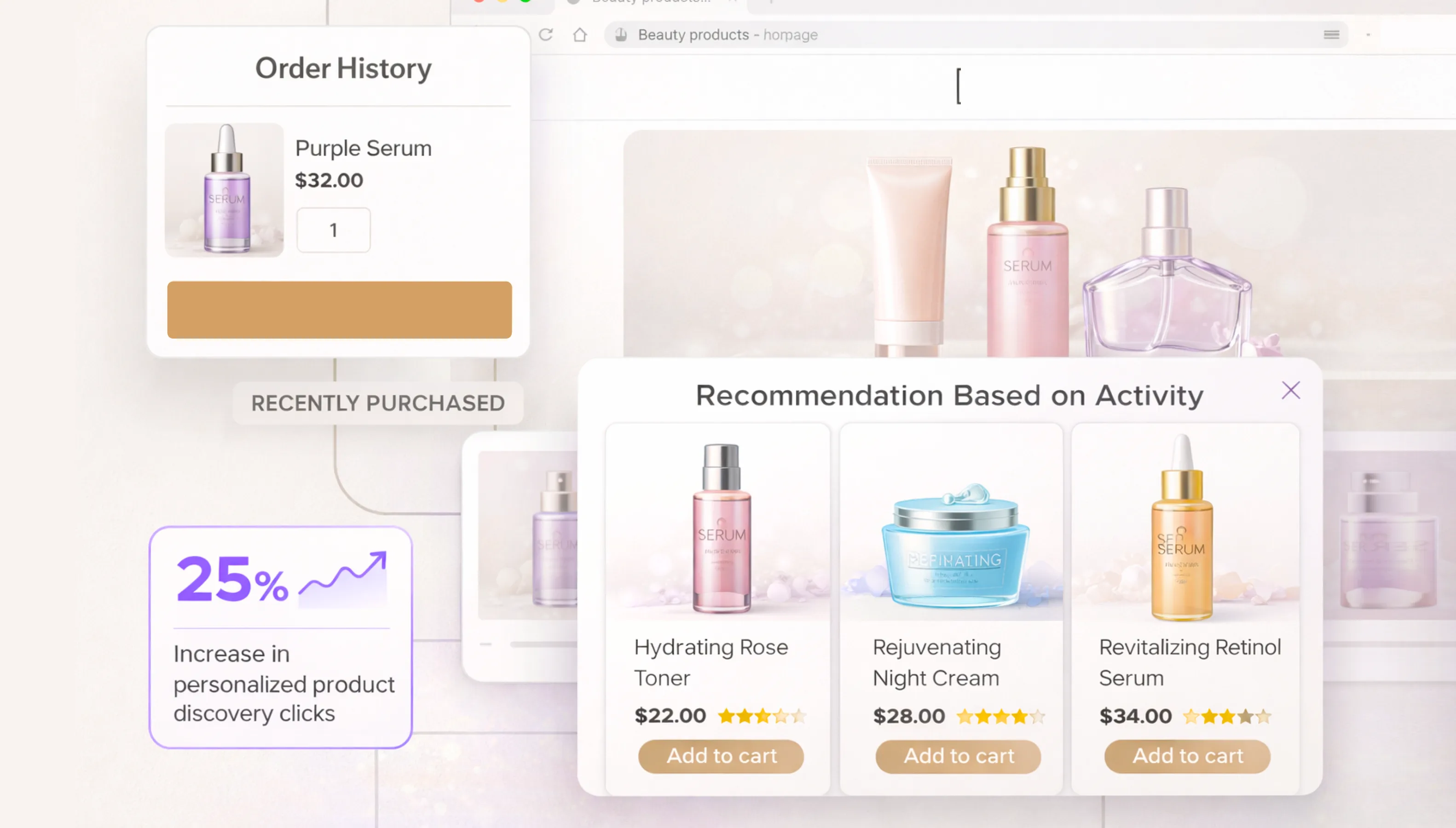
The agent asks about the customer’s needs, preferences, size, budget, and occasion, then searches your live catalog - including real-time inventory, size availability, and customer review data - to recommend products that genuinely match. It handles follow-ups: "Do you have this in red?" "What is the size guide for this brand?" Conversion rates on agent-assisted discovery are 3-5x higher than browse-and-search alone.
Best for: Fashion, beauty, home goods, and any catalog with 1,000+ SKUs where product discovery is the primary conversion bottleneck.
Subscription and Recurring Order Management
The agent handles subscription modifications end to end: pause, skip, reschedule, swap products, update payment methods, cancel with retention offers, and reactivate lapsed subscriptions. Every change executes through your subscription platform (Recharge, Bold, Ordergroove) without a support ticket. Churn-intent customers get personalized retention offers before they hit the cancel button.
Best for: Subscription brands where 15-25% of support tickets are subscription changes and involuntary churn from payment failures costs 5-10% of MRR.
Pre-Purchase Product Q&A and Objection Handling
"Is this compatible with my device?" "What’s the difference between the Pro and Standard?" "Will this arrive before Friday?" The agent answers from your product data, comparison pages, and shipping calculator - in real time during the buying decision. It surfaces reviews, handles objections, and applies discount codes when authorized. Every question answered before checkout is a bounce prevented.
Best for: Electronics, appliances, supplements, and any product category where pre-purchase research creates decision paralysis and abandoned sessions.
Back-in-Stock Alerts and Inventory Notifications
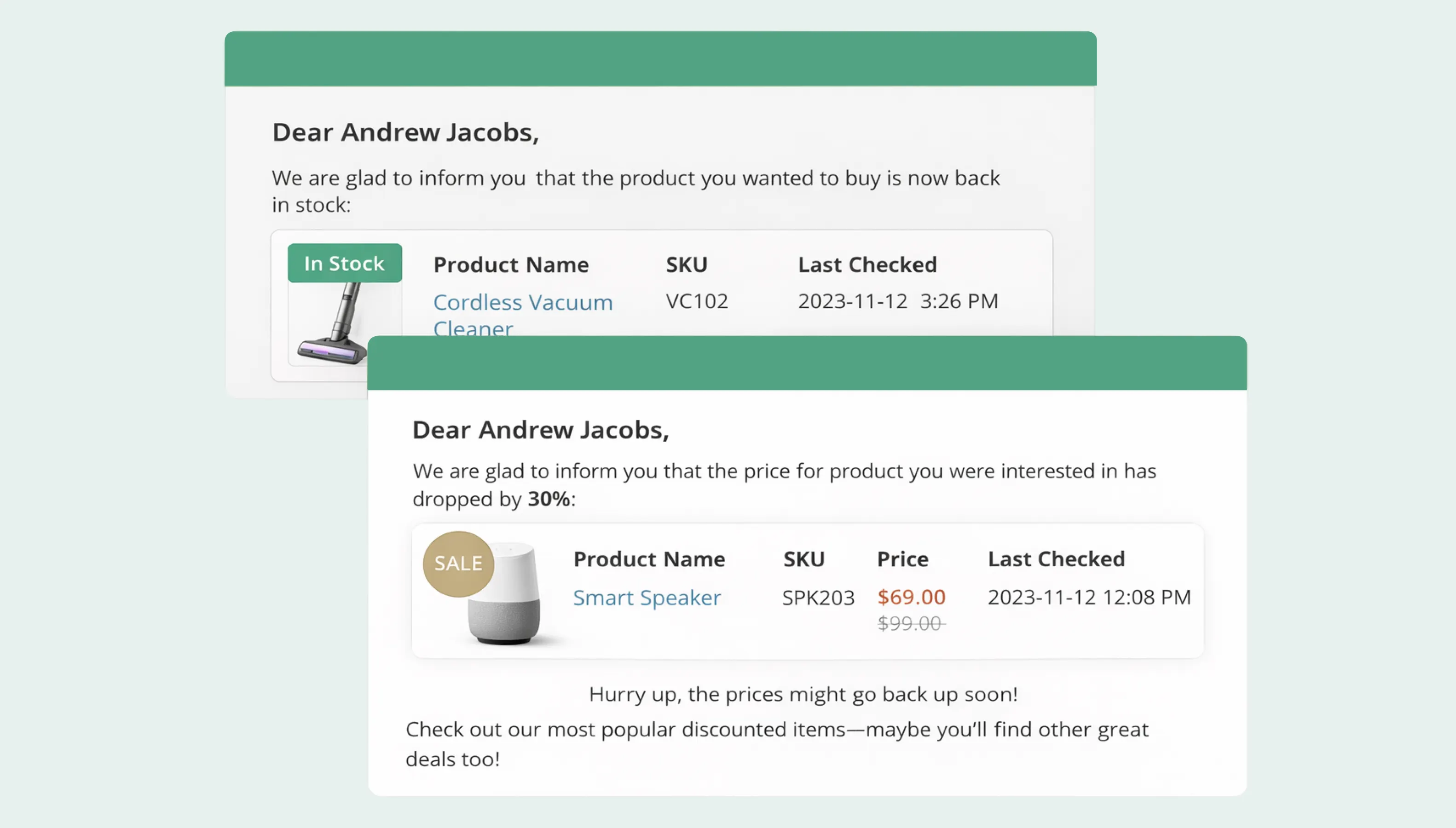
When a product is out of stock, the agent captures the customer’s interest, adds them to a restock notification list, and sends a personalized alert the moment inventory is available - with a direct add-to-cart link. For popular items, it recommends available alternatives that match the customer’s preferences. Out-of-stock pages stop being dead ends and start being lead capture opportunities.
Best for: Brands with high stockout frequency or limited-edition drops where out-of-stock pages lose 20-30% of potential revenue.
Fraud Detection and Chargeback Prevention
The agent flags suspicious orders based on configurable rules: address mismatch, velocity checks, high-risk shipping destinations, and unusual order patterns. Flagged orders route to your fraud team with risk scores and evidence. For chargebacks, the agent assembles the dispute evidence package - order confirmation, delivery proof, customer communication history - and submits through your processor’s dispute portal.
Best for: Brands processing 5,000+ orders per month where fraud review is manual and chargebacks exceed 0.5% of transactions.
Agent Assist Mode for Support Teams
Not ready for full customer-facing autonomy? Agent-assist mode runs alongside your support team. When a customer contacts support, the agent surfaces the order details, customer history, return eligibility, relevant policies, and a suggested response in a sidebar. The support agent reviews and sends. After the interaction, the agent updates the ticket, adjusts inventory if needed, and queues follow-up tasks. Your team stays in control. The agent handles the lookup and data entry.
Best for: Ecommerce teams that want AI productivity gains but need human oversight on every customer interaction during the first deployment phase.
How an AI Ecommerce Agent Works: The Customer Journey
Here is what happens when a customer interacts with your store and an AI ecommerce agent is running.
Step 1: Customer reaches out and the agent activates instantly
A customer sends a message via web chat, WhatsApp, Instagram DM, email, or SMS. The agent activates within seconds - at 2 PM or 2 AM, on a Tuesday or during your Black Friday peak. No queue. No "we will respond within 24 hours." The customer gets an intelligent response the moment they reach out.
Step 2: Agent identifies the customer and pulls their full context
The agent matches the customer against your store using email, phone number, or order number. It pulls their complete profile: order history, active orders with tracking status, past returns, loyalty tier, LTV, communication preferences, and any open support tickets. Every response is informed by the customer’s actual relationship with your brand.
Step 3: Agent understands the request and classifies intent
The agent interprets what the customer needs: order status, return, exchange, product question, billing issue, shipping concern, or complaint. It classifies urgency - a lost package or a duplicate charge gets priority routing. A product recommendation flows through the standard path. Intent classification accuracy exceeds 95% in production.
Step 4: Agent retrieves product, order, and policy data
The agent searches your product catalog, order management system, carrier APIs, and policy documentation through the RAG pipeline. For a return request, it pulls the order, checks eligibility against your policy, and verifies inventory for exchange options. For a product question, it retrieves specifications, reviews, and availability. Every response is grounded in your live store data.
Step 5: Agent executes the resolution and completes the task
This is where an AI agent differs from a chatbot. The agent does not just answer - it acts. It processes the refund, generates the return label, creates the replacement order, applies the discount code, files the carrier claim, or updates the shipping address. For actions above its configured authority, it packages the case with full context for one-click human approval.
Step 6: If the customer needs a human, the handoff is seamless
When the agent encounters a situation requiring human judgment - a complex complaint, a VIP customer with a unique request, or an escalation beyond configured authority - it transfers to your support team with everything attached: customer profile, order history, conversation transcript, actions already taken, and a recommended resolution. The agent handles warm handoffs, not cold transfers.
Step 7: Every interaction feeds your optimization engine
Every customer query, resolution path, cart recovery, and outcome is logged and analyzed. You see which products generate the most support tickets, which return reasons repeat, which cart objections convert when addressed, and where your customer experience breaks down. This is operational intelligence that drives product, logistics, and CX improvements.
Benefits of AI Agents for Ecommerce
Here is what actually changes when you deploy an AI agent for ecommerce - measured as revenue impact, not chat metrics.
Your abandoned carts start converting into completed orders
Recovery rates reach 5-10x what generic email sequences deliver when the agent engages abandoners in real time with personalized responses to their specific objection. For a store with $200K in monthly abandoned cart value, recovering even a quarter of that adds $50K+ in monthly revenue that was previously walking away.
Your support team stops answering the same five questions
WISMO, returns, sizing, shipping, and billing - the five queries that consume the majority of ecommerce support time - resolve autonomously. Your team reclaims more than half their day. That time goes into VIP customer relationships, complex complaints, and the escalations that genuinely need a human. Support costs per ticket drop because the easy tickets never reach a person.
Your returns process in minutes instead of days
End-to-end return processing drops from 15 minutes of manual work to under 2 minutes of automated execution. The customer gets their refund or exchange confirmation during the conversation, not three days later via email. Faster resolution means higher customer satisfaction and lower likelihood of a chargeback or negative review.
Your shipping problems get resolved before customers even ask
Delivery exceptions - delays, lost packages, damaged shipments - get detected and resolved before the customer contacts support. The agent monitors carrier data, sends proactive updates when delays occur, offers resolution options automatically, and files carrier claims without staff involvement. Customer complaints about shipping drop because problems are resolved before they become complaints.
Your peak events stop breaking your support operations
Black Friday, flash sales, influencer-driven spikes - the agent handles 10x volume at the same cost and quality. No hiring surge. No training lag. No degraded response times. Your customers get the same experience during a 5x order spike as they do on a quiet Tuesday. And the agent processes the support surge while your team focuses on the complex cases that need human attention.
Your customer lifetime value grows because the experience improves
Repeat purchase rates increase by 20-30% when post-purchase experience improves: proactive shipping updates instead of silence, instant refund processing instead of 3-day waits, personalized restock alerts instead of generic campaigns. Customer lifetime value compounds when every interaction makes the customer more likely to buy again.
In short: AI agents do not replace your support team. They resolve the repetitive post-purchase tickets, recover abandoned revenue, and deliver the personalized shopping experience that converts browsers into buyers and buyers into repeat customers. Your team focuses on the interactions that build loyalty. The agent handles the transactions that drive operations.
Ecommerce Segments Deploying AI Agents
AI agents for ecommerce look different for a D2C fashion brand than for a B2B wholesale distributor. Here is what production deployments handle across key segments.
Direct-to-Consumer Brands
Your support team of five handles 800 tickets per week. Half are WISMO. A quarter are returns. The rest are sizing, availability, and billing questions. An AI agent resolves the routine majority so your team focuses on the brand experiences that build customer loyalty.
- Full post-purchase automation - order tracking, returns, exchanges, refunds, all within the customer conversation
- Size and fit guidance using brand-specific size charts and customer purchase history
- Cart recovery via SMS and WhatsApp with personalized incentives based on cart value and customer LTV
- Loyalty program management - point balance, reward redemption, tier progression updates
- One D2C brand: the majority of tickets resolved autonomously, cart recovery rate reached 32%, average resolution time dropped from 4 hours to 90 seconds
Fashion and Apparel
Your return rate is 25-40% because customers cannot assess fit and fabric online. Every return is a logistics cost, a revenue delay, and a customer at risk of not buying again. An AI agent reduces returns at the source by guiding customers to the right product before they buy.
- AI-powered size recommendations using brand-specific fit data, customer body measurements, and purchase history
- Styling assistance - outfit completion, color matching, occasion-based recommendations from your catalog
- Exchange processing with real-time inventory check and same-session replacement order
- Pre-order and waitlist management for new collections and limited drops
- One fashion brand: return rate dropped from 34% to 22% after AI-guided size recommendations, average order value up 18%
Subscription Commerce
Your churn rate is 8-12% monthly and half of it is involuntary - expired cards, failed payments, forgotten subscriptions. The other half leaves because modifying a subscription is harder than cancelling it. An AI agent makes subscription management frictionless.
- Subscription pause, skip, swap, reschedule, and cancel with retention offers - all through conversation
- Failed payment recovery with proactive outreach and one-tap card update
- Personalized reorder recommendations based on consumption patterns and order frequency
- Win-back sequences for churned subscribers with personalized re-engagement
- One subscription brand: involuntary churn dropped by 40%, voluntary churn reduced by 22% through retention flows
B2B and Wholesale
Your sales reps spend half their day processing reorders, checking inventory, and generating quotes for customers who already know exactly what they want. An AI agent handles the transactional orders so your reps focus on growing accounts.
- Automated reorder processing from purchase history with volume pricing calculations
- Real-time inventory and lead-time inquiries across warehouse locations
- Quote generation with customer-specific pricing tiers and discount rules
- Account credit limit checks and payment terms enforcement
- One B2B distributor: 70% of reorders processed without rep involvement, quote turnaround dropped from 24 hours to 10 minutes
Multi-Vendor Marketplaces
Your customer contacts support, but the issue is with a third-party seller’s product. Your team has to mediate between the customer and the vendor while maintaining your marketplace’s reputation. An AI agent routes, mediates, and resolves across your vendor network.
- Intelligent ticket routing to the correct vendor based on order data and issue type
- Marketplace policy enforcement across vendor returns, shipping standards, and quality guarantees
- Customer-facing resolution with marketplace warranty coverage and refund processing
- Vendor performance monitoring with automated SLA violation flagging
- One marketplace: vendor-related resolution time dropped from 5 days to 8 hours, customer satisfaction for third-party orders improved by 45%
Common Challenges in Ecommerce AI Agent Deployment - and How We Solve Them
Ecommerce AI agents touch live transactions, real money, and customer trust. A wrong refund, a bad recommendation, or a failed order update has immediate revenue and brand consequences. Here are the five most common failure modes and how Bitontree prevents them.
Challenge 1: The agent processes a wrong refund or exchange
An incorrect refund on a high-value order or an exchange for the wrong item has real financial and operational consequences. This is the #1 fear that blocks autonomous transaction handling.
How Bitontree solves this: Every transaction validates against your business rules before execution. Configurable thresholds - orders under $100 process autonomously, above $100 require one-click approval. Inventory verification before every exchange. Refund amount validation against the original order. Rollback capability on every transaction. Sub-1% error rate in production.
Challenge 2: The agent recommends products that are out of stock or discontinued
Nothing erodes trust faster than recommending a product the customer cannot buy. If the agent’s product data is stale, every recommendation becomes a frustration instead of a conversion.
How Bitontree solves this: Real-time inventory sync with your store platform. Product recommendations filter by current availability, active status, and shipping eligibility. Automated re-indexing when catalog changes occur. Out-of-stock products route to alternatives or restock notifications instead of dead-end responses.
Challenge 3: The agent gives wrong shipping or delivery information
"Your package will arrive by Friday" - and it arrives next Wednesday. Wrong delivery promises create customer complaints, support escalations, and negative reviews. Shipping data from carriers is not always accurate, and the agent needs to handle uncertainty.
How Bitontree solves this: Real-time carrier API integration with exception detection. When tracking data is uncertain, the agent communicates a range instead of a specific date. Proactive delay notifications when carrier data indicates a shipment is behind schedule. Configurable escalation when delivery exceptions match your intervention criteria.
Challenge 4: Customer payment data is exposed
Ecommerce conversations involve order numbers, addresses, partial card numbers, and transaction details. Without proper controls, sensitive data can leak through AI responses or logs.
How Bitontree solves this: PCI DSS compliant data handling. Payment data is never stored in conversation logs or passed to the LLM. Card information routes through your payment processor’s tokenized APIs. PII redaction on all logged conversations. SOC 2 Type II compliant infrastructure. Your customer data never trains models for other clients.
Challenge 5: No visibility into revenue impact or ROI
The agent runs for 90 days and nobody can quantify whether it generated revenue or just handled tickets. Without attribution, the deployment gets questioned at the next budget review.
How Bitontree solves this: Revenue attribution dashboard: carts recovered, orders saved from cancellation, upsell revenue from recommendations, support costs reduced, and chargeback prevention value. Direct comparison: agent-resolved tickets vs manually-resolved tickets by cost, resolution time, and customer satisfaction. Weekly optimization reports with revenue impact.
How We Implement an AI Agent for Ecommerce
Here is how we implement an AI ecommerce agent - the process that consistently delivers measurable revenue and support cost impact within 90 days.
Step 1: Ecommerce operations audit and use case mapping
We analyze your support ticket data, cart abandonment rates, return volume, WISMO frequency, and customer journey drop-off points. Identify the top 10 use cases by revenue and cost impact. Map which can run autonomously, which need human approval, and which must stay manual. Define success metrics: cart recovery rate, ticket automation rate, return processing time, support cost per ticket. We also review your store platform, integrations, and fulfillment workflow.
Step 2: Agent reasoning design and transaction rules
We design the decision logic for each use case. Define autonomous actions (order tracking, return processing under threshold, product recommendations), approval-required actions (high-value refunds, exception handling, discount authorization above limits), and blocked actions (payment modifications, account deletion). Map every system integration. Set brand voice guidelines. This is where your business rules become the agent’s operating boundaries.
Step 3: Store integration and RAG pipeline
We connect the agent to your store platform (Shopify, WooCommerce, BigCommerce), payment processor (Stripe, PayPal), fulfillment systems (ShipStation, ShipBob, carrier APIs), CRM (Klaviyo, Gorgias), and product catalog. Build the RAG pipeline for product and policy grounding using LangChain with Pinecone or Weaviate. Every integration includes real-time inventory sync, error handling, and fallback behavior. Test against your actual order and ticket data.
Step 4: Build, test, and parallel run
Build in 2-week sprints. Transaction accuracy testing against your business rules. Product recommendation validation against live inventory. Cart recovery A/B testing for messaging and incentive calibration. Load testing at 5x your peak order volume (Black Friday readiness). Then 2-4 weeks of parallel run - the agent handles real customer interactions alongside your team for validation before going autonomous.
Step 5: Phased deployment and optimization
Launch with the 2-3 highest-impact use cases - WISMO automation, returns processing, and cart recovery are the most common starting point. Monitor performance daily for the first 30 days. Tune cart recovery messaging, product recommendation accuracy, and return policy enforcement based on real customer interactions. Expand to additional use cases in 30-day cycles. The agent gets measurably better every week from production data.
The Conclusion
Every abandoned cart is a customer who almost bought. Every "where is my order?" ticket is a customer whose experience is already slipping. Every 15-minute return is money your team spent on a process that follows the same rules every single time. The revenue you are losing is not from bad products or bad pricing - it is from an operations layer that cannot keep up with the speed your customers expect.
Bitontree builds AI agents for ecommerce that resolve transactions, recover revenue, and deliver the experience that turns first-time buyers into repeat customers. We integrate with Shopify, Stripe, ShipStation, Klaviyo, and your custom platforms, and deploy with business rules your operations team defines.
Start with a free ecommerce operations audit. We analyze your ticket data, cart abandonment patterns, and support costs, then deliver a deployment plan with timeline and projected revenue impact - before you commit to anything.
Frequently Asked Questions
What is an AI agent for ecommerce?

An AI agent for ecommerce is an autonomous system that handles customer interactions end to end - order tracking, returns, refunds, exchanges, product recommendations, cart recovery, subscription management, and shipping resolution - by connecting to your store platform, payment processor, and fulfillment systems, executing tasks directly, and handing your support team only the cases that require human judgment.
How does it recover abandoned carts?
The agent engages abandoners in real time via on-site chat, SMS, WhatsApp, or email. It identifies the likely objection (shipping cost, sizing, return policy), addresses it with specific information, and offers a personalized incentive based on cart value and customer LTV. Recovery rates reach 25-35% compared to 3-5% from generic email sequences.
What ecommerce platforms does it integrate with?
Store: Shopify, Shopify Plus, WooCommerce, Magento, BigCommerce. Payment: Stripe, PayPal, Klarna, Afterpay. Fulfillment: ShipStation, ShipBob, FedEx, UPS, DHL. CRM/Support: Klaviyo, Gorgias, Zendesk, Intercom. Subscription: Recharge, Bold, Ordergroove. Custom integrations via API.
How much does an AI ecommerce agent cost?
Cost depends on scope: the integrations, channels, data sources, and compliance requirements involved. We scope every engagement against your stack and give you a clear plan and timeline after a free AI fit assessment, before any commitment.
How long does deployment take?
Focused pilot with WISMO and returns: 4-6 weeks. Full deployment with cart recovery, recommendations, subscriptions, and fraud detection: 8-12 weeks. Enterprise deployments with multi-store, multi-language, and marketplace integration: 10-14 weeks.
Will it replace our support team?
No. The agent resolves the repetitive 60% - order tracking, returns, sizing questions, shipping updates - so your team handles the complex 40% that requires human judgment: VIP customers, escalated complaints, and brand-building interactions. Support capacity increases without adding headcount.
What if the agent makes a wrong transaction?
Every transaction validates against your business rules before execution. Configurable thresholds for autonomous vs approval-required actions. Inventory verification before every exchange. Refund validation against the original order. Full audit trail and rollback capability. Sub-1% transaction error rate in production.
Can it handle complex order changes after purchase?
Yes. The agent handles address changes, item swaps, partial cancellations, shipment splits, and other post-purchase modifications by coordinating across your OMS, carrier, and payment processor in a single conversation. Each modification validates against your business rules before execution. Changes that exceed configured thresholds route to your team for one-click approval.
What is the difference between an ecommerce chatbot and an AI agent?
A chatbot answers questions from your FAQ and knowledge base. An AI agent takes action: processes refunds, generates return labels, recovers abandoned carts, creates replacement orders, and files carrier claims. The chatbot tells the customer what the return policy is. The agent processes the return.
How do you measure ROI?
Revenue attribution dashboard: carts recovered, orders saved from cancellation, upsell revenue, subscription churn prevented, and support costs reduced. Direct comparison: agent-resolved vs manually-resolved interactions by cost, time, and customer satisfaction. Weekly optimization reports with revenue impact quantified.
Related AI Agent Use Cases

AI Agent for Logistics
Automates shipment workflows, document processing, and real-time operational decision-making.

AI Agent for Customer Support
Handles customer queries, resolves issues, and scales support operations with instant, consistent responses.

AI Agent for HR
Manages employee queries, onboarding, and HR processes with real-time, policy-aware responses.