




Ask a normal RAG system "what is our refund policy" and it works beautifully. It embeds the question, pulls the three closest chunks, and hands the model a clean answer.
Ask it "which of our enterprise customers churned after we raised prices, and what did their exit interviews say" and it falls apart. That question needs three separate lookups chained together, and traditional RAG does exactly one. It grabs the chunks nearest to the words in your question, generates confidently from whatever it found, and produces a fluent answer that is wrong, because the documents it needed were never retrieved in the first place.
That gap is the entire reason agentic RAG exists. Instead of retrieving once and hoping, an agent plans the search, runs it in steps, checks whether it has enough, and goes back for more when it does not. This guide explains how that works, where it genuinely beats traditional RAG, what it costs you in latency and money, and how to decide whether your use case actually needs it.
What Is Agentic RAG?
Agentic RAG is a retrieval architecture where an AI agent controls the search process rather than following a fixed pipeline. Traditional RAG runs one predetermined path: embed the query, retrieve the top matches, generate an answer. Agentic RAG replaces that straight line with a loop. The agent plans what to look for, retrieves, evaluates whether the results are sufficient, and decides on its own whether to search again with a refined query, try a different source, or stop and answer.
Think of it as the difference between a search engine and a research analyst. A search engine returns what matches your words. An analyst reads the question, works out what they actually need to find, gathers evidence in stages, notices when a source contradicts another, and only writes the answer once the evidence holds together. Agentic RAG moves retrieval from the first category to the second.
This is not a fringe technique. The same pattern powers the deep research features now shipping in OpenAI, Gemini, and Perplexity, all of which use an LLM as an autonomous agent that plans and runs multi-step searches rather than retrieving once.
Why Traditional RAG Breaks on Complex Queries
To see why agentic RAG matters, you have to see exactly where the standard pipeline fails, because it is not a rare edge case. It is most of the questions that actually matter to a business.
Traditional RAG is built for single-hop lookup: one question, one retrieval, one answer. That design creates three hard limits:
- No cross-document reasoning: It has no way to connect facts that live in separate documents, so any question needing two or more sources combined is out of reach.
- No self-correction: When the first retrieval misses, there is no second attempt. The pipeline generates from whatever it found.
- Confident failure: It produces a fluent answer even when the right context was never retrieved, so a wrong answer looks exactly like a right one.
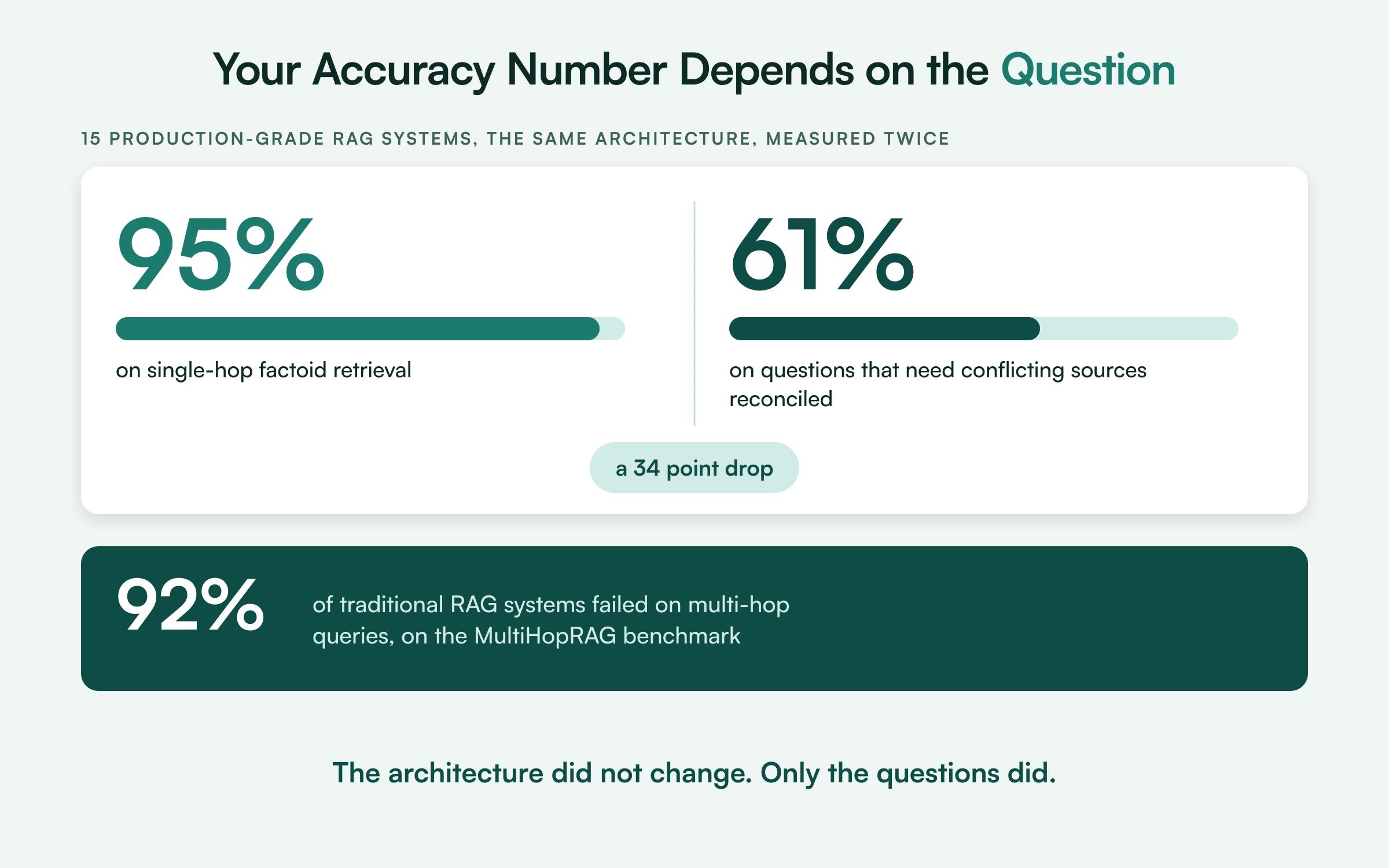
The measured failure rate is stark. On MultiHopRAG, a benchmark of questions each requiring two to four supporting documents, analysis found that around 92% of traditional RAG systems failed on multi-hop queries. A separate enterprise benchmark testing 15 production-grade RAG systems found that systems scoring 95% on single-hop factoid retrieval dropped to 61% accuracy on questions that required reconciling conflicting sources. The same study found hallucination rates roughly tripled on temporal questions, understanding what was true at a particular point in time, because retrieval pulls documents from different periods and the generator weaves them together as if they were contemporaneous.
These are not obscure questions. "Which supplier raised prices after the breach in that email thread" and "what was the stated strategy before the divestiture" are the backbone of real decisions, and single-shot retrieval crumbles under exactly that cognitive load. If you are still tuning chunk sizes and swapping embedding models while accuracy stays flat, the problem is usually not your embeddings. It is the architecture. Our guide to RAG architecture patterns covers where that ceiling sits and how to move past it.
How Agentic RAG Works: Multi-Step Retrieval in Practice
The core mechanic is a loop, not a line. Here is what actually happens when an agentic system handles a complex query.
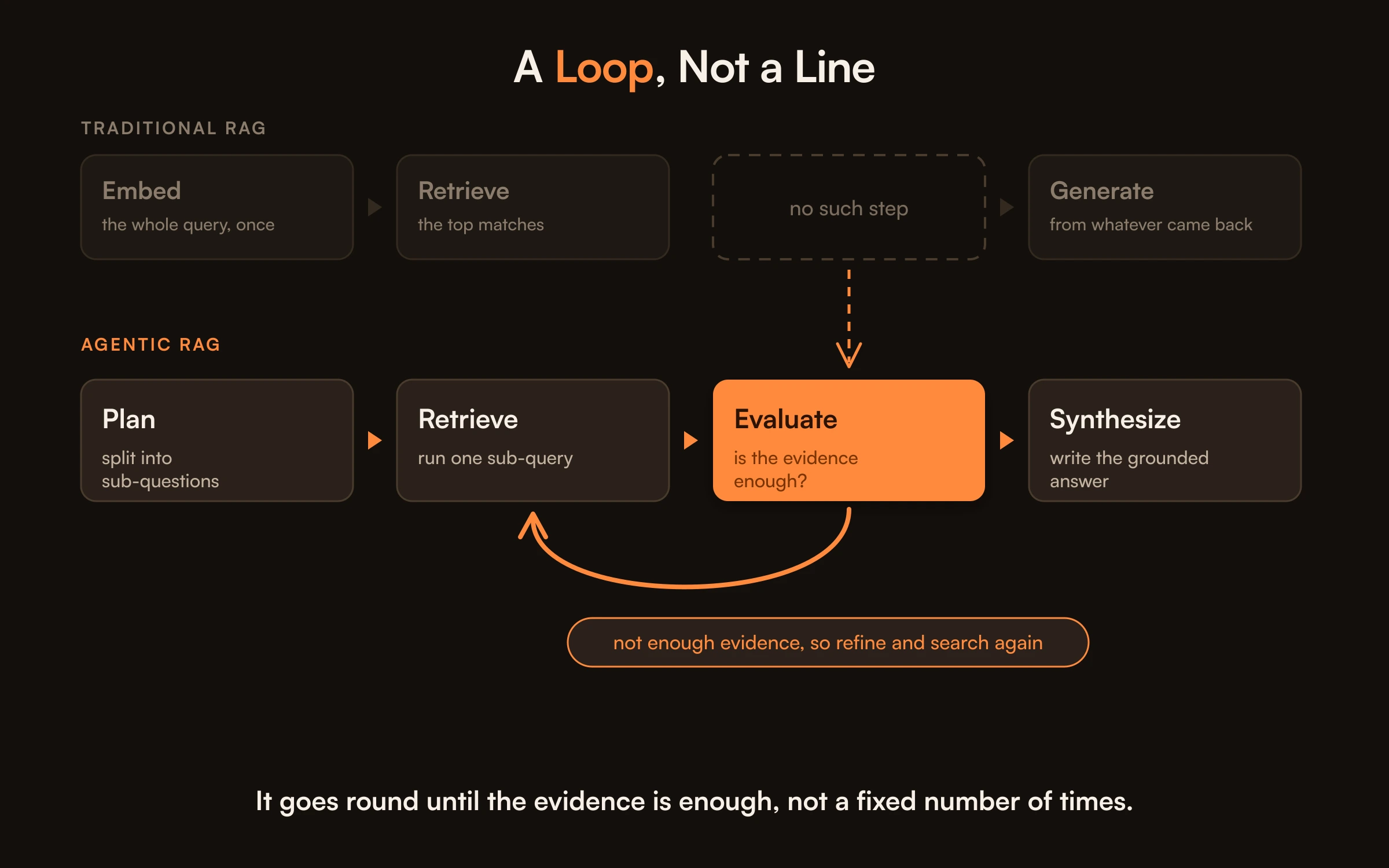
Plan: The agent reads the query and decomposes it into sub-questions. "Which enterprise customers churned after the price rise, and what did their exit interviews say" becomes three steps: find the price rise date, find enterprise churn after that date, retrieve the exit interviews for those accounts.
Retrieve: It runs the first sub-query against the right source. Agentic systems can route to different databases, tools, or indexes depending on what the step needs, rather than hitting one vector store for everything.
Evaluate: This is the step traditional RAG lacks entirely. The agent inspects what came back and asks whether it is sufficient. Did the retrieval actually answer the sub-question, or did it miss?
Re-retrieve or refine: If the evidence is thin, the agent reformulates the query and searches again, or switches sources. It can self-correct from a poor initial retrieval instead of generating from it.
Synthesize: Only once it has gathered enough evidence across steps does it write the final answer, combining facts from multiple retrievals into one grounded response.
Crucially, the agent also decides how much work a question needs. A simple fact question may take one hop. A complex comparison may take four. It stops when it has enough, rather than running a fixed number of steps every time. This adaptive depth is one of the defining differences between agentic RAG and traditional RAG, where the retrieval depth is fixed in advance regardless of question complexity. If you are choosing the components underneath this loop, our guide to RAG architecture patterns walks through the retrieval layer the agent sits on top of.
Agentic RAG vs Traditional RAG: The Numbers
The accuracy gains from multi-step retrieval are large and consistently measured, but they come at a real cost. Both sides of that trade matter. Here is how the two architectures compare on the dimensions that decide which to use:
| Dimension | Traditional RAG | Agentic RAG |
|---|---|---|
| Retrieval | Single pass, fixed | Multi-step loop, adaptive depth |
| Multi-hop reasoning | No | Yes |
| Self-correction | No | Yes, re-retrieves when evidence is thin |
| Source routing | One index | Routes across sources and tools |
| Cost per query | Baseline | Roughly 10x on complex queries |
| Latency | Low | Higher, seconds added |
| Best fit | Simple fact lookup | Complex, cross-document, high-stakes |
The accuracy improvements from independent benchmarks are substantial:
| Benchmark / study | Traditional RAG | Agentic RAG |
|---|---|---|
| DSPy, complex tasks (ReAct agents) | 24% accuracy | 51% accuracy |
| CMU financial-compliance, 9,000 questions | 14.1% hallucination | 4.9% hallucination |
| Controlled academic comparison | Baseline | +13.1% accuracy, +20.1% completeness |
Sources: DSPy / ReAct benchmark, Carnegie Mellon evaluation study, peer-reviewed comparison. The CMU study noted the accuracy jump added only about 220 milliseconds of latency and raised answer completeness by 27 points.
On cost, the trade is real and worth stating plainly. An agentic RAG pipeline doing the same job as a naive one can cost roughly 10 times as much per query and add several seconds of latency, because every extra retrieval and evaluation step is another set of model calls. Agentic RAG is a genuinely different cost class, and for a large share of simple queries it is overkill.
That is the honest summary: dramatically better on the hard questions, meaningfully more expensive on all of them. Which is exactly why the decision below matters.
When to Use Agentic RAG (and When Not To)
The single most expensive mistake teams make with agentic RAG is using it everywhere. The right default is the simplest architecture that meets your accuracy bar, and you add complexity only when the metrics prove the simpler approach is not enough.
Use agentic RAG when:
- Queries genuinely require combining evidence across multiple documents or sources, the multi-hop case
- Answers depend on reconciling conflicting or time-sensitive information
- The cost of a confidently wrong answer is high: compliance, finance, healthcare, legal
- Your questions vary widely in complexity, so fixed-depth retrieval is either too shallow for the hard ones or wasteful for the easy ones
Do not use agentic RAG when:
- Most queries are simple fact lookups that single-pass retrieval already answers well
- Latency and cost per query are tight constraints, for example a high-volume consumer chatbot
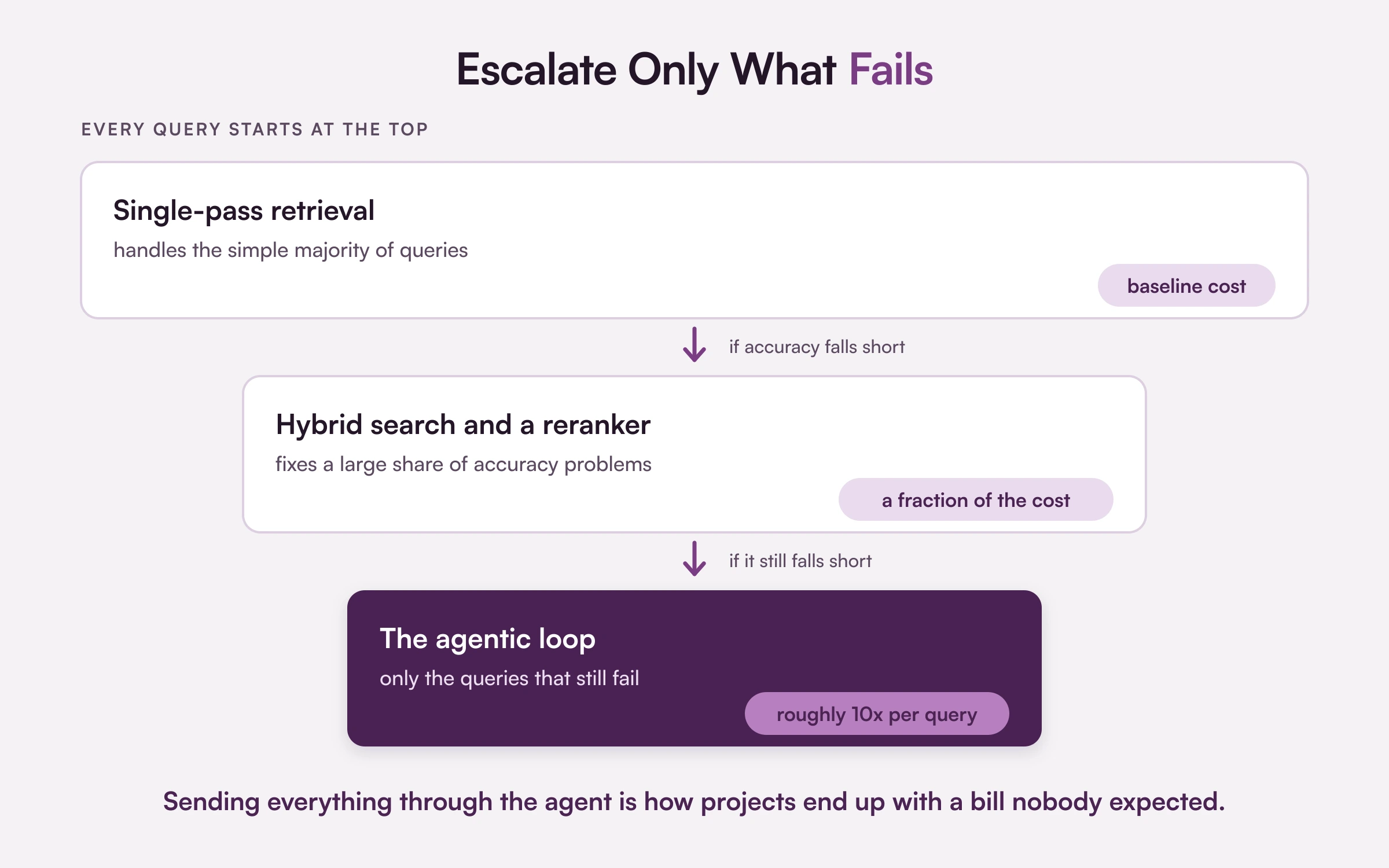
- You have not yet exhausted cheaper improvements. Hybrid retrieval and a reranker fix a large share of accuracy problems at a fraction of the cost and complexity
The practical path most teams should follow: start with a solid single-pass pipeline, add hybrid search and reranking if accuracy falls short, and reach for agentic retrieval only for the query types that still fail. Many production systems end up routing simple questions through the cheap path and only the genuinely complex ones through the agentic loop. This kind of architecture decision is central to how we approach AI agent development, because the goal is the right tool per query, not the most sophisticated tool for every query. For where multi-step retrieval pays off in practice, see our roundup of top RAG use cases delivering real business value.
The Real Failure Modes of Agentic RAG
Agentic RAG is not free of problems. The autonomy that makes it powerful also creates failure modes that are harder to detect than a simple bad retrieval, and any honest treatment has to name them.
The most important one is tool and routing error. When a benchmark tested 15 leading agentic RAG frameworks on 200 multi-step enterprise queries, 23% of wrong answers came not from bad generation but from the agent selecting the wrong tool or misinterpreting a tool's output. The agent made a reasonable-looking plan and executed the wrong step. This is why observability matters more here than in traditional RAG: when an answer is wrong, you need to see which hop introduced the error, which requires tracing every retrieval step, not just the final output. It connects directly to the discipline we cover in evaluating and monitoring production AI.
Teams that run agentic RAG safely add guardrails around the autonomy rather than trusting it blindly:
- Route high-stakes steps to deterministic services: Send calculations and compliance-critical lookups to verified functions instead of relying on the LLM's tool choice.
- Verify the plan before it runs: A cheap, fast classifier can sanity-check the agent's proposed steps and catch an illogical plan before any retrieval happens.
- Trace every hop: Log each retrieval step so a wrong answer can be traced to the exact point the error entered, rather than debugging a black box.
The autonomy is the value, but it has to be contained.
What Agentic RAG Costs to Build and Run
Two costs matter, and they are different from a traditional RAG build.
Runtime cost is the one covered above: multiple model calls per query mean roughly an order of magnitude more spend per complex query, plus added latency. The way teams control this is routing. Send the simple majority of queries through a cheap single-pass path and reserve the agentic loop for the queries that need it. Sending everything through the agent is how projects end up with a bill nobody expected.
Build cost is higher than traditional RAG because there is more to engineer: the planning and decomposition logic, the evaluation step that decides sufficiency, the routing across sources, and the tracing that makes the whole thing debuggable. A single-pass RAG system is a well-trodden build. An agentic system is closer to building an agent than a pipeline, which is why the surrounding engineering, evaluation, guardrails, observability, is most of the work rather than an afterthought. For how that scoping and pricing tends to shape up, our RAG development services page covers what a production build actually involves.
The Point Is the Right Retrieval, Not the Most Complex One
Agentic RAG is a genuine step change for the questions that matter most: the multi-hop, cross-document, high-stakes queries where traditional retrieval quietly fails and hands you a confident wrong answer. The measured gains in accuracy and hallucination reduction are real and large.
But it is not a default, and treating it as one is how teams end up paying ten times the cost to answer questions a single retrieval would have handled. The teams that get value from agentic RAG are the ones who match the architecture to the query: cheap retrieval for the simple majority, planned multi-step search for the genuinely hard questions, and the evaluation and observability to know which is which.
That matching, and the engineering discipline around it, is the actual work. If you are building a retrieval system and hitting the wall where single-pass RAG stops being enough, that is exactly the problem we solve across our RAG development and AI agent development engagements at Bitontree.

I am the founder and CEO of Bitontree, where I lead embedded AI engineering teams that build and run production AI: agents, RAG and knowledge systems, document AI, and workflow automation for healthcare, logistics, legal, and SaaS companies. I write about what it actually takes to ship AI that survives contact with production.
Frequently Asked Questions
What is agentic RAG in simple terms?

Agentic RAG is retrieval-augmented generation where an AI agent controls the search instead of following a fixed pipeline. Rather than retrieving once and answering, the agent plans what to look for, searches in steps, checks whether it found enough, and decides on its own whether to search again before answering. It works like a research analyst gathering evidence in stages, rather than a search engine returning one set of matches.
How is agentic RAG different from traditional RAG?
Traditional RAG runs a single fixed path; embed the query, retrieve the closest chunks, generate an answer. Agentic RAG runs a loop; plan, retrieve, evaluate sufficiency, re-retrieve if needed, then synthesize. Traditional RAG has fixed retrieval depth and no self-correction, so it fails on questions that need combining evidence across documents. Agentic RAG adapts its depth to the question and can recover from a poor first retrieval.
When should I use agentic RAG instead of traditional RAG?
Use agentic RAG when queries require combining evidence across multiple documents, reconciling conflicting or time-sensitive information, or when a wrong answer is costly, as in finance, healthcare, legal, or compliance. Stick with traditional RAG when most queries are simple fact lookups, when latency and cost are tight, or when you have not yet tried cheaper fixes like hybrid retrieval and reranking, which solve many accuracy problems at far lower cost.
Why does traditional RAG fail on multi-hop questions?
Because it retrieves once and cannot chain steps. A multi-hop question needs several pieces of evidence found and combined, but single-pass retrieval grabs the chunks nearest the query wording and generates from whatever it finds. On the MultiHopRAG benchmark, around 92% of traditional RAG systems failed on multi-hop queries, and enterprise systems scoring 95% on single-hop retrieval dropped to 61% on questions requiring cross-document reasoning.
Is agentic RAG more expensive than traditional RAG?
Yes. Because the agent makes multiple retrieval and evaluation passes, an agentic pipeline can cost roughly ten times as much per query as a naive one and adds latency. The standard way to control this is routing simple queries through a cheap single-pass path and sending only genuinely complex queries through the agentic loop, so you pay the higher cost only where it earns its keep.
What are the main failure modes of agentic RAG?
The most significant is tool and routing error; in one benchmark, 23% of wrong answers came from the agent selecting the wrong tool or misreading a tool's output rather than from bad generation. Because the agent acts autonomously across multiple steps, errors are also harder to trace. Running it safely means tracing every retrieval hop, verifying the agent's plan before execution, and routing high-stakes steps to deterministic services rather than trusting the LLM's choice.
Do I need agentic RAG, or is regular RAG enough?
Most teams should start with regular RAG and add hybrid retrieval and reranking first, since that fixes a large share of accuracy problems cheaply. Move to agentic RAG only for the query types that still fail, typically the multi-hop and cross-document questions. The right architecture is the simplest one that meets your accuracy bar, not the most sophisticated one available.
Related Blogs
Read more guides on RAG architecture, agent workflows, and production retrieval systems.


