Production AI Evaluation and Monitoring

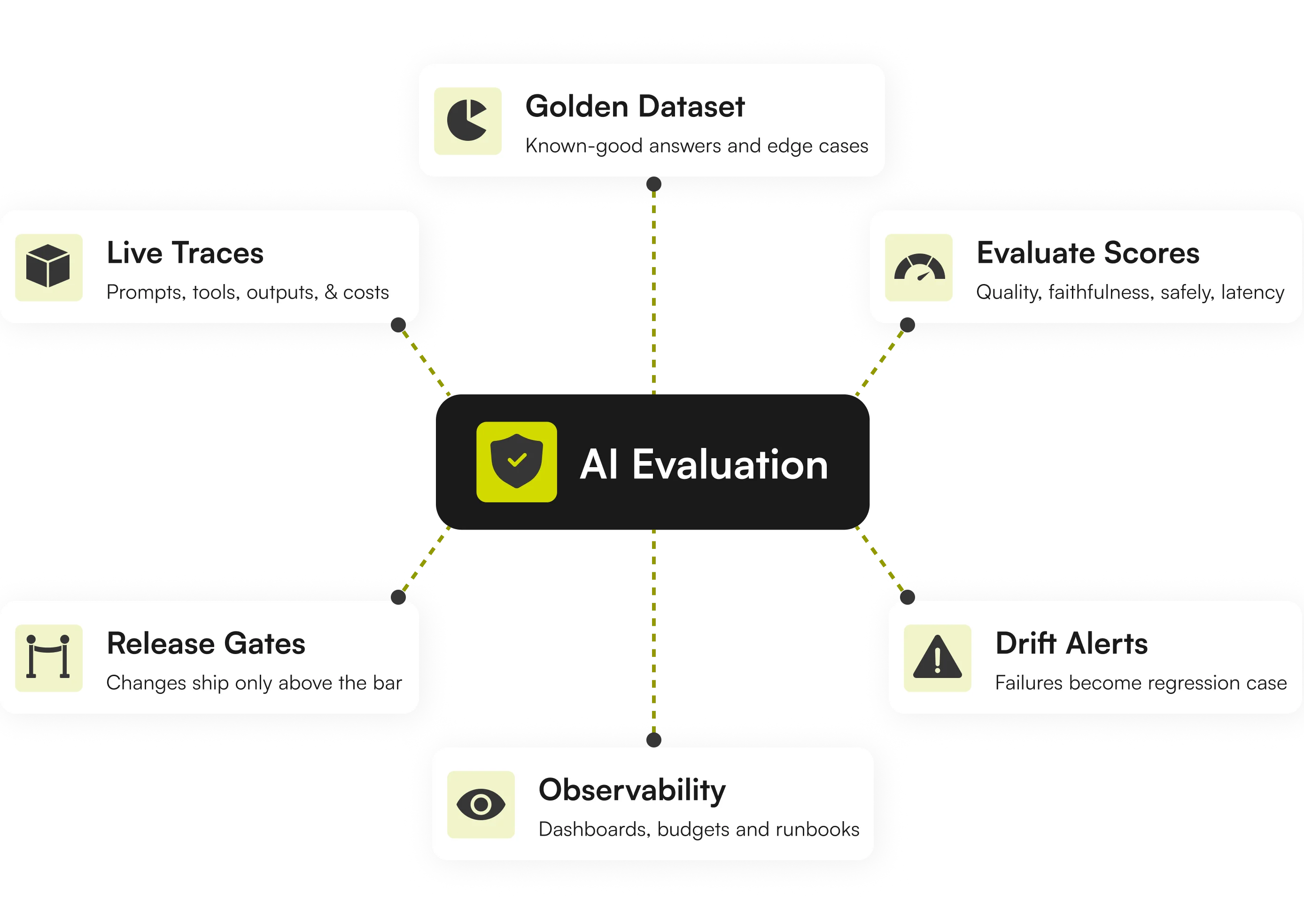
Production AI evaluation and monitoring workflow showing datasets, traces, eval scores, release gates, drift alerts, and observability

A demo that works once is not a production system. The same prompt can return a clean answer in the morning and a confident hallucination after lunch, because the model, the context, and the inputs all keep moving. Normal software is deterministic, so a green test suite locks in the behavior. AI and agent systems are probabilistic, so the worst failures show up after launch and stay invisible unless you measure quality directly. We build the evaluation harness that gates your launch like a CI check, plus the tracing, drift detection, and budget guardrails that keep the system trustworthy once real users arrive. Bitontree has built and operated production AI since 2019 from Ahmedabad with US-overlap hours, including a nightly medication-adherence voice system and SOAP-note automation, so we treat evals and monitoring as part of running the system, not a dashboard we hand over.

Evaluation and Monitoring Services We Provide

Evals and monitoring are the engineering layer that keeps a probabilistic system measurable after it ships. We match that layer to your system, from a single AI feature to a fleet of agents, and the pieces reinforce each other: traces feed the eval set, the eval set gates releases, monitoring catches what slips past, and human review feeds corrections back in.

Pre-launch evaluation harness icon

Pre-Launch Evaluation Harness

We build a golden dataset from your real traffic and known edge cases, then score it with metrics that fit the task: faithfulness for RAG, tool-call accuracy for agents, field-level scores for extraction. Reference-based, reference-free, and LLM-as-judge scoring combine into one number that gates the launch.

Tracing and observability icon

Tracing and Observability

Every run becomes a queryable trace, not a line in a log file. We capture the rendered prompt, retrieved chunks, each tool call, the model and version, token counts, latency, and the final output, built on OpenTelemetry conventions and shipped into LangSmith or Langfuse so you can open a bad run and see exactly where it broke.

Regression and drift detection icon

Regression and Drift Detection

Two things move after launch and we watch both. The eval suite re-runs on every prompt, model, or retrieval change so a regression blocks the release. For drift you do not cause, like a provider silently updating a model, we sample live traffic and monitor input and output distributions, then alert with example traces.

Budgets, loop detection, and alerts icon

Budgets, Loop Detection, and Alerts

Agents need hard ceilings because a probabilistic planner can decide to keep going. We enforce per-task budgets on tokens, tool calls, wall-clock time, and steps, add loop detection for repeated states and re-planning cycles, and alert on cost, latency, error rate, and eval-score drops before anyone reads the bill.

Quality and safety scorecards icon

Quality and Safety Scorecards

A scorecard turns fuzzy impressions into a trend line stakeholders can act on. We track quality metrics like faithfulness and task completion, operational metrics like cost per request and p95 latency, and safety signals like refusal rate and flagged content, sliced by model version, prompt version, segment, and time.

Human-in-the-loop review icon

Human-in-the-Loop Review

Automated scores are fast but imperfect, so we keep a person on a sample of real traffic. Review queues surface low-confidence runs, judge-flagged outputs, and a random sample, and reviewers grade against the same rubric to calibrate the LLM judge. Every correction becomes a new labeled case in the golden dataset.

Why AI Systems Need Evals and Monitoring

Standard software is deterministic, so a passing test suite locks in the behavior. LLM and agent systems are probabilistic and sit on dependencies you do not control, so the failures that matter most show up after launch and stay invisible unless you measure quality directly.

Silent quality drift icon

Silent Quality Drift

A reworded prompt, a model version bump, or a changed retrieval index can quietly degrade answers without throwing a single error. The text stays well-formed, just less accurate or less grounded, and quality erodes a few percent at a time until someone notices. Evals on a fixed test set turn that invisible slide into a number you can watch.

Runaway cost and loops icon

Runaway Cost and Loops

An agent can get stuck retrying a failing tool or re-planning the same step, and each loop is a paid API call plus latency. One session can run for hours unattended. Without token and action budgets the first signal is the invoice rather than an alert, so hard ceilings and loop detection make a stuck run fail cleanly instead.

Opaque failures icon

Opaque Failures

A multi-step agent incident with no trace is a guessing game, because you cannot reproduce a non-deterministic bug by hand. You need to replay the run: input, rendered prompt, retrieved chunks, tool calls, and output. OpenTelemetry-based tracing into LangSmith or Langfuse gives a per-run timeline, so debugging becomes reading the record.

Regression risk icon

Regression Risk on Every Change

Every prompt edit, model swap, or retrieval tweak can fix one case and quietly break three others, and you will not see it without scoring. The eval suite re-runs the golden dataset on each change and compares to the last passing baseline, so a drop below the bar fails the build before users ever reach it.

Provider drift icon

Provider Drift You Did Not Cause

A hosted model can change underneath you with no notice, and the input mix shifts as real users do unexpected things. Both move quality without any code change on your side. Sampling live traffic and watching distributions, like embedding shifts, output length, and refusal rate, catches the bend in the curve weeks before a customer does.

Hallucinations and tool-call errors icon

Hallucinations and Tool-Call Errors

A RAG system can answer fluently from nothing, and an agent can call the wrong tool with valid-looking arguments. These are different failures with different fixes. Faithfulness scoring ties each claim back to a retrieved chunk, while tool-call checks confirm the right tool, valid arguments, and that the result was actually used.

How evals and monitoring keep AI measurable

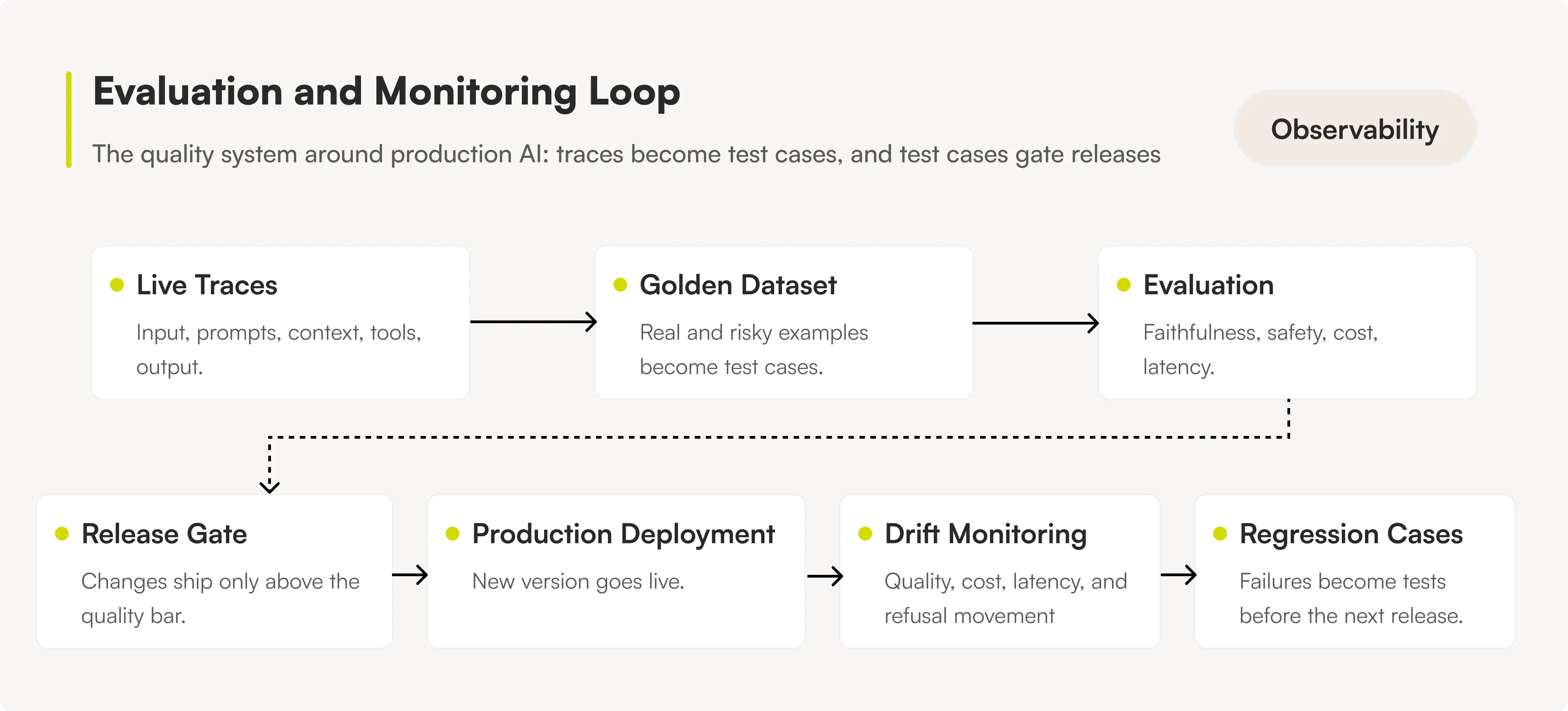
Production AI improves when traces become examples, examples become scored evals, and evals become gates before release. This is the closed loop we build around the system.

Diagram showing the production AI evaluation and monitoring loop with golden dataset, scorers, release gate, live traces, drift alerts, and regression cases.

Why Choose Bitontree for Evals and Monitoring?

We have built and run production AI since 2019 from Ahmedabad with US-overlap delivery hours, including a nightly medication-adherence voice system and SOAP-note automation, both of which depend on tracing, quality checks, and guardrails. The operating model is what sets the work apart: we embed senior engineers, set the quality bar, gate the launch behind it, and stay on to run it rather than handing over a dashboard and walking away.

We Stay On to Operate It

A dashboard at go-live is not the project. Evals and monitoring earn their keep over months, as the eval set grows and the judge stays calibrated. We run the system we instrument, watch the alerts, and keep quality compounding instead of decaying after the first week.

We Build the Loop, Not Just a Score

A single accuracy number is easy and nearly useless. We wire traces into the eval set, the eval set into CI, and human review back into the golden dataset, so each incident becomes a regression test. The value is the closed loop, where yesterday's failure cannot ship again silently.

Tooling-Agnostic by Design

We build on OpenTelemetry conventions and trace into LangSmith or Langfuse, chosen by your stack and constraints rather than a vendor preference. Portable traces matter more than any single dashboard, and we run them alongside your existing metrics and alerting instead of replacing what already works.

Real Production Track Record

Our engineers have shipped AI into environments where a wrong answer has consequences, including a nightly voice system that calls patients about medication and automation that drafts clinical SOAP notes. That experience shows in the unglamorous parts: golden sets, judge calibration, drift alerts, and budget ceilings.

Honest About the Judge

LLM-as-judge scales evaluation, but it has real biases: position, verbosity, and self-preference. We never trust raw judge scores. Position-swap runs, calibrated rubrics, and human spot-checks keep it honest, and when people and the judge disagree we fix the rubric rather than the humans.

Industries We Build Evals and Monitoring For

industy

Healthcare

We run AI in healthcare today, including a nightly medication-adherence voice system and SOAP-note automation. Evals here check faithfulness and safety on every change, traces stay HIPAA-aware with PII handling in mind, and self-hosted observability keeps sensitive data on infrastructure you control.

Ecommerce industry icon

E-commerce

Search, recommendation, and support AI shift quality with the catalog and the season, so a frozen test set goes stale fast. Online evaluation on sampled traffic and drift alerts catch a model that quietly stops grounding answers in current inventory before it shows up in conversion numbers.

Logistics industry icon

Logistics

Document extraction and exception triage run at high volume, where a few points of field-level accuracy drift turns into thousands of bad records. Field-level eval scores and trace replay on flagged cases keep extraction measurable, and budgets stop a stuck agent from billing through the night.

SaaS and Product Companies icon

SaaS Product Companies

AI features ship on your release cadence, so the eval suite belongs in CI next to your unit tests. We embed with your engineering org, adopt your stack, and gate every prompt and model change behind a scoring run, so a regression fails the build instead of reaching customers.

Manufacturing

Finance and Operations

When AI touches reconciliation, reporting, or anything auditable, you need to answer what the system did and why. Per-run traces, quality and safety scorecards, and SOC 2-aware logging give you that record, while budgets and loop detection keep an automated job from running away unattended.

Real Estate industry icon

Professional Services

Drafting and research assistants are judged on whether the output holds up, not just whether it reads well. Faithfulness scoring and human review on a sample keep answers anchored to approved sources, and every correction becomes a labeled case so the eval set tracks your firm's real work.

Shipping an AI Feature or Agent Soon?

Start with a production review. We assess your system against the evaluation and monitoring architecture (golden sets, CI-gated evals, tracing, drift detection, budgets, alerts, and human review) and hand you a prioritized plan to close the gaps before launch. The review stands alone: you walk away with a clear path either way.

Our Evals and Monitoring Setup Process

A staged path from an unmeasured AI feature to a system that tells you when it is wrong. Each step makes the next cheaper, and you can stop after any of them. We embed senior engineers to instrument the system and stay on to operate it, rather than handing over a dashboard at go-live.

01

Define What Good Looks Like

We make quality measurable first, because you cannot monitor what you have not defined. We pick metrics that map to user value, faithfulness for RAG, tool-call accuracy for agents, field-level accuracy for extraction, plus latency and cost, and mine your logs for a versioned golden dataset that becomes the contract.

Quality metric map

Golden dataset mining

Task-specific rubrics

Baseline thresholds

Launch criteria

02

Build the Eval Harness

Next we make the bar enforceable. A scoring harness runs the golden dataset on every change with reference-based, reference-free, and LLM-as-judge scoring, kept honest by position-swap checks and human spot-checks. It runs in CI, so any change that drops below the last passing baseline fails the build.

Reference-based scoring

LLM-as-judge calibration

Human spot-checking

CI evaluation gate

Baseline comparison

03

Instrument and Monitor

With the bar set, we make the running system observable and safe. We instrument every run with OpenTelemetry-based tracing into LangSmith or Langfuse, sample live traffic for online evaluation, and add drift monitoring, per-task budgets with loop detection, and on-call alerts so the system flags itself.

OpenTelemetry traces

LangSmith or Langfuse setup

Live traffic sampling

Drift monitors

Budget and loop alerts

04

Gate the Launch

Launches stop being a leap of faith and become a gate you can see. Releases are blocked unless they hold the bar, and for bigger model swaps we add a canary or shadow rollout: route a slice of traffic to the new version, score it online, and promote only once it clears the threshold.

Release thresholds

Canary rollout

Shadow traffic checks

Online scoring

Promotion criteria

05

Review and Improve

We close the loop and keep it closed. Human review queues cover low-confidence, judge-flagged, and randomly sampled runs, and every correction becomes a new case in the golden dataset. That feedback also recalibrates the LLM judge where it disagrees with people, so the eval set converges on production.

Low-confidence queues

Judge-flagged reviews

Random sample audits

Correction capture

Golden set updates

06

Operate and Tune

The work does not end at launch. We tune budgets and alert thresholds as traffic shifts, expand the eval suite as new failure modes surface, re-baseline when a model is intentionally swapped, and keep watch so quality compounds over weeks instead of quietly decaying.

Alert threshold tuning

Eval suite expansion

Model re-baselining

Cost and latency reviews

Ongoing quality reporting

Business Benefits of Evals and Monitoring

Ship AI Changes Without Holding Your Breath

A CI-gated eval suite turns a hopeful deploy into a measured decision. Any prompt, model, or retrieval change is scored against the golden dataset, and a drop below baseline fails the build, so teams can iterate quickly knowing a regression is caught before users see it.

Quality That Compounds Instead of Decaying

Because every human correction becomes a new labeled case, the eval set keeps converging on your live distribution. Yesterday's incident turns into a regression test, and the same failure cannot ship twice, so the system gets more trustworthy over weeks rather than drifting.

Cost You Can See Before the Invoice

Per-task token and action budgets with loop detection stop a runaway session in its tracks, and alerts on cost per request flag an upward trend while it is still small. The system bounds itself, so an agent stuck in a loop fails cleanly instead of billing all night.

Incidents You Can Actually Debug

Per-run traces mean a bad output is a record you can open, not a non-deterministic bug you try to reproduce. You see the rendered prompt, retrieved chunks, every tool call, and the model version, so you can tell whether retrieval, a tool, or the model broke, and fix the right thing.

A Shared Answer to Did This Change Help

Scorecards sliced by model version, prompt version, and segment give non-engineers a straight answer on whether a change made the system better or worse. Fuzzy impressions become a trend line stakeholders can act on, which ends the argument about whether the new prompt is actually an improvement.

Evidence for Your Compliance Story

Per-call logs, safety scorecards, and quality records gather the evidence that helps you meet HIPAA-aware and SOC 2-aware obligations. Self-hostable observability through Langfuse keeps sensitive traces on infrastructure you control, so visibility does not come at the cost of data residency.

An evaluated system vs ship and hope

Shipping AI without evals feels faster until the first silent regression. A measured system costs a little upfront and turns quality into something you can see, gate, and defend.

Ship and hopeEvaluated with Bitontree
Catching a regressionA user reports it weeks laterA failed CI gate before launch
Debugging a bad runGuesswork from raw logsReplay the full per-run trace
Runaway agent costThe invoice is the alertBudgets cap it, alerts catch it
Drift from a provider updateFound by accident, if at allDrift alert with example traces
Did this change help?Opinions, not evidenceA scored answer per version

Want your AI system observable and measurable?

Talk to our engineers about the AI feature or agent you are shipping. You will get a straight answer on where the eval and monitoring gaps are, which metrics actually map to your users, and what it takes to gate the launch and operate it once it is live.

Production AI systems we already run

Bitontree built these systems and runs them in production today: agent pipelines that process invoices, nightly voice calls to patients, and automated lead handling for real clients.

Smart AI Invoice Processing System
LogisticsSingapore: Singapore

Smart AI Invoice Processing System

AI-powered invoice processing for a Singapore-based logistics enterprise. OCR and ML automate data extraction, validate against business rules, and process invoices end-to-end across multiple formats and currencies.

PythonLangGraphCrewaiStreamlitAzure
AI-Powered Medication Calling System
HealthcareUSA:USA

AI Voice Calling for Medication Adherence

AI voice reminder system for hospitals - automating patient calls, tracking medication adherence, and enabling smart follow-ups.

N8NReact jsPythonVapiTwilioGPT
Sales AI workflow Automation Tool
ManufacturingUSA:USA

B2B Lead Qualification Chatbot

Conversational lead qualification chatbot with BANT-framework questions, real-time scoring, and HubSpot integration for automatic routing.

N8NReact jsPythonSalesforceZapmail

Related Services and Work

Frequently Asked Questions

What is AI evaluation, and why can't we just test it like normal software?

AI evaluation scores the quality of a probabilistic system across many representative cases instead of returning a binary pass or fail on fixed logic. Unit tests assume the same input always produces the same output, so a green suite proves the behavior is locked in. LLM and agent systems break that assumption: the same prompt can return different text on different runs, and the model, prompt, and retrieved context all shift underneath you. So evaluation grades quality across a whole set of cases, often as a percentage or average, and re-runs that set whenever a prompt or model changes. You set a threshold the way you set code coverage, and a change that drops below it counts as a regression. It is closer to statistical quality control than to assertion-based testing.

What should we actually measure for agents versus RAG versus chatbots?

Measure task-specific metrics, because a single accuracy number hides the failures that matter for each system type. For RAG, track faithfulness and groundedness (is the answer supported by retrieved context?), context precision and recall, and answer relevance. For agents, track tool-call accuracy (right tool, right arguments), task completion, step efficiency, and budget adherence. For chatbots, track helpfulness, tone and instruction-following, refusal correctness, and safety. All three share latency, cost per request, and error rate. The point is to grade the thing that actually breaks: a RAG system that retrieves badly and a chatbot that ignores instructions fail in different ways, and one combined score would let both slip through.

Is LLM-as-judge reliable, and how do you keep it honest?

LLM-as-judge is reliable enough to scale evaluation, but only if you actively control its known biases, so we never trust raw judge scores alone. A model scoring other model outputs has documented failure modes: position bias, where it favors whichever answer is shown first; verbosity bias, where it rewards longer answers; and self-preference, where it rates its own model family higher. We counter these with calibrated rubrics, position-swap runs that score answers in both orders, and a structured rationale before the score. Then we anchor the judge with human spot-checks, where reviewers grade the same sampled cases and we measure agreement. When they diverge, we fix the rubric, not the humans. The judge handles volume while people keep it calibrated, which is far cheaper than labeling everything by hand.

How do you build a golden dataset or eval set from real traffic?

Start from production logs, not invented examples, so the eval set reflects what users actually do rather than what you imagined they would. Mine traces for representative cases across your real input distribution, then deliberately add the hard ones: ambiguous queries, adversarial or jailbreak attempts, edge cases, and past incidents. Give each case a reference answer or a graded rubric so it scores automatically, and version the dataset like code to track coverage and compare scores across versions. The set is never finished: every correction from human review becomes a new labeled case, so it keeps converging on your live distribution. A few hundred well-chosen cases that mirror production beat thousands of synthetic ones.

What is the difference between offline and online evaluation?

Offline evaluation runs your fixed golden dataset before you ship, online evaluation scores real traffic after you ship, and a production system needs both. Offline is the CI gate: repeatable, runs on every prompt or model change, and tells you a change is safe against a known baseline. Its blind spot is that the test set is frozen, so it misses new user behavior or a silent provider update. Online samples live requests and scores them with the same metrics, often an LLM judge plus human review on a slice. It catches drift, surfaces inputs you never anticipated, and shows real cost and latency under load. Offline tells you a change passed your bar; online tells you the live system still meets it. Cases that online eval flags get added back into the offline set.

How do you detect drift and regressions when prompts or models change?

Treat regressions and drift as two separate problems, because they have different causes and detection methods. Regressions come from changes you make, like a reworded prompt, a model upgrade, or a retrieval tweak. We re-run the eval suite in CI on every change and compare to the last passing baseline, so a drop blocks the release before it reaches users. Drift comes from changes you do not make, like a provider quietly shipping a new model or the input mix shifting. We sample live traffic, score it offline with the same metrics, and monitor distributions: embedding-space shifts, output length, refusal rate, and tool-use patterns. When a metric crosses a threshold, the alert links to example traces so you can diagnose it. One is a gate at deploy time; the other is a watch on the running system.

How do you catch hallucinations and tool-call errors?

Catch hallucinations with grounding checks and tool-call errors by validating calls against their schemas and results, since these are different failures with different fixes. For hallucinations in RAG, score faithfulness so each claim traces back to a retrieved chunk: reference-based comparison where a known answer exists, an LLM judge with a strict rubric where it does not, and flagging facts the context never supported. For tool-call errors in agents, trace every call and check that the right tool was chosen, the arguments match the schema, and the result was used in the next step rather than ignored. Loop detection catches an agent that keeps retrying a failing tool. Both signals feed the scorecard and the review queue, so flagged cases get human eyes and then become regression cases in the golden dataset.

Which tools do you use for AI observability, and why?

We are tooling-agnostic and choose based on your stack, but in practice we build on OpenTelemetry conventions and trace into LangSmith or Langfuse, because portable traces matter more than any single vendor. OpenTelemetry semantic conventions keep spans in a standard format, so you are not locked in. LangSmith is strong for LLM tracing and eval workflows in the LangChain ecosystem. Langfuse fits when you want open-source and self-hosting, which helps with data residency or HIPAA-aware handling. We run these alongside your existing metrics, logging, and alerting rather than replacing them. The non-negotiables are queryable traces of every run, an eval set wired into CI, and online sampling in production. The dashboard matters less than having those three work together, so we fit the tools to your constraints.

We already shipped an AI feature without evals. Can you retrofit them?

Yes, retrofitting evals onto a live system is one of the most common ways we start, and the existing traffic actually makes it faster. Real production logs mean we build the golden dataset from cases that actually happened. We add tracing and scoring around your existing pipeline without rewriting the application, establish a baseline so you finally know your current quality, then turn on drift detection and budget guardrails so it stops degrading silently. The usual first finding is a quality or cost problem nobody had measured, which is exactly the value of doing it. From there the system behaves like one that had evals from day one. You do not have to rebuild to make a shipped system measurable.

How do budgets and loop detection stop runaway agent cost?

Budgets cap how much an agent can spend on a task and loop detection stops it spinning in place, so a misbehaving run fails cleanly instead of billing all night. We set per-task ceilings on tokens, tool calls, wall-clock time, and total steps, enforced in the runtime. When a session hits a limit it stops, returns a clear failure, and gets logged, rather than calling paid APIs in the background. Loop detection watches for repeated states, the same tool called with the same arguments, and re-planning cycles, then breaks out. Alerts on cost per request and total spend catch an upward trend while it is still small. The principle is that the system should bound itself before anyone has to read the invoice.

Can you gate our launches behind passing evals like a CI check?

Yes, gating launches behind evals is the core of how we make AI releases safe, and it works just like a test gate in your existing CI. Any change to a prompt, model, or retrieval step triggers a scoring run against the versioned golden dataset. Results are compared to the last passing baseline, and a drop below your threshold fails the build, the same way a failing unit test blocks a merge. For bigger model swaps we add a canary or shadow rollout: route a slice of traffic to the new version, score it with online eval, and promote only if it holds the bar. This turns shipping AI from a hopeful deploy into a measured decision, and it gives non-engineers a clear answer to whether a change made the system better or worse before users see it.

Why Bitontree for production AI evaluation and monitoring?

We are an AI engineering company that embeds senior engineers into your team to build and then operate production AI, so we run the evals and monitoring we set up rather than handing you a dashboard and walking away. Founded in 2019, based in Ahmedabad with US-overlap delivery hours, we work as part of your team across time zones. We have built and operate real systems with this discipline, including a nightly medication-adherence voice system and SOAP-note automation, both of which depend on tracing, quality checks, and guardrails. For sensitive data we apply HIPAA-aware and SOC 2-aware controls that help you meet your obligations. The differentiator is that we stay to operate it, so the eval set keeps growing and quality compounds instead of decaying.

Make your AI system observable and measurable

Connect with our team to build the evals and monitoring that keep production AI trustworthy.

Years of experience

6+

Years Of Experience

Skilled Professionals

40+

Skilled Professionals

Projects Delivered

105+

Projects Delivered

Global Clientele served

35+

Global Clientele Served

Tell us about your AI system, and we'll show you what to measure.