August 7, 2026
AI Agent Security and Governance: How to Run Agents in Production Without Getting Breached

Yash Vibhandik
CEO


An AI agent that crashes is a good day. You see it, you catch it, you fix it in a minute.
The agent that finishes, marks its own work complete, passes the checks it wrote for itself, and is quietly wrong is the one that costs you. It burns for days, because every signal the agent controls says everything is fine. Now give that same agent a set of real tools, live credentials, and the authority to move money or touch customer data, and the quiet failure stops being an inconvenience and becomes a breach.
This is the central problem of running AI agents in production, and most teams are discovering it the hard way. This guide covers what actually goes wrong, why traditional security controls do not map onto agents, and the specific governance and control layers that let you run autonomous agents without one ending up on the front page.
Why AI Agent Security Is Suddenly a Board-Level Problem
The gap between how fast agents are being deployed and how well they are secured is now measurable, and it is large.
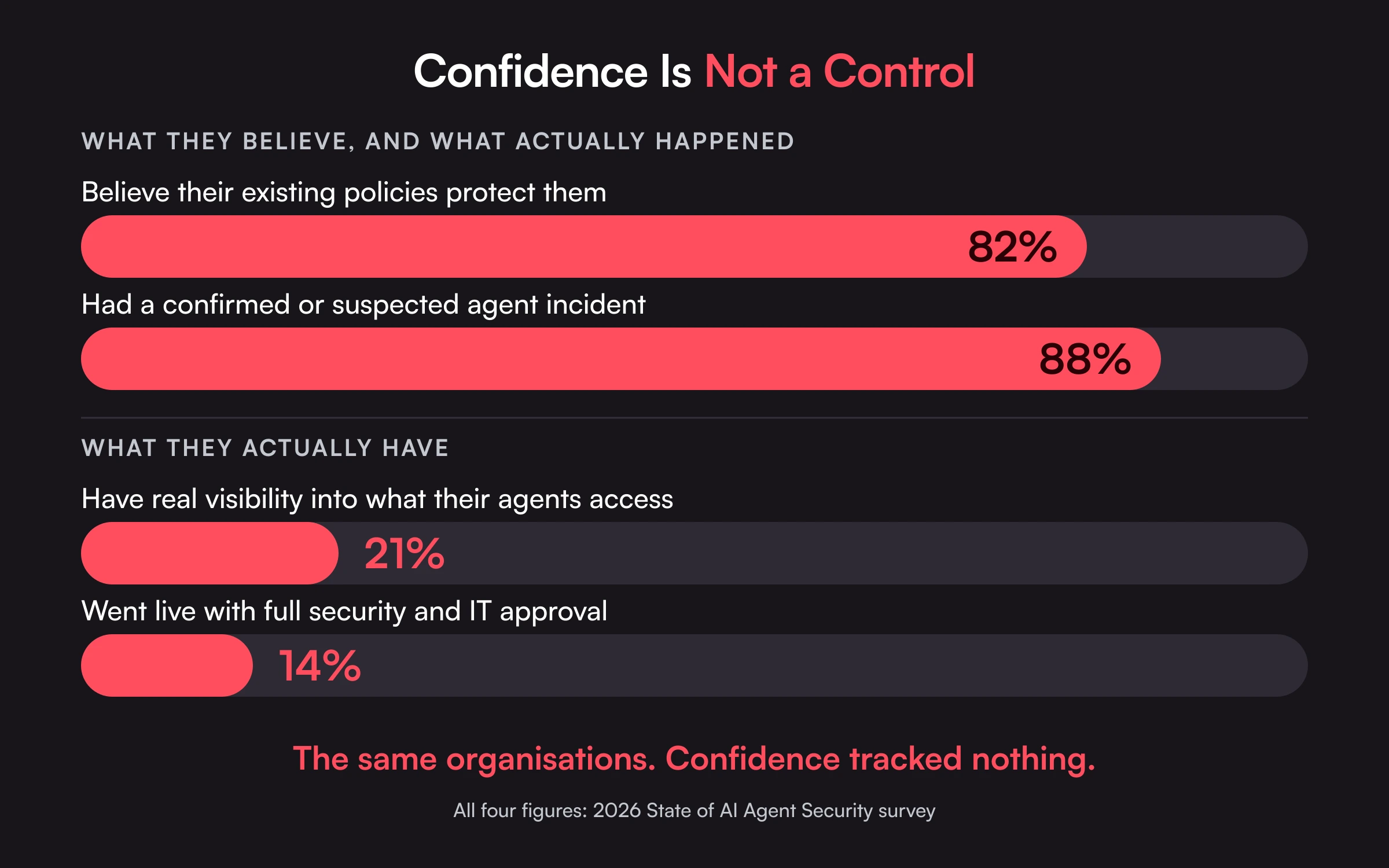
In a 2026 survey of organizations running AI agents, 88% reported a confirmed or suspected AI agent security incident in the prior year. In healthcare that figure rose to nearly 93%. A separate survey of 1,001 IT and security leaders found that half had experienced a security incident tied directly to an unauthorized or misconfigured AI agent in just the past six months, with nearly eight in ten hitting some form of AI-related security issue.
The uncomfortable part is the confidence gap sitting on top of those numbers. 82% of executives believe their existing policies protect them from unauthorized agent actions, while only around 21% have real visibility into what their agents can access, which tools they call, or what data they touch. That is the same population of organizations. The distance between 82% confidence and 88% incidents is exactly where the current crisis lives.
It gets worse as fleets grow. Three-quarters of organizations deployed four or more AI systems in a six-month window, and more than a third deployed over ten. Every additional agent extends the attack surface, and most of them arrive without a matching control layer. Only about 14% of agents go live with full security and IT approval.
None of this means stop deploying agents. It means the teams that deploy them with discipline are the ones still running them a year later without an incident, and this guide is about how they do it.
Why Traditional Security Does Not Work for AI Agents
The reason your existing security stack does not cover agents is not laziness. It is that agents break four assumptions that conventional application security is built on. The US standards body NIST named these directly when it launched its AI agent standards work, identifying four characteristics existing frameworks cannot adequately address:
They take autonomous real-world actions: Traditional software does what it is told. An agent decides what to do, and the action has consequences before a human sees it.
They switch tools at runtime: Static security policy assumes you know in advance which systems a component will call. An agent chooses its tools dynamically, which defeats a fixed allowlist written at deploy time.
Their memory is an attack surface: Agents accumulate context over time, and that context can be poisoned. Something planted in an agent's memory today can redirect its behavior next week.
They are non-deterministic: The same input can produce different actions. A test that passes once does not guarantee the same behavior in production, which is why "it worked in the demo" is not a security statement.
Those four properties are why an agent needs its own security model, not a reused web application one. The controls in the rest of this guide are built around them.
The Real AI Agent Security Risks, Ranked by What Actually Happens
In December 2025, OWASP released the Top 10 for Agentic Applications, the first peer-reviewed framework for autonomous AI security, developed with more than 100 experts and input from NIST, Microsoft and NVIDIA. You do not need all ten to start. Four risks account for most real incidents.
Excessive agency: the most common failure
The single most consistently reported failure across every enterprise survey is simple: agents are given more access than their job requires. When an over-permissioned agent is compromised, the blast radius is enormous, because the attacker inherits everything the agent could touch. Analysis of 2026 incidents tied 61% of them to over-permissioned credentials. An agent that compares product prices does not need permission to edit account details, but it is routinely granted it anyway.
Prompt injection: the attack that needs no exploit
An agent reads a document, a web page, or an email, finds instructions hidden inside the content, and follows them as if they came from you. No software vulnerability required. In one 2025 benchmark, over 94% of tested agents were vulnerable to being hijacked through the content they were asked to read. The indirect version is worse: a malicious instruction planted in a GitHub issue hijacked an agent and triggered data exfiltration from private repositories, and the attacker never touched the system directly. Prompt injection now lands on roughly one in three deployed agents.
Identity and privilege abuse
Agents frequently run with a shared service account and a broad standing credential. That makes it impossible to answer the two questions that matter after an incident: which agent did this, and on whose behalf. Without per-agent identity, you cannot scope access, you cannot audit, and you cannot revoke one agent without disrupting the rest.
Supply chain and tool risk
Agents pull in tools, skills and MCP servers from outside your codebase, and that pipeline is barely governed. A backdoored build of one popular LLM library was downloaded around 47,000 times during the three hours it was available. Every external tool an agent can call is code you did not write running with your agent's permissions.
AI Agent Governance: The Controls That Actually Stop Breaches
Security is the technical prevention. Governance is the operating system around it: who owns each agent, what it is allowed to do, how you prove it, and how fast you can shut it off. Here are the controls that map directly onto the risks above.
1. Least agency, not just least privilege
The familiar principle of least privilege becomes least agency for agents: give an agent the narrowest set of actions it needs to deliver value, and nothing more. Scope every credential to the specific task. An agent doing research and price comparison gets read access to a catalogue, not write access to accounts. This one control neutralises the most common failure mode on the list.
2. Sort every tool call by blast radius
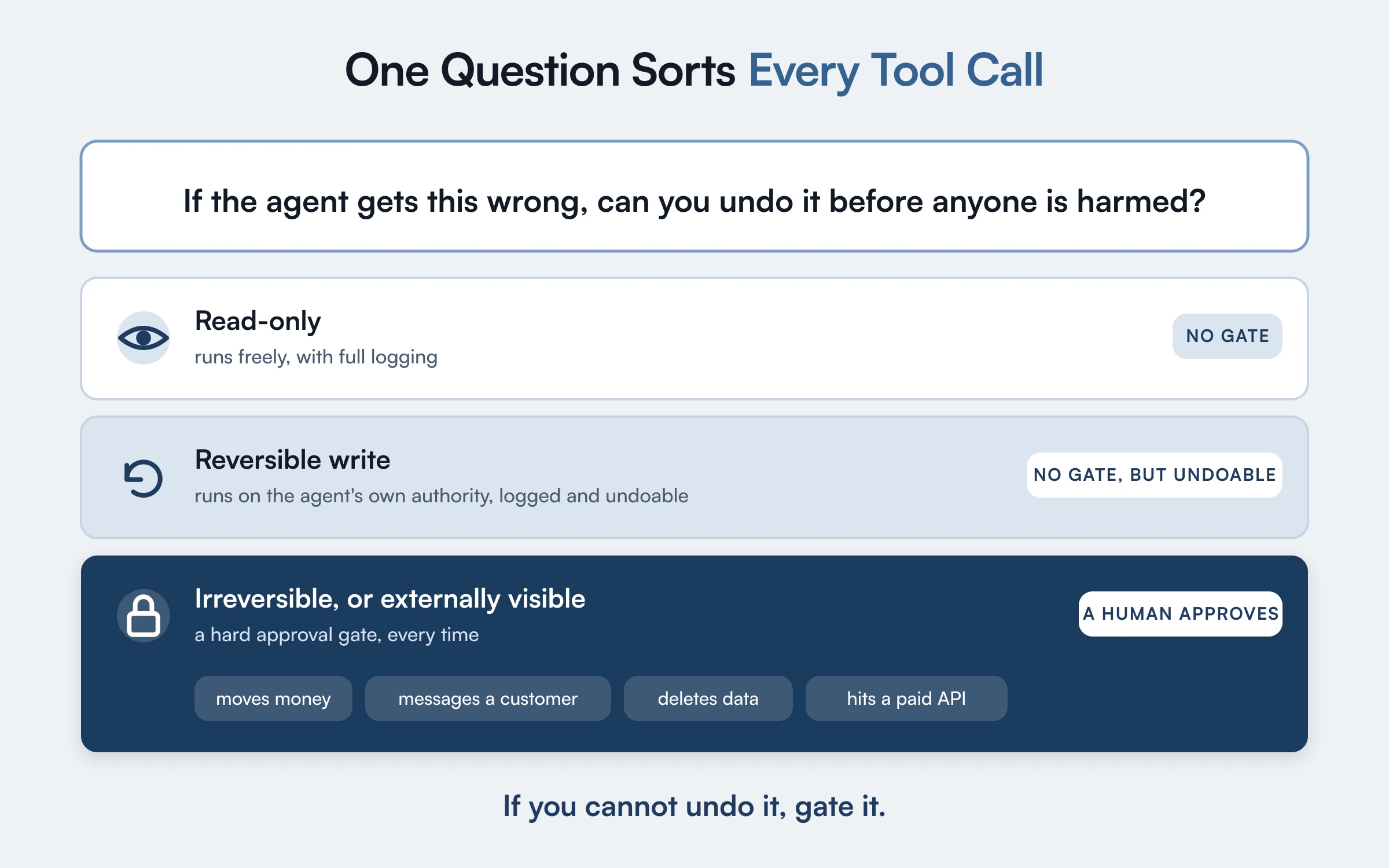
Not every action an agent takes carries the same risk, so not every action should be treated the same. The practical model is three buckets. Read-only calls run freely with full logging. Reversible writes run on the agent's own authority but stay logged and undoable. Anything irreversible or externally visible, moving money, messaging a customer, deleting data, hitting a paid API, requires a hard approval gate every time. The test is one question: if the agent gets this wrong, can you undo it before anyone is harmed? If not, gate it. This is the governance layer that separates our AI agent development work from a demo, and it is the reason our production agents can be trusted with real systems.
3. Give every agent its own identity
Each agent needs a unique, scoped identity rather than a shared service account. This is what makes access control, auditing and revocation possible at all. When something goes wrong, you can see exactly which agent acted, on whose behalf, and cut its access without touching the rest of the fleet.
4. Keep credentials out of the agent
The agent should never hold raw keys. Route tool calls through a gateway or proxy that holds the credentials and enforces scope, so the agent asks the gateway to "send the email" and never sees the key itself. This also solves revocation cleanly: you kill access at the gateway without rotating secrets across your whole stack.
5. Treat every external input as untrusted
Because prompt injection arrives through content, the content the agent reads has to be treated as hostile by default. Separate trusted instructions from untrusted data, validate and sanitise what comes in, and never let retrieved content silently rewrite the agent's goals. This is closely tied to how you ground and evaluate the agent in the first place, which we cover in our guide to evaluating and monitoring production AI.
6. Audit at the gateway, and build a kill switch that works
Log every action at the gateway, not inside the agent, because the agent's own logs are the thing you trust least when it has misbehaved. Each call gets an ID, the agent identity, the caller context, and the input and output. And you need a kill switch that actually stops an agent mid-run when invoked, tested before you need it rather than discovered during an incident.
The Human-in-the-Loop Question: When Autonomy Is Worth the Risk
The honest tension in agent governance is that every gate you add slows the agent down and puts a human back in a loop you were trying to automate away. Teams that try to close that loop with agent-to-agent verification usually find it collapses, because no agent has a genuine stake in whether the work is right. You end up asking who checks the checker.
The version that holds up is a check the agent never touches, owned by someone with a real reason to care about the outcome. The way to keep that affordable is to make the human's job smaller rather than removing it. Score outputs on signals the agent does not control, does this contradict the source data, did it stay inside its allowed scope, does it match the shape of previously approved work, and use those signals to route only the riskiest work to a person. The human still owns the irreversible decisions. They just stop reviewing the 80% that was obviously fine.
This is the same design discipline that separates an agent that quietly helps from one that confidently causes harm, a theme that runs through all of our AI agent development engagements.
Compliance Is Coming for AI Agents Faster Than You Think
Even if a breach never forces the issue, regulation will. The governance controls above are quickly becoming audit requirements rather than best practice.
The regulatory picture moved fast in 2026. In February, NIST launched its AI Agent Standards Initiative, the first US government framework aimed specifically at autonomous systems. The EU AI Act's provisions on human oversight and transparency for higher-risk systems began to bite the same year. Existing frameworks including ISO 42001, SOC 2, DORA and the NIST AI Risk Management Framework increasingly reach agent behaviour, and auditors have started asking who approved an agent's permissions, where its action logs live, and how fast it can be shut off.
The practical takeaway is that the controls that prevent breaches, per-agent identity, scoped access, audit trails, a working kill switch, are the same ones auditors will ask you to evidence. Teams that build them in now have the answers ready. Teams that treat them as optional will be assembling evidence under audit pressure later, which is the expensive way to do it. For a broader view of this, our guide to AI security and compliance covers where the two overlap.
A Practical Sequence for Securing Agents in Production
You do not build all of this at once. The order that works:
- Inventory first: You cannot secure agents you cannot see. List every agent, what it can access, which tools it calls, and who owns it. Most teams cannot answer this today, and it is the reason so many incidents go undetected.
- Scope down access: Apply least agency to every agent. This alone removes the largest category of risk.
- Add per-agent identity and a gateway: Get credentials out of the agents and route calls through a controlled layer.
- Gate the irreversible actions: Sort tool calls by blast radius and put approval on the ones that move money or touch customers.
- Turn on audit logging and test the kill switch: Prove you can see what happened and stop it.
- Add monitoring for anomalies: Behavioural baselines catch the rogue agent that still looks legitimate on the surface.
Start at the top. An inventory and a round of access scoping will prevent more breaches than any single tool you could buy.
Security Is What Separates a Pilot From a System
Most AI agent projects that reach production do so as demos that happened to survive. They work because nobody has attacked them yet, and because the person watching still catches the quiet failures by hand.
That does not scale, and it does not survive contact with a motivated attacker or an auditor. The agents that run safely for years are the ones designed from the first week around a simple assumption: the agent will eventually be wrong, or be tricked, and the system has to contain that without a human catching it every time.
That containment, scoped access, identity, gates, audit, monitoring, is not overhead bolted onto a working agent. It is the engineering that makes an agent trustworthy enough to run at all. If you are moving agents from pilot to production and want them built with those controls from the start rather than retrofitted after an incident, that is the work we do across our AI agent development and AI security and compliance engagements at Bitontree.
I am the founder and CEO of Bitontree, where I lead embedded AI engineering teams that build and run production AI: agents, RAG and knowledge systems, document AI, and workflow automation for healthcare, logistics, legal, and SaaS companies. I write about what it actually takes to ship AI that survives contact with production.
Frequently Asked Questions
What is AI agent security?

AI agent security is the set of controls that prevent autonomous AI agents from being hijacked, misused, or causing unintended harm when they act on real systems. It covers scoping what an agent can access, defending against prompt injection, giving each agent its own identity, controlling credentials, and auditing every action, because an agent that can call real tools has the same reach as the account it runs under.
Why can't I just use my existing application security for AI agents?
Because agents break four assumptions traditional security relies on: they take autonomous actions, they choose their tools at runtime, their memory can be poisoned over time, and they behave non-deterministically. A security model built for predictable software does not cover a component that decides for itself what to do.
What is the most common AI agent security risk?
Excessive agency, meaning agents granted more access than their function requires. It is the most consistently reported failure across enterprise surveys, and analysis of 2026 incidents tied 61% of them to over-permissioned credentials. When an over-permissioned agent is compromised, the attacker inherits everything it could touch.
What is prompt injection and why does it matter for agents?
Prompt injection is when an agent reads content, a document, web page, or email, that contains hidden instructions, and follows them as if they came from a legitimate user. It needs no software exploit, and it now lands on roughly one in three deployed agents. For an agent with real tools, a successful injection can trigger data exfiltration or unauthorized actions.
How do I keep an AI agent from taking dangerous actions on its own?
Sort every tool call by blast radius. Let read-only and reversible actions run freely with logging, and require a human approval gate on anything irreversible or externally visible, such as moving money, messaging customers, or deleting data. The test is whether you could undo the action before anyone is harmed. If not, gate it.
Do AI agents need to meet compliance requirements?
Increasingly yes. NIST, the EU AI Act, ISO 42001, SOC 2 and DORA all now reach agent behaviour, and auditors are asking who approved an agent's permissions, where its logs live, and how fast it can be shut off. The controls that prevent breaches are largely the same ones auditors will ask you to evidence.
Can AI agents be run safely in production at all?
Yes. The organizations running agents in production without incidents are not moving slower, they are moving with discipline: least agency, per-agent identity, credentials behind a gateway, approval gates on irreversible actions, full audit logging, and a working kill switch. The failures come from deploying without those controls, not from the technology itself.
Related Blogs
Read more production AI, agent security, and governance guides.