April 7, 2026
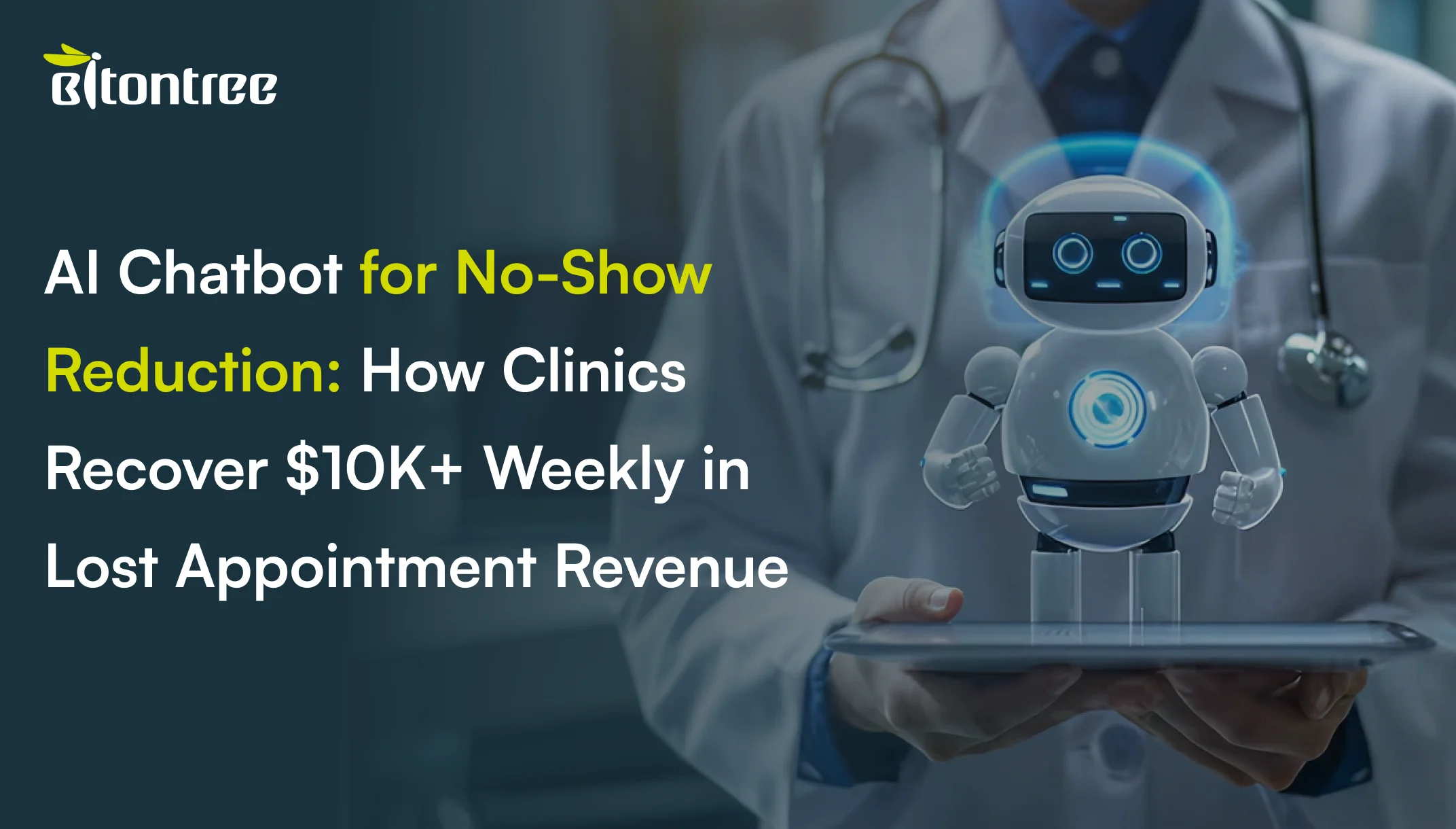
AI Chatbot for No-Show Reduction: How Clinics Recover $10K+ Weekly in Lost Appointment Revenue

Yash Vibhandik
CEO


Key Takeaways
- A multi-provider clinic reduced no-shows from 28% to 12% in 90 days using three automated AI workflows: reminder sequences with one-tap response options, instant rebooking on cancellation, and automated waitlist management.
- Each missed appointment costs a clinic between $150 and $300 in lost slot revenue. At a 20% no-show rate across 30 daily appointments, that is $20,000 to $40,000 in lost monthly revenue.
- 85% of patients who receive no reminder ahead of an appointment either forget it entirely or cannot get through to reschedule when their plans change.
- 34% of patients who cancel immediately accept a rebooking offer when it is presented in the same conversation. Without that instant offer, those slots sit empty.
- Waitlist slots that previously took 24 to 48 hours to fill through manual callback lists now fill in under 10 minutes with automated waitlist management.
- The AI handles reminders, rebooking, and waitlist filling. The front desk handles the exceptions. No-show rates fall without any increase in staff workload.
AI chatbot no-show reduction is a set of three automated workflows that cut patient no-shows: multi-channel reminder sequences with one-tap response, instant rebooking when patients cancel, and automated waitlist management. A multi-provider clinic using Bitontree’s AI scheduling system reduced patient no-shows from 28% to 12% within 90 days. No new headcount. No changes to the existing scheduling system. This post explains exactly how, and it is one of the core patterns inside our healthcare AI solutions practice.
A 30-appointment practice day with a 20% no-show rate means six empty slots. At $200 per appointment, that is $1,200 in lost revenue today. Across a working month of 22 days, it is $26,400 in appointments that were booked, confirmed, and never attended. Most practice managers know their no-show rate. Very few have calculated it as an annual revenue number.
No-shows are not primarily a patient behaviour problem. They are a communication infrastructure problem. Patients no-show because they forgot, because they could not find the reminder, or because they wanted to reschedule and could not get through to do it. All three of those causes are solvable with the right automated system.
This post covers exactly how a multi-provider clinic reduced no-shows from 28% to 12% using three AI workflows, what each workflow does, and how to calculate whether the same approach makes financial sense for your practice.
What are patient no-shows actually costing your clinic?

Patient no-shows cost most clinics between $20,000 and $40,000 per month in lost slot revenue, plus indirect costs from double-booking, staff time on manual reminder calls, and patient experience degradation. The average healthcare no-show rate across practices sits between 15% and 25%, with each missed appointment costing $150 to $300 in lost revenue.
Direct cost: lost slot revenue
- A slot that goes unfilled is not just a revenue gap for that hour - it is a fixed cost absorbed by the practice anyway
- Rent, payroll, utilities, and insurance keep running whether or not a patient walks through the door
- Every empty slot is a full-cost hour with zero revenue on the other side
Secondary cost: schedule trust degradation
- When no-show rates climb, practice managers start double-booking to compensate
- Double-booking works until both patients show up - then wait times climb, providers fall behind, and patients who were not the no-show risk end up with the worst experience
- Trust in the schedule breaks down on both sides of the front desk
Tertiary cost: staff time on manual reminders
- A front-desk team making reminder calls for 40 patients a day spends two to three hours on work that an AI reminder sequence handles in seconds
- That is staff time pulled away from patients in the waiting room, insurance verification, and intake paperwork
- The labour cost is real even when it is invisible on the P&L
The three workflows that reduced no-shows from 28% to 12%
The multi-provider clinic highlighted in this post cut its no-show rate by a 16-percentage-point margin, from 28% to 12%, inside a 90-day window. No new hires. No scheduling system replacement. No change to the underlying EHR. The improvement came entirely from three AI workflows layered on top of existing infrastructure, and the same pattern now runs across several Bitontree healthcare deployments.
Workflow 1: Reminder sequence with one-tap response options
Before the AI rollout, the clinic sent a single SMS reminder 24 hours before each appointment. That message did the job for patients who were already planning to attend. It did nothing for patients who had forgotten, wanted to reschedule, or had a conflict come up. 85% of patients who receive no useful reminder either forget the appointment entirely or cannot get through to reschedule when their plans change. A one-way text is barely better than no reminder at all.
The appointment reminder AI sequence replaces that single message with three timed touches:
- 48 hours before the appointment
- 2 hours before the appointment
- 30 minutes before the appointment
Each message includes one-tap options to confirm, reschedule, or cancel. A patient who taps reschedule moves straight into a rebooking conversation in the same thread. A patient who taps cancel triggers the second workflow automatically. There is no phone tag, no voicemail, no callback list. The reminder and the response happen in the same place, at the moment the patient is actually paying attention.
Workflow 2: Instant rebooking on cancellation
When a patient cancels through the traditional path, a phone call to the front desk, the conversation is about leaving the schedule. The slot opens up, the patient hangs up, and the rebooking happens days later if it happens at all. That is how clinics accumulate gaps they never recover. The AI chatbot no-show reduction workflow closes that gap by turning every cancellation into a rebooking conversation in real time.
The moment a patient taps cancel or reschedule, the AI presents three alternative slots that match the patient’s provider, appointment type, and stated preferences.
- 34% of patients who cancel immediately accept a rebooking offer when it is presented in the same conversation
- Without that instant offer, those slots sit empty until the front desk manages to reach the patient again - which in many practices means they never get filled at all
- A one-third rebooking rate on cancellations is the difference between a 12% no-show rate and a 28% one
Workflow 3: Automated waitlist management
Every clinic has a waitlist. Almost no clinic uses it well. Waitlist slots that previously took 24 to 48 hours to fill through manual callback lists now fill in under 10 minutes with automated waitlist management.
The moment a cancellation creates an open slot:
- The AI notifies the top three waitlist candidates for that provider and appointment type
- First patient to confirm takes the slot
- Remaining candidates stay on the list for the next opening
On a busy day, that workflow alone recovers two to four appointment slots that would otherwise have gone unfilled. At $150 to $300 per appointment, that is $300 to $600 in daily recovered revenue from a workflow that runs without any front-desk involvement. Across a month, waitlist automation frequently pays for the entire AI system on its own.
How do you calculate whether AI chatbot no-show reduction makes financial sense?
Calculating ROI for AI chatbot no-show reduction takes four steps: measure your current no-show rate, calculate the monthly revenue impact, apply the potential improvement to your appointment volume, and factor in recovered staff time. A 16 percentage point improvement on 500 monthly appointments at $150 per visit yields roughly $12,000 in recovered monthly revenue.
Step 1: Measure your baseline
- Pull 90 days of appointment data and calculate your no-show rate as missed appointments divided by scheduled appointments
- Most practices land between 15% and 25%
- If you are above 20%, you are losing enough revenue monthly to justify an AI deployment on the first workflow alone
Step 2: Calculate the monthly revenue impact
- Monthly appointment volume × no-show rate × average appointment revenue = monthly loss
- 500 appointments × 25% no-shows × $150 per visit = $18,750 lost per month
- At $250 per visit, that number climbs past $31,000
Step 3: Apply the potential improvement
- A 16-point reduction (from 25% to 9%) on 500 monthly appointments at $150 each recovers roughly $12,000 per month
- A practice running 1,000 monthly appointments doubles that recovery
- The numbers scale linearly with volume - multi-provider clinics see the fastest payback
Step 4: Factor in recovered staff time
- Replacing 2-3 hours of daily manual reminder calls at $20, $25/hour in fully loaded front-desk cost produces $1,300, $1,700 in monthly savings
- That line item does not show up as new revenue on the P&L, but it is real budget freed for work that actually needs a human in the chair
What to configure before your no-show reduction system goes live
1. Appointment types and provider availability
- The AI needs to know which visit categories exist, which providers handle each, and how each patient prefers to be contacted
- A solo-provider practice completes this setup in about a week
- A multi-provider clinic with several visit types typically takes two to three weeks to configure and test
2. Channel setup
- Most deployments run on WhatsApp Business API, SMS short code, and a web chat widget on the clinic site
- Patients respond through whichever channel they already use
- Plan on roughly two weeks to provision the WhatsApp Business API account through Meta and to set up a compliant SMS short code - this is typically the longest timing bottleneck in a launch
3. Scheduling chatbot architecture
The scheduling chatbot runs underneath reminders, rebooking, and waitlist management. If you are still choosing between a generic bot and one purpose-built for healthcare appointment flows, our walkthrough on AI patient scheduling chatbot design covers the architecture, compliance considerations, and integration patterns that make the difference between a reminder tool and a reduce-patient-no-shows system that actually moves the numbers.
Conclusion
A 16 point drop in no-show rate is not a marketing number. It is the outcome of three specific workflows running against three specific failure modes: patients who forget, patients who want to reschedule and cannot, and slots that sit empty because the waitlist moves too slowly to recover lost appointment revenue. Fix those three failure modes and the no-show rate falls on its own, without new staff and without replacing the scheduling system you already use.
The healthcare AI systems Bitontree builds run at production scale, from 200+ patient calls nightly with a 32% adherence improvement in medication adherence deployments to the no-show reduction workflows covered in this post. If your practice is carrying a 20%+ no-show rate, the monthly revenue math is almost always in favour of acting now rather than next quarter.
I am the founder and CEO of Bitontree, where I lead embedded AI engineering teams that build and run production AI: agents, RAG and knowledge systems, document AI, and workflow automation for healthcare, logistics, legal, and SaaS companies. I write about what it actually takes to ship AI that survives contact with production.
Frequently Asked Questions
How quickly can we expect to see no-show rates change?
The multi-provider clinic in this case saw measurable change within the first two weeks of the reminder sequence going live. The full 16 percentage point improvement took 90 days because waitlist management and rebooking accumulate their impact over multiple appointment cycles. Most practices see statistically significant no-show rate reduction within 30 days of full deployment.
Does this work for practices where patients book far in advance?
Yes. The reminder timing is configurable. For practices with long booking windows, the sequence can be extended to include a reminder at 7 days and 3 days, in addition to the standard 48-hour and 2-hour reminders. The rebooking and waitlist workflows operate the same way regardless of booking lead time.
What if a patient keeps no-showing?
The system can be configured to flag habitual no-shows after a defined threshold. Two consecutive no-shows, for example, triggers a notification to the practice manager rather than an automated reminder. The practice then decides whether to require pre-payment, reduce booking priority, or contact the patient directly. The AI surfaces the pattern. The practice sets the policy.
Does the AI communicate with patients under our clinic name?
Yes. Every message is sent under your practice name and branding. The patient sees your clinic name, not Bitontree. The AI identifies itself as an automated system at the start of every interaction, as required under FTC and healthcare communication standards, but operates as an extension of your front desk.
Every Empty Slot Is Revenue You Already Earned and Lost. Get It Back.
Bitontree’s healthcare AI team audits your current no-show rate, calculates the monthly revenue impact, and shows you exactly how three automated workflows, reminders, rebooking, and waitlist management, would change the numbers for your practice. No commitment until you see the math.