April 9, 2026
Why After-Hours Patient Communication Matters - and How an AI Chatbot Transforms It

Bhavin Karad
Co-Founder
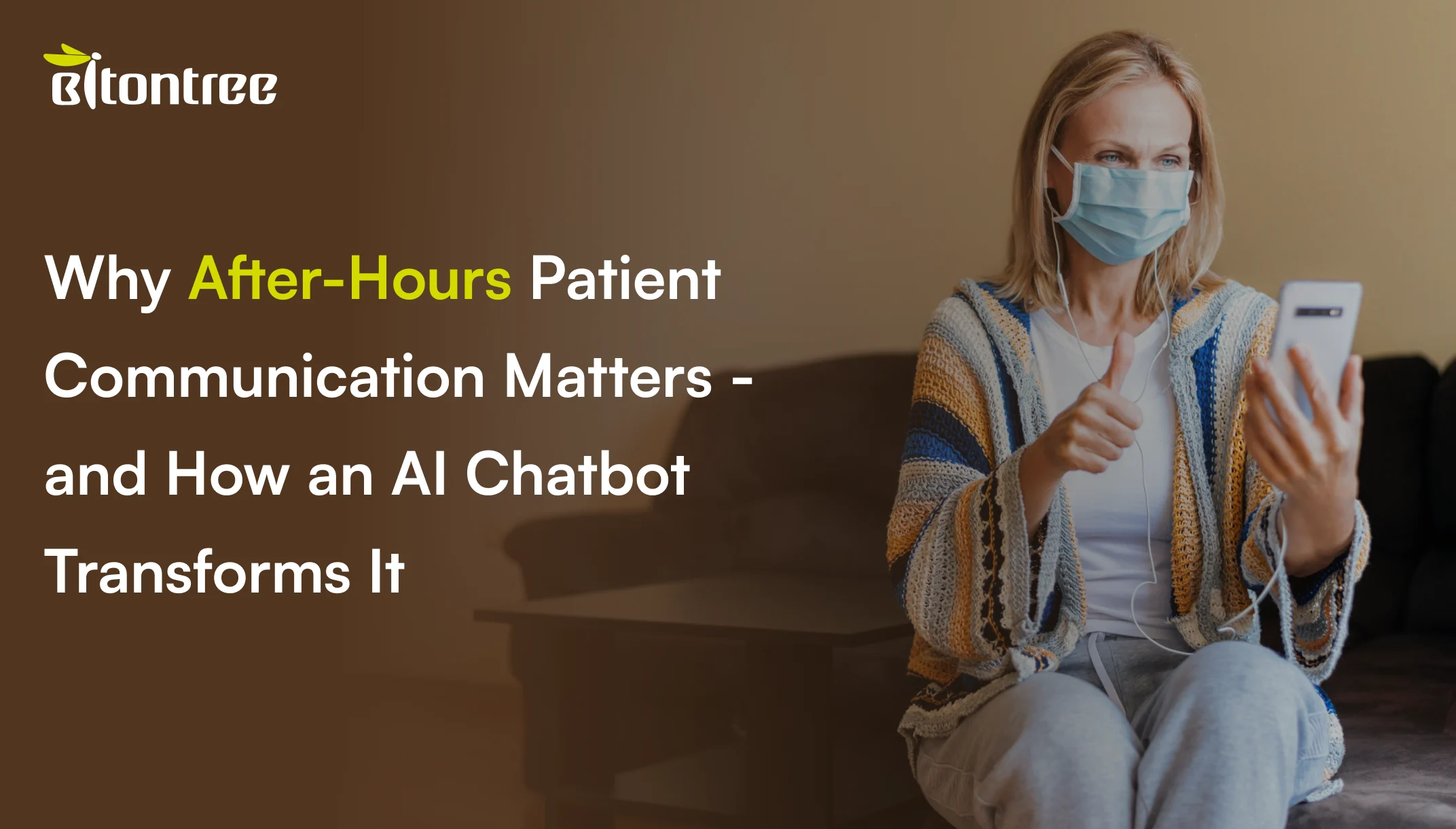


After-hours patient communication is where patient relationships are tested most - and where most practices fail without realizing it.
It is 9 PM on a Tuesday. A patient who had a procedure that morning notices something that worries her. She calls the clinic, reaches voicemail, and hangs up. She spends the next hour reading the worst possibilities online and ends up in the emergency department at midnight - not because her concern was serious, but because she had no one to tell her it was not.
This is not unusual. It happens every evening at clinics that assume their patients can wait. The practices that close this gap keep more patients, prevent avoidable clinical events, and build stronger reputations than those that do not.
What is an after-hours patient communication chatbot?
It is an AI system that responds to patients when your clinic is closed - handling scheduling, prescription routing, post-procedure guidance, and clinical urgency escalation in real time, with every interaction logged in your EHR. Unlike voicemail or answering services, it resolves the patient’s inquiry in the same session and creates a complete audit record for your morning team.
Why After-Hours Patient Communication Is Critical for Every Healthcare Practice
After-hours patient communication is not a secondary concern you can address when things slow down - it is where patient relationships are tested every evening, weekend, and public holiday.
Healthcare needs do not follow a 9-to-5 schedule
A parent notices her child’s fever rising at 11 PM and does not know whether to wait or go to the emergency department. A worker who can only manage personal calls after his shift tries to reschedule an appointment on a Wednesday evening. A senior patient calls on a Saturday morning wondering whether her refill is ready. None of them unreasonable - all of them reaching out at the moment the need arises.
Patients compare you to every service they use
Modern patients bank after midnight, reschedule flights through apps, and order prescriptions online. When they call their clinic and reach voicemail, the message is clear: this practice is not available when I need it. That perception erodes trust quickly, and once a patient decides that reaching you is difficult, the next appointment is often their last.
After-hours access is a legal requirement
The Centers for Medicare and Medicaid Services (CMS) require every Medicare and Medicaid provider to maintain a 24/7 contact method - giving patients access to a live person or on-call clinician at any hour. This falls under the Conditions of Participation (42 CFR § 482.13). Voicemail-only systems do not satisfy this requirement. Practices without a structured after-hours process may be out of compliance without realizing it.
The Hidden Risks of Poor After-Hours Patient Communication
Poor after-hours communication does not show up on a single report as a line-item failure. Its effects accumulate quietly - in patient retention, in appointment patterns, in the gradual drift of patients who stop calling because calling stopped being worth it.
1. Patients who cannot reach you look for a practice that they can.
When a patient calls after hours and reaches voicemail, they are reminded that their provider is not there when it matters. Most will not try again in the morning - they begin searching elsewhere.
2. Missed after-hours calls become abandoned appointments.
Most after-hours calls are about scheduling. When staff return them the next day, the patient has often already moved on and the slot sits empty.
3. Without guidance, patients make the wrong call about emergency care.
When they cannot reach their provider, patients make clinical judgments alone. Many overreact - driving to the emergency department for concerns a brief conversation would have resolved, straining services and affecting quality metrics your practice is measured against.
4. On-call staff carry a burden they should not have to carry.
Prescription routing, rescheduling, and FAQ queries are not clinical decisions - but when there is no other system in place, they land on whoever picks up the phone. That misallocates expertise and accelerates burnout.
5. Undocumented after-hours contacts create care and compliance gaps.
When a patient calls after hours and no record is created, the morning care team arrives without knowing who called or what they needed. Those gaps affect care continuity and your ability to account for clinical outcomes.
Related: AI Patient Scheduling Chatbot: Reduce No-Shows and Automate Bookings
Traditional After-Hours Patient Communication Solutions - and Why They No Longer Work
Healthcare practices have managed after-hours patient communication with the same tools for decades. Each approach made sense in a different era of healthcare. None of them meet the expectations patients have today, the access standards regulators now require, or the consistency that patient retention demands.

Voicemail assumes a patience that no longer exists. Most patients who reach voicemail after hours hang up without leaving a message - and those that do require staff to listen, transcribe, and return calls during an already-full morning.
Outsourced answering services solve the availability problem but not the quality problem. Agents follow scripts with no access to the patient’s record - they cannot schedule, route a refill, or document the interaction in the EHR. Patients feel acknowledged but not helped. If you are looking for an after-hours medical answering service alternative that actually resolves patient inquiries, an AI chatbot is the next step.
On-call staff rotations route administrative tasks to clinical expertise. Prescription routing and rescheduling do not require a clinician - but when they arrive through on-call staff anyway, they consume goodwill, accelerate burnout, and leave genuine urgencies competing for the same attention.
Platform-based solutions like Luma Health, Klara, and Hyro offer scheduling automation and patient messaging. They work well for practices that primarily need appointment reminders and intake forms during business hours. However, they are not built for clinical triage escalation, after-hours EHR documentation, or the full range of after-hours inquiry types that a custom AI chatbot handles - scheduling, prescription routing, post-procedure guidance, billing, and urgent escalation in a single system.
How an AI Chatbot for Patient Communication Transforms After-Hours Care
An AI chatbot for after-hours patient communication is not a smarter voicemail - it is an active system that responds to patients in real time, identifies what each inquiry needs, and handles it without requiring anyone on your team to be awake. The result is a practice that never goes dark for its patients.
When the patient from the opening scenario calls at 9 PM, the chatbot greets her, identifies itself as an automated system, and asks how it can help. She describes her concern - the chatbot identifies language suggesting a clinical issue, immediately alerts the on-call clinician with her name, concern, and contact number, and tells her someone will be in touch. She does not go to the emergency department.
What an After-Hours AI Chatbot Handles Without Staff

The following inquiry types account for most after-hours contacts - all handled by the chatbot without involving your team:
-
Appointment scheduling and rescheduling - Patients find the next available slot and receive an immediate confirmed booking - no voicemail, no abandoned appointment.
-
Prescription refill routing - Refill requests go to the prescribing physician’s task queue for morning review, with immediate acknowledgement sent to the patient.
-
Post-procedure instruction delivery - Patients request written after-care instructions at any hour; the chatbot retrieves the document from the EHR and sends it within seconds.
-
Medication questions - Dosage timing, missed doses, and documented side effects answered using pre-approved guidance already on the patient’s record.
-
Billing and account queries - Balance enquiries, payment plan questions, and insurance status checks handled without staff involvement.
-
Lab result status - Patients find out whether results are ready and are directed to the portal, or given the expected turnaround if results are not yet available.
-
New patient registration - Prospective patients complete intake information after hours; the appointment is confirmed at the next business day’s opening.
-
Clinical urgency escalation - Any message containing concerning language - chest pain, breathing difficulty, severe post-surgical symptoms, or mental health crisis - triggers an immediate SMS alert to the on-call clinician.
Three-tier triage: how every after-hours inquiry gets routed
Every inquiry routes through one of three paths, defined with your clinical team before go-live:
| Tier | What It Covers | What Happens |
|---|---|---|
| Handle immediately | Scheduling, billing queries, instruction delivery, general practice information | Patient receives a confirmed response within minutes, at any hour |
| Queue for morning | Non-urgent clinical questions needing review | Chatbot captures the query, confirms the expected callback window, and creates a prioritized task for morning staff |
| Escalate now | Any message flagging a safety concern | On-call clinician receives SMS with patient name, concern, and contact number. Patient is informed their concern has been received |
Available on Every Channel Your Patients Use
The chatbot operates across phone (IVR), SMS, web chat, and patient portal - your existing clinic number does not change. A patient who calls after hours is routed through your current IVR; a patient who texts the clinic number or opens the website chat widget reaches the same system - the same triage logic applies on every channel.
Every interaction feeds into a single overnight EHR log - morning staff open the day with one consolidated record of every patient who reached out, what they needed, and what was done. No separate inbox, no separate login.
Key Benefits of After-Hours AI Patient Communication for Clinics and Patients
An AI chatbot for after-hours patient communication reduces appointment abandonment, removes routine tasks from on-call staff, and creates a complete overnight EHR record - without adding anyone to your team.
For your practice:
-
Stronger patient retention - patients who can reach their practice after hours stay. Patients who cannot, quietly look for one they can.
-
Fewer empty appointment slots - patients who reach the chatbot to reschedule do not abandon the appointment.
-
Reduced on-call burden - routine administrative queries are resolved before they reach your on-call team, so clinicians focus on patients who genuinely need them.
-
Complete overnight documentation - every interaction is logged in the EHR. Morning staff arrive knowing who called, what they needed, and what was done.
-
CMS compliance met automatically - the 24/7 patient access requirement under [42 CFR § 482.13](Stronger patient retention - patients who can reach their practice after hours stay. Patients who cannot, quietly look for one they can.
For your patients:
-
Responded to at the moment they reach out - not sent to voicemail, not told to call back in the morning.
-
Fewer unnecessary emergency department visits - patients who receive guidance after hours make better decisions about whether their concern can safely wait.
-
Immediate confirmation of every request - whether rescheduling, requesting a refill, or asking about a procedure, patients receive a confirmed response before the conversation ends.
-
Secure communication at every hour - every interaction is encrypted and handled within a HIPAA-compliant system with signed Business Associate Agreements, audit logging, and SOC 2-aligned security controls.
How Bitontree Builds After-Hours Patient Communication Chatbots
Bitontree builds AI chatbots for after-hours patient communication configured to your practice’s specific escalation protocols, patient channels, and EHR - not deployed from a template. Every deployment begins with a communication audit so the system reflects how your patients actually reach you.
Step 1: After-Hours Communication Audit
We map your contact volume, channels, and inquiry types to define what the chatbot handles, queues, and escalates before any configuration begins.
Step 2: Clinical Escalation Threshold Definition
Working with your clinical lead, we define which concerns trigger an immediate on-call alert and which are queued for morning review. Your team sets the thresholds; the chatbot applies them.
Step 3: Channel and EHR Integration
The chatbot connects to your phone IVR, SMS line, web chat widget, and patient portal, writing every interaction back to your EHR - Epic, Cerner, or Athenahealth. Important: EHR integration complexity varies. Read access (pulling patient information) is straightforward. Write-back (logging interactions into the patient record) requires more configuration, and some EHR systems like Epic require their own approval process, which can add 4-8 weeks to the timeline.
Step 4: HIPAA Compliance Verification
Business Associate Agreements are confirmed with every vendor. Encryption, audit logging, and patient AI disclosure are verified against HIPAA requirements before go-live.
Step 5: Supervised Go-Live and Threshold Refinement
The chatbot goes live under a monitored period in which every escalation and callback is reviewed with your team. Thresholds are refined based on real interactions.
Our automated patient communication system built for a mental health clinic in the Netherlands makes over 200 patient calls nightly outside office hours, producing a 32% improvement in medication adherence. Note: this deployment operates under GDPR, not HIPAA. A US-based deployment would include additional HIPAA safeguards including signed BAAs, six-year audit log retention, and patient AI disclosure at every interaction. We are currently piloting with US-based practices and are happy to share anonymized early results during your consultation.
Implementation timeline and investment
Timeline: A focused deployment covering proactive after-hours communication and clinical escalation takes 8-12 weeks. Full deployment including EHR write-back, multi-channel integration (IVR, SMS, web chat, patient portal), and compliance verification takes 12-16 weeks. If your EHR is Epic, add 4-8 weeks for App Market approval.
Investment framework: A custom after-hours patient communication chatbot typically costs less than one full-time after-hours staff member. Setup costs depend on your EHR, channel requirements, and practice size. Monthly operations cover hosting, AI processing, and ongoing support. We provide a specific quote after the communication audit - so you know the exact numbers before you commit to anything.
For the full scope of a custom build, see our AI chatbot development services. For compliance guidance, see HIPAA-Compliant AI Chatbot: What Every Clinician Must Know. For insurance verification automation, see our guide on AI chatbots for insurance verification.
Conclusion
After-hours patient communication is not a problem that solves itself. It is a gap that widens through patients who stopped calling because calling did not help, appointments that were never rescheduled, and trust eroded one voicemail at a time.
An AI chatbot closes that gap without adding to your team’s workload - every patient gets a response, every urgent concern reaches the right person, and every interaction is documented before morning.
I lead strategic consulting and marketing initiatives that empower businesses to scale, strengthen their brand presence, and achieve sustainable growth in competitive global markets.
Frequently Asked Questions
What is an AI chatbot for after-hours patient communication?
An AI chatbot for after-hours patient communication responds to patient inquiries when the clinic is closed - handling scheduling, prescription routing, post-procedure instructions, and clinical urgency escalation in real time, with every interaction logged in the EHR.
Is after-hours patient communication legally required for healthcare practices?
Yes. CMS requires every Medicare and Medicaid provider to maintain a 24/7 contact method giving patients access to a live person or on-call clinician at any hour, under the Conditions of Participation (42 CFR § 482.13). Voicemail-only systems do not meet this requirement, and state regulations may impose additional obligations beyond the federal baseline.
How does the chatbot know when to escalate to a clinician?
Escalation is governed by rules your clinical team defines during setup. When a message contains concern indicators - chest pain, breathing difficulty, post-surgical complications, or mental health crisis language - the chatbot immediately alerts the on-call clinician. If the chatbot is uncertain whether a message is urgent, it defaults to escalation. The chatbot applies your approved rules; it does not make clinical judgments.
What makes this different from a medical answering service?
A medical answering service provides a human following a script - no record access, no scheduling, no refill routing, no EHR documentation. An AI chatbot connects directly to your scheduling system, EHR, and practice management system, resolving the inquiry in the same session and creating a complete audit record. If you are evaluating an after-hours medical answering service alternative, this is the comparison that matters.
How does this compare to Luma Health, Klara, or Hyro?
Luma Health, Klara, and Hyro offer strong scheduling automation and patient messaging for business-hours workflows. They work well for appointment reminders, intake forms, and basic patient communication. A custom Bitontree chatbot is built for the after-hours use case specifically - clinical triage escalation, overnight EHR documentation, multi-channel coverage (IVR, SMS, web, portal), and the full range of after-hours inquiry types in a single system. If your main need is business-hours scheduling, those platforms may be sufficient. If your gap is what happens after 5 PM, that’s what we build for.
How does better after-hours communication reduce appointment no-shows?
Most no-shows begin with a patient who wanted to reschedule but could not reach anyone after hours. When they can reschedule through the chatbot at 10 PM, the appointment is rebooked in the same call rather than abandoned. Practices deploying after-hours AI consistently see abandonment fall within 90 days.
What HIPAA requirements apply to after-hours AI systems?
Every after-hours AI system must have signed Business Associate Agreements with all vendors, encrypt all messages in transit and at rest, maintain a timestamped audit log for a minimum of six years per the HIPAA Security Rule, and disclose at the start of each interaction that the patient is communicating with an automated system.
How long does implementation take?
A focused deployment takes 8-12 weeks. Full deployment with EHR write-back and multi-channel integration takes 12-16 weeks. Epic EHR approval adds 4-8 weeks. The longest phase is clinical threshold definition and EHR configuration, not the chatbot build itself.
What does it cost?
A custom after-hours patient communication chatbot typically costs less than one full-time after-hours staff member. Exact pricing depends on your EHR, channel requirements, and practice size. We provide a specific quote after the communication audit so you know the numbers before you commit.