


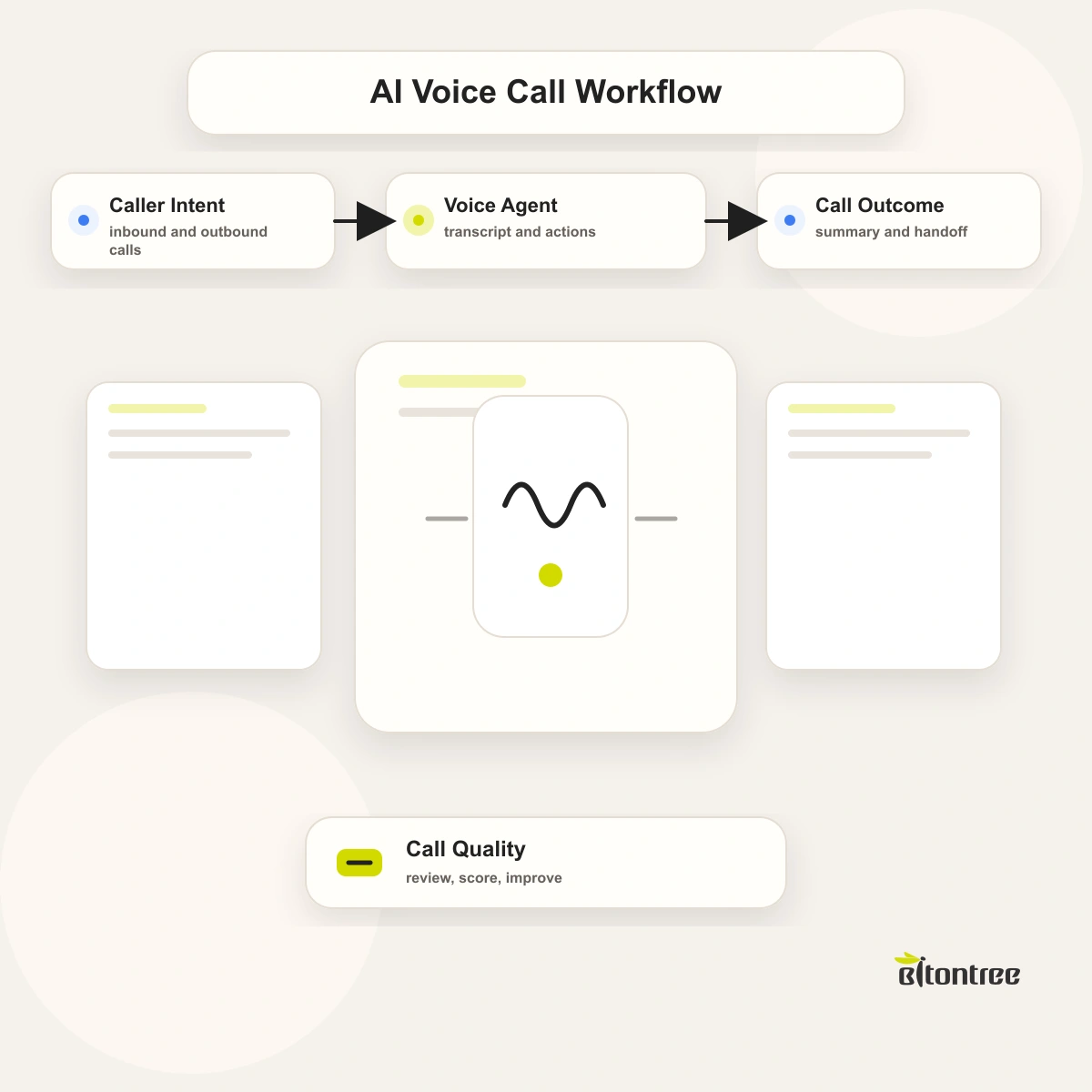
The phone remains one of the highest-intent channels in business, a person who calls is usually ready to act. Yet most businesses cannot answer every call. Lines stay busy, calls come in after hours, and call abandonment rates climb sharply once hold times pass two minutes. Every missed or abandoned call is a lost sale, a frustrated customer, or a problem left unsolved, and human-only call handling cannot close that gap.
An AI voice chatbot does. It answers and places calls in natural spoken conversation, recognizes what the caller wants, completes the task, transfers to a person when needed, and summarizes every call afterward, day and night, without a queue.
This guide covers what an AI voice chatbot is, the inbound and outbound use cases it handles, the benefits it delivers, which industries need it most, the technical architecture behind it, and how it gets built. Voice is the channel where round-the-clock automation removes the most friction for customers, because it needs no app, no typing, and no waiting.
What Is an AI Voice Chatbot?
An AI voice chatbot, also called an AI voice agent, is a conversational AI system that communicates by voice over the phone, rather than by text in a chat window. It understands natural speech, responds in a natural-sounding voice, and completes tasks: answering questions, booking appointments, qualifying leads, taking orders, or routing the call to the right person. As an AI phone agent, it works on inbound calls that customers place to the business, and on outbound calls the business places to customers.
The difference from a traditional phone menu is conversation. An old IVR system makes the caller listen to a list and press a number, then another list, then another. An AI voice chatbot lets the caller simply say what they need, in their own words, and acts on it. There is no menu tree to navigate and no waiting for the right option, the caller speaks and the system responds like a capable agent would. For a deeper look at how the technology developed, see our guide to voice-enabled chatbots.
Why Do Businesses Need an AI Voice Chatbot for Calls?
The phone is the highest-intent channel a business has, a person calling is a person ready to act. Yet phone handling is where businesses leak the most revenue and goodwill. Here are the six ways manual call handling costs a business the most.
- Calls go unanswered after hours and at peak times. Customers call when it suits them, not when the office is open. Every call that hits voicemail or a busy tone is a high-intent customer left to call a competitor instead.
- Hold times drive callers away. Abandonment rises steeply once a caller waits more than a couple of minutes. The customer who hangs up was ready to buy or book, and that intent is gone.
- Outdated IVR menus frustrate callers. Press-one-press-two phone trees force customers through rigid menus that rarely match their actual need, and many simply hang up or mash zero for an operator.
- Staff are tied up on repetitive calls. Skilled people spend their day answering the same routine questions, status checks, hours, pricing, and booking requests, instead of higher-value work.
- Outbound calling does not scale. Reminder calls, follow-ups, lead qualification, and surveys all need someone dialing one number at a time. Manual outbound calling caps how many customers a business can reach.
- Call notes are inconsistent or missing. After a call, staff are supposed to log what happened. Under pressure, notes get rushed, shortened, or skipped, so the next person has no context.
Phone handling is a clear automation opportunity. Gartner projects that conversational AI will handle a growing share of customer interactions, and voice is the channel where that shift removes the most friction, because it needs no app, no typing, and no waiting.
What Can an AI Voice Chatbot Do?
An AI voice chatbot does far more than read a script. Modern voice AI is built on speech recognition, large language models for understanding and response, and natural-sounding speech synthesis. With customer experience now a primary driver of business growth, these are the seven highest-impact things a voice chatbot handles in production.
Answer Inbound Calls Around the Clock
Acting as an AI receptionist, the voice chatbot picks up every inbound call instantly, at any hour, with no hold music and no voicemail. It greets the caller, understands why they are calling, and either resolves the request on the spot or routes it. This always-on AI receptionist means no high-intent caller is ever lost to a busy line again, and the business captures evening, weekend, and overflow demand it used to miss entirely.
Recognize Intent From Natural Speech
Instead of a press-one menu, the chatbot listens to what the caller actually says and works out what they need, even when the request is phrased loosely or rambles. It extracts the key details, a name, a date, an order number, an issue, from ordinary conversation. The caller never has to learn a menu or repeat themselves to be understood.
Hold a Real, Dynamic Conversation
The chatbot does not follow a fixed script. It asks follow-up questions, handles interruptions, copes when the caller changes the subject, and keeps track of everything said earlier in the call. If a caller gives three pieces of information in one sentence, the chatbot captures all three. The exchange feels like talking to a capable agent, not a recording.
Place Outbound Calls at Scale
The chatbot makes outbound calls too: appointment reminders, payment follow-ups, lead qualification, renewal notices, and satisfaction surveys. It can run hundreds of calls in the time a staff member would make a handful, holding a natural conversation on each one and recording the outcome. Our AI-powered medication calling system is a working example, an outbound voice agent that runs more than 200 patient calls every night. Outbound outreach stops being limited by how many people you can put on phones.
Transfer to a Human at the Right Moment
When a call needs human judgment, is sensitive, or falls outside what the chatbot should handle, it transfers to the right person, and it does not start the caller over. The staff member receives the call with a summary of what the caller wants and everything gathered so far. The handoff is seamless, and the customer never repeats themselves.
Connect to Your CRM and Business Systems
The voice chatbot connects to the systems that hold your data: a CRM, a booking or scheduling system, an order or ticketing platform, or a knowledge base. That lets it answer real questions, look up a real order, book a real slot, and update a real record during the call. It acts on live data, not generic answers.
Generate Post-Call Summaries Automatically
After every call, the chatbot writes a structured summary: who called, what they wanted, what was done, and what happens next. The summary lands in your CRM or ticketing system with no manual note-taking. Every call is documented consistently, and the next person who picks up the relationship has full context.
What Are the Benefits of an AI Voice Chatbot?
The business case for an AI voice chatbot is concrete and measurable. Used as an AI answering service, it changes the economics of every call. These are the six benefits businesses see most consistently.
- Every call answered. No missed calls, no voicemail, no busy tone. A 24/7 AI answering service captures after-hours, weekend, and peak-time demand the business used to lose, and recovers the revenue those calls represent.
- Zero hold time. The chatbot answers instantly and handles unlimited calls in parallel, so callers never wait in a queue. The abandonment that hold time causes simply disappears.
- Lower cost per call. AI call center automation handles a large share of routine inbound and outbound call volume without adding headcount, while staff focus on the calls that genuinely need a person.
- Outbound outreach that scales. Reminders, follow-ups, and qualification calls run in volume, not one dial at a time, so the business reaches every customer it should.
- Consistent, documented calls. Every call follows the same quality standard and produces a structured summary, so nothing depends on which staff member happened to answer.
- Accessible to every caller. Voice serves customers who cannot or prefer not to type, including those on the move, those less comfortable with apps, and anyone who simply wants to talk.
These gains compound as call volume grows. The conversational AI market is forecast for strong, sustained growth, and the voice and speech recognition segment is expanding alongside it, precisely because the phone remains a primary channel for high-intent customers.
Which Industries Need an AI Voice Chatbot?
Any business that depends on the phone, for sales, service, bookings, or outreach, benefits from an AI voice chatbot. The need is strongest in these seven industries.
- Healthcare and clinics. Practices use it to answer appointment calls, run reminder and medication follow-up calls, and triage after-hours enquiries when staff are unavailable. See our guide to AI voice assistants in hospitals for a closer look.
- Customer support and call centers. Voice AI for customer service answers tier-one calls instantly, resolves routine issues, and routes complex cases to agents with full context. As AI call center automation, it absorbs the repetitive call volume that would otherwise need a large agent headcount.
- Real estate. Agencies use it to respond to property enquiries the moment they come in, qualify callers, and book viewings without a lead ever reaching voicemail.
- Financial services and insurance. Firms use it for policy and account enquiries, payment reminders, and claim status calls, with sensitive cases handed to a licensed person.
- Logistics and field service. Operators use it for delivery and dispatch updates, scheduling calls, and status enquiries that would otherwise tie up a coordinator on the phone.
- Retail and e-commerce. Retailers use it for order status, returns, and stock enquiries by phone, and for outbound calls on promotions and back-in-stock alerts.
- Hospitality and restaurants. Hospitality businesses use it to take reservations and answer enquiries by phone at any hour, capturing bookings that a busy line would lose.
Whatever the industry, the voice chatbot connects to that business's own phone system and data. With voice remaining one of the most-used customer service channels, it is one capability within our wider AI chatbot development work, applied specifically to the voice channel.
How Does an AI Voice Chatbot Work?
An AI voice chatbot turns a spoken call into understood intent, action, and a recorded outcome. AI call automation like this works in five stages, each running in real time during the call.
1. Speech Recognition
When the caller speaks, a speech-to-text engine converts their words into text in real time, handling accents, background noise, and natural pauses. Advances in AI-driven speech technology have made this accurate enough for production phone calls. This is the chatbot's ear: it turns the spoken call into something the language model can understand.
2. Intent Understanding
A large language model interprets the transcribed speech, works out what the caller wants, and extracts the key details. It manages multi-turn dialogue, so it remembers what was said earlier in the call and handles follow-up questions and changes of subject.
3. System Integration and Data Retrieval
The chatbot connects to your CRM, booking system, order platform, or knowledge base through their APIs to look up real information and take real action. Retrieval-augmented generation grounds every answer in your actual business data, so the chatbot states facts, not guesses.
4. Speech Synthesis and Response
The chatbot generates its reply and a text-to-speech engine speaks it in a natural-sounding voice, with realistic pacing and intonation. The response is fast enough to feel like a normal conversation, with no awkward lag between caller and system.
5. Transfer, Logging, and Summary
If the call needs a human, the chatbot transfers it with full context. Either way, when the call ends it writes a structured summary and logs the outcome into your systems, so every call is documented and nothing is lost.
The telephony layer connecting all of this runs on infrastructure built for real-time voice, using carrier-grade platforms and standards documented by bodies like the Internet Engineering Task Force, so call quality and reliability match what callers expect from a normal phone line.
How Does Bitontree Build an AI Voice Chatbot?
A production-grade AI voice chatbot goes live within 5 to 8 weeks. Done well, AI call automation needs careful scoping, and research on automation programs shows that focused, well-scoped deployments succeed far more often than broad rollouts, so we build in four stages.
Step 1: Call Flow Audit and Use Case Mapping (Week 1)
We map your current call volume, the most common inbound reasons, your outbound calling needs, and the points where calls are missed or mishandled. This defines which calls the chatbot should handle, which it should transfer, and what success looks like in numbers.
Step 2: Conversation Design and System Integration (Weeks 2-4)
We design the conversation flows, set the transfer rules and boundaries, choose the voice, and connect the chatbot to your phone system, CRM, and the data sources it needs to answer and act.
Step 3: Build, Test, and Parallel Run (Weeks 5-7)
We build the voice chatbot and test it against real call scenarios, edge cases, accents, and interruptions. We run it in parallel with your team first, so accuracy and transfer behavior are proven before it takes live calls alone.
Step 4: Go-Live and 30-Day Optimization (Week 8 Onward)
The chatbot goes live, and we monitor call resolution rates, transfer rates, and call summaries, tuning the conversation flows for 30 days so performance keeps improving after launch.
Conclusion
The phone is not going away. It remains the channel customers choose when intent is highest and when something genuinely matters, and it is also the channel where typing is not always an option. The problem was never the phone itself, it was that human-only call handling cannot answer every call, scale outbound outreach, or document every conversation. Analysis of digital customer engagement shows that customers now expect an instant, capable response on whatever channel they choose. An AI voice chatbot, or AI voice agent, meets that expectation on the phone, answering every call, scaling outbound calling, and recording every outcome.
Bitontree builds and ships AI voice chatbots tailored to how your business runs, for inbound calls, outbound calls, or both. We map your call flows, design the conversation, connect the chatbot to your phone system and data, and go live within 5 to 8 weeks with a 30-day optimization period included. If your business loses revenue to missed calls, hold times, or outbound outreach that cannot scale, we can build the system that closes that gap.
Frequently Asked Questions
What is the difference between an AI voice chatbot and an IVR system?
An IVR system makes callers navigate fixed press-one menus. An AI voice chatbot lets callers say what they need in natural language and acts on it directly. There is no menu tree, the chatbot understands free speech, holds a real conversation, and completes the task rather than just routing the call.
Does the AI voice chatbot handle both inbound and outbound calls?
Yes. It answers inbound calls customers place to your business, and it places outbound calls such as reminders, follow-ups, lead qualification, and surveys. The same conversational system works in both directions, holding a natural conversation and recording the outcome of every call.
Can the voice chatbot transfer a call to a human agent?
Yes. When a call needs human judgment or falls outside the chatbot's scope, it transfers to the right person and passes along a summary of what the caller wants and everything gathered so far. The customer does not repeat themselves, and the handoff is seamless.
Does an AI voice agent sound robotic?
No. A modern AI voice agent uses text-to-speech that produces natural-sounding speech with realistic pacing and intonation. Combined with fast response times and dynamic conversation, the experience feels like talking to a capable agent rather than listening to a recording.
What systems can the voice chatbot integrate with?
The voice chatbot connects to your phone system and to the platforms that hold your data: CRMs like Salesforce or HubSpot, booking and scheduling systems, order and ticketing platforms, and knowledge bases. If a system has an API, the chatbot can read from it and write to it during the call.
How long does it take to build and deploy an AI voice chatbot?
A typical AI voice chatbot goes live within 5 to 8 weeks. That includes the call flow audit, conversation design, phone and system integration, testing against real call scenarios, a parallel run, and a 30-day optimization period after launch.
Which industries use AI voice chatbots?
Any business that depends on the phone. AI voice chatbots are used across healthcare, customer support and call centers, real estate, financial services, logistics, retail, and hospitality, for inbound service and sales calls and for outbound reminders, follow-ups, and outreach.
Related Use Cases

AI Chatbot for Appointment Booking
Build an AI chatbot that books, confirms, and reschedules appointments across web, SMS, and WhatsApp. Integrates with your calendar or CRM. Cut no-shows fast.
AI Chatbot for Healthcare
Patients call. Nobody picks up. Our HIPAA-aware AI chatbot handles appointment booking, triage, insurance verification, and follow-ups 24/7. Free healthcare audit.
AI Knowledge Base Chatbot
Build a RAG chatbot that turns your docs into instant, accurate answers. This AI knowledge base chatbot cites every source and refuses out-of-scope questions.
AI Multilingual Chatbot
Build an AI multilingual chatbot that detects language and replies in a matched tone across 30+ languages, serving every market from one bot.