


April 23, 2026
AI Agents for Abandoned Cart Recovery: Win Back Sales That Email Sequences Can’t

Yash Vibhandik
CEO


Key Takeaways
- 70% of ecommerce carts are abandoned before checkout (Baymard Institute, 2024). That represents an estimated $260 billion in recoverable revenue annually in the US and EU alone.
- Well-optimized abandoned cart email sequences recover 5-14% of lost carts (Klaviyo Benchmarks, 2024). An AI agent for abandoned cart recovery can push recovery rates to 15-25% by engaging shoppers in real-time conversation - though first-year implementations typically start at 8-15%.
- The agent detects when a shopper is about to leave, starts a conversation within seconds on desktop, resolves the objection (shipping cost, payment trust, sizing doubt), and guides them back to checkout.
- Works across your website, WhatsApp, SMS, and phone - reaching shoppers on the channel where they are most likely to respond. WhatsApp and SMS require explicit customer opt-in (TCPA in the US, GDPR in the EU).
- The agent does not just send a reminder. It has a conversation, answers the question that caused the hesitation, and completes the recovery - without your team touching it.
An AI agent for abandoned cart recovery is a conversational AI system that detects cart abandonment in real time and engages the shopper through website chat, WhatsApp, or SMS to resolve the specific objection that caused the hesitation - and bring them back to checkout.
A shopper spends 8 minutes on your store. Adds a $120 jacket to the cart. Gets to checkout. Sees $14 shipping. Closes the tab.
Your Klaviyo flow sends an email 45 minutes later. The shopper sees it the next morning between 30 other emails. Maybe they open it. Probably they do not. The jacket sits in an abandoned cart, and the $120 is gone.
This happens roughly 70 times out of every 100 carts on the average store (Baymard Institute, 2024). That is not a small leak. That is the majority of your potential revenue walking out the door - and your email sequence is catching a fraction of it.
An AI agent for abandoned cart recovery does not wait 45 minutes. It detects the hesitation in real time, starts a conversation on your website, WhatsApp, or SMS, figures out what stopped the purchase, resolves the objection, and brings the shopper back to checkout - while the buying intent is still alive.
Who this guide is for: ecommerce stores doing $50K+/month in revenue with 500+ monthly abandoned carts. If your store has significant cart traffic and your current email-only recovery feels like it’s leaving money on the table, this guide will show you what’s possible.
This guide breaks down why carts are abandoned, where email recovery falls short, what the AI agent does differently, what the conversation looks like, and how to measure whether it is working for your store. For a broader view of how AI agents are transforming ecommerce operations, start with our complete guide.
Why Customers Abandon Carts: The 6 Reasons Behind 70% Abandonment
Before you can recover abandoned carts, you need to understand why shoppers leave. These are the six most common reasons (Baymard Institute cart abandonment research, 2024) - and each one requires a different response from your recovery system.
Unexpected costs at checkout
- 48% of cart abandonments happen because shipping fees, taxes, or extra charges appear at the final step (Baymard, 2024)
- The shopper calculated $120 for the jacket. The checkout said $134. That $14 surprise killed the purchase.
- What the AI agent does: detects the price hesitation, explains the cost breakdown, offers free shipping if available, or suggests a product swap that qualifies for free delivery
Complicated or slow checkout process
- 22% of shoppers leave because the checkout requires too many steps, asks for too much information, or loads too slowly
- The average ecommerce checkout has 5.1 steps - every step is a chance for the shopper to reconsider
- What the AI agent does: guides the shopper through checkout step by step, answers questions about required fields, and offers guest checkout when account creation causes friction
Payment security concerns
- 19% of shoppers abandon because they do not trust the site with their payment information
- Small or unfamiliar stores suffer most - no brand recognition means no automatic trust
- What the AI agent does: proactively shares trust signals during checkout - SSL encryption confirmation, accepted payment badges, return policy, and customer review highlights
Delivery timeline does not meet expectations
- 21% abandon because estimated delivery is too slow or unclear
- In a world of next-day delivery expectations, “ships in 5-7 business days” loses the sale
- What the AI agent does: checks real-time shipping options and presents the fastest available delivery - or offers express shipping as an alternative before the shopper leaves
Comparison shopping and price checking
- Shoppers add items to the cart as part of their research. They leave to check prices on Amazon, a competitor, or a coupon site.
- If they find a better deal, they never come back. If they do not, they forget which site had the product.
- What the AI agent does: reaches out on WhatsApp or SMS (with prior opt-in) while the shopper is still comparing - with a personalized message that includes the product, a direct checkout link, and a reason to buy now
Unanswered product questions at the last moment
- “Will this fit me?” “Does this work with my phone?” “What is the return policy?” - questions that need an instant answer
- If the answer requires searching the FAQ, emailing support, or calling a number, the shopper closes the tab and buys from the store that answered faster
- What the AI agent does: answers the specific question in real time within the checkout conversation - pulling from your product catalog, size charts, specs, and policies
Each abandonment reason requires a different response. An email sequence sends the same message regardless of why the shopper left. An AI agent for abandoned cart recovery identifies the specific reason and addresses it directly.
Why Abandoned Cart Email Sequences Are Not Enough Anymore
Abandoned cart emails are the industry standard. Every Shopify, WooCommerce, and BigCommerce store has them. And that is exactly the problem - when everyone sends the same recovery email, nobody stands out. For a look at how AI chatbots are reshaping online store communication more broadly, see our guide.
Emails arrive too late
- The fastest abandoned cart emails arrive 30-60 minutes after abandonment. Most arrive 1-3 hours later.
- Recovery messages sent within 15 minutes convert at significantly higher rates than those sent after an hour (Omnisend, 2024)
- By the time your email arrives, the shopper has moved on, bought elsewhere, or forgotten what they wanted
Emails are one-way - they cannot have a conversation
- An email says: “You left something in your cart.” The shopper thinks: “Yes, because the shipping was $14.”
- The email cannot ask why the shopper left, cannot resolve the objection, and cannot adjust the offer based on the response
- It is a reminder, not a recovery. The shopper has to solve their own problem.
Email open rates are declining
- Abandoned cart emails have a 40-50% open rate - better than marketing emails, but that still means half your shoppers never see them
- Of those who open, 10-11% click through. Of those who click, a fraction complete the purchase.
- Net recovery rate for well-optimized sequences: 5-14% of abandoned carts (Klaviyo, 2024). Many stores with basic flows recover closer to 3-5%.
Every store sends the same email
- “Hey, you left something behind!” - your customer receives this from 5 different stores on the same day
- The format is identical: product image, discount code, “complete your purchase” button
- No differentiation. No personalization beyond the product name. No conversation.
Email is not broken - it is just not enough. It works as a baseline reminder but it cannot recover the shoppers who left for a specific, resolvable reason. That is where a conversational AI cart recovery agent steps in.
How an AI Agent for Abandoned Cart Recovery Works
An AI abandoned cart recovery agent does not replace your email sequence. It adds a real-time, conversational recovery layer that handles the cases email cannot touch.
Detects abandonment as it happens
- On desktop, the agent monitors shopper behavior in real time: mouse movement toward the close button, inactivity on the checkout page, tab switching, and scroll-to-exit patterns.
- On mobile (60-75% of ecommerce traffic), exit-intent detection is less precise. The agent relies on inactivity signals, checkout step drop-off, and session timeout patterns rather than cursor tracking.
- On desktop, the agent can engage the shopper before they leave. On mobile and off-site channels (WhatsApp, SMS), the agent follows up within minutes of abandonment - not in a “10-second window,” but while buying intent is still fresh.
Starts a conversation, not a notification
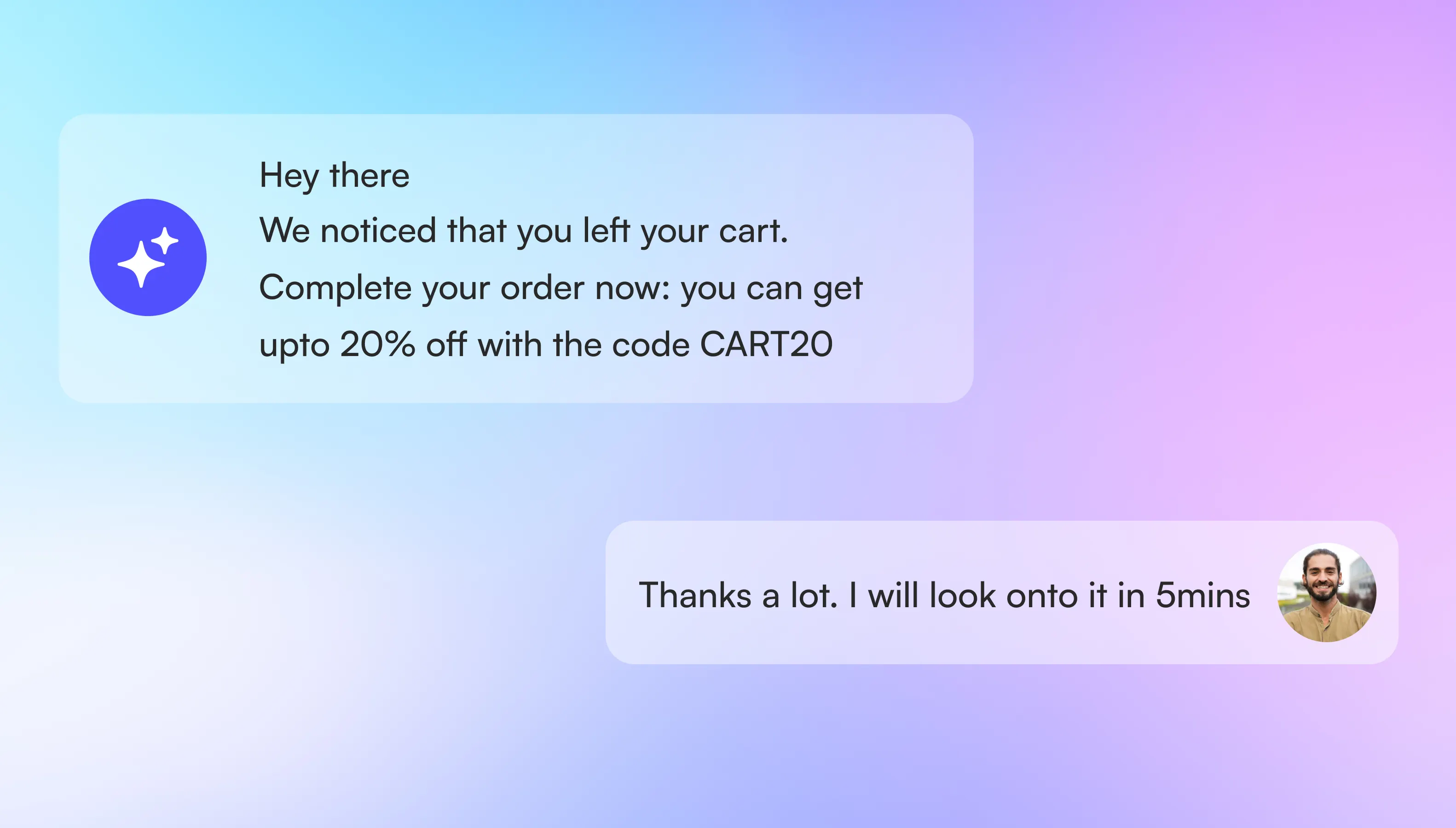
- “I noticed you have the Evergreen Jacket in your cart. Anything I can help with before you go?”
- The shopper responds: “The shipping is too much.” Now the agent knows the exact reason for the abandonment.
- It offers a solution: free shipping on orders above a threshold, or a product swap that qualifies
- Email cannot do this. It sends a generic reminder. The agent has a targeted recovery conversation.
Follows up across WhatsApp, SMS, and phone
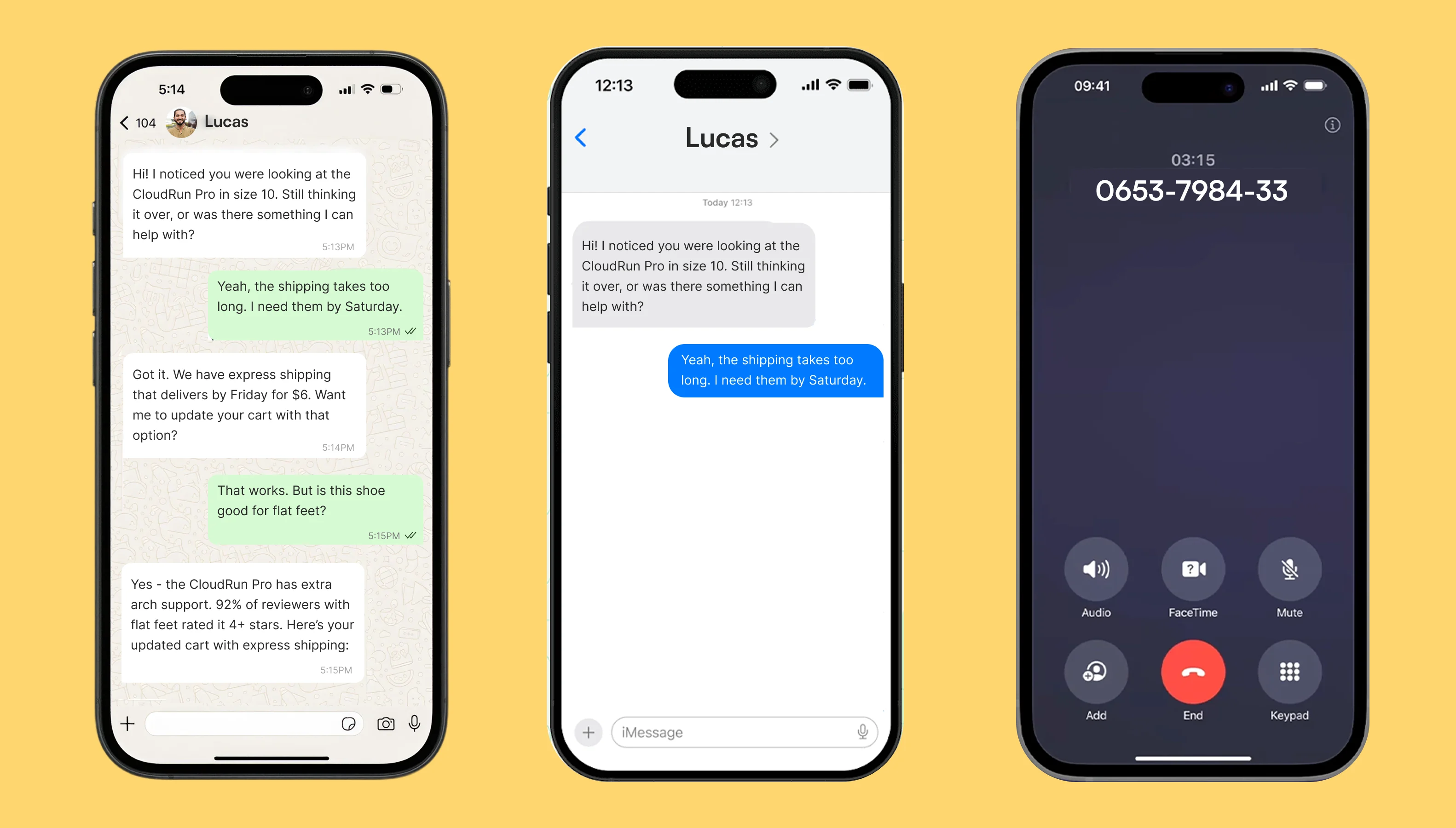
- If the shopper leaves before the on-site conversation starts, the agent follows up on the channel most likely to get a response
- WhatsApp: high open rates (58-79% for business messages per Meta Business data, 2024), response within minutes. Includes product image, price, and a one-tap checkout link. Requires prior customer opt-in.
- SMS: 90-second average read time. Short, direct, with a checkout link. Also requires opt-in under TCPA/GDPR.
- Phone (AI voice): for high-value carts, the agent can call within 15-30 minutes. Important: the FCC has ruled AI-generated voices are “artificial voices” under TCPA. Prior express consent is legally required, and penalties run $500-$1,500 per violation. Ensure your consent flows are compliant before enabling AI voice outreach.
- The agent picks the right channel based on the shopper’s opt-in history and preferences - not a fixed sequence
Resolves the specific objection that caused the abandonment
- Shipping concern - agent presents cheaper or free shipping options
- Product question - agent answers from catalog data (size, specs, ingredients, compatibility)
- Price hesitation - agent offers a limited-time incentive or suggests a comparable lower-priced alternative
- Trust concern - agent shares reviews, return policy, and payment security details
- Every recovery is personalized to the reason the shopper left - not a one-size-fits-all discount code
Completes the recovery without your team
- The shopper says “OK, I will buy it.” The agent sends a direct checkout link with the cart pre-loaded.
- Payment and order confirmation are completed via the checkout link in the shopper’s browser. (Native in-conversation WhatsApp payments are currently available only in select markets like India and Brazil.)
- No hand-off to support. No manual intervention. The agent recovers the cart from detection to purchase.
AI Agent vs Email: Why Conversational Cart Recovery Outperforms Email Sequences
| Capability | Email Sequence | AI Recovery Agent |
|---|---|---|
| Detects exit intent | No. Reacts after the shopper has already left | Yes on desktop. Engages before the shopper closes the tab. On mobile, follows up within minutes |
| Identifies why the shopper left | No. Sends the same message to every abandoner | Yes. Asks the shopper and gets the specific reason |
| Resolves product questions | No. Links to FAQ or support page | Yes. Answers sizing, compatibility, ingredients from catalog data in conversation |
| Adjusts offer based on response | No. Pre-written sequence runs regardless | Yes. Changes approach based on what the shopper says |
| Recovers on WhatsApp and SMS | Limited. Separate tools needed | Built-in. Same agent, same conversation, same cart data across all channels (with opt-in) |
| Handles high-value carts differently | No. Same flow for a $30 cart and a $500 cart | Yes. Prioritizes high-value carts with personalized outreach |
| Works without discounting | Rarely. Most sequences offer 10% off by email 2 or 3 | Yes. Resolves the objection first. Discounts only when configured |
The table makes it clear: email sequences and AI agents are not competing tools - they operate on different levels. Email sends reminders. The AI agent detects intent, has conversations, resolves objections, and completes recovery. They work together, but the agent handles the cases email was never built to handle.
For a shipped ecommerce implementation, see the AI ecommerce automation platform case study, which connects commerce workflows beyond a single cart-recovery touchpoint.
What AI Cart Recovery Conversations Look Like in Practice
Example 1: Mid-AOV - Running shoes on WhatsApp ($89)
A shopper adds a $89 running shoe to the cart on your website. Gets to checkout. Sees 5-7 day shipping. Closes the tab. The AI agent sends a WhatsApp message 12 minutes later:
Agent: “Hi! I noticed you were looking at the CloudRun Pro in size 10. Still thinking it over, or was there something I can help with?”
Shopper: “Yeah, the shipping takes too long. I need them by Saturday.”
Agent: “Got it. We have express shipping that delivers by Friday for $6. Want me to update your cart with that option?”
Shopper: “That works. But is this shoe good for flat feet?”
Agent: “Yes - the CloudRun Pro has extra arch support. 92% of reviewers with flat feet rated it 4+ stars. Here’s your updated cart with express shipping:”
Shopper: “Done. Just ordered.”
Example 2: High-AOV - Furniture on website chat ($680)
A shopper adds a $680 mid-century dining table to the cart. Spends 4 minutes on the checkout page. Stops typing. The on-site agent engages:
Agent: “I see you’re looking at the Walton Dining Table. It’s one of our most popular pieces. Anything I can help with before you check out?”
Shopper: “I’m not sure about the delivery. My apartment has narrow hallways.”
Agent: “Great question. This table ships in two boxes and assembles on-site - the largest box is 48” x 24”. It fits through standard doorways (30”+). Delivery is free, and our team does in-room assembly. Would you like to proceed?”
Shopper: “What if it doesn’t match my space? What’s the return policy?”
Agent: “30-day returns, free pickup. We also have a color sample kit I can send you today at no cost if you’d like to see the finish before committing.”
Shopper: “Actually, the return policy is enough. I’ll go ahead.”
What happened in both conversations:
Specific objections resolved in real time: delivery speed, product fit, dimensions, return policy. No discounts were needed in either case - the shoppers’ real problems were information gaps, not price. $769 in combined revenue recovered in under 5 minutes with zero staff involvement. An email would have arrived 45 minutes later saying “You forgot something!” - and both shoppers would likely have moved on.
The agent does not just recover the sale - it also recommends alternatives and complementary products within the same conversation. For a deeper look at how this works across your entire catalog, see our guide on AI agents for product recommendations in ecommerce.
What Changes in Your Ecommerce Business After AI Cart Recovery Agent is Live?
Deploying an AI agent for abandoned cart recovery does not just recover lost sales. It changes how your ecommerce business operates across marketing, support, margins, and customer relationships.
You stop losing margin to discount-dependent recovery
Your email sequence offers 10% off by email 2 or 3. Your customers learn the pattern: add to cart, leave, wait for the discount. Your margins shrink. The AI agent resolves the real objection - shipping info, sizing question, payment trust - without discounting. Because the agent is designed to address objections before offering incentives, the majority of agent-recovered carts involve zero discounts. The customer buys at full price because their actual problem was answered, not because they were bribed.
You learn exactly why your customers don’t buy
Every agent conversation generates data your analytics dashboard cannot give you. You learn which products cause the most sizing questions, which price points trigger shipping cost hesitation, which checkout step has the highest drop-off, and which product pages create the most doubt. This is not click data - this is the customer telling you, in their own words, what stopped them. Use it to fix product pages, adjust pricing, improve size guides, and reduce cart abandonment at the source.
Your ad spend starts converting the traffic you already paid for
You spend money driving visitors to your store through ads, SEO, and content. If 70% of those visitors abandon their cart, you are wasting the majority of that spend at the final step. An AI agent that recovers even 10-15% of abandoned carts in its first year means your effective cost per acquisition drops significantly. You do not need more traffic. You need more of the traffic you already have to complete the purchase.
Your support team stops handling pre-purchase questions
Sizing questions, shipping inquiries, compatibility doubts, return policy clarifications - these are not support issues. They are purchase-blocking questions that currently land in your support inbox. The AI agent answers them during the cart recovery conversation before they ever become tickets. For more on how AI reduces post-purchase support load, see our guide on AI agents for order tracking.
You recover revenue at 2 AM without hiring night staff
Over 60% of ecommerce traffic is mobile, and most mobile shopping happens in the evening, on weekends, and during commutes. Your email sequence sends a reminder that sits unread until morning. The AI agent recovers the cart at 11 PM on a Sunday, when the shopper is still in the buying mindset and no one on your team is working.
Recovered customers become repeat buyers
A shopper whose objection was resolved personally - whose sizing question was answered in seconds, whose shipping concern was handled with a real alternative - remembers that experience. That surprise creates loyalty. Industry data suggests that recovered customers often show higher repeat purchase rates than customers who bought without hesitation, because the agent created a personal interaction they were not expecting.
Which Ecommerce Stores Recover the Most Abandoned Carts With AI Agents?
AI abandoned cart recovery works for any ecommerce store losing revenue to unfinished checkouts. But certain store types see faster results based on cart value, product complexity, and customer behavior. For a broader view of how AI agents are transforming ecommerce operations:
Fashion and Apparel
- High cart values ($80-$300+) with sizing as the #1 abandonment reason
- The agent answers: “Will this fit me? What if I need to return it?” - with brand-specific size data and return policy
- Stores with 30%+ return rates see the biggest impact because the agent gets the size right before purchase
Beauty and Skincare
- Ingredient concerns cause a significant share of abandonment in this category
- The agent answers: “Is this fragrance-free? Will it react with my sensitive skin?” - with ingredient-level data
- Builds purchase confidence that static product pages cannot match
Electronics and Gadgets
- Compatibility questions are the biggest cart killer: “Will this case fit my phone model?” “Does this charger support fast charging?”
- The agent confirms compatibility in real time before the shopper leaves to check Reddit
- Higher cart values ($100-$500+) mean each recovered cart has significant revenue impact
Subscription and DTC Brands
- Shoppers hesitate at recurring commitments: “Can I cancel anytime? What if I do not like it?”
- The agent explains cancellation flexibility, first-order guarantees, and trial options
- Subscription recovery is especially valuable because one recovered cart generates months of recurring revenue. See our guide on AI agents for customer retention for more
Home and Furniture
- High-AOV purchases ($200-$2,000+) with delivery cost and timeline as primary abandonment triggers
- The agent answers: “How long is delivery? Is assembly included? What if it does not fit my space?”
- One recovered furniture purchase can pay for the agent’s monthly operating cost
How to Measure Whether Your AI Cart Recovery Agent Is Working
You cannot improve what you do not measure. These are the five metrics that tell you whether your AI agent for abandoned cart recovery is delivering real results:
Cart recovery rate
- Percentage of abandoned carts that the agent converts into completed purchases
- Email benchmark: 5-14% (well-optimized). AI agent benchmark: 8-15% in year one, 15-25% at maturity.
- Measure weekly. Compare against your email-only recovery rate from the same period last month.
Recovered revenue
- Total revenue from purchases that were abandoned and then recovered by the agent
- This is the number your CFO cares about. Track it monthly and compare against the agent’s operating cost.
- Example: 100 recovered carts at $85 average = $8,500/month in recovered revenue
Time to recovery
- How quickly the agent engages the shopper after abandonment and how quickly the purchase completes
- Best-performing agents engage within 5 minutes (on-site) or 10-15 minutes (WhatsApp/SMS)
- Shorter time to recovery = higher conversion. Every hour of delay reduces recovery probability significantly.
Discount rate per recovery
- Percentage of recoveries that required a discount vs. those resolved without one
- A well-configured AI agent resolves most objections without discounting (shipping info, product questions, trust signals)
- If your agent is offering discounts on more than 30% of recoveries, the objection-handling logic needs tuning
Recovery by channel
- Which channel (website chat, WhatsApp, SMS, phone) recovers the most carts and at what rate
- Use this data to optimize your recovery sequence: if WhatsApp converts at 3-5x the rate of email, shift volume accordingly
- Most stores find that WhatsApp and SMS outperform email meaningfully for abandoned cart recovery
Conclusion
Every abandoned cart is a customer who was interested enough to add a product, go to checkout, and start the buying process. They did not leave because they did not want your product. They left because something stopped them - and nobody was there to help.
An AI agent for abandoned cart recovery is that help. It detects the moment of hesitation, starts a conversation, resolves the specific objection, and brings the shopper back - in real time, on any channel, at any hour. The difference between a 5% recovery rate and a 20% recovery rate is not a better email subject line. It is having a conversation instead of sending a notification.
Start with a free cart recovery audit for your store. We analyze your current abandonment rate, review your existing recovery flow, and show you exactly how much revenue an AI agent would recover based on your actual numbers.
I am the founder and CEO of Bitontree, where I lead embedded AI engineering teams that build and run production AI: agents, RAG and knowledge systems, document AI, and workflow automation for healthcare, logistics, legal, and SaaS companies. I write about what it actually takes to ship AI that survives contact with production.
Frequently Asked Questions
How is an AI agent for abandoned cart recovery different from Klaviyo or Mailchimp email flows?

Email flows send one-way reminder messages after the shopper has left. An AI agent starts a real-time conversation while the shopper is still on your site or within minutes on WhatsApp and SMS. It identifies why the shopper left, resolves the specific objection, and completes the recovery in the same conversation. Email is a reminder. The agent is a recovery.
Does the AI agent work with Shopify, WooCommerce, and BigCommerce?
Yes. Bitontree’s cart recovery agents integrate with Shopify, Shopify Plus, WooCommerce, BigCommerce, Magento, and custom ecommerce platforms via API. The agent accesses your cart data, product catalog, inventory, and shipping options in real time.
Can the agent recover carts on WhatsApp?
Yes. The agent sends a personalized WhatsApp message with the abandoned product, answers questions in a two-way conversation, and sends a direct checkout link. WhatsApp business messages see open rates of 58-79% and significantly outperform email for cart recovery. Note: WhatsApp outreach requires prior customer opt-in and WhatsApp Business API approval from Meta (2-4 weeks).
Does it always offer a discount to recover the cart?
No. The agent first resolves the actual objection - shipping cost, delivery speed, product question, payment trust, or sizing doubt. Discounts are offered only when necessary and only based on rules you configure. Most recoveries happen without a discount because the real problem was information, not price.
What cart recovery rate can I expect?
First-year implementations typically achieve 8-15% recovery rates as the agent’s objection-handling is tuned. Mature deployments with optimized conversation flows can reach 15-25%. The exact rate depends on your cart value, product complexity, catalog data quality, and the speed of engagement. For comparison, well-optimized email sequences typically recover 5-14%.
Does the agent replace my existing email recovery flow?
No. The agent works alongside your email flow. It handles real-time, conversational recovery on your website, WhatsApp, and SMS. Your email flow continues as a baseline reminder for shoppers who do not engage with the agent. Together, they cover more channels and more abandonment scenarios than either one alone.
How quickly does the agent engage after a cart is abandoned?
On your website (desktop), the agent can engage when it detects exit intent - before the shopper has actually left. On mobile and off-site channels (WhatsApp, SMS), the agent follows up within 10-15 minutes of abandonment. Speed matters: recovery rates drop meaningfully with every hour of delay.
How long does setup take?
A focused deployment covering website cart recovery takes 4-6 weeks. Full deployment including WhatsApp, SMS, AI voice calls, and CRM integration takes 8-14 weeks. The longest phase is configuring the objection-handling logic and connecting to your product catalog.
What does it cost?
Custom AI cart recovery agents start at $15,000-$25,000 for setup depending on channels and platform complexity. Monthly operations: $1,500-$3,000 including AI and messaging costs. Typical payback: 1-3 months based on your cart volume and average order value.
Why build a custom agent instead of using Tidio, Rep AI, or Octane AI?
SaaS tools offer plug-and-play email + SMS recovery with templated message sequences. They work well for straightforward products and standard checkout flows. A custom agent makes sense when you need true conversational recovery (not templates), multi-channel coordination, catalog-aware objection resolution, or deep integration with your specific tech stack. We help you decide which path fits during the audit.


