September 30, 2025
How to Start an AI Automation Project: Step-by-Step Implementation Guide for Business Success

Yash Vibhandik
CEO


The world is changing because of artificial intelligence. AI is projected to add $15.7 trillion to the economy. Companies are investing billions in this powerful technology, and most organizations say AI is a top business priority. If you're wondering how to start AI automation in your organization, understanding the right AI automation strategy is crucial from day one.
However, there is a big problem. A recent MIT study shows a shocking truth. 95% of enterprise AI pilot programs fail; they do not deliver any financial return. This is not a technology failure. It is an execution failure. You need a better plan for your AI automation project. Many surveys report that companies see a return. Yet, the data reveals a harsh reality. Only 5% of projects have a real impact.
What makes this 5% different? It is not about having better technology. The divide is strategic. Successful companies have more discipline and rigour. They are better at AI automation implementation.
To succeed, you need a disciplined, step-wise journey through AI project planning. This framework provides a clear AI implementation roadmap. It helps you navigate the complexities of AI adoption framework principles. Follow this process to gain a competitive advantage. Avoid wasting millions on abandoned projects.
Understanding AI Automation: What Does it Mean

AI automation represents the convergence of artificial intelligence and traditional workflow automation. It doesn't just follow rules but can think, adapt, and decide. Unlike simple automation that just connects apps, AI workflow automation includes machine learning, natural language processing and decision making to handle complex tasks that require human intelligence.
Not just a traditional spreadsheet ecosystem, business process automation with AI can analyze that data, qualify leads, send personalized responses and even make strategic recommendations. That's why 60% of companies have already implemented automation by 2024.
Modern AI automation works through several key components that work together seamlessly:
- Triggers start the process; whether it's a new email, form submission or scheduled time.
- Filters determine what should continue through the workflow.
- The intelligence layer is where AI models analyze, interpret and decide on the data.
- Actions do the actual work: Send emails, update databases or create documents.
- Formatters make sure data is formatted for the next step in the process.
Step-by-Step Process to Set up an AI Automation Project
Let's see the step-by-step AI automation guide process to set up an AI automation project.
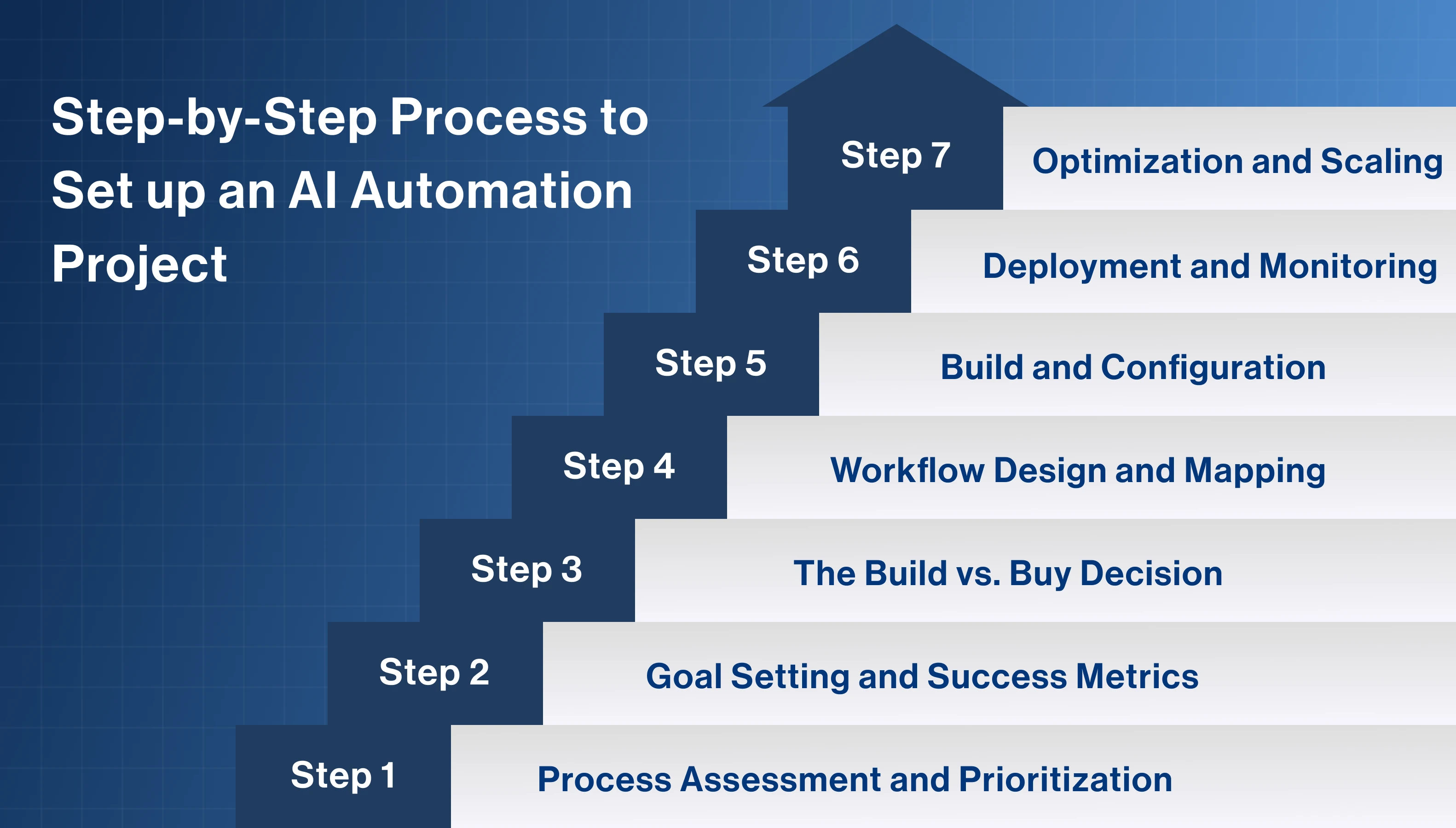
Step 1: Process Assessment and Prioritization
The first step of any AI automation project is to assess current workflows. So, look for processes that are repetitive, rule-based, time-consuming and error-prone. Choose the tasks where human error rates are high, bottlenecks slow things down, or 24/7 would add huge value.
You need to focus on high-impact, low-risk processes first when you start AI automation. Document your current workflows thoroughly, every step, decision point and handoff. This will reveal not just what to automate but how automation can improve the process. For simplicity, create a priority matrix ranking potential automation projects based on business impact vs implementation complexity.
Step 2: Goal Setting and Success Metrics
The next step in your AI automation implementation is to set clear, measurable goals for your automation project. Instead of vague goals like "improve efficiency," set specific targets: Reduce processing time by 50%, eliminate 80% of manual data entry, or achieve 95% lead qualification.
Define both quantitative and qualitative success metrics as part of your AI project planning. Quantitative measures are cycle time reduction, error rate decrease, processing volume increase, and cost savings. According to data, Small businesses report a $3.50 return for every $1 invested in AI. Qualitative indicators are employee satisfaction improvement, customer experience enhancement, and compliance strengthening. So set these indicators first.
Step 3: The Build vs. Buy Decision
There are two ways to start AI automation: build a custom solution or buy one. Everyone has their choices, but a custom model can create a powerful advantage. But it requires a huge investment in talent and time. Using pre-trained models is faster and cheaper. It costs only 10-15% of a custom solution.
You can use pre-trained models when speed is your top priority in AI integration for business. If you have a future plan to scale up your business, custom models are must have. Or you can also fine-tune a pre-trained model on your data. This offers a great balance of cost and customization.
| Criteria | Pre-Trained Model (API) | Fine-Tuned Model (Hybrid) | Custom-Built Model |
|---|---|---|---|
| Estimated Cost | $20,000 - $80,000 | $50,000 - $150,000 | $500,000+ |
| Time-to-Value | Weeks | Months | 12+ Months |
| Required Expertise | Low (Integration Skills) | Medium (ML Engineering) | High (Data Scientists, Researchers) |
| Data Requirement | Low (API calls) | Medium (Labeled fine-tuning data) | High (Massive, high-quality datasets) |
| Ideal For | Everyday tasks | Company-specific processes | Core, strategic business functions |
Planning to use a pre-trained model for your AI automation strategy? You must consider the following factors:
- Future Scalability: Think about your future business requirements, and analyze whether this model will grow with your business?
- Ease of use: Is the solution easy to use for people with non-technical backgrounds?
- Integration capabilities: Find out how easily the model connects with your existing tech stack for seamless AI integration for business?
- Security features: What security features does the solution offers? Also, think about the compliance adherence.
- Vendor support: In case of any problems or issues, will you get assistance from the vendor? If yes, then which type of support, online via email, phone, or live, or offline assistance?
Or if your business demands a more sophisticated system, custom AI automation is a must-go option. But for this, you need to access some key parameters. Here are two pillars: your data and your team. You need to be very careful about what input you are giving. Is it financial data, transactional data, legal data or maybe operational data? Be specific and strategic about data interpretation because misleading data can ruin the project. So clean and refine the data before input.
The next thing is the team. If you are building a custom AI automation project which oversees vital business operations, then rather than outsourcing, an in-house team gives you more strategic advantages. Not solely data scientists and developers, but you also have to hire these roles for the ultimate outcome:
- Executive Sponsor
- AI Product Manager
- Machine Learning (ML) Engineer
- Domain Expert
Step 4: AI Workflow Automation Design and Mapping
After deciding all, you need to create visual maps of your automated workflows before you build anything. This design phase will save you from costly mistakes and ensure all stakeholders understand the new process. Use flowcharts or process diagrams to show triggers, decision points, actions, and data flows.
Design phase of your "to-be" AI workflow automation, be careful where technology can replace manual steps. What are the specific triggers? What actions will the system perform? What conditional logic does it need to follow? Which systems need to be integrated? The design phase is where you can not just automate existing processes but improve them fundamentally through business process automation with AI.
Step 5: Build and Configuration
If you are using a pre-trained model from a provider, you need to know their offerings. So during building time for your AI automation implementation, you can use the platform's visual tools and pre-built templates. Most modern platforms have drag-and-drop interfaces that make building automations easy, even for non-technical users.
Start with pre-built templates when available, then customize for your needs. This is faster than building from scratch and follows proven patterns. Get a minimum viable automation working first, then add complexity later.
Configure each component carefully: set up triggers with the right filtering criteria, define actions with proper error handling, establish conditional logic for decision points and ensure data formatting between steps.
Step 6: Deployment and Monitoring
Once you've set everything up in your AI implementation roadmap, you can start your pilot to answer your questions and get momentum. A pilot is to reduce uncertainty and not waste millions on a failed deployment. A "failed" pilot that gives you a clear "no-go" is a huge win.
When designing your pilot, focus on a rapid "build, measure, learn" cycle where "human-in-the-loop" design is the way to go. The pilot must include mechanisms for users to give feedback. This feedback is used to retrain and improve the model.
Next is tracking performance against your KPIs with real-time dashboards. This will help you make a data-driven go/no-go decision. This must be a holistic evaluation.
Your evaluation should cover several areas:
- Performance Metrics: How did the pilot perform against your target KPIs?
- Accuracy and Reliability: How well did the model work in the real-world?
- User Adoption and Feedback: Did users use the tool? What was their feedback?
- Scalability Potential: What obstacles would prevent a full-scale rollout?
- Return on Investment (ROI): Can you make a business case for more investment?
Using these evaluations, you can fine-tune your AI automation project for more strategic work.
Step 7: Optimization and Scaling
AI automation is a continuous process. So review the performance data, collect the user response and identify optimization opportunities. Once your first automation is successful, apply those learns to other procedures. Gradually, scale, combine with complexity and confidence with each implementation. The goal is to create an automation-first culture where teams naturally think about how AI can help their workflow through effective AI workflow automation.
Advanced AI Automation Implementation Strategies
Here are some advanced AI automation strategy implementation approaches that you can use in your project.
AI Best Practices
Modern automation platforms have AI capabilities that basically support machine learning models, natural language processing and intelligent decisions. Choose according to your needs when you start AI automation. Data quality is very important in AI automation success. To create a good custom automation project, invest in a data regime to ensure stability, accuracy and access to all data sources.
Safety and Compliance
The AI integration for business system reaches sensitive business data and integrates with important systems. Apply strong authentication, encryption and access control to the company and customer data protection. This is particularly important for financial data, personal information or automation that handles regulated materials.
Change Management and Adoption
Cultural changes are also required for successful AI adoption framework implementation. By explaining employee concerns about job displacement, how automation eliminates tedious tasks and enables more strategic, creative tasks. Provide complete training to your employees on the new automated procedures. They need to know how their role changes, what automation does, when human intervention is required and how normal issues are prevented.
Overcoming Common Challenges in AI Project Planning
No project is complete without challenges. Here are some common challenges you may encounter in an AI automation project.
Technical Challenges
Technical problems can arise anytime but they require foreshadowing and careful AI project planning. You may encounter obstacles in the integration of new systems, data quality problems and code errors. Here is how you can overcome it:
-
Integration complexity: You will find that integration is your biggest technical obstacle. Your company probably uses dozens of systems; sometimes, you need to integrate them. To address it, you should choose platforms with strong API support and consider comprehensive integration specialists.
-
Data quality problems: Be aware that bad data can undermine your best project. In your workflows, you should implement data verification steps and ensure that information is always accurate.
-
Error handling: While writing AI automation codes, include an indigenous error handling system. This means it can detect errors, logic and clear ways to solve them. The successful system should handle exceptions instead of failing to fail.
Organizational Challenges
The human side of AI automation implementation is as critical as technology. You have to prepare your organization for change and effectively manage expectations. Success depends on bringing your people on the way.
-
Change resistance: You can manage resistance by involving employees in the design process. Tell them transparently about how automation will help them. Stress that AI is a tool to strengthen their work, not to replace it.
-
Skill gaps: You will need to invest in training to close the gaps in skills. Consider a partnership with experts for your first projects. This allows you to build internal skills over time.
-
Unrealistic expectations: To avoid disappointment, you should set clear and achievable goals. Communicate both the potential and the limits of AI. This helps keep everyone aligned and focused.
Strategic Pitfalls
Avoiding common strategic mistakes will save you significant time and resources in your step-by-step AI automation guide journey. The biggest mistakes often appear before writing any code. Think carefully about what you automate and which partners you choose.
-
Automation of broken processes: You should never automate a broken process. This will only exacerbate existing problems. First, analyze and improve your workflow, and then use automation.
-
Excessive automation: Be careful not to be too much, as it can make your organization less flexible. You should always maintain human oversight, especially for tasks that require judgment or creativity.
-
Supplier locking: To avoid locking into one supplier, select platforms with good export options. Prefer standard integration and avoid proprietary formats if you can. Think about the long-term impact of your possibilities.
Wrapping Up Your AI Implementation Roadmap
Success with AI automation isn't about having the most advanced technology. It's about having the most disciplined AI automation strategy. By following this step-by-step AI automation guide, you can build a solid foundation and start AI automation to turn the promise of AI into a measurable reality for your business through effective business process automation with AI.
Ready to move your AI automation project from pilot to profit? Bitontree provides the strategic guidance and technical expertise to navigate your AI automation implementation journey. We help you build a clear, data-driven AI implementation roadmap for success.
If you need help choosing the first automation workflow, our AI consulting services can validate readiness, business impact, and technical feasibility before a full build.
I am the founder and CEO of Bitontree, where I lead embedded AI engineering teams that build and run production AI: agents, RAG and knowledge systems, document AI, and workflow automation for healthcare, logistics, legal, and SaaS companies. I write about what it actually takes to ship AI that survives contact with production.
Frequently Asked Questions
What’s the single biggest mistake companies make when starting with AI automation?
The most common mistake is focusing on the technology first instead of the business problem. Many organizations rush to adopt AI tools without identifying a clear, high-impact use case. This leads to scattered pilot projects that don’t align with strategic goals or deliver measurable ROI.
How long should an AI automation program take to implement?
The AI automation program implementation timeline varies based on automation and complexity. For a small project, it can be completed in 5 to 12 weeks, and for larger custom models, it can stretch upto 1 year.
How do I measure the ROI of AI automation projects?
ROI can be measured using both quantitative and qualitative metrics. Quantitative measures include reduced processing time, cost savings, error reduction, and increased output. Qualitative benefits include improved employee satisfaction, better customer experience, and stronger compliance.
Do I need a huge team of data scientists to get started with AI Automation?
No, you don’t. For a small project, you can use pre-trained models from reputable vendors.