


An AI agent for sales handles lead qualification, CRM data enrichment, follow-up sequencing, proposal generation, meeting scheduling, competitive analysis, and pipeline forecasting - across your website, email, LinkedIn, and phone. Our AI sales automation deployments achieve 35% higher conversion rates within the first 90 days and reduce cost per qualified lead by 40-60%.
Your sales team spends 65% of their time on work that is not selling. They are updating CRM records, writing follow-up emails, researching prospects on LinkedIn, building proposals from templates, and manually scoring leads that should have been disqualified on day one. The pipeline is full of contacts that will never buy, and the deals that will close are buried under the noise.
An AI sales agent does not send your prospect a brochure. It qualifies the lead against your ICP, enriches the CRM record with firmographic and intent data, drafts a personalized outreach sequence, books the meeting, prepares the pre-call brief, generates the proposal after the demo, and follows up until the deal closes or disqualifies - without your rep touching the busywork.
This guide covers what an AI agent for sales actually does, the specific use cases it handles in production, the measurable benefits it delivers, and how we implement one that drives pipeline velocity without replacing your sales team. We also build custom AI agents and AI chatbots for teams that need a different scope.
What Is an AI Agent for Sales?
An AI agent for sales is an autonomous system that receives a sales trigger - a new lead, a website visit, an inbound inquiry, a deal stage change - reasons about what action to take, retrieves live data from your CRM and enrichment sources, executes the next step in your sales process, and reports the outcome to your team - without waiting for a rep to manually work the lead.
Unlike a chatbot that answers prospect questions from a knowledge base, a sales agent takes action. A new lead fills out your demo request form. The agent enriches the contact with firmographic data from Clearbit or ZoomInfo, scores the lead against your ICP criteria, checks your CRM for duplicate records or existing accounts, assigns the lead to the right rep based on territory and segment, drafts a personalized outreach email referencing the prospect’s company and use case, and books the meeting on the rep’s calendar. The rep did not research. They did not write. They showed up prepared.
Modern AI sales agents are built on three core technologies:
Large language models (LLMs) like GPT-4o, Anthropic Claude, or Meta Llama that understand prospect intent, reason about deal context, generate personalized outreach, and produce proposals - not robotic templates.
Retrieval-augmented generation (RAG) pipelines built on LangChain with Pinecone or Weaviate that search your product documentation, pricing rules, competitive intelligence, and case studies in real time - so the agent sells from your actual data, not from its general training.
Tool calling and system integration via Model Context Protocol (MCP) and custom APIs that let the agent read from and write to your CRM (Salesforce, HubSpot), enrichment platforms (Clearbit, ZoomInfo, Apollo), email systems, calendar tools, and proposal software - taking real actions in your production systems.
The result is a 24/7 sales engine that qualifies leads instantly, enriches every record, follows up consistently, and hands your reps only the opportunities that deserve their time.
Why Sales Teams Need AI Agents
Sales automation through an AI agent is not about replacing your closers. It is about eliminating the 65% of their day spent on work that never touches a prospect.
Your reps spend 65% of their time not selling
CRM updates. Lead research. Email drafting. Meeting scheduling. Proposal assembly. Data entry. Every hour your top closer spends on admin is an hour they are not on a call with a qualified buyer. Salesforce research shows reps spend only 28% of their week actually selling. An AI sales agent handles the other 72% - so your reps spend their day on conversations, not spreadsheets.
47% of your pipeline will never convert
Your reps are working leads that were never going to buy. Bad-fit companies, unqualified contacts, tire-kickers who downloaded a whitepaper and ghosted. Without intelligent qualification, every lead gets the same follow-up sequence and the same rep time. An AI agent scores every lead against your ICP within seconds of arrival, routes qualified leads to reps immediately, and moves unqualified contacts into nurture sequences automatically. Your pipeline shrinks in size but grows in conversion rate.
Follow-up inconsistency is killing deals that should close
80% of sales require 5+ follow-ups. But most reps stop after 2. Not because they are lazy - because they are juggling 40 leads and the follow-up for that mid-funnel prospect falls off the calendar. An AI agent never forgets. It executes your follow-up cadence at the right time, in the right channel, with the right message - every time, for every deal in the pipeline.
Your CRM data is incomplete, outdated, and unreliable
Reps hate data entry. So they skip it, abbreviate it, or do it three days late. Your CRM is full of contacts with no company size, no industry, no last-activity date, and deal stages that have not been updated in weeks. An AI agent enriches every record at creation with firmographic, technographic, and intent data - and keeps it current as deals progress. Your forecasts become accurate because the data underneath them is finally real.
Your best reps are doing work that junior SDRs should not be doing either
Lead research, email personalization, proposal assembly, meeting scheduling - this work does not require sales judgment. It requires pattern execution. An AI agent handles the execution. Your SDRs focus on outbound prospecting. Your AEs focus on closing. Everyone works at the top of their capability instead of the bottom.
In short: the problem is not that your sales team is too small. The problem is that your team spends most of their time on work that does not require a human. AI agents do not replace your sales team. They give your reps back the hours they are currently burning on admin, research, and follow-up - so every hour is spent on pipeline that converts.
Key Use Cases of AI Agents for Sales
An AI agent for sales goes far beyond lead scoring. Here are the specific use cases that production deployments handle - each one combines high volume, clear business rules, and multi-system execution.
Lead Qualification, Scoring, and Intelligent Routing
Every inbound lead is scored within seconds of arrival against your ICP criteria: company size, industry, technology stack, funding stage, geographic region, and buying intent signals. Qualified leads route to the right rep based on territory, segment, and capacity. Unqualified leads enter automated nurture sequences. No more rep time wasted on leads that will never convert. Scoring accuracy exceeds 90% when trained on your historical conversion data.
Best for: Any sales team handling 200+ inbound leads/month where reps currently spend 30-40% of their time qualifying contacts that should have been filtered automatically.
CRM Data Enrichment and Hygiene
The agent enriches every new contact and account with firmographic data (company size, revenue, industry, headcount), technographic data (tech stack, tools used), and intent signals (content downloads, pricing page visits, competitor research). Existing records are continuously updated. Duplicates are detected and merged. Stale deals are flagged. Your CRM stops being a graveyard of incomplete records and starts being a reliable source of pipeline intelligence.
Best for: B2B sales teams where CRM data quality directly affects forecasting accuracy and reps skip data entry 60-70% of the time.
Personalized Outreach and Follow-Up Sequencing
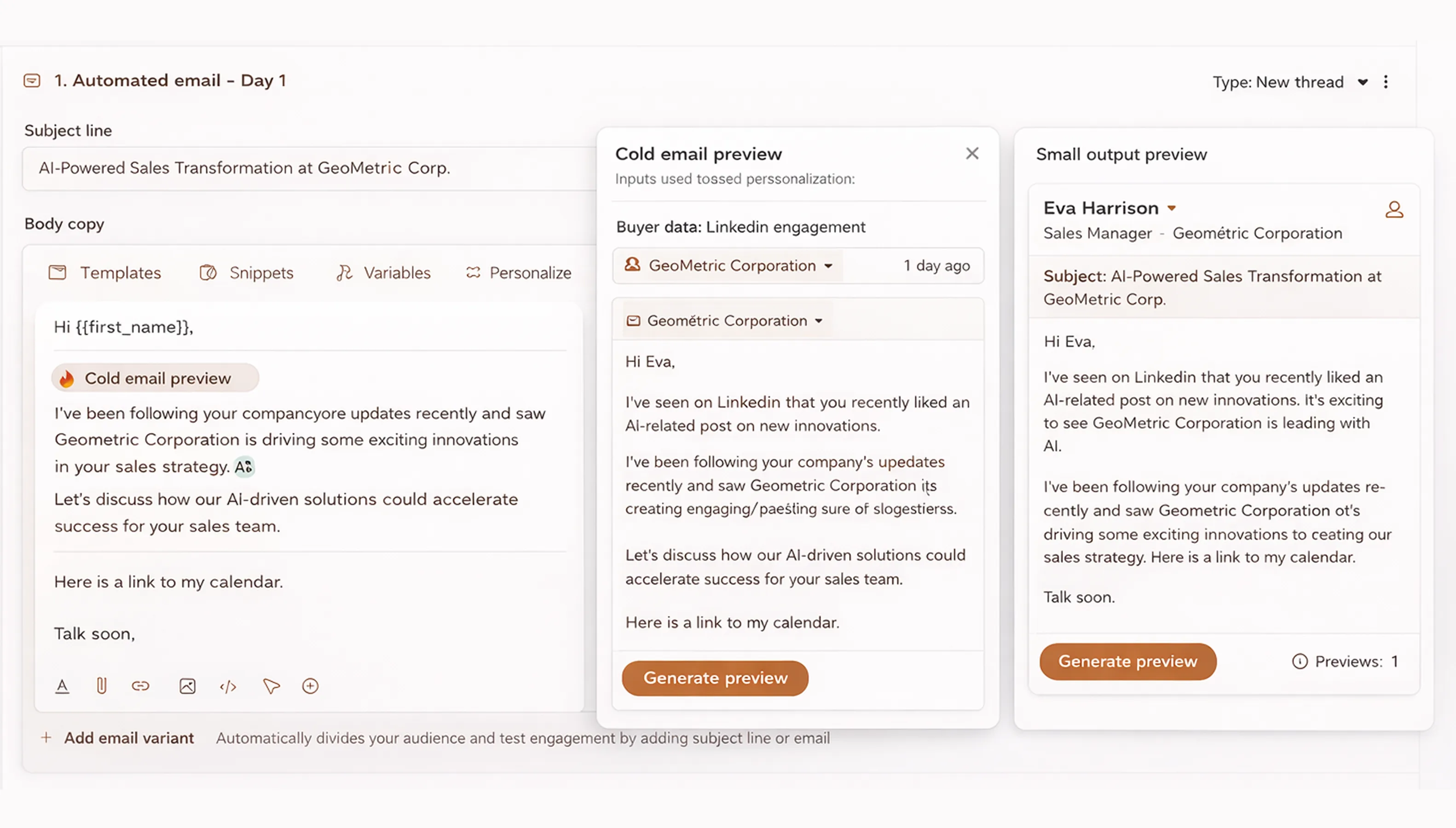
The agent drafts personalized emails for every stage of the buyer journey - initial outreach, post-demo follow-up, proposal delivery, objection handling, and re-engagement for gone-dark deals. Each message references the prospect’s company, role, pain points, and prior interactions. Follow-ups execute on schedule across email, LinkedIn, and SMS. No lead falls through the cracks because a rep forgot to send the third touch.
Best for: SDR and BDR teams running outbound sequences where personalization at scale is the difference between 2% and 15% reply rates.
Meeting Scheduling and Pre-Call Intelligence
When a prospect is ready to meet, the agent checks the rep’s calendar, proposes available times, handles timezone conversions, sends the invite with a personalized agenda, and delivers a pre-call brief to the rep: company overview, recent news, tech stack, decision-maker map, prior interactions, and competitive landscape. The rep walks into every meeting prepared without spending 20 minutes researching.
Best for: AE and enterprise sales teams where deal complexity requires preparation and reps currently spend 15-20 minutes researching before every call.
Proposal and Quote Generation
The agent assembles proposals using your approved templates, pulls in the relevant product modules, applies pricing rules based on deal size and segment, adds case studies matched to the prospect’s industry, and generates the document in your branded format. For configurable products, it calculates pricing based on usage tiers, seat counts, or custom parameters. Reps review and send - instead of spending 2 hours building from scratch.
Best for: SaaS and professional services teams with configurable pricing where proposal assembly currently takes 1-3 hours per deal.
Competitive Intelligence and Battlecard Delivery
When a prospect mentions a competitor by name or the agent detects competitive evaluation signals, it retrieves the relevant battlecard - competitor strengths, weaknesses, pricing comparison, win themes, and objection-handling scripts - and delivers it to the rep in real time. No more searching through Google Drive for the latest competitive doc. The agent serves the right intelligence at the moment it matters.
Best for: Sales teams in competitive markets where 40-60% of deals involve a head-to-head evaluation and reps need current competitive positioning on every call.
Pipeline Forecasting and Deal Health Monitoring
The agent analyzes every deal in pipeline - activity recency, engagement patterns, stage velocity, contact depth, and sentiment from email exchanges - and generates a deal health score. Stalled deals are flagged before they go dark. High-risk deals get recommended intervention strategies. Forecast accuracy improves because the prediction is based on real behavioral signals, not the rep’s gut feeling about when a deal will close.
Best for: Sales leaders managing $2M+ pipeline where forecast accuracy directly impacts hiring, spend, and board reporting.
Sales Playbook Enforcement and Coaching
The agent monitors deal progression and ensures reps follow your sales methodology. If a deal moves to proposal without a discovery call logged, the agent flags it. If a multi-threaded approach is required above a certain deal size, the agent checks for multiple contacts engaged. After calls, it generates structured summaries with next steps, objections raised, and coaching notes for managers. Your playbook gets followed consistently - not just by your best rep, but by everyone.
Best for: Sales organizations with defined methodologies (MEDDPICC, BANT, Challenger) where playbook adherence directly correlates with win rates.
Agent Assist Mode for Sales Reps
Not ready for full autonomy? Agent-assist mode runs alongside your reps. During live calls, it surfaces relevant product information, pricing, objection responses, and customer history in a sidebar. After calls, it generates summaries, updates the CRM, and queues follow-up tasks. The rep stays in control of every decision. The agent handles the context retrieval and admin that slows them down.
Best for: Enterprise sales teams that need AI productivity gains but want human judgment on every customer interaction during the first deployment phase.
How an AI Sales Agent Works: The Sales Journey
Here is what happens when a new lead enters your pipeline and an AI sales agent is running.
Step 1: A new lead arrives and the agent activates instantly
A prospect fills out a demo form, visits your pricing page, downloads a whitepaper, or is imported from a list. The agent activates within seconds - not hours or days. There is no queue, no round-robin delay, no waiting for a rep to check their inbox on Monday morning. Speed-to-lead drops from hours to under 60 seconds.
Step 2: Agent qualifies and scores the lead
The agent evaluates the lead against your ICP criteria: company size, industry, revenue range, technology stack, funding stage, job title, and buying intent signals. It checks for duplicates in your CRM, identifies if the company is an existing customer or has prior interactions, and assigns a lead score. Qualified leads proceed. Unqualified leads are routed to nurture or disqualified with a reason code.
Step 3: Agent enriches the record with live data
The agent queries Clearbit, ZoomInfo, Apollo, LinkedIn, and your internal data to add firmographic details, org chart information, recent company news, technology stack, and intent signals. The CRM record is complete before a rep ever sees it. No manual research. No incomplete profiles.
Step 4: Agent drafts personalized outreach
Using your messaging templates, brand voice guidelines, and the enriched prospect data, the agent generates a personalized email that references the prospect’s company, role, likely pain points, and the specific value proposition that matches their profile. The message is queued for immediate send or for rep review depending on your configuration.
Step 5: Agent manages the follow-up cadence
If the prospect does not respond, the agent executes your follow-up sequence across email, LinkedIn, and SMS at the intervals you configured. Each follow-up is contextually different - not the same email resent with "just bumping this to the top of your inbox." The agent adjusts messaging based on engagement signals: email opens, link clicks, website revisits, and content downloads.
Step 6: Agent books the meeting and prepares the rep
When the prospect responds positively, the agent proposes meeting times from the rep’s calendar, handles scheduling back-and-forth, sends the invite with a personalized agenda, and delivers a pre-call brief: company overview, key stakeholders, competitive landscape, prior interactions, and recommended discovery questions. The rep walks in prepared.
Step 7: Every interaction feeds your optimization engine
Every lead score, outreach message, response rate, meeting conversion, and deal outcome is logged and analyzed. The agent learns which messaging works for which segments, which follow-up cadences produce the highest reply rates, and which qualification criteria best predict closed-won deals. Your sales process gets smarter every week from production data.
Benefits of AI Agents for Sales
Here is what actually changes when you deploy an AI agent for sales - measured as revenue outcomes, not activity metrics.
Your reps stop researching and start selling
Lead research, CRM updates, email drafting, and meeting prep collapse from hours to seconds. Your reps reclaim 15-20 hours per week that were consumed by admin. That time goes directly into prospect conversations, discovery calls, and deal progression. Pipeline velocity increases because the bottleneck - rep capacity - is no longer spent on work a system should handle.
Your pipeline fills with leads that actually convert
Conversion rates increase by 30-40% when every lead is scored against your ICP within seconds and only qualified opportunities reach reps. Your pipeline shrinks in volume but grows in value. Reps stop chasing bad-fit leads and start closing deals that were always there - buried under the noise of an unqualified funnel.
Your follow-ups happen every time, on time, with the right message
No more deals lost because a rep forgot the third follow-up. The agent executes your cadence on every lead, in every channel, at the configured interval - with personalized messaging that adapts to engagement signals. Reply rates increase because outreach is timely, relevant, and persistent without being robotic.
Your CRM becomes a reliable source of truth
Every record enriched at creation. Every deal stage updated in real time. Every interaction logged automatically. Your forecast becomes accurate because the data underneath it is complete and current - not based on what a rep remembered to type three days after the call. Sales leaders make decisions from pipeline reality, not pipeline fiction.
Your proposals go out in hours, not days
Proposal generation drops from 2-3 hours of manual assembly to 15 minutes of rep review. Pricing is calculated automatically. Case studies match the prospect’s industry. The document arrives in your branded format. Deals move faster because the prospect gets the proposal while the demo is still fresh - not four days later when they have already started evaluating your competitor.
Your new reps ramp in weeks, not quarters
The agent enforces your sales playbook on every deal. New reps get coached in real time: discovery frameworks surfaced before calls, objection handling delivered during calls, and structured summaries with coaching notes after calls. The performance gap between your best closer and your newest hire shrinks because the playbook runs consistently - not just when a manager is watching.
In short: AI agents do not replace your sales team. They eliminate the 65% of rep time that never touches a prospect. Your closers close. Your SDRs prospect. Your pipeline converts. And your CRM finally tells you the truth about where revenue is coming from.
Industries Deploying AI Agents for Sales
AI agents for sales look different in SaaS than in real estate. Here is what production deployments handle across key verticals.
SaaS and B2B Technology
Your SDRs spend half their day qualifying inbound demo requests that should have been scored automatically. Your AEs spend 20 minutes researching before every call. An AI sales agent qualifies every lead in seconds, enriches the CRM record, and delivers a pre-call brief before the rep opens their laptop.
- Inbound lead scoring against ICP with sub-60-second routing to the right AE
- Product-led growth signal detection - free trial activity, feature usage, upgrade triggers
- Automated demo follow-up with personalized recaps referencing features discussed
- Proposal generation with usage-based pricing calculations and relevant case studies
- Churn risk detection for existing accounts with expansion opportunity mapping
- One B2B SaaS company: 40% more qualified pipeline, rep research time dropped from 25 min to 2 min per prospect
Ecommerce and D2C
Your cart abandonment rate is 70%. Your re-engagement emails get 3% open rates because they are generic. An AI sales agent personalizes every recovery touchpoint based on the customer’s browse history, purchase patterns, and price sensitivity - converting abandoned carts into completed orders.
- Cart abandonment recovery with personalized incentives based on customer LTV and margin thresholds
- Post-purchase upsell and cross-sell recommendations triggered by order confirmation
- Win-back sequences for lapsed customers using purchase history and browse behavior
- Wholesale and B2B inquiry qualification with automated quote generation
- Seasonal campaign personalization at scale across email, SMS, and WhatsApp
Financial Services and Insurance
Your advisors spend 40% of their day on compliance documentation and client onboarding paperwork instead of building relationships and closing policies. An AI sales agent handles the admin so your advisors focus on the conversations that build trust.
- Lead qualification based on investable assets, risk profile, and product fit
- Pre-meeting research briefs with portfolio history, life events, and recommended products
- Automated policy renewal reminders with personalized coverage recommendations
- Compliance-aware proposal generation that validates against regulatory requirements
- Cross-sell detection from existing client portfolios - insurance gaps, product upgrades, wealth milestones
Real Estate
A buyer inquiry arrives at 10 PM. By the time your agent responds the next morning, the prospect has already contacted three other brokerages. An AI sales agent responds instantly, qualifies the buyer, matches listings, and books the showing - before your competitor’s office opens.
- Instant buyer qualification based on budget, location preference, property type, and mortgage pre-approval status
- Automated listing matching from MLS data with personalized property recommendations
- Showing scheduling with calendar integration for agents and buyers
- Seller lead nurture sequences with market reports and comparable property analysis
- One brokerage: response time dropped from 14 hours to 45 seconds, lead-to-showing conversion up 55%
Professional Services
Your partners and directors are the rainmakers, but they spend a third of their billable time on proposal writing, RFP responses, and prospect research. An AI sales agent drafts proposals, assembles RFP responses from your knowledge base, and prepares client briefs - so your senior team focuses on relationships, not document assembly.
- RFP response assembly from your knowledge base with capability matching and case study selection
- Proposal generation with rate calculations, team composition, and timeline estimation
- Referral source tracking and automated thank-you sequences to maintain partner relationships
- Pipeline management for long-cycle enterprise deals with multi-stakeholder engagement tracking
- One consulting firm: proposal turnaround dropped from 5 days to 8 hours, win rate up 22%
Common Challenges in AI Sales Agent Deployment - and How We Solve Them
Over 40% of agentic AI projects will be canceled by end of 2027 due to escalating costs, unclear value, or inadequate risk controls (Gartner). Here are the five most common failure modes and how Bitontree prevents them.
Challenge 1: The agent sends wrong or off-brand messages to prospects
A poorly configured sales agent sends an email that misrepresents pricing, makes a commitment the company cannot honor, or uses language that does not match your brand voice. This is the #1 fear that blocks autonomous outreach.
How Bitontree solves this: Every outreach message validates against your brand guidelines and approved messaging before sending. Configurable approval workflows - autonomous for templated outreach, human-review for custom messaging above a threshold. Pricing rules enforced programmatically so the agent cannot quote outside your approved ranges. Sub-1% brand violation rate in production.
Challenge 2: The agent qualifies leads incorrectly
Bad scoring wastes rep time on unqualified leads or, worse, disqualifies prospects that should have been worked. Either direction costs revenue.
How Bitontree solves this: Scoring models trained on your historical conversion data, not generic criteria. Calibration against 90 days of closed-won and closed-lost deals. Continuous retraining as new conversion data arrives. A/B testing of scoring thresholds. Quarterly scoring audits comparing agent qualification against actual outcomes.
Challenge 3: CRM integration breaks or creates data conflicts
The agent creates duplicate records, overwrites rep notes, or triggers conflicting workflows in your CRM. Data integrity issues undermine trust in the entire system.
How Bitontree solves this: Duplicate detection at every write operation. Field-level permission controls - the agent can enrich company data but cannot overwrite rep-entered deal notes. Conflict resolution rules for simultaneous updates. Full audit trail on every CRM modification with rollback capability.
Challenge 4: Prospect data is exposed to the model
Sales conversations contain sensitive information: pricing negotiations, competitive intelligence, personal contact details. Sending this to an LLM without controls creates data privacy risk.
How Bitontree solves this: PII redaction before any data reaches the language model. SOC 2-aware infrastructure. Data retention policies configurable per client. Your data never trains models for other clients. Enterprise deployment options with VPC isolation for regulated industries.
Challenge 5: No visibility into agent performance or ROI
The agent runs for 90 days and nobody can tell you whether it generated revenue or just generated activity. Without attribution, the deployment gets questioned at the first budget review.
How Bitontree solves this: Revenue attribution from first touch to closed-won. Dashboard showing leads qualified, meetings booked, proposals generated, pipeline influenced, and deals closed with AI agent involvement. Weekly optimization reports. Direct comparison: agent-sourced pipeline vs manually-worked pipeline by conversion rate, velocity, and average deal size.
How We Implement an AI Agent for Sales
Here is how we implement an AI sales agent - the process that consistently delivers measurable pipeline impact within 90 days.
Step 1: Sales operations audit and use case mapping
We analyze your CRM data, pipeline metrics, conversion rates by stage, and rep activity patterns. Identify the top 10 use cases by revenue impact. Map which can run autonomously, which need rep approval, and which must stay manual. Define success metrics: pipeline generated, conversion rate improvement, rep time saved, cost per qualified lead. We also review your current tech stack, integrations, and compliance requirements.
Step 2: Agent reasoning design and permissions
We design the decision logic for each use case. Define autonomous actions (lead scoring, enrichment, follow-up), approval-required actions (custom outreach, proposal send), and blocked actions (pricing exceptions, contract modifications). Map every system integration. Set escalation boundaries with your sales leadership. This is where the agent’s judgment is configured - not just what it does, but what it is not allowed to do.
Step 3: Integration and RAG pipeline
We connect the agent to your CRM (Salesforce, HubSpot), enrichment platforms (Clearbit, ZoomInfo, Apollo), email systems, calendar tools, and proposal software. Build the RAG pipeline for product, pricing, and competitive intelligence grounding using LangChain with Pinecone or Weaviate. Every integration includes error handling, retry logic, and fallback behavior. Test against your actual pipeline data.
Step 4: Build, test, and parallel run
Build in 2-week sprints. Outreach quality testing against your brand guidelines. Lead scoring validation against historical conversion data. CRM integration testing for data integrity. Load testing at 3x your peak lead volume. Then 2-4 weeks of parallel run - the agent works your pipeline alongside your reps for validation before going autonomous.
Step 5: Phased deployment and optimization
Launch with the 2-3 highest-impact use cases. Monitor performance daily for the first 30 days. Tune scoring models, outreach messaging, and follow-up cadences based on real engagement data. Expand to additional use cases in 30-day cycles. The agent gets measurably better every month from production feedback - not from retraining, but from observing what converts.
The Conclusion
Your sales team is not the bottleneck. The busywork is. Your representatives spend most of their week on CRM updates, lead research, email drafting, proposal assembly, and follow-up management - work that follows patterns a system should handle. An AI agent for sales eliminates that work end to end: leads qualified in seconds, CRM records enriched automatically, follow-ups executed on schedule, proposals generated in minutes, and meetings booked with pre-call intelligence delivered. Your team gets back the hours they are currently burning on admin - and your pipeline converts because every rep hour goes into the deals that matter.
Bitontree builds AI agents for sales that work your pipeline - not just answer questions. We analyze your CRM data, identify the highest-impact automation opportunities, integrate with the systems your team already uses (Salesforce, HubSpot, Clearbit, ZoomInfo, and your custom platforms), and deploy an agent that improves every week from production data. Whether you are starting with agent-assist mode or going fully autonomous from day one, we engineer the reasoning, the integrations, the guardrails, and the monitoring - so your agent drives revenue in production, not just activity in a demo.
Start with a free sales operations audit. We analyze your pipeline data, map the use cases with the highest revenue impact, and deliver a deployment plan with architecture, timeline, and projected ROI - before you commit to anything.
Frequently Asked Questions
What is an AI agent for sales?

An AI agent for sales is an autonomous system that qualifies leads, enriches CRM data, drafts personalized outreach, manages follow-up cadences, generates proposals, books meetings, and monitors pipeline health - executing your sales process across multiple systems without waiting for a rep to manually work each step.
How does an AI sales agent increase conversion rates?
By qualifying leads against your ICP within seconds (eliminating bad-fit leads from the pipeline), executing follow-ups consistently (no dropped leads), personalizing outreach at scale, and ensuring reps spend their time only on qualified opportunities. Typical deployments see 30-40% conversion improvement within 90 days.
What does an AI sales agent cost?
Cost depends on scope: the integrations, channels, data sources, and compliance requirements involved. We scope every engagement against your stack and give you a clear plan and timeline after a free AI fit assessment, before any commitment.
What systems does it integrate with?
CRM: Salesforce, HubSpot, Pipedrive. Enrichment: Clearbit, ZoomInfo, Apollo, LinkedIn Sales Navigator. Email: Gmail, Outlook, Outreach, SalesLoft. Calendar: Google Calendar, Calendly, Microsoft Bookings. Proposal: PandaDoc, Proposify, custom templates. Custom integrations via API for proprietary systems.
How long does deployment take?
Focused pilot with 2-3 use cases: 6-8 weeks. Full deployment with CRM integration, enrichment, outreach automation, and proposal generation: 8-12 weeks. Enterprise deployments with compliance infrastructure and multi-region setup: 10-14 weeks.
Will it replace our sales team?
No. AI sales agents eliminate the 65% of rep time spent on non-selling activities - CRM updates, lead research, email drafting, follow-up management, and data entry. Your reps spend more time on prospect conversations, discovery calls, and deal closing. The agent makes your team more productive, not smaller.
What if the agent sends a wrong message to a prospect?
Every outreach validates against your brand guidelines and approved messaging. Pricing rules are enforced programmatically. Configurable approval workflows - autonomous for standard sequences, human review for custom messaging. Rollback capability. Sub-1% brand violation rate in production deployments.
How does lead scoring work?
The agent scores every lead against your ICP criteria using firmographic data (company size, industry, revenue), technographic data (tech stack), and behavioral signals (content engagement, pricing page visits). Scoring models are trained on your historical closed-won and closed-lost data, and continuously recalibrated as new outcomes arrive.
Can I start with agent-assist mode before going fully autonomous?
Yes. Agent-assist mode is our recommended starting point for most teams. The agent surfaces intelligence during calls, drafts outreach for rep review, generates pre-call briefs, and handles CRM updates - but every customer-facing action requires rep approval. Most teams move to selective autonomy within 60-90 days after validating accuracy.
How do you measure ROI?
Revenue attribution from first touch to closed-won. Dashboard showing leads qualified, meetings booked, proposals generated, pipeline influenced, and deals closed with agent involvement. Direct comparison: agent-sourced pipeline vs manually-worked pipeline by conversion rate, velocity, and deal size. Weekly optimization reports.
Related AI Agent Use Cases

AI Agent for HR
Manages employee queries, onboarding, and HR processes with real-time, policy-aware responses.

AI Agent for Customer Support
Handles customer queries, resolves issues, and scales support operations with instant, consistent responses.

AI Agent for E-commerce
Drives product discovery, order support, and personalized shopping experiences across channels.