


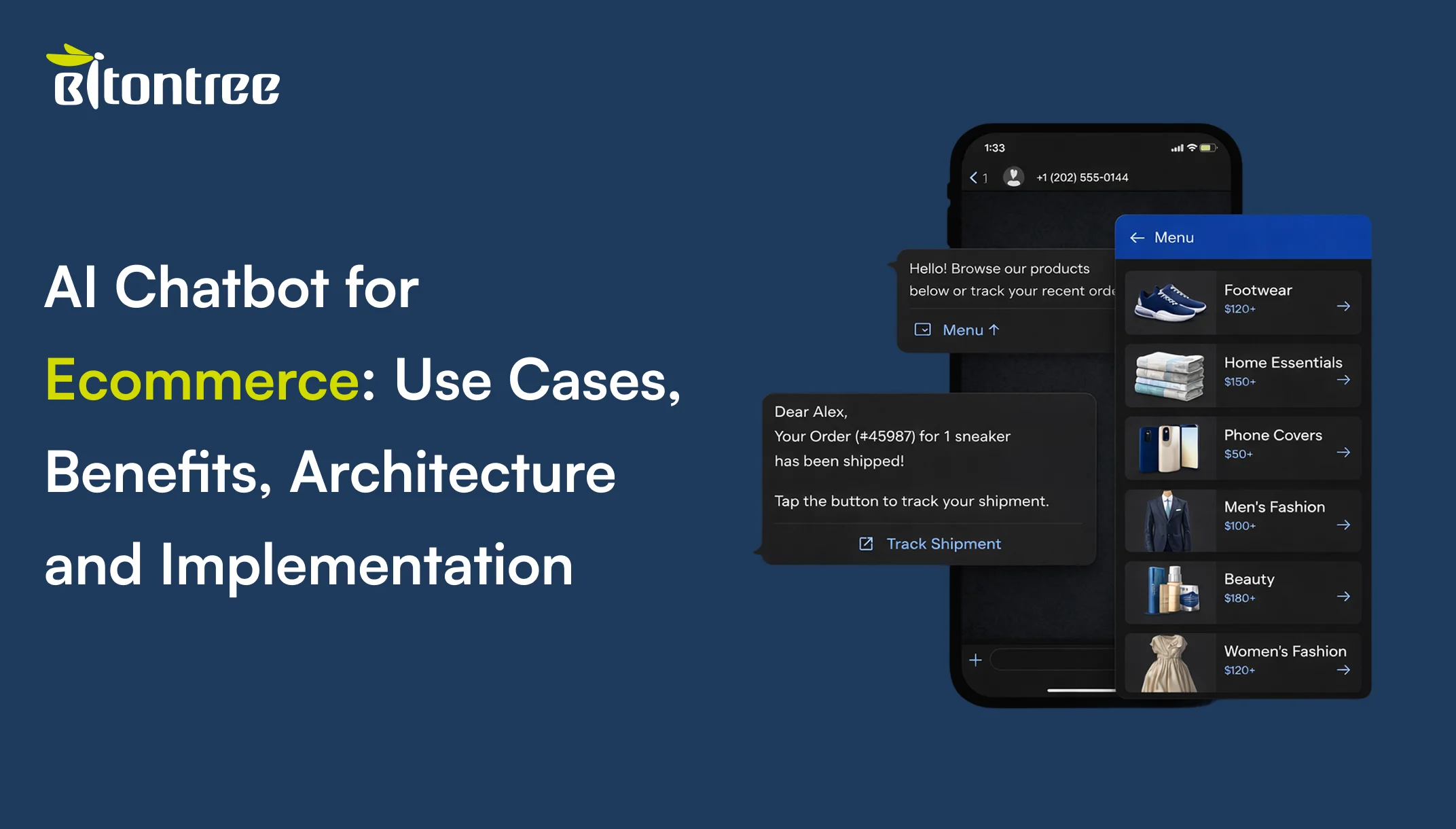
An ecommerce chatbot handles product recommendations, order tracking, cart recovery, returns and refunds, size guidance, and post-purchase support across your website, WhatsApp, Instagram, and Messenger. Our ecommerce deployments generate measurable revenue lift within 30 days and reduce support costs by 40-60%.
Your customers do not call you. They do not email you. They leave. 70% of ecommerce shopping carts are abandoned (Baymard Institute). 53% of shoppers abandon if they cannot find a quick answer to their question (Forrester). Your support team takes 4-12 hours to respond to an email, and by then the customer has already bought from a competitor.
An AI chatbot for ecommerce changes that equation. It engages the customer at the moment they hesitate, answers their question in under two seconds, recommends the right product based on their browsing behavior, and recovers the cart they were about to abandon all without a single support agent getting involved.
This guide covers what an AI chatbot for ecommerce actually does, the specific use cases it handles across the customer journey, the measurable benefits it delivers, and how we implement one that turns browsers into buyers. Read our blog on AI chatbots for online stores for a broader overview of how ecommerce chatbots work.
What Is an AI Chatbot for Ecommerce?
An ecommerce chatbot is a conversational AI system that assists online shoppers throughout the buying journey from product discovery and size guidance to checkout support, order tracking, and returns using your actual product catalog, inventory data, and store policies as its knowledge base.
Unlike a static FAQ page or a basic live chat widget, an AI shopping assistant holds a real conversation. A customer says “I’m looking for running shoes under $120 with good arch support” and the bot searches your product catalog, filters by price and feature, and recommends 3-4 options with images, reviews, and add-to-cart buttons in a single conversational turn.
Modern ecommerce chatbots are built on three core technologies:
Large language models (LLMs) like GPT-4o, Anthropic Claude, or Meta Llama that understand natural shopping queries and generate conversational, helpful responses not robotic scripts.
Product catalog integration and retrieval-augmented generation (RAG) pipelines built on LangChain with Pinecone or Weaviate that search your actual product data, inventory levels, pricing, and reviews in real time so the bot recommends products you actually have in stock.
Ecommerce platform integration with Shopify, WooCommerce, Magento, BigCommerce, and Salesforce Commerce Cloud that lets the bot read orders, process returns, apply discounts, update carts, and check shipping status directly in your store’s backend.
The result is a 24/7 shopping assistant that increases conversion, reduces support costs, and turns every customer interaction into either a sale or a resolved issue.
Why Ecommerce Needs AI Chatbots
Ecommerce automation is not about replacing your customer experience team. It is about catching the revenue that falls through the cracks every day.
The cart abandonment problem
70% of ecommerce carts are abandoned (Baymard Institute). The top reasons: unexpected shipping costs (48%), forced account creation (26%), and unanswered questions about the product (18%). A chatbot that answers sizing questions, explains shipping options, and offers a discount code at the right moment recovers 20-30% of those abandoned carts. For a store doing $500K/month, that is $70,000-105,000 in recovered monthly revenue.
The product discovery problem
Your store has 500, 5,000, or 50,000 SKUs. Your navigation has 12 categories and 40 filters. Your customer wants “a birthday gift for a 10-year-old who likes science.” Your site search returns 200 results. The customer scrolls, gets overwhelmed, and leaves. A conversational product recommendation chatbot narrows 50,000 SKUs to 4 perfect suggestions in 30 seconds.
The support ticket volume problem
Where is my order? Can I return this? What is the refund timeline? Do you ship internationally? Your support team answers the same 15 questions every day. Each ticket costs $3-8 to handle via live chat or email. When you process 2,000 tickets per month and 70% are repetitive, that is $4,200-11,200 per month in costs that a chatbot handles for $0.05-0.30 per conversation.
The after-hours sales gap
40-60% of ecommerce traffic arrives outside business hours. Evenings, weekends, holidays when your support team is offline but your ad spend is still driving visitors. A customer with a sizing question at 11 PM either gets an instant answer from the chatbot and completes the purchase, or they leave and buy from someone who answers faster.
In short: 70% of carts are abandoned, shoppers leave when questions go unanswered, support teams drown in repetitive tickets, and 40-60% of traffic arrives when nobody is working. An ecommerce chatbot solves all four and the revenue impact is measurable from week one.
Key Use Cases of AI Chatbots for Ecommerce
An AI chatbot for ecommerce goes far beyond “Hi, how can I help?” Here are the specific use cases that production deployments handle across the full customer journey.
Conversational Product Recommendations
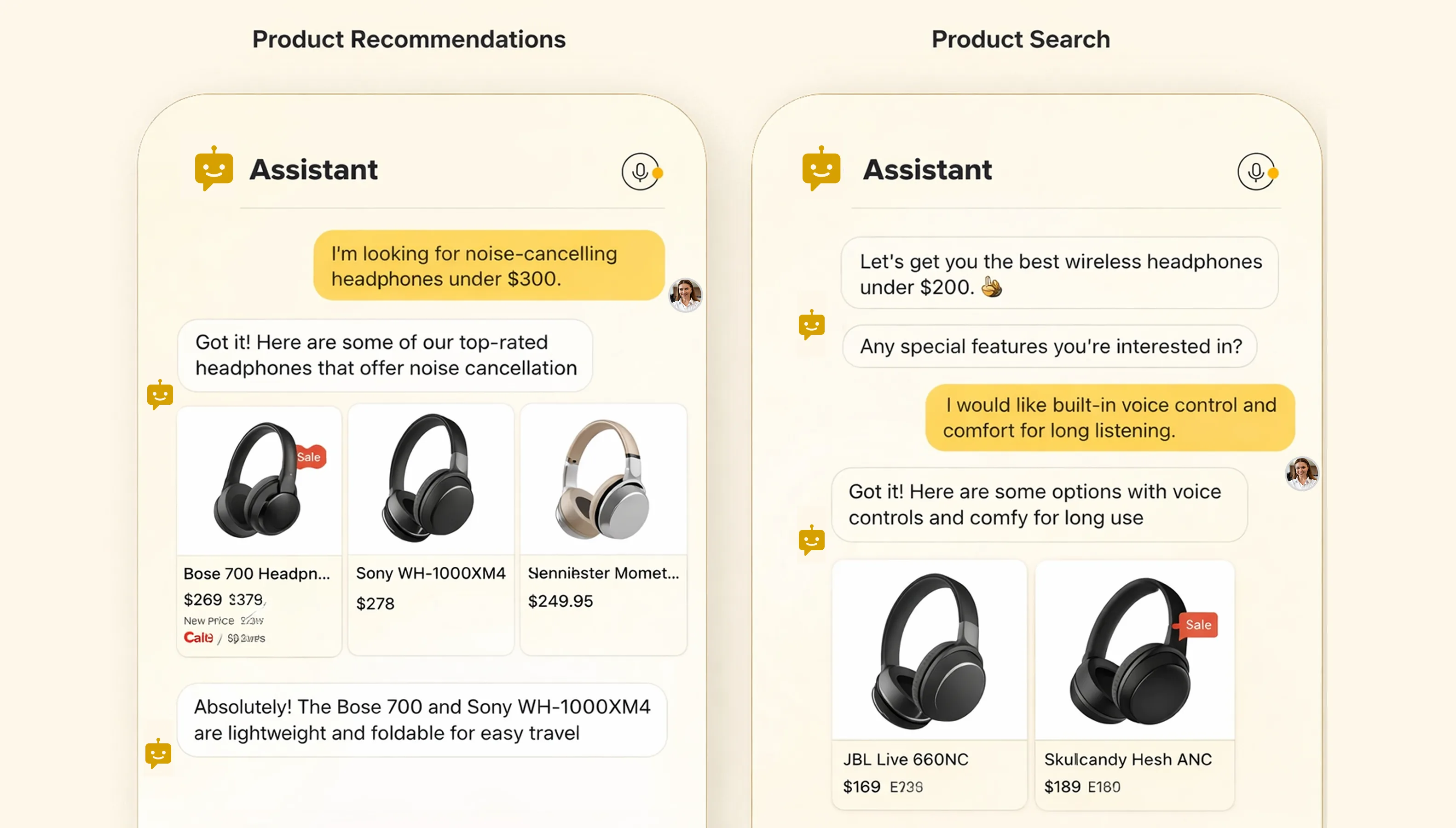
The AI shopping assistant asks what the customer is looking for, understands preferences (budget, style, occasion, size), searches your product catalog in real time, and recommends 3-5 matching products with images, prices, reviews, and direct add-to-cart buttons. It handles follow-ups: “do you have that in blue?” “anything similar but under $80?” This is personal shopping at scale.
Best for: Stores with 500+ SKUs where product discovery is a barrier to conversion.
Cart Abandonment Recovery
When a customer adds items to cart but hesitates, the chatbot triggers with a contextual message: “Still deciding? I can help with sizing for that jacket” or “Want me to check if we have a discount on that?” It addresses the specific objection shipping cost, size uncertainty, payment options instead of sending a generic “you left something behind” email 3 hours later. Real-time recovery converts 20-30% of hesitating shoppers.
Best for: Stores with average order values above $50 where each recovered cart has meaningful revenue impact.
Order Tracking and Shipping Updates
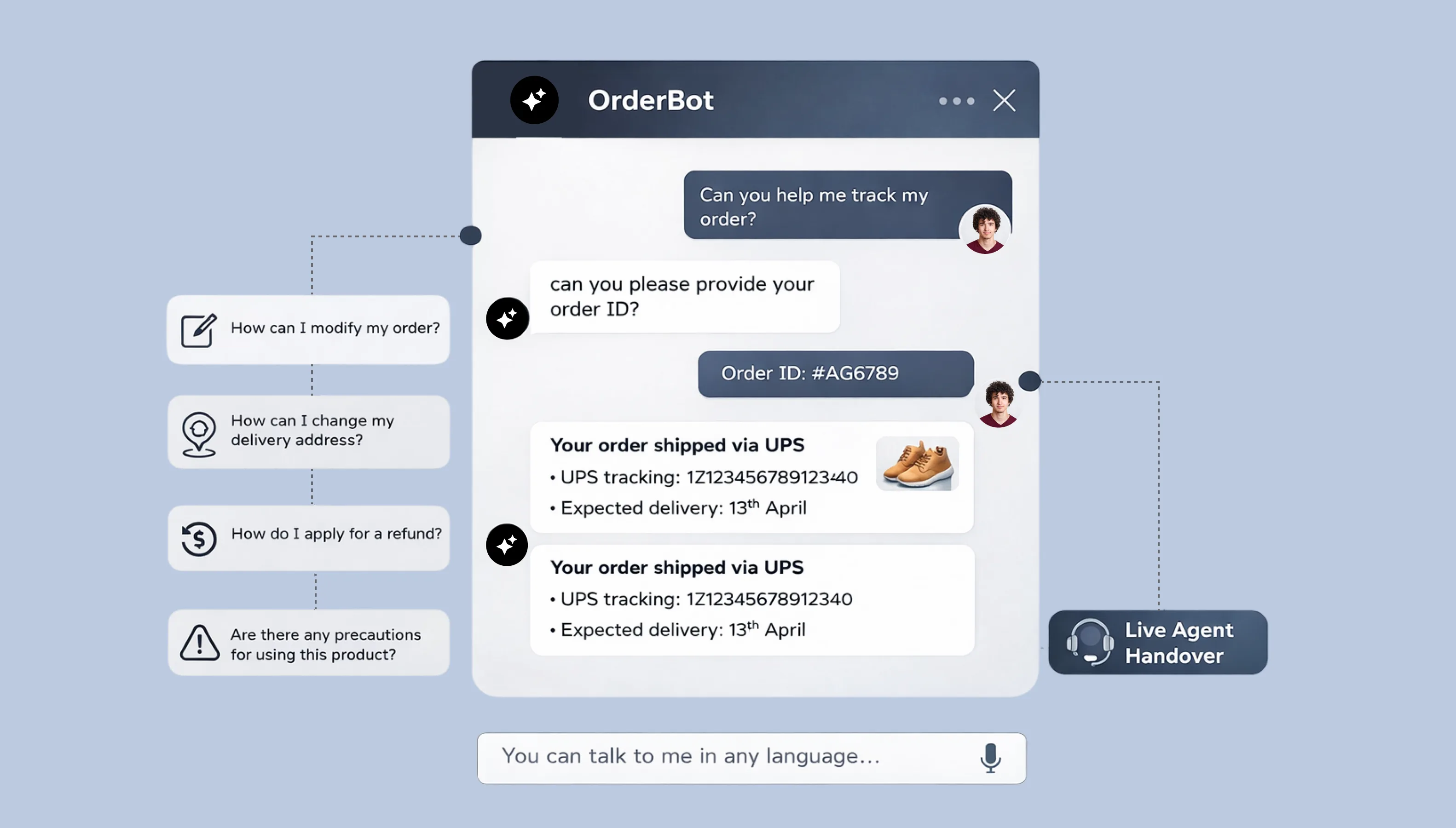
“Where is my order?” is the single highest-volume support query in ecommerce accounting for 25-40% of all tickets. The chatbot pulls real-time tracking data from your fulfillment system (ShipStation, ShipBob, Shopify Fulfillment, or custom logistics) and gives the customer their exact status, carrier, tracking number, and estimated delivery date in under two seconds. No ticket created. No agent involved.
Best for: Every ecommerce store. This is the highest-volume, lowest-risk use case and the best starting point.
Returns and Refund Processing
The chatbot walks customers through your return policy, checks eligibility (within return window, condition requirements), generates a return shipping label, initiates the refund in your system, and sends confirmation all through conversation. No form. No email chain. No 3-day wait for a response. One fashion retailer reduced return processing time from 5 days to 12 hours after deploying chatbot-assisted returns.
Best for: Fashion, apparel, and any category with return rates above 15%.
Size and Fit Guidance
Size uncertainty is the #1 reason for both cart abandonment and returns in apparel ecommerce. The chatbot asks the customer’s measurements, usual size in comparable brands, fit preference (relaxed vs fitted), and recommends the right size from your specific size chart. This reduces size-related returns by 25-40% and increases purchase confidence at checkout.
Best for: Apparel, footwear, and any store where fit uncertainty drives returns and abandonment.
Discount and Promotion Assistance
Customers search for coupon codes, try expired ones, and abandon checkout when they fail. The chatbot proactively surfaces active promotions, applies eligible discounts, explains bundle deals, and answers “is there a student discount?” or “can I combine these offers?” from your promotions engine. One D2C brand saw checkout conversion increase 18% after deploying discount-aware chatbot messaging.
Best for: Stores running frequent promotions, loyalty programs, or tiered discounts.
Post-Purchase Engagement
The chatbot follows up after delivery: delivery confirmation, product care instructions, usage tips, cross-sell recommendations based on what they bought, review request, and loyalty program enrollment. This is where one-time buyers become repeat customers. Automated post-purchase sequences increase repeat purchase rates by 15-25% in our deployments.
Best for: D2C brands focused on customer lifetime value and repeat purchase rates.
Back-in-Stock and Wishlist Notifications
When a product is out of stock, the chatbot captures the customer’s interest, adds them to a waitlist, and notifies them the moment it’s back. Same for price drops on wishlisted items. These are high-intent signals the customer already wanted the product. Automated back-in-stock notifications convert at 8-12% versus 2-3% for generic email blasts.
Best for: Stores with frequent stockouts or limited-edition drops.
Multi-Channel Customer Support
The ecommerce chatbot handles support across your website, WhatsApp Business API, Instagram DM, Facebook Messenger, and email with a single knowledge base and unified conversation history. A customer who asks about their order on Instagram and follows up on WhatsApp gets a seamless experience. No channel silos. No repeated context.
Best for: Brands with significant social commerce presence and multi-channel customer engagement.
Conversational Upsell and Cross-Sell
The chatbot identifies upsell and cross-sell opportunities based on what’s in the cart. A customer buying a laptop gets recommended a case, mouse, and extended warranty. A customer buying a dress gets recommended matching accessories. Unlike static “customers also bought” widgets, the chatbot explains why the recommendation matters: “This case is specifically designed for the model you’re buying and includes drop protection.” Average order value increases 12-20% in our deployments.
Best for: Stores where accessory attach rates and average order value are key metrics.
How an Ecommerce AI Chatbot Works: The Customer Journey
Here is what happens when a shopper interacts with your chatbot explained through how an ecommerce chatbot works as a real customer experience.
Step 1: Shopper lands on your store and the chatbot triggers
The chatbot does not pop up on every page immediately. It triggers based on behavior: time on a product page, scrolling through reviews, adding to cart then pausing, visiting the shipping info page, or returning to the store for a second session. The trigger strategy is the difference between helpful engagement and an annoying popup that gets closed instantly.
Step 2: Chatbot understands what they need
“Do you have this jacket in medium?” “What’s your return policy?” “I need a gift for my sister, she’s into yoga.” The chatbot figures out whether the customer needs product help, order support, or purchase guidance regardless of how they phrase it. It handles casual language, typos, and mid-conversation topic changes.
Step 3: Chatbot searches your catalog and systems
For product questions, the bot searches your catalog in real time through your Shopify, WooCommerce, Magento, or BigCommerce backend. For order inquiries, it pulls data from your order management and fulfillment systems. For policy questions, it retrieves answers from your store documents using retrieval-augmented generation with LangChain and Pinecone. The customer gets their specific answer, not a generic one.
Step 4: Chatbot responds and drives action
The bot does not just answer it moves the customer forward. Product recommendation? It shows images, prices, reviews, and an add-to-cart button. Size question? It recommends the right size and links to the product. Shipping concern? It explains options and applies free shipping if eligible. The goal of every response is resolution or conversion, not just information.
Step 5: If the customer needs a human, the handoff is seamless
Complex issues damaged products, order disputes, custom requests, or VIP customers get routed to your support team with the full conversation transcript, customer order history, and issue classification. The customer never repeats themselves. The agent picks up mid-conversation with full context. We integrate with Gorgias, Zendesk, Freshdesk, Intercom, and custom helpdesk platforms.
Step 6: Every interaction feeds your optimization engine
The chatbot logs every conversation: what customers asked, which products were recommended, which were added to cart, which were abandoned, which support issues were resolved, and which needed escalation. This data identifies your top product questions, most common objections, highest-converting recommendation patterns, and the exact points where your funnel leaks.
Benefits of AI Chatbots for Ecommerce
Here is what actually changes when you deploy an AI chatbot for ecommerce measurable within the first 30 days.
Your abandoned carts start converting into orders
70% of carts are abandoned. Most recovery strategies rely on email sequences that arrive hours later by then the customer has already closed the tab. The chatbot intervenes at the exact moment of hesitation and addresses the specific objection: shipping cost, size uncertainty, payment concern. Real-time recovery outperforms email drip campaigns by 5-8x because the customer is still on your site, still interested, still one answer away from buying.
Your support team stops answering “where is my order
Order tracking, return status, shipping timelines, and refund inquiries account for 60-70% of ecommerce support volume. The chatbot resolves them instantly by pulling live data from your fulfillment system. Your support team stops spending their day on repetitive lookups and starts handling the complex issues that actually require human judgment damaged goods, custom orders, VIP escalations.
Your customers get help at midnight, not Monday morning
Your best-converting ad campaigns run in the evening. Your flash sales peak on weekends. Your product launches hit at midnight. But your support team is offline for all of it. A customer browsing at 10 PM with a sizing question either gets an instant answer and completes the purchase, or they close the tab and forget about it by morning. After-hours chatbot engagement consistently drives 15-25% of total chatbot-attributed revenue because it captures demand that previously disappeared into the void.
Your average order value goes up without hard selling
The chatbot recommends complementary products based on what is in the cart but unlike a static “frequently bought together” widget, it explains why. “This screen protector is cut specifically for the phone you’re buying and comes with an alignment tool.” Contextual, conversational recommendations feel helpful instead of pushy. Average order value increases 12-20% in our deployments.
Your return rate drops before the return even happens
Most ecommerce returns happen because the customer bought the wrong size, the wrong variant, or did not understand the product. The chatbot prevents these at the point of purchase by guiding size selection, clarifying product details, and setting accurate expectations. Size-related returns drop 25-40% when the chatbot handles pre-purchase guidance. Fewer returns means fewer support tickets, lower logistics costs, and higher net revenue.
Every customer interaction becomes revenue intelligence
When customers leave your store silently, you learn nothing. When they talk to the chatbot, every question is logged. You can see which products generate the most sizing questions, which categories have the highest return inquiries, which price points cause abandonment, and which promotions drive the most conversions. This data feeds your merchandising, pricing, and product description decisions not just your support strategy.
Ecommerce Verticals Using AI Chatbots
An ecommerce chatbot looks different in fashion than it does in electronics. Here is what deployments handle across ecommerce verticals.
Fashion and Apparel
- Size and fit guidance using brand-specific size charts and customer body measurements
- Visual style recommendations based on occasion, color preference, and budget
- Outfit builder that suggests complete looks from complementary products in your catalog
- Return processing with automated eligibility checks, label generation, and refund initiation
- VIP and loyalty program engagement with early access notifications and personalized drops
- One fashion D2C brand: size-related returns reduced 35%, cart recovery rate at 24%
Electronics and Consumer Tech
- Spec comparison chatbot that explains technical differences in plain language
- Compatibility checks: “will this charger work with my MacBook Pro M3?”
- Warranty and extended protection plan explanation with add-to-cart
- Troubleshooting for common setup issues, reducing post-purchase support tickets by 40%
- Trade-in and upgrade program guidance with device valuation
- One electronics retailer: AOV increased 18% through accessory cross-sell recommendations
Beauty and Personal Care
- Skin type and shade matching through guided conversational quiz
- Routine builder that recommends products based on skin concerns, budget, and existing products
- Ingredient questions answered from product data: “is this fragrance-free?” “does it contain retinol?”
- Subscription management for replenishment-based products with frequency adjustments
- Sample and trial program enrollment based on skin profile
- One beauty brand: product quiz completion rate 65% vs 22% for static quiz pages
Home and Furniture
- Room-based product recommendations: “I’m furnishing a 200 sq ft living room on a $3,000 budget”
- Dimension and fit verification: “will this sofa fit through a 30-inch doorway?”
- Delivery scheduling with white-glove service coordination and time slot selection
- Assembly support with step-by-step guidance and troubleshooting for common issues
- Custom order intake for made-to-order furniture with fabric, color, and dimension specifications
- One home furnishings brand: 30% fewer “will it fit” returns through pre-purchase dimension guidance
Food, Grocery, and CPG
- Dietary filter assistance: “show me gluten-free snacks under $10 with no artificial sweeteners”
- Subscription box customization and frequency management through conversation
- Recipe-based product bundling: “I want to make pad thai tonight” → add all ingredients to cart
- Delivery window selection and order modification up to cutoff time
- Allergen and nutritional information retrieval from product data in real time
- One grocery delivery service: chatbot-assisted orders had 22% larger basket sizes than self-serve
B2B and Wholesale Ecommerce
- Bulk order inquiry with volume-based pricing tiers and minimum order quantities
- Account-specific pricing and catalog visibility for logged-in wholesale buyers
- Reorder assistance: “I want the same order as last month but add 50 units of SKU-1234”
- Quote generation for custom orders with approval workflow routing
- Inventory availability checks across multiple warehouses with lead time estimates
- One B2B distributor: 40% of repeat orders now processed through chatbot without sales rep involvement
AI Chatbot vs. Live Chat vs. FAQ Page vs. Email Sup
| Feature | FAQ Page | Email Support | Live Chat | AI Ecommerce Chatbot |
|---|---|---|---|---|
| Response time | Self-service (if found) | 4-24 hours | 1-5 min (if staffed) | Under 2 seconds, 24/7 |
| Product recommendations | None | None | Agent-dependent | Personalized from catalog data |
| Cart recovery | None | Email drip (hours later) | If agent notices | Real-time, at point of hesitation |
| Order tracking | Generic instructions | 4-12 hour reply | Agent looks it up | Instant from fulfillment API |
| Availability | 24/7 (passive) | Business hours reply | Business hours only | 24/7 with full capability |
| Cost per interaction | Free (but low resolution) | $3-8 per ticket | $3-6 per chat | $0.05-0.30 |
| Personalization | None | Agent-dependent | Agent-dependent | Purchase history + browsing + catalog |
| Scalability | Static | Requires headcount | 3-5 per agent | Unlimited concurrent |
In summary: An ecommerce chatbot is not a replacement for your support team it is the first layer that handles every repetitive interaction that does not need a human. FAQ pages are passive. Email is slow. Live chat is expensive to scale. The chatbot combines instant response, product intelligence, and order access at $0.05-0.30 per conversation versus $3-8 for a human-handled ticket.
Common Challenges in Ecommerce Chatbot Deployment and How We Solve Them
Deploying an AI chatbot for ecommerce is not without risks. Here are the five most common challenges and how Bitontree addresses each one.
Challenge 1: The chatbot recommends products that are out of stock
Nothing frustrates a customer faster than being recommended a product they cannot buy. This happens when the chatbot’s product data is stale, syncing once a day instead of in real time, or pulling from a cached catalog instead of your live inventory.
How Bitontree solves this: We integrate directly with your ecommerce platform’s live inventory API. Product availability, pricing, and variants are checked in real time at the moment of recommendation, not from a cached copy. If a product sells out mid-conversation, the bot updates immediately and offers alternatives. Catalog sync runs continuously, not on a nightly batch.
Challenge 2: The chatbot sounds like a robot, not a shopping assistant
Scripted chatbots with decision trees feel like navigating a phone menu. The customer asks a question that is slightly off-script, and the bot responds with “I didn’t understand that. Please choose from the following options.” Trust breaks instantly. The customer closes the chat and leaves.
How Bitontree solves this: We use LLMs (GPT-4o, Claude, or Llama) to generate natural, conversational responses. The bot handles unexpected questions, mid-conversation topic changes, and vague requests like “something nice for my mom.” System prompt engineering defines your brand voice, casual and fun for a streetwear brand, polished and helpful for a luxury retailer. The bot sounds like your best sales associate, not a customer service phone tree.
Challenge 3: The chatbot cannot handle returns and order changes
A chatbot that can answer questions but cannot take action is half a solution. Customers want to initiate a return, cancel an order, change a shipping address, or apply a discount code, not just be told how to do it themselves.
How Bitontree solves this: We build deep integrations with Shopify, WooCommerce, Magento, BigCommerce, and your fulfillment and payment systems (Stripe, PayPal, Klarna). The chatbot does not just explain your return policy, it processes the return, generates the label, initiates the refund, and confirms with the customer. Every action includes validation, confirmation, and error handling.
Challenge 4: The chatbot hallucinates product information
A chatbot that invents product specs, fabricates reviews, or misquotes pricing creates a trust and liability problem. If the bot says a product is waterproof and it is not, that is a return and a negative review waiting to happen.
How Bitontree solves this: Every product response is grounded in your actual catalog data through retrieval-augmented generation. The bot retrieves product details, specs, reviews, and pricing from your store, not from its general training data. When it cannot find information about a product, it says so instead of guessing. We maintain sub-2% hallucination rates across all ecommerce deployments through RAG architecture, confidence scoring, and response validation.
Challenge 5: You cannot attribute revenue to the chatbot
Many companies deploy a chatbot and cannot tell whether it is actually driving sales or just having conversations. Without proper attribution, you cannot justify the investment or optimize the experience.
How Bitontree solves this: Every chatbot deployment ships with revenue attribution tracking: chatbot-assisted conversions, recovered cart revenue, cross-sell revenue, support ticket deflection savings, and return prevention value. We integrate with your analytics platform (Google Analytics 4, Segment, Mixpanel, Klaviyo) so you see chatbot-attributed revenue alongside every other channel. Weekly ROI reports for the first 90 days.
How We Implement an AI Chatbot for Ecommerce
Here is how we implement an ecommerce chatbot the process that turns a concept into a revenue-generating system within 6-8 weeks.
Step 1: Store and funnel audit
We analyze your conversion funnel, cart abandonment patterns, top support ticket categories, product return reasons, and after-hours traffic. We identify where the funnel leaks most that is where the chatbot deploys first. We also review your product catalog structure, inventory management, and current support stack.
Step 2: Use case prioritization and conversation design
We define which use cases to launch first (typically order tracking + cart recovery highest volume, fastest ROI), design conversation flows for each, calibrate the chatbot’s brand voice, and map escalation paths for edge cases. For product recommendations, we design the preference-gathering flow that turns “I need a gift” into a specific, actionable product suggestion.
Step 3: Platform integration and RAG setup
We connect the chatbot to your ecommerce platform (Shopify, WooCommerce, Magento, BigCommerce), fulfillment system, payment provider (Stripe, PayPal, Klarna), and helpdesk (Gorgias, Zendesk, Freshdesk). We build the retrieval-augmented generation pipeline using LangChain with Pinecone or Weaviate so the bot searches your live catalog, return policies, and FAQ content for every response.
Step 4: Testing
We test against 200+ real customer scenarios: product questions, order tracking, returns, size guidance, cart recovery, discount inquiries, and edge cases. Hallucination testing with adversarial product questions. Integration testing end-to-end: catalog search, order lookup, return processing, cart modification. Load testing at Black Friday volume.
Step 5: Phased launch and optimization
We deploy on your highest-impact use case first. Monitor conversion lift, cart recovery rate, ticket deflection, and revenue attribution for 2 weeks. Expand to additional use cases and channels. Weekly performance reviews for 90 days with A/B testing of triggers, messaging, and recommendation logic. The chatbot gets smarter every week based on real customer interactions.
Frequently Asked Questions
What is an AI chatbot for ecommerce?

An ecommerce chatbot is a conversational AI system that assists online shoppers throughout the buying journey product discovery, size guidance, cart recovery, order tracking, returns, and post-purchase support using your actual product catalog, inventory data, and store policies. It resolves 65-75% of customer interactions without a human agent.
How does it recover abandoned carts?
The chatbot triggers when a shopper hesitates at checkout and addresses their specific objection: shipping cost, size uncertainty, payment options, or coupon questions. Real-time intervention converts 20-30% of hesitating shoppers compared to 3-5% for email recovery sequences that arrive hours later.
Which ecommerce platforms does it integrate with?
We integrate with Shopify, WooCommerce, Magento, BigCommerce, Salesforce Commerce Cloud, and custom platforms. The bot reads your product catalog, inventory, orders, and customer data in real time. We also integrate with Gorgias, Zendesk, Freshdesk for helpdesk, and Stripe, PayPal, Klarna for payments.
How much does an ecommerce chatbot cost?
Cost depends on scope: the integrations, channels, data sources, and compliance requirements involved. We scope every engagement against your stack and give you a clear plan and timeline after a free AI fit assessment, before any commitment.
Can it recommend products from my catalog?
Yes. The chatbot searches your product catalog in real time based on customer preferences: budget, style, occasion, size, features. It shows product images, prices, reviews, and direct add-to-cart buttons. It handles follow-ups like “anything similar but in blue?” and updates recommendations based on what the customer says.
Does it work on WhatsApp and Instagram?
Yes. We deploy across your website, WhatsApp Business API, Instagram DM, Facebook Messenger, and SMS. Same chatbot, same catalog, same capabilities across every channel. Conversation context carries across channels seamlessly.
How does it handle returns?
The chatbot walks the customer through your return policy, checks eligibility, generates a shipping label, initiates the refund in your ecommerce platform, and confirms with the customer all through conversation. No form. No email chain. Integrates with Shopify, WooCommerce, and your fulfillment system.
Will it replace my support team?
No it handles the repetitive 65-75% (order tracking, returns, FAQs) so your team focuses on complex issues: damaged goods, custom orders, VIP escalations. Most clients reallocate support team hours rather than reduce headcount.
How long does deployment take?
A starter deployment takes 4-6 weeks. Multi-use-case with platform integration takes 6-8 weeks. Enterprise with multi-channel and advanced personalization takes 8-12 weeks. Every engagement starts with a free store audit.
Can I measure the ROI?
Yes. Every deployment ships with revenue attribution: chatbot-assisted conversions, recovered cart revenue, cross-sell revenue, ticket deflection savings, and return prevention value. We integrate with Google Analytics 4, Segment, Mixpanel, and Klaviyo for full-funnel attribution reporting.
Related AI Chatbot Use Cases

AI Chatbot for Customer Support
Delivers instant, accurate, and scalable customer support across channels, 24/7.

AI Chatbot for HR & Onboarding
Automates employee queries, onboarding steps, and HR requests efficiently.

AI Chatbot for Lead Generation
Captures, qualifies, and converts visitors into high-quality leads automatically.