April 5, 2026
AI Chatbot for Prescription Refills: How Pharmacies and Clinics Can Automate 80% of Refill Requests

Bhavin Karad
Co-Founder


Key Takeaways
- An AI chatbot prescription refills system automates identity verification, eligibility checks, prescriber routing, and patient notification, handling roughly 80% of refill volume without staff touch.
- The AI never approves prescriptions. Clinical authority stays with the licensed prescriber who makes every approval decision.
- HIPAA requires a signed Business Associate Agreement, encrypted transmission, and audit logs retained for 6 years on every patient data access event.
- High-volume practices handling 400 to 600 refill requests per month see the strongest ROI case from prescription refill automation.
- A refill-only deployment runs 4 to 6 weeks. Full multi-channel, EHR-integrated builds run 6 to 10 weeks.
An AI chatbot for prescription refills automates the rules-based workflow around refill requests: identity verification, eligibility checks against the patient record, routing to the prescribing clinician, and patient notification when the prescription is ready. The AI does not approve prescriptions. Clinical authority stays with the licensed prescriber. This post explains how the workflow runs, what HIPAA requires, and when a custom build makes financial sense for your healthcare AI solutions roadmap.
It is 8:47 AM on a Monday. The front desk at a mid-size primary care practice has 20 voicemails waiting, 14 patient portal messages, and 6 faxes from pharmacies. Nearly all of them are refill requests. A medical assistant will spend the next three hours pulling charts, checking last-visit dates, confirming the prescription is still current, routing the request to the correct clinician, waiting on approval, and then calling the patient back to confirm the refill is sent.
An AI chatbot prescription refills workflow handles this entire rules-based sequence automatically. The patient initiates through WhatsApp, SMS, web chat, or the phone line. The AI verifies identity, checks the chart against eligibility rules, forwards approved requests to the prescribing clinician in a priority queue, and notifies the patient when the prescription is ready at their pharmacy. The clinician still makes the approval call. The staff time spent chasing the paperwork around that decision drops sharply.
This post walks through the workflow in detail, explains what HIPAA requires of any vendor building one, and shows where a custom build starts to make financial sense compared to off-the-shelf patient messaging tools.
Why does prescription refill processing consume so much staff time?
Prescription refill processing consumes staff time because each request involves six manual steps: receive, verify identity, check eligibility, route to clinician, await approval, notify patient. High-volume practices see 400 to 600 requests per month. Even at 8 minutes per request, that volume consumes dozens of staff hours monthly.
Walk through the six steps:
1.Receive the request (phone, portal, fax, or pharmacy transmission)
2.Verify identity (confirm the caller is the patient or an authorized representative)
3.Check eligibility (patient is active, last visit within prescribing interval, medication not discontinued, no overdue labs)
4.Route to the prescribing clinician for approval
5.Await clinician decision (approve or deny)
6.Notify the patient with the outcome
Six steps, six handoffs, six places where a request can sit idle.
The volume problem
- A primary care practice with 4,000 to 6,000 active patients typically sees 400 to 600 refill requests per month
- Post-holiday weeks, flu season, and end-of-month insurance cycles push that number higher
- That request stream lands on the same front-desk team responsible for new appointments, insurance questions, and triage
The quality problem
- Refill requests sitting in a voicemail queue for two days generate angry callbacks, missed doses, and patient complaints
- Staff working under volume pressure miss eligibility flags
- Both failure modes carry real clinical and operational cost - and both come from the same root cause: a rules-based process running on manual throughput
How does an AI chatbot prescription refills workflow handle requests?
An AI prescription refill chatbot runs the rules-based portion of the workflow across website chat, WhatsApp Business API, SMS, and the phone line. The patient experience is consistent across all four channels, and the practice manages every request from a single admin interface. The refill workflow is typically delivered as part of a broader AI clinical chat assistant that also handles scheduling, triage, and post-visit follow-up. Here is how the five-step workflow runs in a production deployment built to automate pharmacy refill requests.
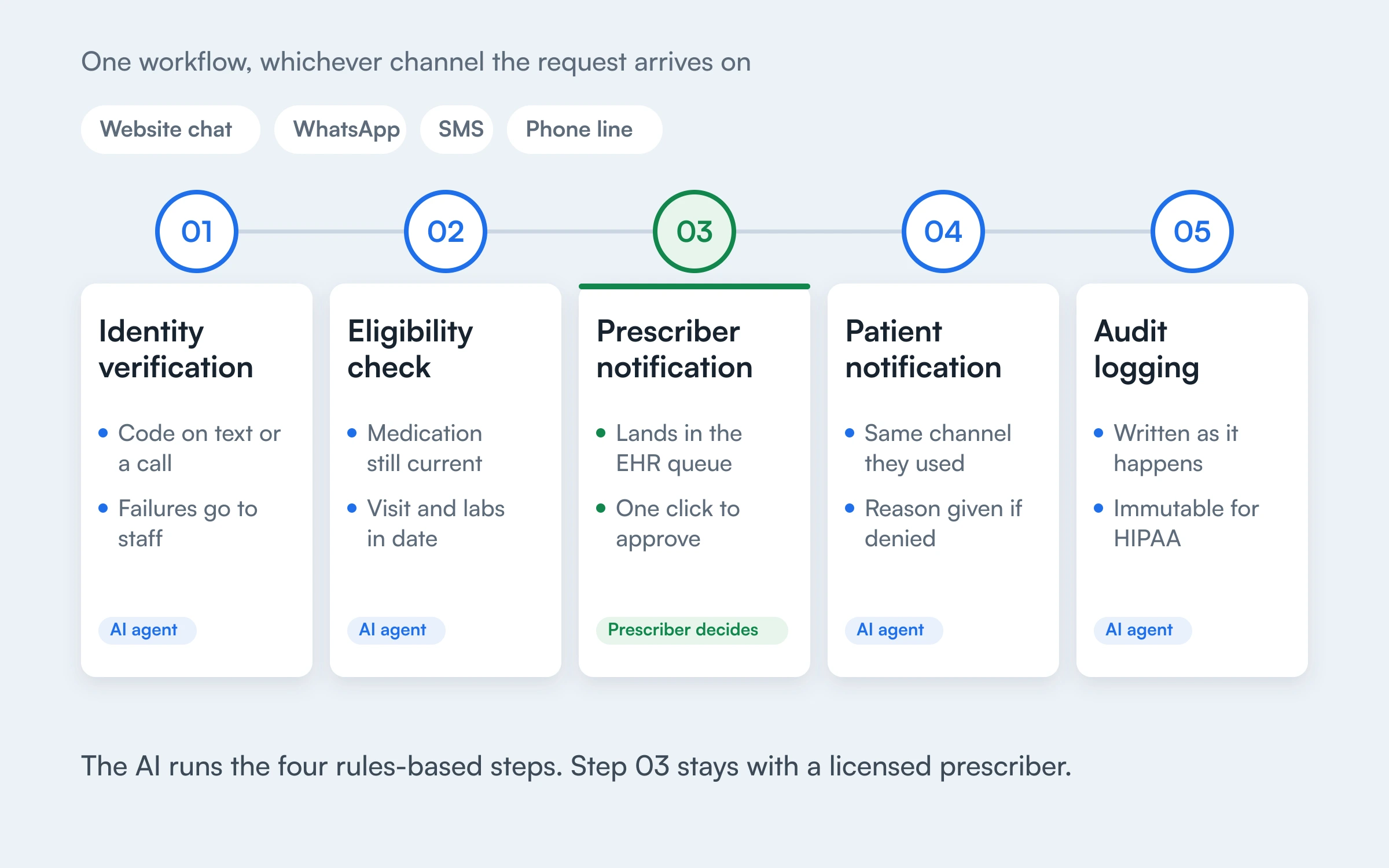
Step 1. Identity verification
- The AI verifies patient identity before touching any chart data
- Text channels: one-time password sent to the phone number on file
- Voice channels: verbal confirmation of date of birth and address against the record
- Failed verifications escalate to a human staff member immediately rather than looping the patient through retries
Step 2. Eligibility check
- The AI checks the request against your eligibility rules in the EHR
- Confirms the medication is current and not discontinued
- Verifies the last office visit falls inside the required prescribing interval
- Checks that no overdue labs block the refill
- Flags controlled substances for stricter routing
- Ineligible requests are flagged with the specific reason and routed for human review, never auto-denied
Step 3. Prescriber notification
- Eligible requests are routed to the prescribing clinician through a priority queue inside the existing EHR workflow
- The clinician sees: patient name, medication, last fill date, last visit date, any flags from the eligibility check, and a one-click approve or deny action
- No new app to check. No parallel inbox. The AI brings the request to where the clinician already works.
Step 4. Patient notification
- The AI notifies the patient through the same channel they used to request the refill - WhatsApp request gets WhatsApp notification, SMS request gets SMS notification
- Approved: notification confirms the prescription has been sent to the patient’s pharmacy of record with an expected ready time
- Denied: the AI delivers the denial with the specific reason and, where applicable, prompts the patient to book an appointment
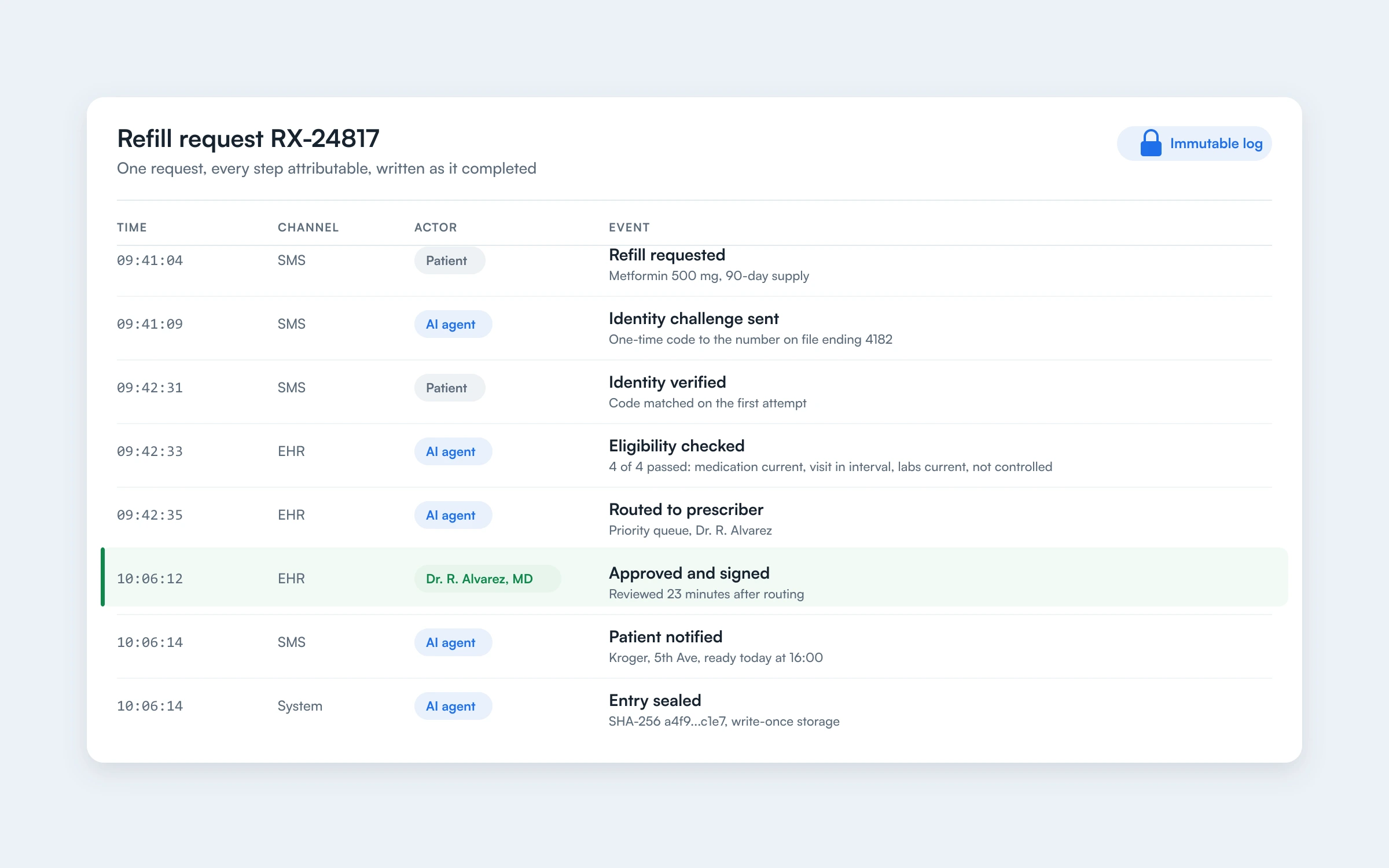
Step 5. Audit logging
- Every step writes to an immutable audit log: who requested, when, through which channel, what identity verification method was used, what eligibility checks ran, which clinician approved or denied, and when the patient notification was delivered
- The log satisfies HIPAA audit requirements and gives the practice a complete record for any future dispute or compliance review
What the AI does not do and why that matters
The AI does not prescribe. It does not approve refills. It does not interpret lab results or make clinical judgments about whether a medication is still appropriate for a patient. Every refill that leaves the system has been affirmatively approved by a licensed prescriber who reviewed the request. AI medication refills healthcare workflows only work when this line is drawn hard and kept visible.
This distinction is not a marketing point. It is a legal and clinical requirement. Prescribing authority sits with licensed clinicians under state medical practice acts. A system that auto-approved refills would expose the practice to liability and would violate the scope of what any current AI system is actually competent to decide. Bitontree builds every clinical AI deployment on this principle: the AI handles the rules-based workflow around the decision, and the human clinician makes the decision.
What does HIPAA require for AI prescription refill systems?
HIPAA requires three things from any AI system handling prescription refill requests:
1. Signed Business Associate Agreement
- Every vendor touching protected health information on your behalf must sign a BAA
- The agreement must flow down to every sub-processor: the LLM provider, the messaging gateway, the voice transcription service, and the hosting infrastructure
- If any link in the chain is not covered, the whole system is non-compliant
2. Encrypted transmission
- TLS 1.2 or higher for data in transit between the patient and the chatbot, between the chatbot and the EHR, and between the EHR and the pharmacy
- AES-256 for data at rest in any logging or storage layer
3. Audit logging
- Every patient data access event must be logged
- Audit logs must be tamper-evident and retained for 6 years from the date of creation or last effective date under the HIPAA Security Rule
For a deeper walk through BAA scope, sub-processor requirements, encryption configuration, and audit log design, the full compliance framework is covered in our HIPAA Compliant AI Chatbot guide.
Conclusion
Prescription refill automation is one of the clearest wins in clinical AI because the work is rules-based, the volume is high, and the failure modes are well understood. A practice handling 400 to 600 refill requests per month can pull dozens of staff hours back every month without changing who holds prescribing authority. The clinician still decides. The paperwork around the decision stops eating the front desk.
If your refill volume justifies a custom build, or if you want to understand what the threshold looks like for your specific practice, Bitontree’s healthcare AI team starts with a free audit before any proposal. Our production systems range from this refill workflow to 200+ patient calls nightly with a 32% adherence improvement in medication adherence deployments.
I lead strategic consulting and marketing initiatives that empower businesses to scale, strengthen their brand presence, and achieve sustainable growth in competitive global markets.
Frequently Asked Questions
Can patients request refills through WhatsApp?

Yes. A properly configured refill AI works across WhatsApp Business API, SMS, web chat, and phone. The patient experience is the same regardless of channel. Identity verification, eligibility check, and prescriber routing all run automatically. The practice manages everything through a single admin interface regardless of which channel the patient used.
What happens if a patient requests a controlled substance refill?
The AI applies a stricter verification and routing process for controlled substance refill requests. These are never auto-approved. They go directly to the prescribing clinician with a complete history of recent requests and the applicable prescribing interval rules for that medication class. The system flags them with a priority marker. Some practices configure controlled substance refill requests to trigger an appointment requirement automatically. That configuration is set by the practice, not the AI.
How does this integrate with our existing EHR?
The system integrates with the major EHR platforms including Epic, Athenahealth, Cerner, and Allscripts. It reads refill eligibility from your existing patient records and writes approved refill notifications back to the record. No parallel database, no manual syncing. Before deployment, your vendor confirms in writing exactly which fields are read and written.
What is the deployment timeline for an AI prescription refill chatbot?
A focused refill-only deployment takes 4 to 6 weeks from contract to go-live. Full deployment including multi-channel setup, EHR integration, and controlled substance handling configuration takes 6 to 10 weeks. HIPAA compliance configuration is typically the longest phase.
Your Front Desk Is Spending 40+ Hours a Month on Refill Paperwork. It Doesn't Have To.
Bitontree's healthcare AI team audits your current refill volume, staff time, and workflow bottlenecks - then shows you exactly how much time and cost an AI prescription refill system would save your practice. No commitment. No proposal until you see the numbers.