


November 18, 2026
Agentic Commerce Protocols Explained: How ChatGPT, Gemini, and Perplexity Shopping Agents Discover Products

Yash Vibhandik
CEO


For ecommerce merchants, AI shopping agents are now a discovery channel in their own right. When a buyer asks ChatGPT for running shoes, asks Gemini to compare two laptops, or uses Perplexity to find a replacement part, an AI agent reads product data and decides what to surface. The agentic commerce protocols behind that process determine whether your catalog is readable at all.
Three protocols matter right now, and they do not do the same job. ACP, from OpenAI and Stripe, is the product feed and checkout specification behind ChatGPT shopping. AP2, from Google, covers payment authorization. UCP, also from Google and co-developed with major retailers, is an end-to-end standard reached through Merchant Center. Treating them as competing options to choose between is the most common misreading in this area.
This guide covers product discovery: how each agent finds products, what each protocol specifies, and what a merchant has to expose. Payment settlement and the x402 flow are deliberately out of scope, and are covered in our article on agentic commerce, AI agents and payments.
One caution before the detail. This area moves fast. OpenAI launched in-chat Instant Checkout in September 2025 and moved away from it six months later, in March 2026. Key claims below link to primary sources, which were last checked on November 5, 2026. Check them again before you build, because they will be more current than this page.
What Agentic Commerce Protocols Are, and What Problem They Solve
An agentic commerce protocol is a specification that lets an AI agent act on a buyer's behalf against a merchant's systems without a bespoke integration being built for every agent and merchant pair.
The problem is combinatorial. Without a shared standard, every shopping agent needs a custom integration with every merchant, and every merchant needs one with every agent. With N agents and M merchants, that is N times M integrations. A protocol reduces it to N plus M.
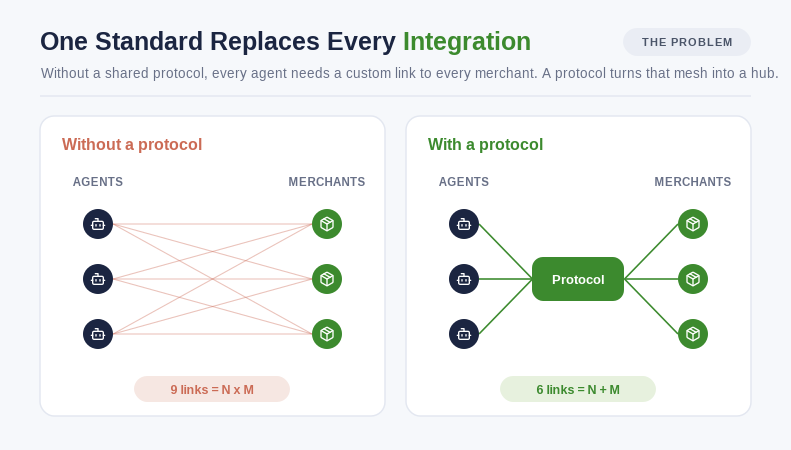
The protocols currently in play split the problem differently, which is why more than one exists and why they are not strictly competitors:
- Discovery: How an agent learns what a merchant sells, at what price, in what stock
- Cart and checkout: How an agent assembles an order and initiates a purchase
- Payment authorization: How the buyer's approval is captured and proven
- Order lifecycle: How the agent receives fulfillment and status updates
ACP specifies discovery through checkout, although ChatGPT now uses it mainly for discovery. AP2 covers payment authorization. UCP is Google's end-to-end standard. They overlap, and in some stacks they compose.
The Protocol Landscape at a Glance
Four protocols appear in this space. Three of them matter for most merchants, and the fourth is included so you can recognize it when it comes up.
| Protocol | Originator | Primary concern | First announced |
|---|---|---|---|
| ACP (Agentic Commerce Protocol) | OpenAI and Stripe | Product feed, cart, checkout, order updates | September 29, 2025 |
| AP2 (Agent Payments Protocol) | Payment authorization via signed mandates | September 16, 2025 | |
| UCP (Universal Commerce Protocol) | Google, with Shopify, Etsy, Wayfair, Target and Walmart | Discovery, checkout, payment and order management | January 11, 2026 |
| x402 | Coinbase | HTTP-native machine payments | Covered in our payments article |
Two observations worth noting before the detail.
These are not all the same kind of thing. ACP and UCP are commerce protocols. AP2 is a payments protocol that composes with others. Treating them as alternatives to be chosen between is a common misreading.
Announcement is not availability. Several of these have published specifications well ahead of broad merchant eligibility, and at least one launch feature has already been withdrawn. A specification existing does not mean your catalog is reachable through it today.
How AI Shopping Agents Discover Products: The Flow
The protocols describe interfaces. This is the sequence they sit inside, and it is the same shape across all three agents even though the data sources differ.
- The buyer states a need, usually with constraints: "Waterproof hiking boots, wide fit, under $150, that will arrive before Friday." Only one part of that request is a product category. The other four are constraints
- The agent decomposes the request into attributes: Category, a waterproofing property, a width fitting, a price ceiling, a delivery deadline. Each becomes a filter
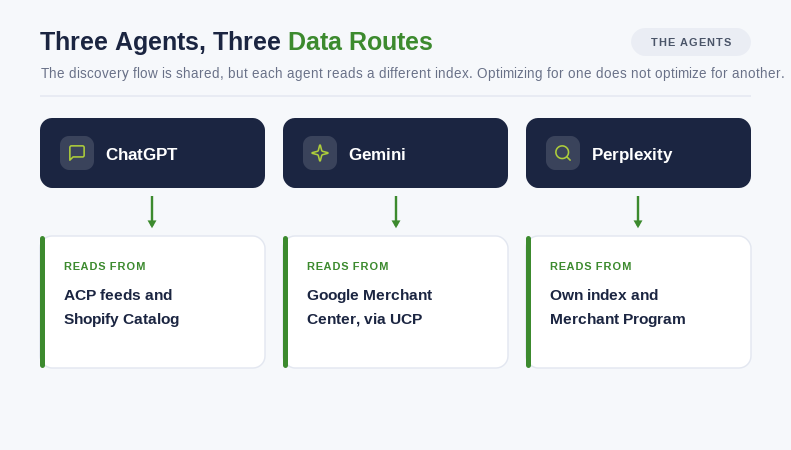
- The agent retrieves candidates: From whatever index it has. For ChatGPT, that is ACP feeds and Shopify Catalog. For Gemini and Google AI Mode, it is Merchant Center data. For Perplexity, it is its own index plus merchant data
- The agent filters on hard constraints: Anything it cannot verify, it either drops or guesses at. A product with no width attribute is not a wide-fit candidate, regardless of whether the boot is actually available in a wide fit
- The agent ranks what survives: On relevance, with tie-break factors where several merchants carry the same item. The ChatGPT section below covers the factors OpenAI has published
- The agent presents a shortlist with reasons: Typically three to five products with a sentence explaining each against the stated constraints
- The buyer refines or selects: Follow-up constraints are applied to the same candidate set
- Checkout or handoff: Increasingly, a handoff to the merchant's own checkout. In-agent purchase exists only on some surfaces and in some retailer apps
Step four is where most catalogs lose. The failure is silent and it is not a ranking problem. A product that genuinely meets the buyer's constraint but does not express that constraint as structured data never reaches step five. It is not ranked badly. It is not considered.
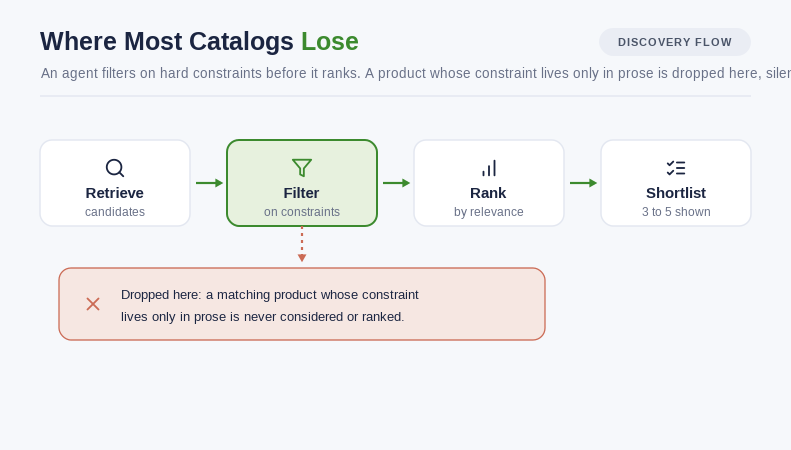
This is the practical difference between agent discovery and search engine optimization. A search engine will rank a page that mentions "wide fit" in its description. An agent filtering on a width attribute will not find a product whose width lives only in a sentence.
Agentic Commerce Protocol (ACP)
What ACP Is
ACP is an open specification governed jointly by OpenAI and Stripe as founding maintainers. The repository states the specification is currently in beta and describes a path toward neutral foundation stewardship. It is published under the Apache 2.0 license.
OpenAI introduced it in its Instant Checkout announcement as "an open standard for AI commerce that lets AI agents, people, and businesses work together."
What the ACP Specification Contains
Per the ACP specification repository:
- Checkout API: Defined as an OpenAPI specification,
openapi.agentic_checkout.yaml - Delegate Payment: A second OpenAPI specification,
openapi.delegate_payment.yaml, for passing payment tokens between buyers and businesses - JSON Schemas: Data models for payloads, events and reusable objects
- RFCs: Design documents covering agentic checkout, capability negotiation, payment handlers, seller-backed payment handlers, extensions and discounts
- Versioned releases: Five dated releases (2025-09-29, 2025-12-12, 2026-01-16, 2026-01-30 and 2026-04-17), plus an unreleased directory for current work
The 2026-04-17 release is described as covering cart, feed, orders, authentication and MCP. The feed specification matters most for this guide, because that is the discovery surface. The inclusion of MCP is notable architecturally: the same protocol layer used for connecting agents to enterprise systems appears here as a commerce transport. If you already run MCP infrastructure, that work is not wasted, and our MCP server development notes cover the general pattern.
How ACP Is Used in ChatGPT Today
ACP launched alongside Instant Checkout in September 2025, starting with US Etsy sellers. Instant Checkout let shoppers buy without leaving ChatGPT.
In March 2026, OpenAI changed course. Its product discovery update says the first version of Instant Checkout did not offer the flexibility OpenAI wanted. Merchants now run their own checkout, and ChatGPT concentrates on discovery. Press coverage at the time pointed to limited merchant adoption.
ACP survived the change. It is now the data route into ChatGPT shopping:
- Product feeds: Merchants share product feeds and promotions through ACP, either directly or through providers such as Salesforce and Stripe
- Shopify merchants: Product data is already integrated through Shopify Catalog, with no extra work for individual merchants. The purchase completes on the merchant's own store, inside an in-app browser
- Retailer apps: Retailers that want a native experience can build an app inside ChatGPT. OpenAI cites Walmart, whose app supports account linking, loyalty and Walmart payments
OpenAI describes ACP as the layer that connects merchants and users, and says it will support future features such as personalization, local availability and delivery estimates.
What This Means for Merchants Commercially
Orders, payments and fulfillment remain with the merchant. The original Instant Checkout model charged merchants a fee on purchases completed inside ChatGPT. With checkout back on the merchant's site, check OpenAI's current merchant terms for whichever route you use, rather than relying on fee figures from the 2025 launch coverage.
Agent Payments Protocol (AP2)
What AP2 Is
AP2 is Google's protocol for authorizing and processing agent-initiated payments. It is not a discovery protocol, and it does not define a full checkout flow. It is included in this guide because it is frequently confused with one.
The AP2 Mandate Model
AP2's distinguishing mechanism is the mandate: a signed record proving the user authorized a specific action. Three mandate types are described:
- Intent mandate: What the user authorized the agent to do
- Cart mandate: What specifically is being purchased
- Payment mandate: The payment authorization itself
The purpose is to create a verifiable, non-repudiable chain from user intent to executed payment, which matters when the party clicking buy is not a human.
How AP2 Relates to Other Protocols
AP2 is designed to complement A2A and MCP rather than replace them, and it supports cards, bank transfers and stablecoins. Google publishes a combined AP2 and UCP walkthrough showing how the two compose, and Google describes UCP as compatible with AP2. In practice, AP2 can sit underneath a commerce protocol that handles discovery and cart, supplying the authorization layer.
Universal Commerce Protocol (UCP)
What UCP Is
Google announced UCP on January 11, 2026, in a Google Developers Blog post. Google co-developed it with Shopify, Etsy, Wayfair, Target and Walmart, and more than 20 payment and retail companies endorse it. Google describes it as open source, with the specification at ucp.dev and on GitHub.
UCP aims to cover the full journey: discovery, checkout, payment and order management. Three design details matter for merchants:
- Capability discovery: A business publishes a JSON manifest at
/.well-known/ucp, so an agent can see what it supports and which payment options it accepts - Transport choice: UCP works over REST APIs, MCP or A2A
- Payments: UCP is compatible with AP2, and each authorization is backed by proof of user consent
Google names AI Mode in Google Search and the Gemini app as the first surfaces, with others to follow.
The Merchant Center Route
The practically important detail is that UCP runs through Google Merchant Center, which is where product data already lives for Shopping and Performance Max. To take part, a merchant needs an active Merchant Center account with eligible products, plus Google's interest form and integration guide.
This is the most consequential structural difference between the Google and OpenAI approaches:
- ACP: A feed a merchant sends directly or through a provider, or receives through a platform such as Shopify Catalog
- UCP: An extension of the Merchant Center product data a merchant may already maintain, plus a checkout integration
If your catalog is already in Merchant Center and accurate, your starting position for UCP is well ahead.
Caution on UCP Maturity
UCP is the youngest protocol in this guide. Treat specifics here as directional and verify them against Google's Merchant Center documentation and ucp.dev before you plan work.
How Each Shopping Agent Discovers Products
Those are the specifications. This is what each agent does with them. The flow described earlier is shared. The data sources behind step three are not. The three agents read different indexes, so optimizing for one does not automatically optimize for another.
ChatGPT Product Discovery
Mechanism: Product data reaches ChatGPT through ACP feeds, sent directly or through a provider, and through Shopify Catalog for Shopify merchants. Checkout happens on the merchant's site or inside a retailer's own ChatGPT app.
Ranking, as last published: In its September 2025 announcement, OpenAI said product results were organic and unsponsored, ranked on relevance to the user. Where several merchants sold the same product, it listed these tie-break factors:
- Availability: Whether the item is actually in stock
- Price: Competitiveness against other sellers of the same item
- Quality: Signals about the offer
- Primary seller status: Whether the merchant is the primary seller of the product
- Instant Checkout enablement: A tie-break only, not a ranking boost. This factor no longer applies
The March 2026 update does not restate these rules. Treat them as the last published guidance, not as current policy. The practical point holds either way: availability, price, data quality and clear primary seller status are signals you control.
Gemini Product Discovery
Mechanism: Product data flows through Google Merchant Center, the same infrastructure that powers Shopping surfaces, extended through UCP for agentic checkout in AI Mode and the Gemini app.
Practical implication: Feed quality work you have already done for Google Shopping is the foundation. Attribute completeness, accurate availability, correct GTINs and structured product data all carry over.
What changes: An agent reads the feed to reason about fit, not just to match a query. Attributes that were previously optional for ranking become materially useful when an agent answers "which of these works for someone with a narrow foot".
Perplexity Product Discovery
Mechanism: Perplexity launched a Merchant Program in November 2024, in its Shop Like a Pro announcement. At launch, the program was free, and merchants shared product specifications so Perplexity could show live product details. Launch benefits included a better chance of being recommended, payment integration, free API access and a trends dashboard.
Shopify at launch: Perplexity also pulled recent product data from Shopify stores that sell and ship to the US, which gave those merchants a discovery path without joining the program.
Check before you apply: Perplexity has changed its shopping and payment features since that launch. Confirm the current program terms and eligibility on Perplexity's own merchant pages before you plan around them.
Your Own Storefront Is a Separate System
Conversational commerce on your own storefront and agent discovery on someone else's surface are different systems with different owners. An AI shopping assistant you run on your site is not the agent recommending you inside ChatGPT, and an AI chatbot answering storefront questions does not make your catalog readable externally.
What connects them is the catalog underneath. The structured attributes that let an external agent filter your products on a buyer's constraint are the same attributes that let your own AI agents for product recommendations match a visitor to the right item. Thin product data limits both, and the work below fixes both at once.
Protocol Comparison Matrix
With the three protocols and the three agents described, this is the side-by-side view.
| ACP | AP2 | UCP | |
|---|---|---|---|
| Originator | OpenAI and Stripe | Google, with Shopify, Etsy, Wayfair, Target and Walmart | |
| Covers discovery | Yes, feed spec in the April 2026 release | No | Yes, including a capability manifest |
| Covers checkout | Yes in the spec. ChatGPT now hands checkout to the merchant | No | Yes |
| Covers payment authorization | Via delegated payment spec | Yes, this is its purpose | Yes, compatible with AP2 |
| License | Apache 2.0 | Open protocol | Open source. Check the GitHub repo for the license |
| Governance | OpenAI and Stripe as founding maintainers, beta | Google and co-developers | |
| Merchant entry point | ACP feed, direct or via a provider, or Shopify Catalog | Payments infrastructure | Google Merchant Center |
| Composes with MCP | Yes, in the April 2026 release | Designed to complement MCP and A2A | Yes, MCP is one supported transport |
| Maturity at last check | Beta, five dated releases | Published, partner-backed | Newest, launched January 2026 |
What Merchants Must Expose for Agent Discovery
The protocols differ. The data they read does not, which is the most useful thing in this guide for an ecommerce team deciding where to start. Across all three agents, the same data quality problems cause the same failures. These are ordered by how often they break agent discovery in practice.
- Accurate real-time availability: An agent that recommends an out-of-stock item produces a failed purchase and a damaged recommendation. Availability matters more for agents than for human browsing, because the human sees the out-of-stock badge and the agent may not
- Complete structured attributes: Size, material, dimensions, compatibility, color. An agent answering a constrained question can only use attributes it can read
- Correct product identifiers: GTIN, MPN and brand, which are how an agent determines that two listings are the same product and applies tie-break logic
- Unambiguous pricing: Current price, currency, and whether shipping and tax are included. Price was a published tie-break input for ChatGPT
- Primary seller signals: Where you are the brand owner, make that status unambiguous in your data. It was a published tie-break factor
- Variant modeling: Each purchasable variant as its own addressable item, not a single parent item with options buried in description text. Where your product attribute data currently lives in supplier PDFs and spreadsheets rather than a structured catalog, intelligent document processing is usually the first step before any product feed work
- Delivery, returns and shipping terms as data: Not as prose in a footer, because an agent comparing two offers can only weigh what is structured, and delivery dates are now a stated direction for ACP
- Machine-readable policies: Where your policies are relevant to a purchase decision, they need to be retrievable, not only rendered. Where an agent needs to answer questions beyond the product feed, that is a retrieval problem rather than a feed problem, and our guide to retrieval augmented generation covers how that layer is built
Feeds Are One Route, Schema Markup Is the Other
A feed is how you push data to an agent. Schema markup on your product pages is how an agent reads data it pulls. Most ecommerce merchants need both, because the three agents do not all arrive the same way. With checkout now on your own site for most ChatGPT traffic, your product pages also have to hold up when a shopper lands on them from an agent.
- Schema.org Product markup:
name,sku,gtin,brand,offerswith price and availability, andadditionalPropertyfor attributes with no dedicated field. This is the same markup that has long driven rich results in search, which means product feed optimization work and AI search visibility work largely overlap - Keep markup and feed in agreement: A page claiming in stock while the feed says otherwise is worse than either alone, because the agent now has two conflicting sources and no way to resolve them
- Mark up the variant, not just the parent: An agent evaluating a size or fitting constraint needs the purchasable variant to carry its own attributes
- Do not mark up what you cannot keep current: Stale structured data is a liability. Price and availability are the two fields most likely to drift
The practical framing for an ecommerce team: this is the same discipline as technical SEO, applied to a reader that cannot infer. Search engines tolerate ambiguity and rank you lower. Agents filter you out.
What an Agent Reads Versus What a Shopper Reads
The same product, listed two ways. Both pages look fine to a human.
Listing A, written for shoppers:
Our bestselling trail boot is built for serious hikers. Fully waterproof with a breathable membrane, and available in regular and wide fittings across our full size range. Grippy outsole handles wet rock with confidence. Fast shipping on every order.
Listing B, the same product as structured data:
| Attribute | Value |
|---|---|
waterproof | true |
width_fitting | regular, wide |
size_range | US 7 to US 14 |
availability | in_stock |
price | 139.00 USD |
delivery_estimate | 2 to 3 business days |
gtin | present |
Listing A tells an agent almost nothing it can filter on. Every attribute is there in prose, and none of it is queryable. "Fast shipping" cannot be checked against a Friday deadline. Listing B answers all four of the buyer's constraints directly: waterproof, wide fit, under $150, and delivery in time.
Most merchants have Listing A. The work in front of them is not writing better copy, it is extracting what the copy already says into fields an agent can read.
We built this kind of extraction into Zyberon, a Shopify seller platform. Its product page module pulls title, price, variants, colors and sizes from a source URL and publishes them to Shopify as structured product fields rather than as a block of copy.
The pattern: anything an agent must reason about has to be structured data, not page copy. Merchandising copy written to persuade a human reader is close to invisible to an agent evaluating fit against a stated constraint.
Agentic Commerce Implementation Checklist for Merchants
Putting the above into order of work, with the broadest payoff first.
- Audit your product feed before choosing a protocol: Availability accuracy, attribute completeness, identifier correctness. This work benefits every surface and is wasted on none
- Establish your Google Merchant Center baseline: If the product feed is already accurate, you are well placed for UCP
- Decide your ChatGPT route: Shopify merchants are already connected through Shopify Catalog. Custom storefronts need an ACP feed, sent directly or through a provider such as Salesforce or Stripe
- Test the landing and checkout path: ChatGPT shoppers now complete the purchase on your site, often inside an in-app browser. Test that path on mobile
- Check the Perplexity Merchant Program: Confirm the current terms and eligibility before you apply
- Instrument attribution before launch, not after: Agent-referred traffic is difficult to attribute retrospectively. Decide how you will recognize it first
- Model the economics: Compare agent-referred traffic and conversion against your other channels, and include any fees that apply to your route
- Set a re-verification date: Every specification in this guide is moving, and one launch feature has already been withdrawn. Schedule a review rather than treating an integration as finished
Two downstream consequences are worth planning for at the same time. An agent-referred order still has to flow through your fulfillment and follow-up systems, which is where AI sales workflow automation applies, and it generates post-purchase queries that land on whoever handles support, which is the case for AI agents for customer support. If you are building agent-side rather than merchant-side, the architecture question is covered in single-agent vs multi-agent systems.
For teams weighing whether this is an in-house build, a platform feature or an integration project, the general framework applies: build what differentiates you, integrate the commodity layer. Our AI agent development work on the merchant side almost always begins with the data audit in step one rather than with the protocol.
Conclusion
The three protocols in this guide solve different parts of one problem, and the most useful thing a merchant can do is stop treating them as a choice. ACP carries product data into ChatGPT. AP2 handles payment authorization. UCP is Google's end-to-end route, reached through product data infrastructure many merchants already maintain.
The work that pays off across all three is the same, and it is not protocol work. It is product data. Accurate availability, complete structured attributes, correct identifiers and unambiguous pricing determine whether an agent can represent your catalog at all, and that work is wasted on none of these surfaces.
If one detail is worth carrying away, make it this. In 2025, in-chat checkout was the headline. It did not last. Discovery did. The merchants who benefit are the ones whose product data an agent can read, whatever the checkout model looks like next year.
Bitontree works with merchants on the data layer underneath these protocols, which is usually where the real gap is. We audit product feeds against what agents actually read before recommending any integration, and where your feed is already clean, we will tell you that rather than scoping work you do not need.
I am the founder and CEO of Bitontree, where I lead embedded AI engineering teams that build and run production AI: agents, RAG and knowledge systems, document AI, and workflow automation for healthcare, logistics, legal, and SaaS companies. I write about what it actually takes to ship AI that survives contact with production.
Frequently Asked Questions
What is an agentic commerce protocol?
An agentic commerce protocol is a specification that lets an AI agent act on a buyer's behalf against a merchant's systems without a custom integration being built for every agent and merchant pair. It standardizes how an agent reads product data, assembles a cart, initiates checkout and receives order updates.
Do I need to support all three protocols?
No, and in most cases you should not start by trying. ACP, AP2 and UCP address different layers, and your starting position differs for each. If your Google Merchant Center feed is already accurate, you are closer to UCP than to ACP. If you are on Shopify, you are already in ChatGPT through Shopify Catalog.
Can shoppers still buy inside ChatGPT?
Mostly not through Instant Checkout. OpenAI moved away from in-chat checkout in March 2026. Shoppers now discover products in ChatGPT and buy on the merchant's site, or inside a retailer's own ChatGPT app where one exists.
How do products get into Gemini shopping results?
Through Google Merchant Center, the same product data infrastructure that powers Shopping surfaces, extended through UCP for agentic checkout in AI Mode and the Gemini app. Feed quality work already done for Google Shopping carries over directly.
Is the Perplexity Merchant Program free?
It was free at launch in November 2024. Perplexity has changed its shopping features since then, so confirm the current terms with Perplexity before you plan around the program.
What product data do AI shopping agents actually read?
Structured data, not merchandising copy. Availability, price, delivery estimates, identifiers such as GTIN and MPN, and complete attributes including size, material and compatibility. Persuasive page copy written for a human reader is close to invisible to an agent evaluating fit against a stated constraint.
Will agentic commerce replace our website?
No. Under the current ChatGPT model, the purchase usually happens on your own site, so your website matters as much as before. The practical change is that a share of discovery happens somewhere you do not control the presentation.
How often do these specifications change?
Often enough that any guide dates quickly. ACP published five dated releases between September 2025 and April 2026, UCP launched in January 2026, and Instant Checkout lasted about six months. Treat any integration as something to re-verify on a schedule rather than as finished work.