


Customers expect support in their own language, and most businesses cannot provide it. Hiring native speakers for every market is slow and expensive, and the majority of consumers say they prefer to buy in their own language. A customer who cannot get help in a language they understand will not wait, they will leave.
An AI multilingual chatbot closes that gap. An AI chatbot for multiple languages, it detects the language a customer is writing in, answers naturally in that language, and matches the tone of the conversation, all from a single bot connected to a single knowledge base. One system serves every region you operate in, without a separate bot or a separate team for each market.
This guide covers what an AI multilingual chatbot is, how language detection and tone matching work, the use cases it handles, the benefits it delivers, which industries need it most, the technical architecture behind it, and how it gets built. One bot, one knowledge base, many regions, is what separates a genuinely global support experience from a patchwork of disconnected tools.
What Is an AI Multilingual Chatbot?
An AI multilingual chatbot is a conversational AI system that understands and replies in many languages from a single deployment. A customer can write in Spanish, Arabic, Japanese, or any other supported language, and the chatbot detects that language automatically and responds in it, without the customer selecting anything or the business running a separate bot per market.
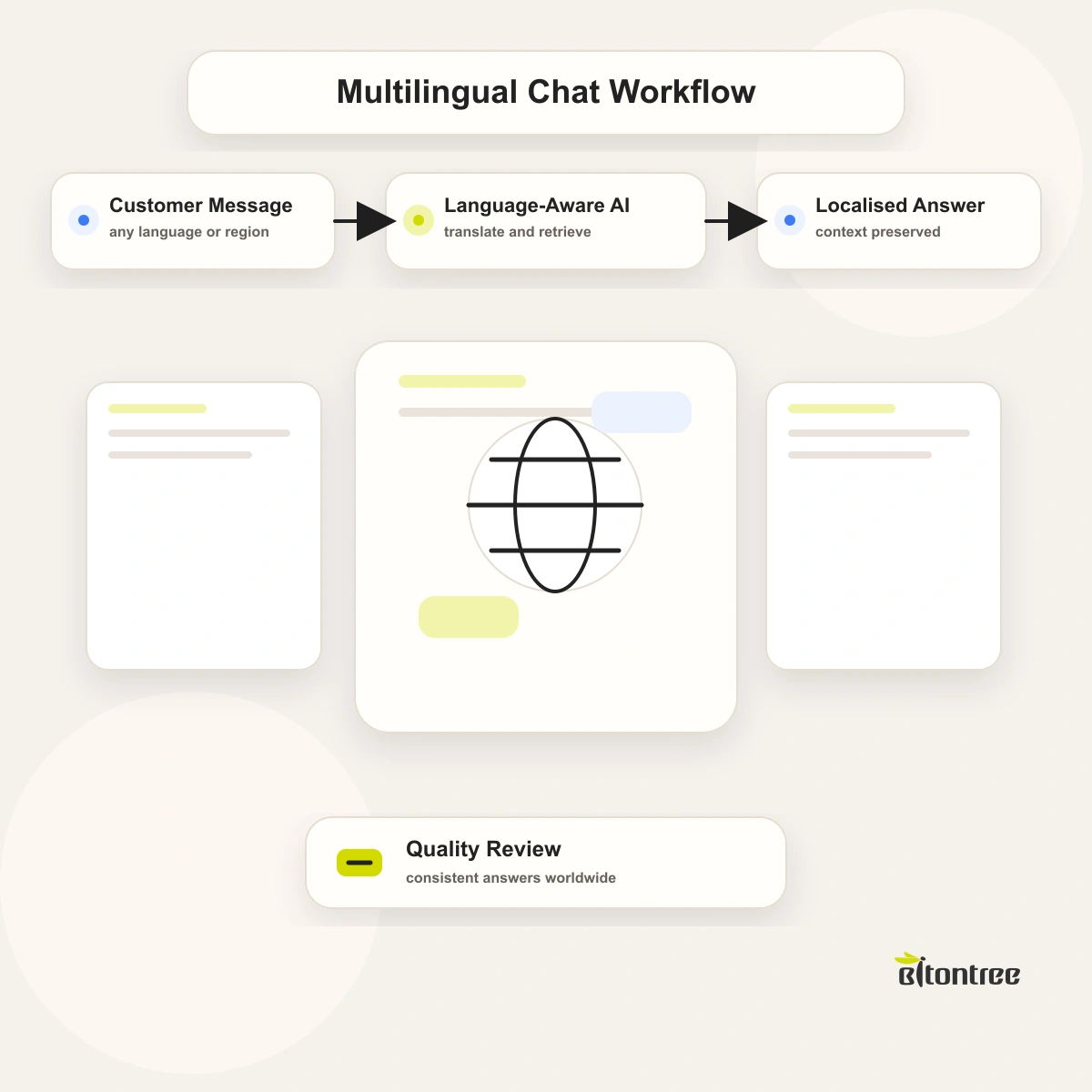
What makes a multi-language chatbot different from a translated one is that it does not simply run text through a translation layer. It detects the incoming language, understands the intent behind the message in that language, retrieves the answer from one shared knowledge base, and generates a natural reply in the customer's language with a tone that fits the conversation. The knowledge is maintained once, in one place, and every language draws from it, so an update to a policy or product fact reaches every market at the same moment.
Why Do Businesses Need an AI Multilingual Chatbot?
Running a chatbot for international customers is one of the hardest things a growing business does, and the usual approaches all break down at scale. Here are the six ways language barriers cost a business the most.
- Customers leave when support is not in their language. A customer who cannot get help in a language they understand does not wait for a translation. They abandon the purchase or the ticket and often do not come back.
- Hiring native speakers for every market does not scale. Staffing a support team in every language a business sells in is slow, expensive, and impossible to maintain as the company enters new regions.
- Running a separate bot per language creates chaos. Maintaining a different chatbot and a different knowledge base for each market means every update has to be made many times, and the versions drift apart.
- Translation tools lose intent and tone. Bolting a generic translation layer onto an English-only bot produces stilted, literal replies that miss the customer's intent and feel impersonal.
- After-hours and time-zone gaps go unanswered. Global customers contact a business around the clock, but human teams in one or two regions cannot cover every time zone, so many enquiries wait.
- Knowledge drifts out of sync across regions. When each market maintains its own content, a policy change or product update reaches some customers and not others, creating inconsistent and incorrect answers.
This is a scale problem, not a translation problem. The knowledge is the same in every market, only the language changes. Gartner expects conversational AI to handle a growing share of customer interactions, and chatbot adoption continues to climb. A multilingual chatbot is how a business delivers that consistently in every language it operates in.
What Can an AI Multilingual Chatbot Do?
An AI multilingual chatbot does far more than translate. It detects, understands, and responds naturally in each customer's language. With more than half of all web content in just a handful of languages yet customers spread across many more, these are the seven highest-impact things it handles in production.
Detect the Customer's Language Automatically
The chatbot identifies the language of an incoming message on its own, with no language menu and no prompt for the customer to choose. Whether someone writes in French, Hindi, or Portuguese, the chatbot recognizes it instantly and switches to it. The customer simply writes the way they naturally would, and the conversation continues in their language from the first message.
Respond Naturally in 30 or More Languages
The chatbot holds a real conversation in each supported language, not a word-for-word translation. It understands the intent behind the message and generates a fluent, natural reply, the way a native-speaking agent would phrase it. Supporting 30 or more languages from one deployment means a business can enter new markets without building anything new.
Match Tone and Formality to the Conversation
Languages carry formality differently, and a reply that feels right in one can feel rude or distant in another. The chatbot matches the tone and level of formality the customer uses and the convention of their language, so a formal enquiry gets a formal answer and a casual one feels relaxed. The conversation feels natural, not machine-generated.
Answer From One Shared Knowledge Base
Every language draws its answers from a single, shared knowledge base. The business maintains its product facts, policies, and support content once, in one place, and every language serves answers from it. There is no separate content set per market to update, and no risk of one region running on outdated information.
Keep Every Market Consistent and Current
Because all languages share one knowledge base, an update reaches every market at the same moment. When a policy changes or a product detail is revised, the change is live in every language instantly. Customers in every region get the same correct, current answer, with no lag and no drift between markets.
Switch Languages Mid-Conversation
If a customer changes language partway through a conversation, the chatbot follows without losing context. It keeps track of everything discussed so far and continues seamlessly in the new language. Multilingual households, travelers, and bilingual customers can communicate however is most comfortable, and the chatbot adapts in real time.
Operate Across Every Channel and Time Zone
The multilingual chatbot works across your website, messaging apps, and support channels, and it runs around the clock. Customers in every region get an instant answer in their language at any hour, so time-zone gaps and after-hours demand stop being a reason that enquiries go unanswered.
What Are the Benefits of an AI Multilingual Chatbot?
The business case for an AI multilingual chatbot is concrete and measurable. These are the six benefits global businesses see most consistently.
- Reach customers in every market. The business serves customers in their own language from day one in any region, so language stops being a barrier to entering a new market or closing a sale.
- One system instead of many. A single multi-language chatbot and one shared knowledge base replace a patchwork of per-language bots and teams, which removes duplicated maintenance and the cost that comes with it.
- Consistent answers everywhere. Because every language draws from the same knowledge base, a customer in any market gets the same correct answer, and updates reach every region at once.
- Lower support cost as you scale. Adding a language is a configuration change, not a new hire and a new bot, so support cost does not rise in step with the number of markets served.
- 24/7 coverage across time zones. A global customer base contacts a business at every hour. The chatbot delivers multilingual customer support instantly in every region, so no enquiry waits for a local team to come online.
- A better experience for every customer. Multilingual customer support that answers naturally, in the customer's own language and a tone that fits, feels personal. That lifts satisfaction and trust in every market the business serves.
These benefits are measurable in practice. For a cryptocurrency exchange operating across 22 countries, the Bitontree multilingual chatbot replaced a patchwork of language-specific support channels and now handles KYC verification, transaction, and compliance questions across 23 languages from a single deployment, up from separate flows in just 6. The result was a 54% reduction in support tickets needing human translation, a 40% faster resolution time for non-English speakers, and customer satisfaction across non-English interactions rising from 3.1 to 4.3 out of 5. Language detection reached 89% accuracy on the first message and 99.2% by the second.
These gains compound as a business grows internationally. The conversational AI market is forecast for strong, sustained growth, and multilingual capability is one of the clearest reasons businesses adopt it, because it turns a global customer base from a staffing problem into a solved one.
Which Industries Need an AI Multilingual Chatbot?
Any business that serves customers across language boundaries benefits from an AI multilingual chatbot. The need is strongest in these seven industries.
- E-commerce and retail. Online retailers sell across borders and use a chatbot for international customers to answer product, shipping, and returns questions in every language, lifting conversion in each market.
- Travel and hospitality. Airlines, hotels, and booking platforms serve travelers from everywhere and use it to handle bookings and enquiries in the traveler's own language.
- SaaS and technology. Software companies with global users use it to answer product and support questions in many languages from one shared documentation base.
- Financial services. Banks and fintech firms serving multiple regions use it to answer account and product questions consistently in each customer's language.
- Customer support and BPO. Support operations deploy it as a global customer support chatbot, resolving routine questions in any language and routing complex cases to the right agent.
- Education and e-learning. Online education providers with international students use it to answer enrollment, course, and support questions in each student's language.
- Healthcare and public services. Providers serving diverse communities use it to make information and support accessible in the languages their patients and residents actually speak.
Whatever the industry, one chatbot connects to one knowledge base and serves every market. With the global chatbot market expanding rapidly, multilingual capability is one of its strongest growth drivers. It is one capability within our wider AI chatbot development work, focused on serving a global customer base from a single system.
How Does an AI Multilingual Chatbot Work?
A multilingual AI chatbot turns a message in any language into an understood, accurately answered reply in that same language. It works in five stages, each running in real time on every message.
1. Language Detection
When a message arrives, the chatbot identifies which language it is written in automatically. This detection runs on every message, so the chatbot knows from the first word which language to think and respond in, with no input from the customer.
2. Intent Understanding
A large language model interprets the message in its original language and works out what the customer wants. Because modern language models are trained across many languages, intent is understood directly, without a lossy translation step in between.
3. Retrieval From the Shared Knowledge Base
The chatbot retrieves the relevant answer from one shared knowledge base using retrieval-augmented generation. The knowledge is stored once, and retrieval works across languages, so a question asked in any language finds the same correct source content.
4. Response Generation and Tone Matching
The chatbot generates a natural reply in the customer's language, not a translation of an English answer. It matches the tone and formality of the conversation and the conventions of that language, so the response reads the way a native-speaking agent would write it.
5. Delivery and Continuous Improvement
The answer is delivered in the customer's channel, and every conversation is logged for review. As the knowledge base is updated or new languages are added, the chatbot improves without rebuilding, because the knowledge and the language coverage are configuration, not code.
The quality of multilingual understanding depends on strong underlying language models, an area of active research documented by groups such as the Stanford NLP group, and getting language detection and tone right is what separates a natural multilingual chatbot from a literal translator.
How Does Bitontree Build an AI Multilingual Chatbot?
A production-grade AI multilingual chatbot goes live within 5 to 8 weeks. Research on automation programs shows that focused, well-scoped deployments succeed far more often than broad rollouts, so we build in four stages.
Step 1: Market and Language Scoping (Week 1)
We identify which markets and languages the chatbot must serve first, review your existing knowledge content, and define the channels it will run on. This sets the scope and what success looks like in each market.
Step 2: Knowledge Base and Language Architecture (Weeks 2-4)
We build the single shared knowledge base, set up retrieval, and configure language detection, response generation, and tone matching for each target language. We design how the chatbot escalates to a human when needed.
Step 3: Build, Test, and Tune Per Language (Weeks 4-6)
We build the chatbot and test it in every supported language against real questions, checking detection accuracy, answer accuracy, and tone. Native-speaker review catches anything that reads as unnatural before launch.
Step 4: Deployment and 30-Day Optimization (Weeks 6-8 Onward)
The chatbot goes live across your channels, and we monitor detection accuracy, answer quality, and customer satisfaction per language, tuning for 30 days so performance keeps improving after launch.
Conclusion
Serving a global customer base has always forced a hard choice: hire and maintain a team for every language, or accept that some customers get a worse experience than others. Neither is sustainable as a business grows. The knowledge a company needs to share is the same in every market, only the language changes, and customer experience is now a primary driver of growth. An AI multilingual chatbot resolves the choice by serving every language well from one system.
Bitontree builds and ships AI multilingual chatbots tailored to the markets you serve. We scope your languages, build the single shared knowledge base, configure detection and tone matching for each language, and go live within 5 to 8 weeks with a 30-day optimization period included. If your business loses customers to language barriers, or spends too much maintaining a separate setup for each market, we can build the one system that serves them all.
Frequently Asked Questions
How many languages can an AI multilingual chatbot support?
A well-built AI multilingual chatbot supports 30 or more languages from a single deployment, and the practical limit depends on the underlying language model. Adding a language is a configuration step, not a new build, so coverage can expand as the business enters new markets.
How does the chatbot know which language a customer is using?
The chatbot detects the language automatically on every incoming message. The customer does not select a language or press anything. From the first word, the chatbot identifies the language and responds in it, and it can follow if the customer switches language mid-conversation.
Is an AI chatbot for multiple languages just a translation tool?
No. A translation tool converts text word for word and often loses intent and tone. A multilingual chatbot understands the message in its original language, retrieves the answer from a shared knowledge base, and generates a natural, tone-matched reply in that language, the way a native-speaking agent would.
Does each language need its own knowledge base?
No, and that is the core advantage. The chatbot uses one shared knowledge base for every language. The business maintains its content once, and every language serves answers from it, so an update reaches every market at the same moment with no version drift.
Can the chatbot match the tone of each language?
Yes. The chatbot matches the formality and tone the customer uses and the conventions of their language. A formal enquiry receives a formal reply, and a casual one feels relaxed, so the conversation feels natural in every language rather than machine-generated.
How long does it take to build an AI multilingual chatbot?
A typical AI multilingual chatbot goes live within 5 to 8 weeks. That includes market and language scoping, building the shared knowledge base, configuring and testing each language with native-speaker review, deployment, and a 30-day optimization period after launch.
Which industries use AI multilingual chatbots?
Any business serving customers across language boundaries. Multilingual chatbots are used across e-commerce, travel and hospitality, SaaS, financial services, customer support, education, and healthcare, anywhere customers in different regions need answers in their own language.
Related Use Cases

AI Chatbot for Customer Support
Build a customer support chatbot that resolves 70% of tickets automatically. 24/7 availability, 2-second response, CRM integration, human handoff.
AI Chatbot for Ecommerce
70% of your carts are abandoned. Our AI chatbot recovers 25% of them, handles order tracking, returns, product recommendations, and support 24/7. Free store audit.
AI Voice Chatbot
Build an AI voice chatbot that handles inbound and outbound calls: intent recognition, live transfers, and post-call summaries. Available 24/7, no hold times.