July 20, 2026
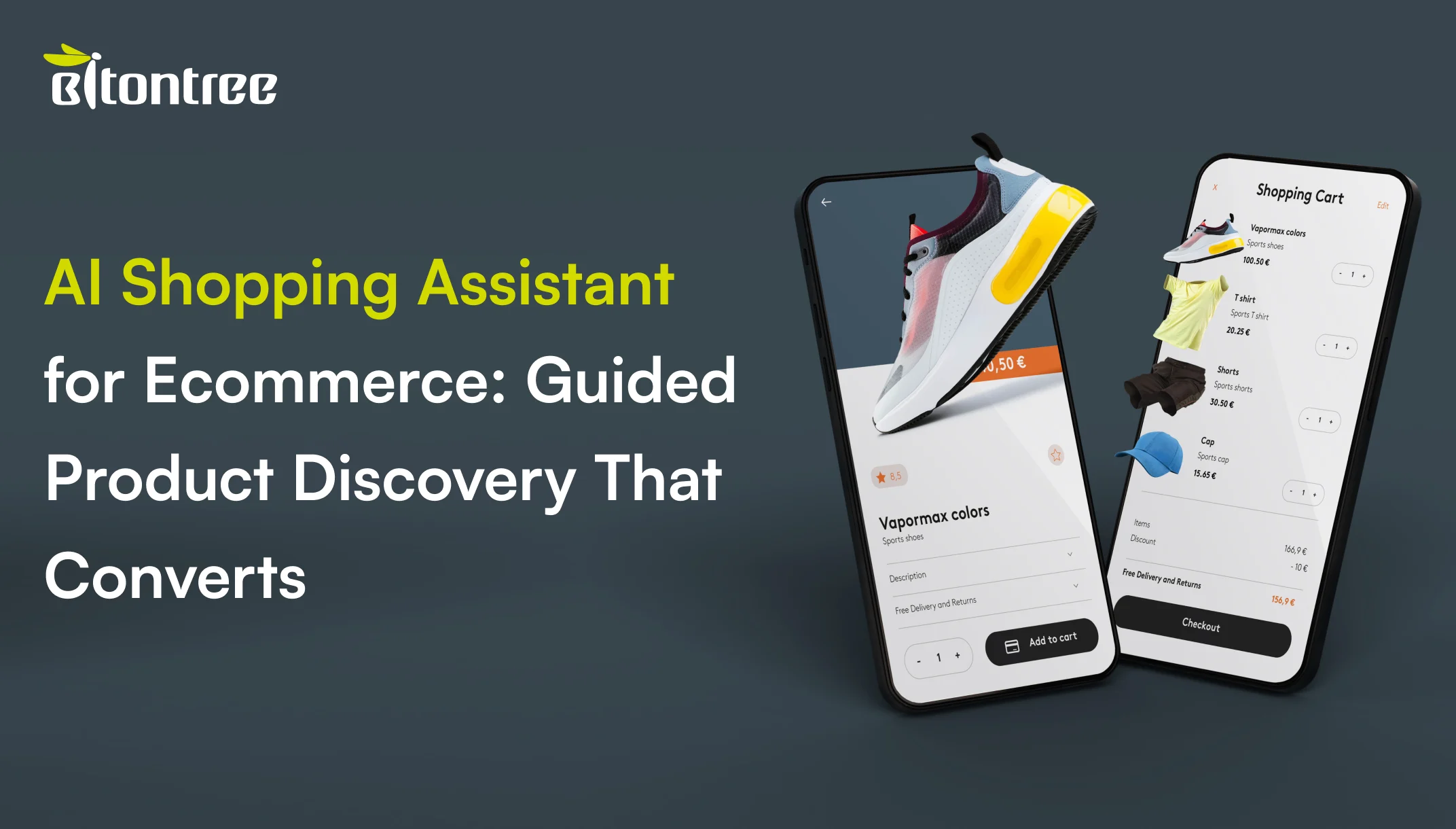
AI Shopping Assistant for Ecommerce: Guided Product Discovery That Converts

Yash Vibhandik
CEO


Key Takeaways
-
An AI shopping assistant helps shoppers express a need in their own words, asks focused follow-up questions, and recommends products from approved catalog data.
-
It is not a replacement for every search or filter experience. The strongest implementation often combines semantic retrieval, filters, and conversation.
-
Product and inventory data quality determine recommendation quality. The language model cannot repair missing measurements, inconsistent variants, or stale stock.
-
Measure incremental conversion with a randomized holdout. Comparing people who chose to use the assistant with people who did not creates self-selection bias.
-
Start with an app when the goal is validation. Build custom when domain-specific reasoning, merchandising controls, system integration, or cross-channel consistency justify the added cost.
A visitor arrives at your store looking for something you sell. Three minutes later, they leave. The analytics record a bounce, but not the question that stopped the purchase.
Maybe the catalog had 4,000 products. Maybe the shopper knew the outcome they wanted but not the product name. Search returned nothing because the store used different terminology. Filters narrowed the list but did not answer whether the product would fit, work with a device, suit sensitive skin, or arrive before an event.
That is the product-discovery problem. The shopper has intent, but the interface makes them translate that intent into the store's data model.
An AI shopping assistant for ecommerce changes the interaction from "enter the right keyword" to "describe what you need." It asks clarifying questions, retrieves suitable products, explains the match, and helps the shopper refine the result. In implementation terms, it is an AI product recommendation agent focused on the discovery stage of the buying journey.
What Is an AI Shopping Assistant?

An AI shopping assistant is a conversational product-discovery system connected to a store's catalog, inventory, product knowledge, and approved commerce actions.
Three capabilities distinguish it from a chat widget with scripted answers:
-
It clarifies intent: "A gift for my mother under $50" is not enough information. A useful assistant asks about interests, occasion, preferences, and constraints without turning the conversation into a survey.
-
It retrieves from real product data: Recommendations should reflect current variants, price, availability, measurements, compatibility, and merchant-approved product information.
-
It explains the match: Instead of returning a grid, it identifies a small set and states why each option meets the shopper's stated needs.
The assistant may also compare products, answer follow-up questions, suggest a compatible accessory, or add an approved item to the cart. It should say when the catalog does not contain a suitable match rather than fabricate one.
This is one part of the wider move toward agentic commerce, where AI systems help users discover and sometimes transact across commerce experiences. On the merchant's own site, the immediate goal is simpler: reduce the distance between the shopper's language and the catalog.
Why Product Discovery Breaks Down
Baymard Institute's ecommerce usability research found that 31% of product-finding tasks ended in failure when test participants used site search, and that many leading sites struggled with synonyms and product-type queries (Baymard ecommerce search research). Its product-list research also shows that filtering and list usability can materially affect abandonment during product finding (Baymard product-list research).
The problem is not that search and filters are obsolete. Modern semantic search can handle misspellings, synonyms, natural-language queries, and vector similarity. Filters remain faster for shoppers who know the attributes they care about. The gap appears when the decision requires interpretation or reassurance.
Common examples include:
-
"I need running shoes for flat feet, but I do not want a heavy stability shoe."
-
"Which charger works with my exact laptop model?"
-
"I need a fragrance-free moisturizer that fits with the products I already use."
-
"Will this sofa fit through a 30-inch doorway?"
-
"Find a gift under $75 for a 10-year-old who likes space."
Each request contains intent, constraints, and language that may not map neatly to a product title or filter.
AI Shopping Assistant vs Search, Filters, and Chatbots
| Capability | Site Search | Filters | Rule-Based Chatbot | AI Shopping Assistant |
|---|---|---|---|---|
| Best at | Retrieving a known or describable item | Narrowing structured attributes | Answering predictable scripted questions | Clarifying intent and guiding a choice |
| Vague requests | Possible with semantic search | Limited | Only when anticipated in the flow | Can ask follow-up questions |
| Product comparison | Usually returns results | Shopper compares manually | Limited to scripted branches | Can explain approved attributes side by side |
| Live availability | Platform-dependent | Usually available | Integration-dependent | Requires a live catalog/inventory integration |
| Product answers | Limited | No | FAQ-dependent | Can retrieve approved product knowledge |
| Main risk | Weak relevance or zero results | Excessive effort | Brittle flows | Confident answers from incomplete data |
The right architecture may use all four. Search retrieves candidates. Filters enforce hard constraints. The assistant interprets language and guides the decision. Rules limit what it can claim or do.
How Conversational Product Discovery Works
A useful shopping conversation follows a restrained sequence.
1. Capture the need in the shopper's language: Let the shopper describe the use case without choosing a category first.
2. Ask only the questions that change the result: Budget, size, occasion, compatibility, material, delivery deadline, or another decision-critical constraint. Too many questions recreate filter fatigue in chat form.
3. Retrieve candidates and enforce hard constraints: Exclude incompatible, unavailable, restricted, or out-of-budget items before the model writes a recommendation.
4. Return a small, diverse shortlist: Two or three options with a reason for each are usually easier to evaluate than another forty-product grid.
5. Handle the purchase-blocking question: Size, compatibility, ingredients, delivery, care, warranty, or returns often determine whether the shopper continues.
6. Let the shopper refine: "Anything similar in blue?" or "Which one is easiest to maintain?" should update the same decision context.
7. Complete only approved actions: Add-to-cart and channel handoff actions need accurate product IDs, explicit confirmation, error handling, and a clear success state.
If the shopper reaches checkout and then hesitates, the workflow moves into abandoned-cart recovery. Product discovery and cart recovery share context, but they solve different moments in the funnel.
Which Ecommerce Categories Benefit Most?
Conversational discovery is most useful when the choice depends on several attributes or when a wrong choice creates a costly return.
Fashion and apparel: Size, fit, cut, style, occasion, material, and care. The assistant can explain brand-specific measurements, but it should not promise fit when the data cannot support it.
Beauty and skincare: Product type, ingredient preferences, routine compatibility, and allergies. Recommendations should remain within approved product information and route medical questions to a qualified professional.
Electronics and parts: Device models, ports, standards, dimensions, and compatibility. Structured compatibility data matters more than fluent prose.
Home and furniture: Room dimensions, doorway constraints, assembly, materials, delivery, and care. High-value purchases often stall on one specific logistical question.
Gifts and multi-brand catalogs: Occasion, recipient, interests, price, shipping deadline, and available stock. Guided narrowing can create a useful starting point when category navigation is not obvious.
The common factor is decision complexity - not a minimum SKU count. A store with 150 technical products may benefit more than a store with 5,000 nearly interchangeable ones.
What It Takes to Build a Reliable AI Product Recommendation Agent
The model is rarely the hardest part. Four layers determine whether the assistant remains useful after the demo.
Catalog quality: Product attributes, variants, measurements, materials, compatibility, care, imagery, and category structure need consistent identifiers and values.
Retrieval and grounding: The assistant should retrieve product and policy information from approved sources. Product claims need citations or traceable source records inside the system, even when the shopper does not see the underlying architecture.
Live commerce integrations: Prices, availability, variants, delivery promises, and cart actions must come from the relevant systems at decision time. Cached data needs a defined freshness policy.
Merchandising and safety rules: Merchants may exclude low-stock products, control sponsored placement, protect margin thresholds, restrict claims, and define when a human or specialist is required. Recommendations should disclose sponsored or incentive-driven ranking where relevant.
Evaluation is the fifth layer. Test vague requests, contradictory requirements, zero-result cases, unavailable variants, unsafe product questions, and adversarial attempts to make the assistant invent information. RAG development can improve grounding, but retrieval does not compensate for incorrect source data.
AI Shopping Assistant App vs Custom Build
There are capable off-the-shelf shopping-assistant and semantic-search products. Choosing one is often the fastest way to learn whether customers want conversational discovery.
Start with an app when:
-
The catalog and attributes already fit the platform;
-
The website is the main channel;
-
Product questions are common but not highly specialized;
-
The priority is fast validation;
-
Standard analytics and merchandising controls are enough.
Consider a custom build when:
-
Products require domain-specific compatibility or constraint reasoning;
-
The assistant needs proprietary data or workflows a generic product cannot represent;
-
Recommendations must follow complex inventory, margin, compliance, or merchandising rules;
-
Website, WhatsApp, Instagram, support, and post-purchase experiences need shared context;
-
The assistant must take controlled actions across custom systems;
-
The expected value supports build, monitoring, maintenance, and evaluation costs.
The honest sequence is often app first, custom later. A custom system should solve a demonstrated constraint, not merely replace a less expensive tool with bespoke code.
How to Measure Conversion Impact Without Fooling Yourself
Shopping-assistant vendors often compare conversion among users who opened the assistant with conversion among users who did not. That comparison is useful operationally but weak evidence of incremental lift. People who ask product questions may already have stronger purchase intent.
Use a randomized holdout:
-
Randomly assign eligible sessions to an assistant group and a control group.
-
Measure conversion across all sessions assigned to each group, not only the people who engaged.
-
Keep traffic source, device, market, catalog availability, and promotion periods balanced.
-
Run the test long enough to cover normal purchase cycles and reach adequate sample size.
-
Review guardrail metrics as well as revenue.
Track:
-
Assistant exposure and engagement rate;
-
Overall conversion in exposed versus control sessions;
-
Average order value in both groups;
-
Zero-result and no-suitable-product rate;
-
Product-question support volume;
-
Return rate on assisted versus control orders;
-
Recommendation acceptance and removal rate;
-
Latency, escalation, and incorrect-claim rate.
Do not "halve" observed lift by rule of thumb. Either run a controlled experiment or label the calculation as a scenario based on an assumed incremental effect.
A Planning Scenario for Incremental Value
Assume a store has 250,000 eligible monthly sessions, a 2% baseline conversion rate, and a $70 average order value. A randomized test shows the assistant group converts at 2.15% while the control remains at 2%.
-
Incremental conversion: 0.15 percentage points;
-
Incremental orders: 250,000 x 0.15% = 375;
-
Incremental revenue: 375 x $70 = $26,250;
-
At a 50% gross margin before assistant costs: $13,125 in incremental gross contribution.
From that amount, subtract model usage, software or hosting, monitoring, maintenance, merchandising time, and any incremental discounts or returns. The result - not assisted-session conversion - is the figure to compare with the investment.
The scenario is not a benchmark or Bitontree client outcome. Replace every input with your own controlled result.
The Traffic You Already Paid For
An AI shopping assistant will not rescue weak products, inaccurate inventory, thin product pages, or an uncompetitive offer. It can help when a qualified shopper reaches the catalog and cannot translate a real need into a confident choice.
That is why the first step is not choosing a model. Review zero-result searches, filter exits, product questions, chat transcripts, assisted sales, and return reasons. They reveal where product discovery fails and which questions deserve a guided answer.
At Bitontree, we build production AI systems around the merchant's real catalog, controls, and measurement plan. If conversational discovery does not create incremental value in a controlled test, it should not move beyond the experiment. If it does, the same evidence tells you which categories and channels to expand next.
I am the founder and CEO of Bitontree, where I lead embedded AI engineering teams that build and run production AI: agents, RAG and knowledge systems, document AI, and workflow automation for healthcare, logistics, legal, and SaaS companies. I write about what it actually takes to ship AI that survives contact with production.
Frequently Asked Questions
What is an AI shopping assistant for ecommerce?
An AI shopping assistant is a conversational product-discovery system that lets shoppers describe what they need in natural language, asks clarifying questions, searches the store's catalog and inventory, and recommends suitable products with reasons. Its answers are only as reliable as the product data and integrations behind it.
How is an AI shopping assistant different from site search?
Site search retrieves products from a query, while an AI shopping assistant can clarify vague intent, compare constraints, answer product questions, and refine recommendations through conversation. Modern semantic search can also handle natural language, so the best experience may combine search retrieval with conversational guidance.
Is an AI shopping assistant the same as a chatbot?
It may use a chat interface, but its primary job is guided product discovery. A general chatbot often handles FAQs and support. A shopping assistant needs reliable catalog retrieval, inventory checks, recommendation logic, product comparisons, and safe add-to-cart actions.
Can an AI shopping assistant increase ecommerce conversion?
It can reduce discovery friction and answer purchase-blocking questions, but the incremental effect must be measured. Use a randomized holdout that compares all sessions offered the assistant with a control group; do not treat the higher conversion of self-selected assistant users as proof of lift.
Can the same assistant work on WhatsApp and Instagram?
Yes, when the channels are integrated with the same product, inventory, policy, and conversation services. Channel permissions, consent, message formats, platform review, and supported commerce actions vary, so capabilities are not automatically identical everywhere.
Should we use an app or build a custom AI shopping assistant?
Start with an app when the catalog is straightforward, one channel is enough, and the goal is to validate customer engagement. Consider a custom build when products require specialized reasoning, merchandising rules matter, several systems and channels must share context, or the app's data model creates operational constraints.
What product data does an AI shopping assistant need?
It needs accurate titles, variants, prices, availability, attributes, measurements, compatibility data, media, and policy content. Product-specific claims should be grounded in approved sources, and missing information should produce a clear limitation rather than a guessed answer.