

Key Takeaways
-
The cost of an ecommerce AI agent depends more on the workflow, systems, permissions, data, and controls than on the model selected.
-
For planning - not quoting - a focused custom build may fall around $15,000-$30,000, with an illustrative $1,500-$3,000 monthly operating range. Multi-workflow, multi-market, or regulated systems can cost materially more.
-
Reading order data is simpler than writing refunds, changing inventory, or initiating payments. Every write action adds validation, permissions, rollback, reconciliation, and monitoring.
-
Data cleanup, policy translation, shadow-mode evaluation, internal business time, and edge cases are frequent hidden costs.
-
A custom agent is not automatically cheaper than software. If expected monthly value does not clearly exceed ongoing cost and risk, use an app or improve the process first.
Search for AI agent development cost and you will find estimates from a few thousand dollars to several hundred thousand. Those figures can all describe real projects while still being useless for planning, because the word "agent" covers systems with completely different responsibilities. The broader ecommerce opportunity is substantial too: U.S. Census Bureau data via FRED showed ecommerce at 16.9% of total retail sales in Q1 2026 (FRED ECOMPCTSA).
An assistant that reads an order status and drafts a reply is not the same build as an agent that decides return eligibility, updates inventory, and issues a refund. The second system touches money and customer rights. It needs more engineering, more controls, and more evidence before it acts.
This guide breaks down AI agent cost for ecommerce by scope, recurring expenses, hidden work, and payback. It also explains when a custom build does not make economic sense. For the workflow-level view, start with AI agents for ecommerce.
What Does an AI Agent for Ecommerce Cost?
For early planning, Bitontree uses the following illustrative ranges for a focused ecommerce agent. If you need the broader service model first, see our AI agent development practice.
-
Build: approximately $15,000-$30,000 for one bounded workflow or a small connected set of workflows.
-
Managed operation: approximately $1,500-$3,000 per month for infrastructure, usage, monitoring, maintenance, and tuning within an agreed scope.
-
Delivery: commonly measured in weeks for a bounded workflow, but timeline depends on data access, platform approvals, integration readiness, controls, and business review.
These are planning ranges reviewed in July 2026, not a public fixed-price offer, industry benchmark, or project quote.
They assume:
-
One ecommerce business and a clearly defined workflow.
-
Existing systems expose usable APIs and permissions.
-
Product, policy, and order data exist, even if cleanup is needed.
-
No custom foundation-model training.
-
Standard cloud deployment.
-
A staged launch with evaluation and monitoring.
-
Client stakeholders are available for policy and exception decisions.
They exclude taxes, third-party SaaS subscriptions, message fees, unusually large data-remediation programs, formal compliance certification, 24/7 enterprise support, and major re-platforming work.
Illustrative Ecommerce AI Agent Cost by Tier
| Planning tier | Typical scope | Illustrative build | Illustrative monthly operation |
|---|---|---|---|
| Focused | One read-heavy workflow, one main channel, one or two systems | $15,000-$20,000 | $1,500-$2,000 |
| Connected | Two or three related workflows, several systems, controlled write actions | $20,000-$30,000 | $2,000-$3,000 |
| Complex | Multi-store, multi-market, multi-language, high-risk actions, or extensive governance | Individually scoped | $3,000+ |
The table is a scoping aid. It does not replace discovery. A "focused" workflow with poor data or a difficult legacy system can cost more than a broader workflow on a clean modern stack.
Why Published AI Agent Cost Ranges Vary So Much
Three differences explain most of the spread.
The label does not define the capability: Gartner has warned about "agent washing" - products described as agentic without the autonomy or goal-oriented behavior implied by the term (Gartner, June 2025). A scripted FAQ bot, a drafting assistant, and a tool-using refund agent can all be sold under the same name.
Scope is omitted: Number of workflows, integrations, channels, markets, languages, actions, and edge cases can change effort by multiples.
The commercial model differs: A freelancer prototype, a product subscription, an offshore development team, and a US enterprise consultancy include different people, warranties, support, documentation, ownership, and risk transfer.
Compare estimates line by line. A lower number may be genuinely efficient, or it may exclude data preparation, evaluation, production controls, warranty, monitoring, and ongoing support.
7 Factors That Drive Ecommerce AI Agent Development Cost
1. Number of workflows: Order status, product discovery, cart recovery, returns, and post-purchase retention are separate workflows with different data and success metrics. Start with one bounded job.
2. Read actions versus write actions: Reading shipment status is relatively low risk. Canceling an order, changing an address, issuing credit, or moving inventory requires authorization, confirmation, idempotency, rollback, and reconciliation.
3. Systems and integration quality: Shopify, WooCommerce, Magento, BigCommerce, payment providers, help desks, carriers, loyalty platforms, and warehouses all expose different APIs and limits. Legacy middleware and inconsistent identifiers add effort.
4. Channels: Website chat is different from WhatsApp, Instagram, SMS, email, or voice. Each channel adds consent, templates, message constraints, identity, testing, and error handling. Platform review or business verification may also add calendar time, but the duration varies.
5. Data readiness: Catalog attributes, size charts, policies, return reasons, customer IDs, and product compatibility data often live in inconsistent sources. The agent cannot ground an answer in information that does not exist.
6. Autonomy and risk: A drafting assistant with human approval costs less to control than an autonomous agent acting on high-value transactions. Higher autonomy requires stronger evaluation, permissions, thresholds, observability, and incident response.
7. Governance and compliance: Privacy, payment scope, data residency, audit retention, accessibility, regulated product claims, and internal approvals can be larger workstreams than the conversation itself.
Write down these seven inputs before requesting a quote. Bitontree's AI agent development service begins with the workflow and control boundary, not the model name.
What Should an AI Agent Estimate Include?
Ask every vendor to state:
-
What discovery and process mapping are included.
-
Who prepares product, policy, and historical data.
-
Which systems, environments, and actions are in scope.
-
Whether evaluation datasets and shadow-mode testing are included.
-
Which security and authorization controls are included.
-
Whether documentation, training, and handover are included.
-
Who owns the source code, prompts, evaluation data, and operational rules.
-
What third-party usage is billed separately.
-
The warranty and incident-support terms.
-
The monthly maintenance and monitoring scope.
-
The assumptions that trigger a change request.
A quote that does not define these boundaries is not necessarily cheap. It is incomplete.
AI Agent Cost by Ecommerce Use Case
Complexity usually increases in this order, although the actual stack can change it.
Order status and WISMO automation
Read-heavy, high-volume, and governed by relatively simple access rules. This is often an appropriate first workflow; see AI agents for order tracking.
Product discovery and recommendations
Requires clean catalog attributes, reliable retrieval, live inventory, recommendation evaluation, and merchandising controls. See the AI shopping assistant guide and the related AI product recommendations guide.
Cart recovery
Adds behavioral triggers, communication consent, incentive rules, and attribution. The revenue upside can be meaningful, but measurement must separate incremental recovery from purchases that would have happened anyway. See how that scope differs in AI agents for abandoned cart recovery.
Returns and exchanges
Adds policy interpretation, inventory, labels, inspections, refunds, fraud risk, and customer-rights considerations. The AI returns management guide covers the necessary control tiers.
Connected post-purchase coverage
Order tracking, delivery exceptions, returns, refunds, loyalty, and retention share context, but implementing them at once increases edge cases and makes attribution harder. Expand only after a bounded workflow is stable.
Monthly Running Costs After Launch
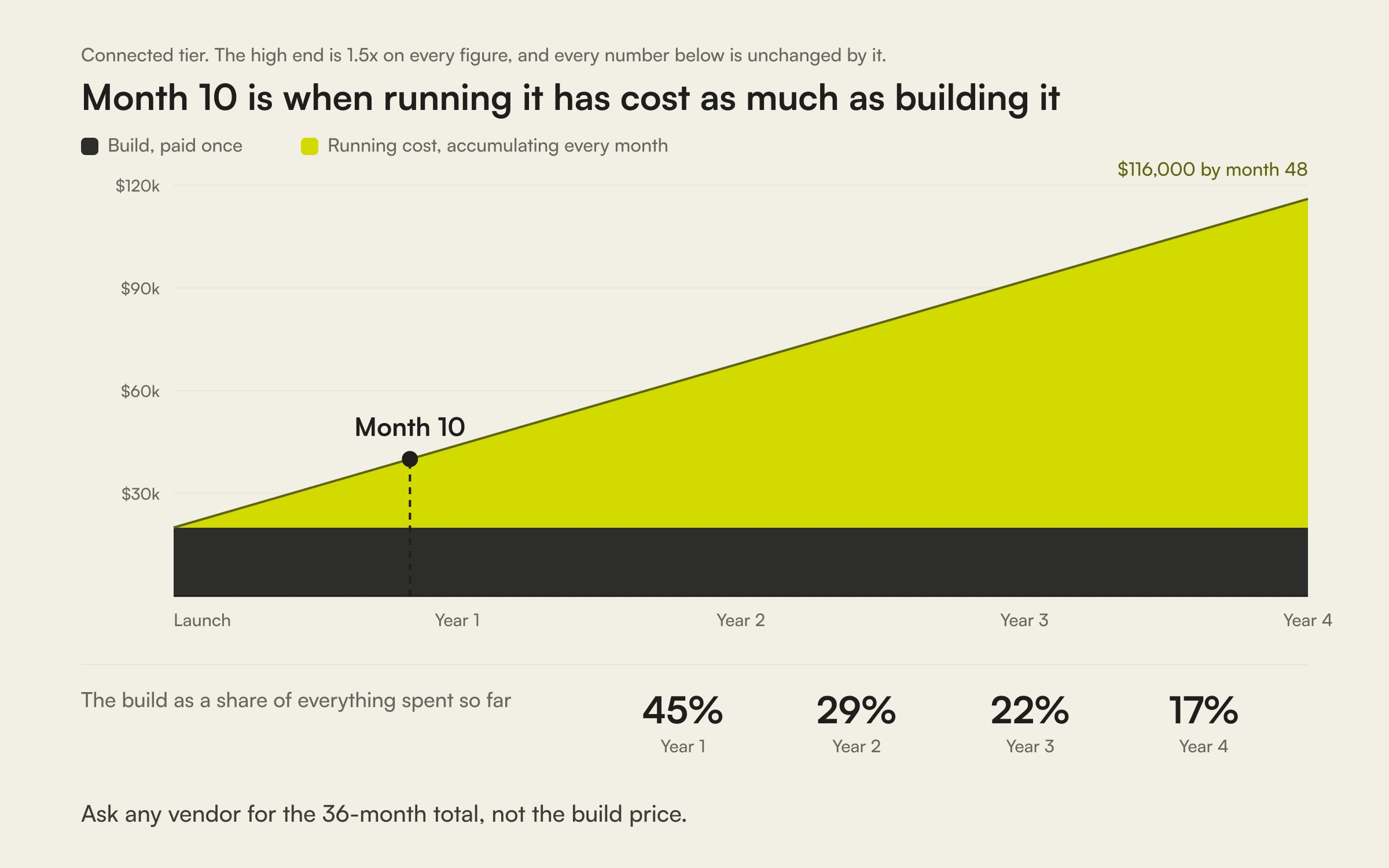
The build is not the total cost of ownership. A production agent carries recurring expenses:
-
Model usage and embeddings.
-
Application hosting and databases.
-
Retrieval or vector infrastructure where needed.
-
Logs, traces, metrics, and alerting.
-
Evaluation runs and human review.
-
API, message, and third-party platform charges.
-
Integration maintenance when vendors change APIs.
-
Security patches and dependency updates.
-
Prompt, rule, and product tuning.
-
Incident response and operational ownership.
Usage is only one line. For many focused systems, disciplined monitoring and maintenance cost more than raw model tokens. A proposal with no operating-cost model is a prototype estimate, not a production budget. This is why cost planning should include tracing, alerts, regression checks, and human review loops, not just inference pricing.
The Hidden Costs Most Estimates Miss
Data cleanup: Consolidating product measurements, policies, exception codes, and identifiers into reliable sources.
Policy translation: Humans work around contradictory policy language. Software cannot; someone must resolve the contradictions.
Shadow-mode evaluation: The agent proposes decisions without acting while the team compares accuracy, policy compliance, escalation quality, and failure cases.
Edge cases: Split shipments, partial returns, gifts, bundles, multiple currencies, marketplaces, subscription orders, and custom B2B pricing.
Internal stakeholder time: Support, operations, merchandising, legal, security, finance, and engineering must make decisions and review evidence.
Change management: Staff need to know what the agent handles, how to override it, and who owns an incident.
Decommissioning: Old tools and workflows do not disappear automatically. Migration, contract overlap, data export, and fallback plans can add cost.
Build vs Hire vs Buy
Buy software: Usually the fastest and least expensive starting point. Choose this when a standard tool covers the workflow and integration depth. Subscription pricing should be evaluated against usage, add-ons, internal administration, and platform limits.
Use freelancers: Appropriate for a prototype or narrow experiment when the business can own architecture, security, deployment, and continuity. Higher-risk write actions need stronger review and long-term ownership.
Use a development partner: Appropriate when a bounded outcome needs product, AI, backend, QA, security, and operations skills for a defined period. Compare the full team and delivery responsibility - not one project quote with one employee salary.
Hire internally: Appropriate when AI is a long-term core capability and the company can recruit and support product, software, data, security, and operations capacity. The relevant comparison is total team cost and time to capability, not a single "AI engineer" salary. US labor data can be referenced through BLS categories such as software developers and data scientists, but neither category alone represents a complete agent team.
The honest comparison is the total cost of the workflow today versus the total cost and incremental value of the proposed system.
How to Calculate Ecommerce AI Agent Payback
Deloitte's 2025 AI ROI research reported that most surveyed organizations took two to four years to achieve satisfactory ROI on a typical AI use case, while only 6% reported payback within one year (Deloitte, AI ROI). That broad enterprise evidence is a useful warning against casual payback promises.
A narrowly scoped ecommerce workflow can behave differently because volume and outcomes are easier to measure.
Use this formula:
Monthly net value = labor capacity value + incremental gross contribution + avoidable software cost - added logistics and incentives - monthly agent operating cost
Payback period = build cost / monthly net value
Use incremental contribution, not retained revenue. If an exchange keeps a $75 sale but adds replacement COGS, shipping, handling, and a credit, those costs belong in the calculation.
Scenario A: The Custom Build Does Not Pay Back
Assume a store processes 1,200 orders per month.
-
Routine tickets that can be contained: 210.
-
Average handling time: 5 minutes.
-
Loaded support cost: $22 per hour.
-
Monthly labor capacity value: about $385.
-
Incremental gross contribution from better exchange outcomes: $600.
-
Avoidable software cost: $200.
-
Added logistics and incentives: $250.
-
Monthly managed agent cost: $1,500.
Monthly net value: $385 + $600 + $200 - $250 - $1,500 = -$565.
The system does not pay back before including the build. The store should use standard software, improve product and policy data, and revisit the decision when volume or measurable upside changes.
Scenario B: A Focused Build Can Pay Back
Assume a store processes 8,000 orders per month.
-
Routine tickets contained: 1,440.
-
Average handling time: 5 minutes.
-
Loaded support cost: $22 per hour.
-
Monthly labor capacity value: $2,640.
-
Incremental gross contribution from exchange and recovery improvements: $6,000.
-
Avoidable software cost: $800.
-
Added logistics and incentives: $1,300.
-
Monthly managed agent cost: $2,500.
Monthly net value: $2,640 + $6,000 + $800 - $1,300 - $2,500 = $5,640.
At a hypothetical $25,000 build, simple payback is about 4.4 months. That result is only as credible as the contribution assumptions. Validate them with historical data or controlled tests before approval.
These are planning scenarios, not client results or universal thresholds.
How to Control AI Agent Development Cost
Gartner predicts that more than 40% of agentic AI projects will be canceled by the end of 2027 because of escalating cost, unclear business value, and inadequate risk controls. Those are scope and governance problems that can be addressed before implementation.
Actions that genuinely control cost:
-
Choose one workflow, one owner, and one success metric.
-
Clean the highest-value data before development begins.
-
Start with human approval or low-risk actions.
-
Use existing platform APIs and stable software where they fit.
-
Define failure cases and escalation before building the happy path.
-
Run shadow mode before granting write access, then keep the workflow measurable through production AI evaluation and monitoring.
-
Set usage, transaction, and support budgets.
-
Expand only after incremental value is demonstrated.
False economies:
-
Skipping monitoring and evaluation.
-
Shipping proof-of-concept architecture to production.
-
Comparing quotes without matching scope.
-
Deferring policy, privacy, or transaction controls that should be handled through AI security and compliance from the start.
-
Assuming the cheapest model creates the cheapest system.
-
Building multiple workflows before one is measurable.
The pattern is straightforward: reduce scope before reducing rigor.
When Should You Not Build a Custom Ecommerce AI Agent?
Do not build yet when:
-
A standard app handles the workflow economically.
-
Transaction or interaction volume is too low for recurring value.
-
No team owns the process or success metric.
-
Product, policy, and system data are unreliable.
-
The required APIs or permissions do not exist.
-
The workflow cannot tolerate the proposed failure modes.
-
Monthly value does not clearly exceed monthly operating cost.
-
The project depends on an unverified conversion or automation claim.
"Not yet" is a useful outcome from discovery. It prevents an expensive build and identifies the operational work that may create a better opportunity later.
The Real Question Is Whether the Workflow Is Worth Automating
AI agent cost for ecommerce is knowable only after the workflow is defined. Order volume, data quality, systems, write actions, risk, channels, and operating ownership determine the number.
Start with the smallest measurable constraint inside your ecommerce operation. Compare the annual cost of the current process with the full three-year cost of the proposed system. Include contribution, not just labor savings. Include monitoring and maintenance, not just the build.
At Bitontree, that is the purpose of an AI fit assessment: determine what should be built, what should remain rules-based, and whether the economics work before a project begins. If the answer is an app or a process fix, that is better than pricing a custom agent the business does not need.

I am the founder and CEO of Bitontree, where I lead embedded AI engineering teams that build and run production AI: agents, RAG and knowledge systems, document AI, and workflow automation for healthcare, logistics, legal, and SaaS companies. I write about what it actually takes to ship AI that survives contact with production.
Frequently Asked Questions
How much does it cost to build an AI agent for ecommerce?
A focused custom ecommerce AI agent may fall within an illustrative planning range of $15,000 to $30,000 to build, while broader multi-workflow systems can cost more. The actual budget depends on workflows, write actions, systems, channels, data quality, risk controls, and compliance. This range is not a quote.
What are the ongoing costs of an ecommerce AI agent?
Ongoing costs can include model usage, hosting, retrieval infrastructure, observability, evaluation, integration maintenance, security updates, incident response, and product tuning. An illustrative managed range is $1,500 to $3,000 per month for a focused system, but usage and service scope can move it materially.
Why do AI agent development estimates vary so widely?
Vendors often price different systems under the same label. An assistant that reads order status is not comparable with an agent that issues refunds across payment, inventory, and fulfillment systems. Geography, team composition, data cleanup, controls, support, and intellectual-property terms also affect the estimate.
Is it cheaper to hire an AI engineer or use a development partner?
Hiring can be appropriate when AI is a permanent core capability and the business can support the surrounding backend, product, security, and operations work. A development partner may be more economical for a bounded workflow because it provides a cross-functional team for a defined period. Compare total capability and risk, not one salary with one project quote.
What is the biggest hidden cost in an AI agent project?
Data and policy readiness are frequent surprises. Product attributes, return rules, size charts, exception handling, and system permissions may be inconsistent or distributed across spreadsheets and documents. Turning them into reliable machine-readable inputs can require more business effort than the initial prototype.
How do we calculate payback for an ecommerce AI agent?
Estimate incremental contribution retained or created, labor capacity released, and avoidable software cost. Subtract added logistics, incentives, model and infrastructure spend, monitoring, maintenance, and implementation cost. Use controlled experiments or historical baselines and state every assumption.
When should an ecommerce business not build a custom AI agent?
Do not build when transaction volume is low, the workflow is already handled economically by standard software, product and policy data are unreliable, no team owns the process, or expected monthly value does not clearly exceed ongoing cost and operational risk.