November 16, 2026
Build vs Buy vs Integrate: What's the Right AI Strategy for Your Business?

Yash Vibhandik
CEO


The build vs buy AI question is almost always asked as a binary, and that framing is why so many of these decisions turn out badly. There is a third option, it is the one most businesses should pick for most use cases, and it rarely appears on the slide.
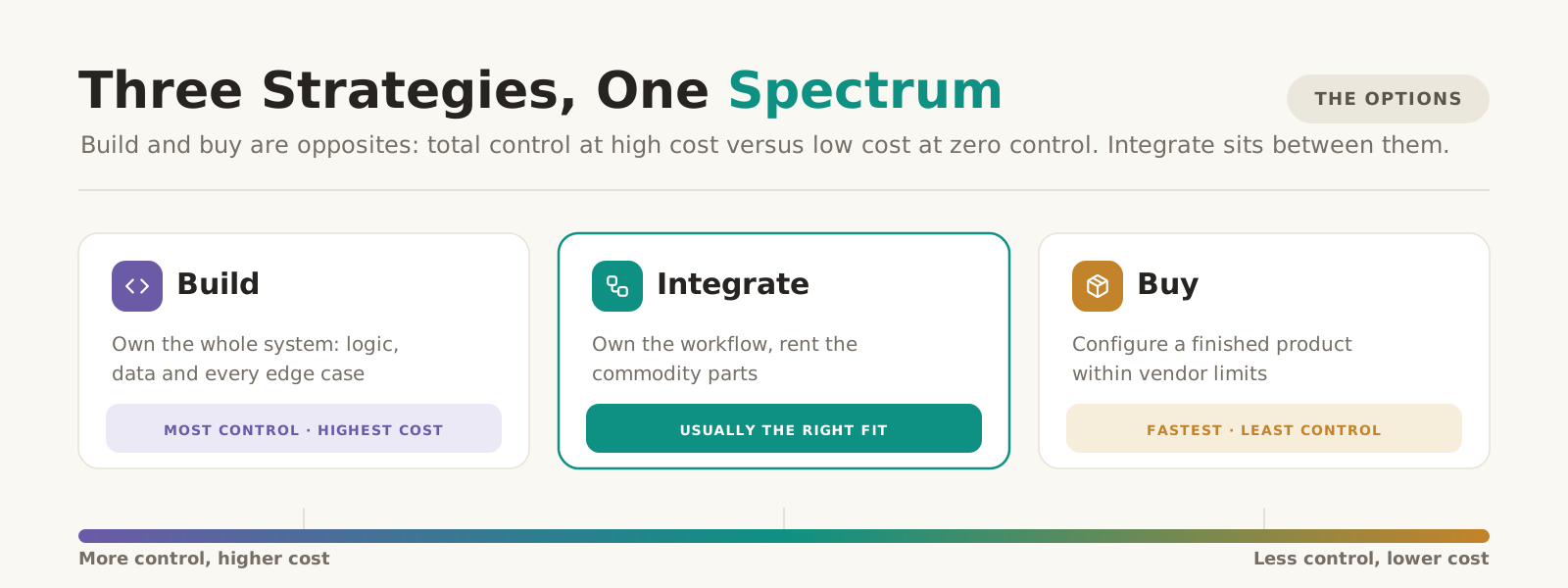
You can build a system from scratch. You can buy a finished product. Or you can integrate: compose someone else's components inside a workflow you own and control.
The difference matters commercially. Build and buy are opposites, so comparing them forces a choice between total control at high cost and low cost at zero control. Integrate sits between them and changes the economics of both. A business that thinks it has two options is choosing from a shortlist that is missing the answer.
This article gives you the decision framework we use: six questions that determine the answer, a worked cost model you can put your own numbers into, the hidden costs on all three sides, and a table matching common AI use cases to the strategy that usually fits.
The Short Answer: When to Build, Buy or Integrate AI
- Buy AI when: The process is a commodity, a product fits at least 90% of your workflow, your data can leave your infrastructure, and the process is stable
- Build AI when: The process is how you compete, regulated data cannot leave, or the workflow changes faster than any vendor's release cycle
- Integrate AI when: The capability is a commodity but the workflow is yours, which describes most business AI use cases
- The deciding question: Is this process a differentiator or table stakes? Everything else follows from that answer
Build vs Buy AI: Why the Third Option Changes the Decision
Before the framework, precise definitions. Most disagreements about AI strategy are really disagreements about what these words mean.
What "Build" Actually Means for an AI System
Building means you own the application: the logic, the data model, the integrations, the interface and the ongoing maintenance. You are almost certainly still using someone else's model, which is fine. The distinction is not whether you trained a model. It is whether you own the system that uses one.
- You control: The workflow, the data, the integration points, the release schedule
- You own: Maintenance, monitoring, upgrades, and every edge case
- Time to value: Longest
- Fits when: The process is specific to how your business competes
What "Buy" Actually Means for an AI System
Buying means licensing a finished product that performs a defined job. The vendor owns the roadmap, the architecture and the model choices. You configure within the boundaries they provide.
- You control: Configuration, within limits the vendor sets
- You own: The subscription, and the consequences of their roadmap decisions
- Time to value: Shortest
- Fits when: The process is a commodity and your version of it is not special
Off-the-shelf AI has improved enormously, and dismissing it reflexively is as expensive a mistake as buying something that does not fit.
What "Integrate" Actually Means, and Why It Is Not a Compromise
Integrating means assembling vendor-supplied capabilities inside a system you own. A model API, a speech service, a document parser, an embedding provider, each doing the undifferentiated heavy lifting, with your business logic and your data staying in your infrastructure.
- You control: The workflow, the data, and which components you depend on
- You own: The orchestration layer and the cost of swapping components
- Time to value: Between the other two, and usually closer to buy than most people expect
- Fits when: The workflow is yours but the underlying capability is a commodity
The reason this option gets missed is that it looks like building. The difference is scope. You are not building speech recognition. You are building the fifteen percent of the system that is specific to your business, and renting the rest.
Almost every system we deliver, from an AI agent handling operational workflows to intelligent document processing pipelines, is an integrate decision rather than a build-from-nothing one.
A worked example makes the boundary concrete. Our AI email assistant for executives case study is an integrate build: the mailbox authorization, the language model and the calendar access are all third-party AI components, while the classification categories, the extraction rules, the approval boundary and the data model are custom AI development. Nobody sells that combination as a product, and nobody needed to build the commodity parts in-house.
The Six Questions That Decide Your AI Strategy
Answer these before anyone demos anything.
1. Is This AI Use Case a Differentiator or a Commodity?
The single most important question, and the one most often skipped.
- If customers choose you partly because of how you do this: It is a differentiator, and putting it inside a vendor's black box hands your advantage to a product your competitors can also license
- If every company in your industry does this roughly the same way: It is a commodity, and building it is spending scarce engineering time on something that confers no advantage
- The test: Could a competitor buy the same product tomorrow and match you? If yes, and that matters, do not buy
A common and expensive error is getting this backwards: building a commodity because the team wanted to, and buying a differentiator because it was faster.
2. Can Your Data Leave Your Infrastructure for an AI Vendor?
This question can end the discussion before any other factor is considered.
- Regulated or contractually restricted data: Rules out most hosted products immediately, regardless of their quality
- Customer data under confidentiality terms: Check what your own client contracts say about subprocessors before you evaluate anything
- Data minimization obligations: GDPR Article 5 limits personal data to what the purpose needs. A product that ingests whole records to do a narrow task can break that rule
- Where integrate wins: You can process locally, reduce what you send, and only transmit the minimum a vendor component needs
3. How Often Does the Process Change After You Buy?
- Stable for years: Buying is safe. The product and your process will stay aligned
- Changes quarterly: Buying is risky. You will spend the time you saved working around a product that no longer fits
- Changes because you are still learning what the process should be: Integrate. You need the ability to change the workflow without a vendor release cycle
4. Does an Off-the-Shelf AI Product Actually Fit Your Workflow?
Be honest in the evaluation, because this is where optimism costs the most.
- A product that fits 90% of your workflow: Buy it, and change your process for the remaining 10%
- A product that fits 60%: This is the dangerous zone. The configuration work, the workarounds and the manual steps around the gaps often cost more than building the thing properly
- A product that fits 60% but you tell yourself is 90%: The most common failure in this category
Ask the question in reverse. If the product did not exist, would you design your process this way? If not, you are buying a process change and calling it a tool.
5. Who Maintains It in Year Two?
Build decisions are usually made by people thinking about year one.
- Buy: The vendor maintains it. This is the strongest argument for buying, and it is routinely undervalued
- Integrate: You maintain the orchestration. Vendor components change underneath you, models get deprecated, APIs version
- Build: You maintain everything, forever, including the parts that are nobody's favorite work
If your answer to "who maintains this" is a named person who already has a full-time job, you have not answered the question. Maintenance is not only patching either. Any AI system that learns from corrections needs someone owning that loop, which we cover in how feedback loops turn chatbots into learning systems. Leave it unowned and your AI investment quietly degrades.
6. What Does Exit Cost?
Every option creates lock-in. The question is how expensive it is to leave.
- Buy: Your data is in their schema, your process is shaped around their product, and your team knows their interface. Exit is a migration project
- Integrate: Lock-in is per component, so the switching cost is paid once per piece rather than all at once. This is the strongest structural argument for integrating, and it is the point AI procurement processes most often fail to score
- Build: No vendor lock-in, maximum knowledge lock-in. If two people understand the system and both leave, you own something nobody can change
Turning the Six Questions Into a Score
Answer each question and award the point. Whichever column scores highest is your starting position, not your conclusion, but it stops the decision being made by whoever presents best.
| Question | 1 point to BUILD | 1 point to BUY | 1 point to INTEGRATE |
|---|---|---|---|
| Differentiator or commodity? | Differentiator | Pure commodity | Commodity capability, specific workflow |
| Can data leave? | No, and it is regulated | Yes, no restriction | Partially, with minimization |
| How often does it change? | Constantly | Stable for years | Changing while you learn |
| Does a product fit? | Nothing close exists | Fits 90% or more | Fits roughly 60% to 89% |
| Who maintains it in year two? | Dedicated owner exists | Nobody internal | Engineering capacity exists |
| What does exit cost? | Exit is not a scenario | Acceptable migration risk | Per-component replacement wanted |
A split score is informative rather than inconvenient. Three points for buy and three for integrate usually means the use case should be split: buy the commodity part and integrate the part that touches your systems.
What Each AI Strategy Actually Costs Over Three Years
Direct cost comparisons mislead because the cost shapes are different, not just the totals. Compare total cost of ownership across three years rather than the first invoice, and the ranking frequently reverses.
| Build | Buy | Integrate | |
|---|---|---|---|
| Upfront cost | Highest | Lowest | Moderate |
| Cost shape | Large capital spend, then maintenance | Flat subscription, rising with seats or volume | Moderate build, then usage-based running cost |
| Scales with | System complexity | Headcount or transaction volume | Usage volume |
| Cost you will underestimate | Maintenance and glue code | Renewal increases and seat growth | Component migration when a vendor changes |
| Cost you can control | All of it, slowly | Almost none | Most of it, by swapping components |
The row that surprises people is year three on buying. A per-seat product that looked cheap at twenty users is a different conversation at two hundred, and the renewal conversation is not a negotiation you enter from a position of strength once your process depends on it.
A Worked AI Total Cost of Ownership Model
Shapes are easier to argue about than numbers, so here is the arithmetic. These are illustrative assumptions in US dollars, not market rates. Substitute your own and the method still holds.
Assumptions:
- Buy: 30 seats at $40 per seat per month, seat count growing 20% a year
- Build: $60,000 upfront, then annual maintenance at 25% of the build cost
- Integrate: $25,000 upfront, $500 a month in usage growing 20% a year, plus maintenance at 15% of the build cost from year two
| Year (USD) | Buy | Build | Integrate |
|---|---|---|---|
| 1 | 14,400 | 60,000 | 31,000 |
| 2 | 17,280 | 15,000 | 10,950 |
| 3 | 20,736 | 15,000 | 12,390 |
| 4 | 24,883 | 15,000 | 14,118 |
| 5 | 29,860 | 15,000 | 16,192 |
| 3-year total | 52,416 | 90,000 | 54,340 |
| 5-year total | 107,159 | 120,000 | 84,650 |
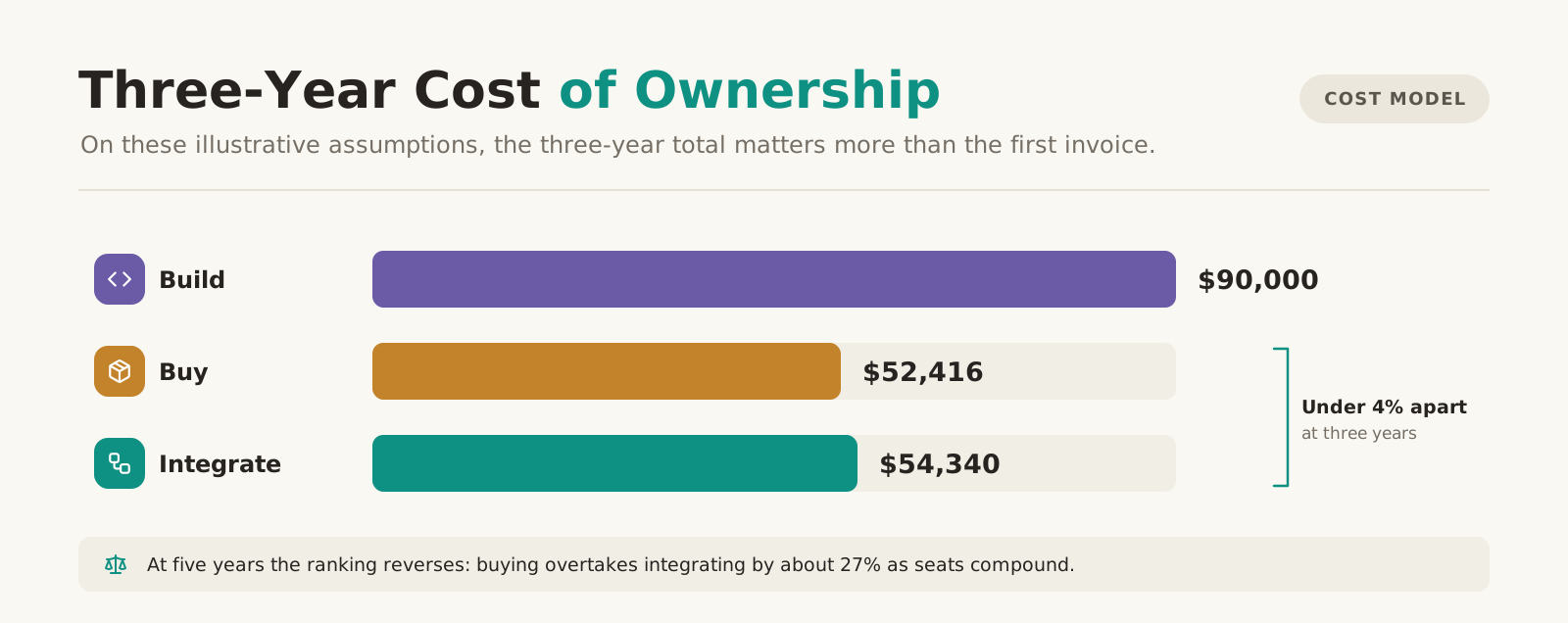
Three findings fall out of this, and the first is the one most comparisons miss.
- At three years, buy and integrate are nearly identical: $52,416 against $54,340, a difference of under 4%. If your evaluation horizon is three years, cost is not the deciding factor between those two options, and you should decide on control, data and workflow fit instead
- At five years the ranking reverses: Buying overtakes integrating by about 27%, because subscriptions compound with headcount while usage costs grow more slowly than seats
- Building does not catch up in this scenario: Its 5-year total is still the highest. Build economics only win when the thing you build creates revenue or advantage that the other options cannot, which is exactly why the differentiator question comes first
The sensitivity worth testing yourself is seat count. On these assumptions, three-year buy cost overtakes three-year integrate cost at around 31 starting seats. Below that, buying is cheaper. Above it, integrating is. A single number in your own spreadsheet moves that threshold, which is why a generic answer to the build vs buy AI question is worth so little.
The Hidden Cost of Building AI
There is strong published evidence on this, and it predates the current wave of AI by a decade.
In Hidden Technical Debt in Machine Learning Systems, Sculley and colleagues at Google documented what happens to machine learning systems after launch. Their abstract states that it is common to incur massive ongoing maintenance costs in real-world ML systems. The introduction puts the trap plainly: developing and deploying ML systems is relatively fast and cheap, but maintaining them over time is difficult and expensive.
The most quoted finding is about proportion. The paper observes that only a tiny fraction of the code in many ML systems is actually devoted to learning or prediction, and that a mature system might end up being at most 5% machine learning code and at least 95% glue code.
That paper is from 2015 and describes classical ML pipelines. The ratio has not improved for LLM applications, it has worsened, because the model is now someone else's API and everything you write is by definition glue: retrieval, state, tool calls, validation, observability, fallback handling, evaluation.
The practical lesson for a build decision:
- The model is not the project: It is the five percent
- The demo is not the system: A working prototype is the easy part, which is exactly why prototypes are so persuasive
- Debt compounds quietly: The paper's warning that hidden debt is dangerous because it compounds silently is the reason year-two costs surprise people
- Budget maintenance as a line item: If it is not in the business case, the business case is wrong
None of this means do not build. It means cost the build honestly, and build only the part that is actually yours.
The Hidden Cost of Buying AI
Buying trades control for speed, and the bill arrives in ways that do not appear in the subscription line.
- Workflow conformity: You will change how you work to match the product. Sometimes that is an upgrade. Sometimes it quietly degrades something you were good at
- Roadmap dependency: The feature you need is on their roadmap, not yours. So is the feature you rely on that they decide to deprecate
- Data gravity: Two years of your operational data sits in their schema, and that is the real lock-in, not the contract
- Integration debt: Products rarely sit alone. The connective tissue between three bought products is work you own, and it looks a lot like building
- Price escalation: Seat growth, usage tiers and renewal increases compound in a way that upfront comparisons never show
- The commodity trap in reverse: If the product is good and cheap, your competitors have it too. You have bought parity, not advantage
The Hidden Cost of Integrating AI
Integrate is the option we recommend most often, so it deserves the same scrutiny.
- You own the orchestration: The logic connecting components is yours to maintain, and it is where the complexity lives
- Components move underneath you: Model versions get deprecated, APIs change, pricing changes. A system assembled from five vendor components inherits five roadmaps
- It needs real engineering judgment: Choosing where the boundary sits between what you build and what you rent is the whole skill, and getting it wrong in either direction is expensive. Framework choice is part of that boundary, and our comparison of LangGraph vs LangChain vs CrewAI covers the trade-offs
- Observability is on you: When something fails, determining which component failed is your problem, and you need the logging to answer it
- It can sprawl: Without discipline, an integrate strategy becomes a build strategy with extra vendors
The mitigation is architectural. Keep vendor components behind interfaces you define, so replacing one is a contained change rather than a rewrite. This is the same reasoning behind protocol layers such as MCP server development, which exist precisely to stop integrations hardcoding themselves into your application.
Build, Buy or Integrate: A Decision Table by AI Use Case
| Use case | Usually | Why |
|---|---|---|
| General productivity assistance | Buy | Pure commodity, no differentiation available |
| Transcription and speech to text | Buy or integrate | Solved problem, do not build |
| Customer support on common questions | Buy, if your product is simple | Many mature products fit standard support workflows |
| Customer support with your systems and policies | Integrate | Your policies and escalation rules are yours |
| Internal knowledge search | Integrate | Your permissions model and content structure are specific |
| Document extraction, standard formats | Buy | Invoices and identity documents are well served |
| Document extraction, your industry's formats | Integrate | No product has seen your document mix |
| Pricing, underwriting, risk scoring | Build | This is how you compete, do not outsource it |
| Core operational workflows | Build or integrate | Specific to your business, changes as you learn |
| Sales outreach and CRM hygiene | Buy | Commodity, strong existing market |
| Anything touching regulated data | Integrate or build | The data question decides before anything else |
The pattern across that table is consistent. Buy where the process is identical across your industry. Build where the process is the reason customers choose you. Integrate everywhere in between, which is most places. Note that no sensible business picks one strategy: you should expect to buy the commodity layer, integrate the operational layer and build only the two or three processes that are genuinely how you compete.
Two rows deserve expanding. Conversational interfaces look like a buy decision until the conversation has to touch your systems, which is the line between a packaged bot and AI chatbot development against your own data. Retrieval is the clearest integrate case of all: the embedding models and vector stores are commodities, while your content structure and permissions model are not, which is how most RAG development engagements are scoped. If you are still deciding whether retrieval is the right approach at all, start with what retrieval augmented generation is and how it works.
A support example makes it concrete. A simple product with repeating questions is well served by a product you buy. A business whose support requires reading its own policies, checking its own systems and following its own escalation rules is in integrate territory, which is why we build AI agents for customer support and a grounded customer support AI assistant around existing systems rather than replacing them, and why an internal knowledge assistant is nearly always a custom build on commodity retrieval components.
Five Mistakes That Make the Build vs Buy AI Decision Wrong
- Deciding from a demo: Demos are built on the happy path. A proof of concept built on your own difficult cases is worth more than ten vendor demos, and an AI pilot scoped to one process will tell you more about the real build vs buy AI answer than any evaluation spreadsheet
- Treating integrate as free: It is cheaper than building and more work than buying. Costing it as buying is how integrate projects overrun
- Building because the quote looked expensive: Compare the quote against the fully loaded cost of building, including maintenance for three years and the opportunity cost of the engineers doing it
- Buying because the team lacks capacity: A product still needs an owner, configuration, integration and change management. Capacity shortage is a reason to scope smaller or to hire AI ML developers for a defined build, not a reason to buy the wrong thing
- Ignoring the exit until renewal: Teams score features and price, then skip the question of how to leave. Test the data export path before you sign, because data gravity is the lock-in the contract does not show
Anthropic's engineering guidance on building effective agents makes a related point that applies to every option here: start with the simplest solution that works, and add complexity only when you need it. Applied to strategy, the simplest option that meets your constraints usually wins, and that is more often buy or integrate than engineering teams expect.
When to Revisit the Build vs Buy AI Decision
These decisions expire. Review them when any of the following happens.
- A capability becomes a commodity: An AI capability you built two years ago may now be available as a mature product at a fraction of the running cost, which flips the build vs buy AI answer without anything changing on your side
- Volume changes materially: Per-seat and per-transaction economics shift hard at scale, in both directions
- The vendor changes direction: A deprecation, an acquisition or a pricing change can turn a good buy decision into a migration
- Your process stabilizes: A workflow that was changing monthly and is now stable may be a candidate for a product
- Your process diverges: A workflow that has drifted away from the product you bought is costing you in workarounds you have stopped noticing
Put a date on it. An annual review of what you build, buy and integrate takes an afternoon and is the cheapest governance you will do.
Conclusion
The build vs buy AI debate produces bad decisions because it offers two options when there are three, and because it is usually settled by whoever gives the most convincing presentation rather than by the questions that actually determine the outcome.
Answer the six questions honestly and the strategy usually picks itself. Most of the time it is integrate, because most AI work applies a commodity capability to a workflow specific to your business. Build the part that is yours. Rent the rest. Buy the whole thing only where your version is genuinely no different from anyone else's.
Bitontree works with businesses on exactly this decision, and we are not neutral about being honest on it. If the right answer is a product you can buy for a few hundred a month, we will tell you at the first meeting rather than scoping a build. Where a build or an integration is warranted, we scope it against the three-year cost including maintenance, not the demo. Our AI agent development and business process automation work almost always starts with deciding what not to build.
I am the founder and CEO of Bitontree, where I lead embedded AI engineering teams that build and run production AI: agents, RAG and knowledge systems, document AI, and workflow automation for healthcare, logistics, legal, and SaaS companies. I write about what it actually takes to ship AI that survives contact with production.
Frequently Asked Questions
When should a business build custom AI instead of buying a product?
When the process is a genuine differentiator, when regulated data cannot leave your infrastructure, when the workflow changes faster than a vendor's release cycle, or when no product fits closely enough that you would not spend more on workarounds than on building.
How do we avoid vendor lock-in with AI?
Keep vendor capabilities behind interfaces you define, so each component can be replaced independently. Keep your data in your own schema. Keep prompts, business rules and evaluation sets in your own version control rather than inside a vendor's configuration.
Can we start by buying and move to building later?
Often yes, and it is frequently the right sequence. Buy to learn what the process should be, then build or integrate once you understand it. The risk to manage is data gravity, so check what exporting your data actually involves before you sign.
Should a small business build or buy AI?
Buy or integrate, almost always. Building makes sense when a process is genuinely how you compete, and smaller businesses rarely have the engineering capacity to maintain a custom system alongside everything else. Scope smaller rather than building bigger.
What is the biggest risk of buying an AI product?
Data gravity. After two years your operational history sits in the vendor's schema and your process has shaped itself around their interface, which makes leaving a migration project rather than a cancellation. Check the export path before you sign, not at renewal.
Who should own the AI implementation decision?
Not engineering alone, and not procurement alone. The differentiator question is a commercial judgment, the data question is legal and compliance, and the maintenance question is engineering. A decision made by one of those three in isolation is usually the one that gets revisited.