


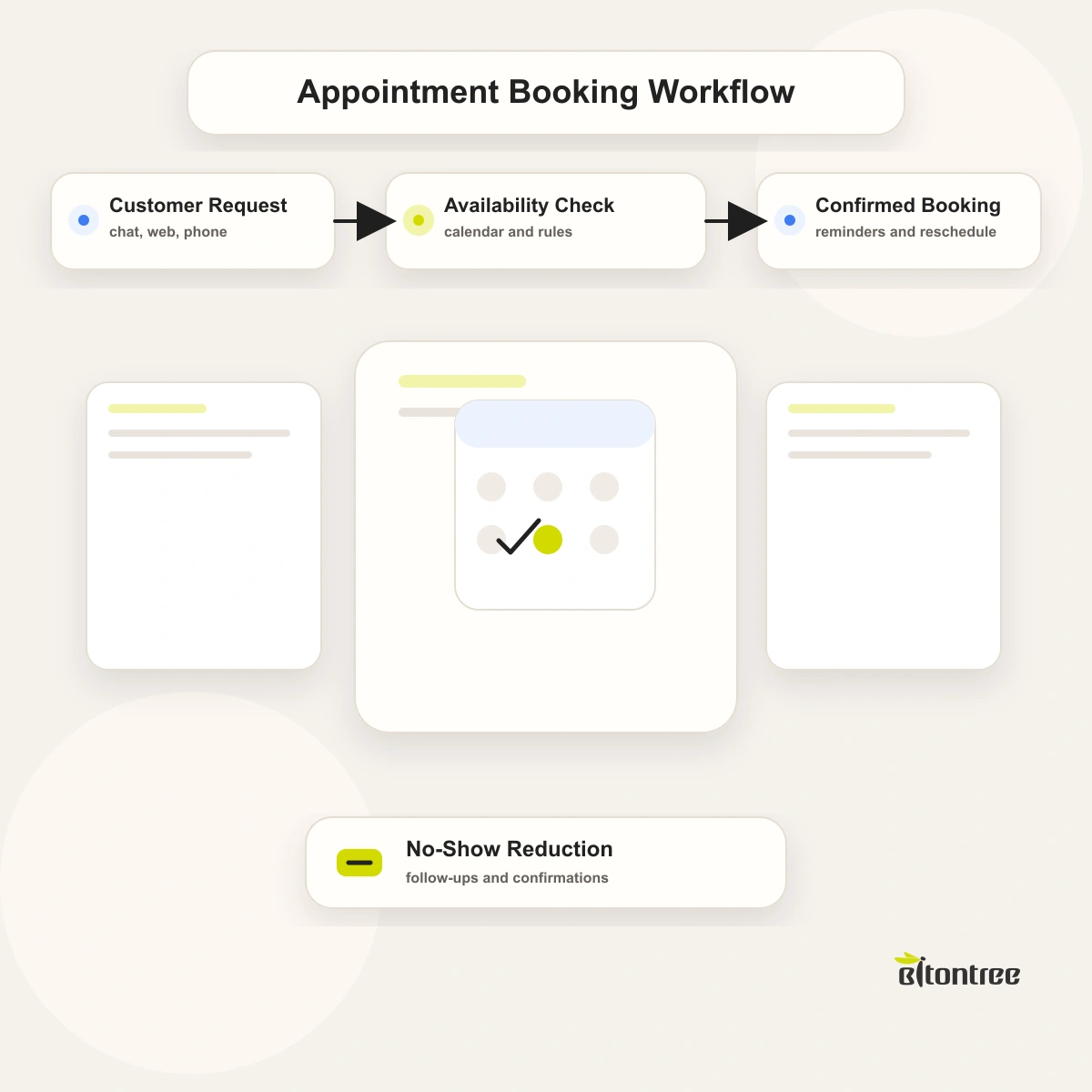
An AI chatbot for appointment booking books, confirms, reschedules, and cancels appointments automatically across web, SMS, and WhatsApp. It connects to your calendar, booking system, or CRM and handles the full scheduling lifecycle around the clock, with no staff involved. Clinics, salons, law firms, dealerships, and service businesses of every kind use it to fill their calendars without picking up the phone.
Missed appointments are expensive in any industry. In healthcare alone, no-shows drain an estimated 150 billion dollars a year, and the same pattern plays out in salons, clinics, repair shops, and consultancies: every empty slot is revenue the business never recovers. The cause is rarely customer apathy. It is friction in how appointments get booked and confirmed.
This guide covers what an AI appointment booking chatbot does, the use cases it handles, the benefits it delivers, which industries need it most, the technical architecture behind it, and how to implement one that runs your scheduling 24/7. It sits within our broader AI chatbot development work, and while we also build chatbots for customer support and lead generation, appointment booking is where automation pays back fastest.
What Is an AI Chatbot for Appointment Booking?
An AI chatbot for appointment booking is a conversational system that manages the full appointment lifecycle, booking, confirmation, rescheduling, cancellation, and waitlist management, in natural language. It connects to whatever scheduling system a business already runs, a calendar, a practice management tool, a CRM, or a booking platform, reads real-time availability, and writes confirmed appointments back without anyone on staff touching the process.
The difference from a standard online booking form is conversation. A form makes the customer do the work: pick a category, scroll a calendar, guess which service maps to their need. The chatbot does the work instead. Someone types "I need a haircut on Saturday morning," or "my car is making a noise and I need it looked at this week," and the chatbot interprets the request, matches it to the right service and staff member, offers real open slots, and confirms in a single short exchange.
Why Do Businesses Lose Money to Appointment Scheduling?
Appointment scheduling looks simple, but it quietly drains revenue and staff capacity every week, in clinics, salons, repair shops, and professional firms alike. The problem is friction, not customer apathy. Here are the six ways manual scheduling costs a business the most.
No-shows carry a direct revenue cost. Every empty slot is billable time that earns nothing, whether it is a doctor's appointment, a salon chair, a service bay, or a consultation. For a business running 200 appointments a week, a 20% no-show rate means 40 lost slots every week.
Phone-based booking creates friction at every step. Customers call during business hours, sit on hold, and leave voicemails that go unreturned for days. Many who never get a confirmation simply book somewhere else.
Scheduling consumes a third of front-desk hours. Reception and admin staff spend 30 to 45% of their working time booking, confirming, rescheduling, and chasing cancellations, skilled labor lost to repetitive, rules-based work.
Customers want to text, not call. Most customers under 45 would rather book by text or chat than call, yet most businesses still funnel every booking through a single phone line.
Peak-hour calls go unanswered. During busy periods, call abandonment rates routinely exceed 25%. Every abandoned call is a customer who may book with a competitor instead.
Manual entry creates costly errors. Double bookings, wrong time zones, and mismatched staff availability create downstream chaos that erodes customer trust and staff morale.
The scheduling problem is not a technology gap, it is an automation gap. Research from McKinsey on automation shows that well-defined, rules-based processes like scheduling are exactly where automation delivers the fastest, most reliable return.
What Can an AI Appointment Booking Chatbot Do?
An appointment booking chatbot does far more than fill a calendar slot. With messaging apps now among the most-used channels worldwide, a chatbot meets customers where they already are. These are the seven highest-impact things it handles in production.
Book Appointments in Natural Conversation
Customers describe what they need in plain language. The chatbot interprets the request, identifies the service, staff member, and time, checks real-time availability, and confirms a real slot, with no forms and no phone call. It handles vague requests too, asking a single clarifying question when a customer is unsure which service they need. The entire exchange takes well under two minutes, and the confirmed appointment is written straight into your booking system.
Reschedule and Cancel Without Staff
Customers move or cancel appointments in seconds through chat, with no need to call during business hours or wait for a callback. The chatbot updates the calendar or booking system automatically, so it always reflects reality and freed slots reopen instantly. Because rescheduling is this easy, customers choose it over simply not showing up, which is one of the main reasons no-show rates fall after deployment.
Send Automated Multi-Step Reminders
Reminders go out at 72 hours, 24 hours, and 2 hours before each appointment through the customer's preferred channel, whether that is SMS, WhatsApp, or email. Each reminder carries a one-tap confirm, reschedule, or cancel action, so the customer responds without typing a word. This steady, low-friction nudging is what keeps calendars full and is consistently the single biggest driver of fewer no-shows.
Manage a Smart Waitlist
When a customer cancels, the chatbot automatically offers the open slot to a waitlisted customer in priority order, so the schedule refills itself without staff making a single call. Waitlisted customers get a real-time notification and can claim the slot with one tap. This turns last-minute cancellations, normally a pure loss, into filled appointments and recovered revenue.
Qualify and Route Every Booking
The chatbot asks the right intake questions up front, collects details from new customers in-line, and applies new-versus-returning and service-type routing rules so every booking lands with the right staff member. It can flag bookings that need special handling and gather the information your team would otherwise collect by phone. Staff start each appointment already knowing who is coming in and why.
Operate Across Web, SMS, and WhatsApp
Customers start booking on whichever channel they prefer, the website widget, a text message, or WhatsApp, and receive reminders on that same channel. One system covers every channel instead of a single overloaded phone line. A conversation can even begin on one channel and continue on another without the customer repeating themselves, because the chatbot keeps full context across the interaction.
Work 24/7 and Escalate When Needed
The chatbot books through evenings, weekends, and holidays, capturing demand that would otherwise go to a competitor or be lost to voicemail. When a request is genuinely complex or sensitive, it does not guess; it routes the conversation to a staff member with the full context already attached. Customers get an instant response at any hour, and your team only gets pulled in when human judgment is actually required.
What Are the Benefits of an AI Appointment Booking Chatbot?
The business case for an appointment booking chatbot is concrete and measurable. These are the five benefits practices see most consistently.
Fewer no-shows. Multi-step reminders with one-tap rescheduling keep customers engaged and slots filled, directly recovering revenue that empty appointments would lose. Research on appointment reminder systems consistently links automated reminders to measurable no-show reductions.
Reclaimed staff hours. Automating the booking lifecycle returns hours of reception and admin time every day for higher-value, in-person customer work.
24/7 scheduling capacity. A large share of customers book outside business hours. The chatbot captures evening and weekend demand that a phone line simply cannot.
Higher customer satisfaction. Customers consistently prefer fast, low-friction chat booking to sitting on hold, which lifts both satisfaction scores and retention.
Fewer scheduling errors. Direct integration with your booking system removes double bookings, time-zone mistakes, and availability mismatches that manual entry creates.
These gains compound. Gartner projects that chatbots will become a primary customer service channel for a large share of organizations, and appointment-driven businesses are among the clearest early winners.
Which Industries Need an AI Appointment Booking Chatbot?
Any business that runs on booked appointments and loses revenue to no-shows or after-hours demand benefits from an appointment booking chatbot. The need is strongest in these seven industries.
Healthcare clinics. Primary care and multi-specialty practices use it to cut no-shows, absorb peak-hour call volume, and book against real-time EHR availability. See a real appointment booking AI chatbot built for a multi-location healthcare provider.
Behavioral health and mental health practices. Therapy and counseling practices use it for sensitive, low-friction booking and reminders, where a missed session carries both clinical and revenue cost.
Dental practices. Dental offices use it to fill cancellation slots from a waitlist and send reminders for cleanings, treatments, and recurring check-ups.
Diagnostic labs and imaging centers. Labs use it to schedule tests and scans, deliver preparation instructions, and reduce no-shows that leave expensive equipment idle.
Salons, spas, and wellness studios. Appointment-driven service businesses use it for 24/7 booking, staff-specific availability, and reminders that protect against lost bookings.
Professional services. Legal, financial, and consulting firms use it to let clients book consultations across channels without back-and-forth email.
Restaurants and hospitality. Restaurants use the same conversational booking model to manage table reservations, confirmations, and waitlists. Our AI restaurant reservation system shows appointment automation applied directly to hospitality.
The global chatbot market is projected to grow sharply through the decade, and the appointment scheduling software market is forecast for steady growth alongside it. Appointment-heavy industries are adopting fastest because the return is so easy to measure. Whatever the industry, the chatbot simply connects to that business's own calendar or booking system.
How Does an AI Appointment Booking Chatbot Work?
The chatbot is built in four layers. Each layer handles one part of turning a customer message into a confirmed, synced appointment.
1. Conversation Layer
A natural language understanding engine processes messages across web chat, SMS, and WhatsApp. It identifies intent, extracts entities like date, time, staff member, and service type, and manages multi-turn dialogue, running on LLMs paired with retrieval-augmented generation so every reply is grounded in your real services and scheduling rules.
2. Integration Layer
Bidirectional API connections to EHR systems like Epic, Cerner, athenahealth, and DrChrono pull real-time availability and patient records. HL7 FHIR-compliant data exchange ensures interoperability without custom middleware.
3. Logic Layer
A rules engine enforces scheduling constraints: staff availability windows, appointment durations, buffer times, intake requirements, and customer routing. It also manages the waitlist, offering open slots to waitlisted customers when cancellations occur.
4. Notification Layer
Automated reminders go out at configurable intervals through each customer's preferred channel, every one carrying a one-tap confirm, reschedule, or cancel action.
Together these layers complete a typical booking in around 90 seconds: greet the customer, identify new or returning status with a quick lookup, present filtered slots, confirm the choice, and send a calendar invite. If no slot matches, the chatbot offers alternatives, adds the customer to the waitlist, or routes to staff with full context.
How Do You Implement an AI Appointment Booking Chatbot?
A production-grade appointment booking chatbot goes live within 4 to 6 weeks. Industry analysis of digital transformation in healthcare shows that focused, well-scoped automation projects succeed far more often than broad platform overhauls. Implementation follows four stages.
Step 1: Scheduling Workflow Audit (Week 1)
We map your current booking flow, staff availability rules, appointment and service types, and the points where customers drop off or no-show. This defines what the chatbot must handle and what success looks like in numbers.
Step 2: Booking System Integration and Logic Configuration (Weeks 2-3)
We connect the chatbot to your calendar, CRM, or booking system through its API, or to an EHR through FHIR for healthcare deployments, and configure your scheduling rules: buffers, durations, intake questions, and routing.
Step 3: Multi-Channel Deployment and Testing (Weeks 4-5)
We deploy across web, SMS, and WhatsApp, then test against real booking scenarios and edge cases until the conversation flow is reliable on every channel.
Step 4: Go-Live and 30-Day Optimization (Week 6 Onward)
The chatbot goes live, and we monitor booking completion rates and drop-off points, tuning the flow for 30 days so performance keeps improving after launch.
Conclusion
Appointment scheduling is one of the clearest automation opportunities any service business has. The logic is well-defined, the rules are consistent, and customers increasingly expect to book the way they already communicate, by text and chat, at any hour. Analysis of digital customer engagement shows that fast, self-serve interaction is now the baseline expectation across industries. A no-show is not a customer problem to tolerate, it is a friction problem to engineer out. An AI appointment booking chatbot removes that friction, turns scheduling into a 24/7 capability, and gives staff their time back for work that genuinely needs a human.
Bitontree builds and ships AI appointment booking chatbots tailored to how your business runs, whether you are a clinic, a salon, a law firm, an auto service center, or any other appointment-driven business. We integrate with your calendar, CRM, or booking system, configure your scheduling rules, deploy across web, SMS, and WhatsApp, and go live within 4 to 6 weeks with a 30-day optimization period included. If your business loses revenue to no-shows, slow booking, or after-hours demand, we can build the system that closes that gap.
Frequently Asked Questions
How does an AI chatbot reduce appointment no-shows?
The chatbot sends automated reminders at 72, 24, and 2 hours before each appointment through the customer's preferred channel, each with one-tap confirm or reschedule. Easy rescheduling keeps slots filled instead of empty, which is what drives the no-show reduction.
What systems does the appointment booking chatbot integrate with?
The chatbot connects to whatever scheduling system you run: Google Calendar, Outlook, a CRM like Salesforce or HubSpot, an industry booking platform, or an EHR. For healthcare, it integrates with systems like Epic and Cerner through HL7 FHIR APIs. If your system has an API, the chatbot can connect to it.
Which channels does the chatbot support?
The chatbot works across web chat, SMS, and WhatsApp from a single system. Customers can start booking on one channel and receive reminders on another, meeting the large share of people who prefer texting over calling.
Is the appointment booking chatbot secure and compliant?
Yes. Customer data is encrypted in transit and at rest, and every interaction is logged for audit purposes. For healthcare deployments, the chatbot runs on HIPAA-aware infrastructure with a Business Associate Agreement in place.
How long does it take to build and deploy?
A typical appointment booking chatbot goes live within 4 to 6 weeks. Every build includes multi-channel deployment across web, SMS, and WhatsApp, scheduling logic configuration, booking-system integration, and a 30-day optimization period.
Can the chatbot handle rescheduling and cancellations, not just booking?
Yes. The chatbot manages the full appointment lifecycle: booking, confirmation, rescheduling, cancellation, and waitlist management. When a customer cancels, the waitlist layer automatically offers the open slot to a waitlisted customer.
Which industries can use an AI appointment booking chatbot?
Any appointment-driven business. It is used by healthcare and dental practices, salons and spas, fitness studios, auto service centers, legal and financial firms, and home-service providers. The booking logic stays the same and the chatbot connects to that industry's scheduling system.
Related Use Cases

AI Chatbot for Healthcare
Patients call. Nobody picks up. Our HIPAA-aware AI chatbot handles appointment booking, triage, insurance verification, and follow-ups 24/7. Free healthcare audit.
AI Voice Chatbot
Build an AI voice chatbot that handles inbound and outbound calls: intent recognition, live transfers, and post-call summaries. Available 24/7, no hold times.
AI Knowledge Base Chatbot
Build a RAG chatbot that turns your docs into instant, accurate answers. This AI knowledge base chatbot cites every source and refuses out-of-scope questions.