


October 5, 2026
Why Your RAG Chatbot Gives Wrong Answers and How to Improve Accuracy

Yash Vibhandik
CEO


Your RAG chatbot answers most questions well. Then it confidently tells a customer something that is not in any of your documents, or misses a clause that sits on page fourteen of a contract it was given.
The instinct at that point is to blame the model, and almost every team does. They swap in a bigger model, rewrite the prompt, raise the temperature, lower the temperature, and the accuracy barely moves.
When a RAG chatbot gives a wrong answer, it is usually not a generation problem. It is a retrieval problem wearing a generation costume. The model answered correctly from what it was given. It was given the wrong thing.
This guide covers the seven distinct places RAG accuracy breaks, how to tell which one you have, and the fixes that work for each. Fixing the wrong layer is the single most common waste of effort in RAG development, and knowing which layer failed is most of the work.
The Seven Failure Points in a RAG Chatbot
If you are new to how retrieval systems work, our explainer on what retrieval augmented generation is and how it works covers the basics this post assumes.
Research on production RAG systems has converged on a useful taxonomy. A study of three deployed systems across research, education and biomedical domains identified seven distinct failure points when engineering retrieval augmented generation, and they remain the clearest way to think about why a RAG chatbot gives wrong answers.
| # | Failure point | What happens |
|---|---|---|
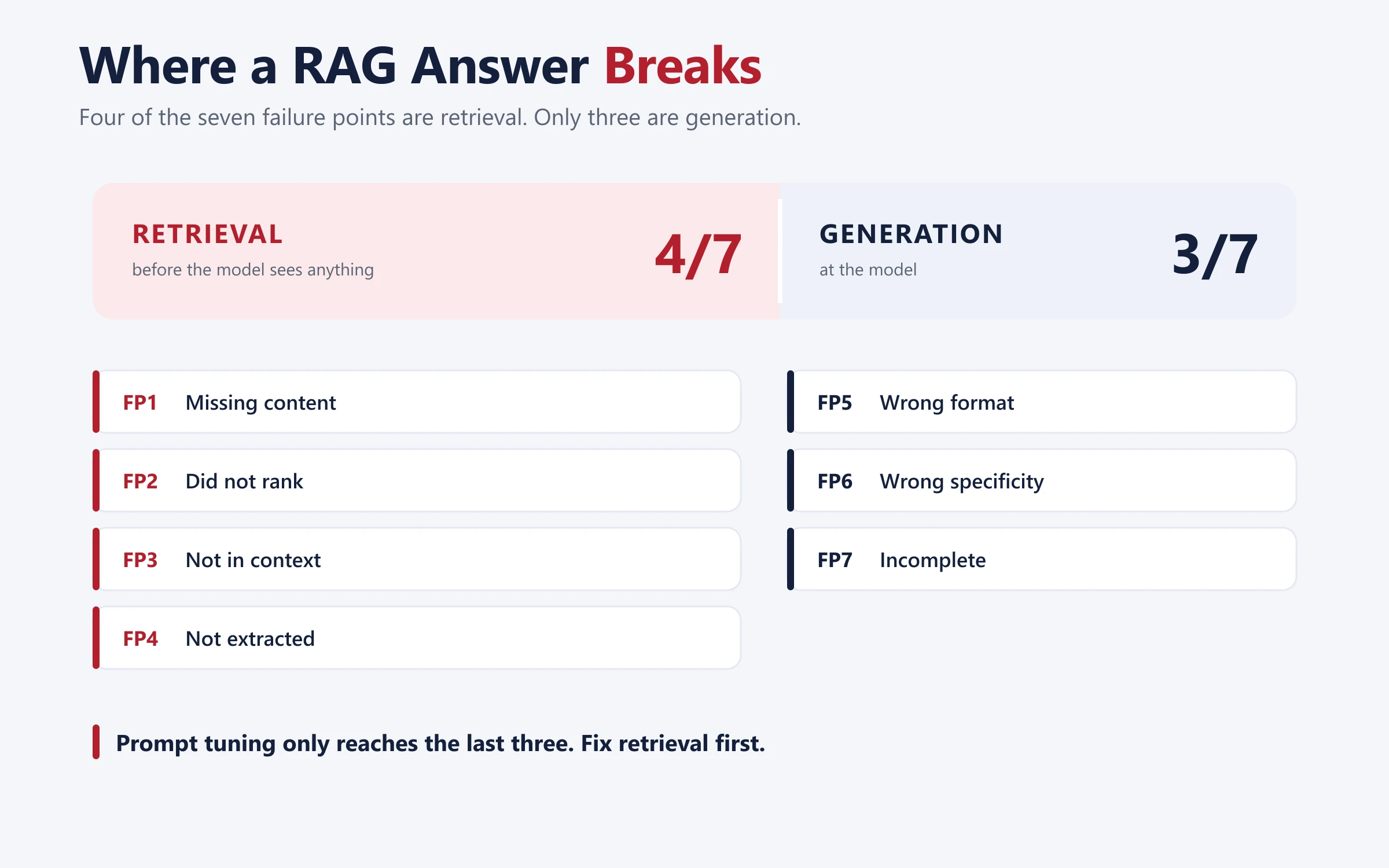
| FP1 | Missing content | The answer is not in your documents at all |
| FP2 | Missed top-ranked documents | The answer exists but did not rank high enough to be retrieved |
| FP3 | Not in context | Retrieved, but dropped during consolidation before generation |
| FP4 | Not extracted | In the context, but the model could not isolate it from the noise |
| FP5 | Wrong format | Ignored the requested structure, such as a table or a list |
| FP6 | Incorrect specificity | Too vague or too technical for what the user needed |
| FP7 | Incomplete | Left out information that was available, common on multi-document questions |
Notice where these sit. Three of the seven (FP1 to FP3) happen before the model sees anything. FP4 sits where retrieval and generation meet: the answer reached the model, but buried in noise that retrieval put there. Only FP5, FP6 and FP7 are purely about generation, and even FP7 is usually caused by what reached the context window.
That ratio is why prompt engineering alone rarely fixes RAG accuracy. You are tuning the last stage of a pipeline that failed three stages earlier.
How to Diagnose RAG Chatbot Wrong Answers
Before fixing anything, find out which layer broke. The diagnostic is straightforward and almost nobody does it.
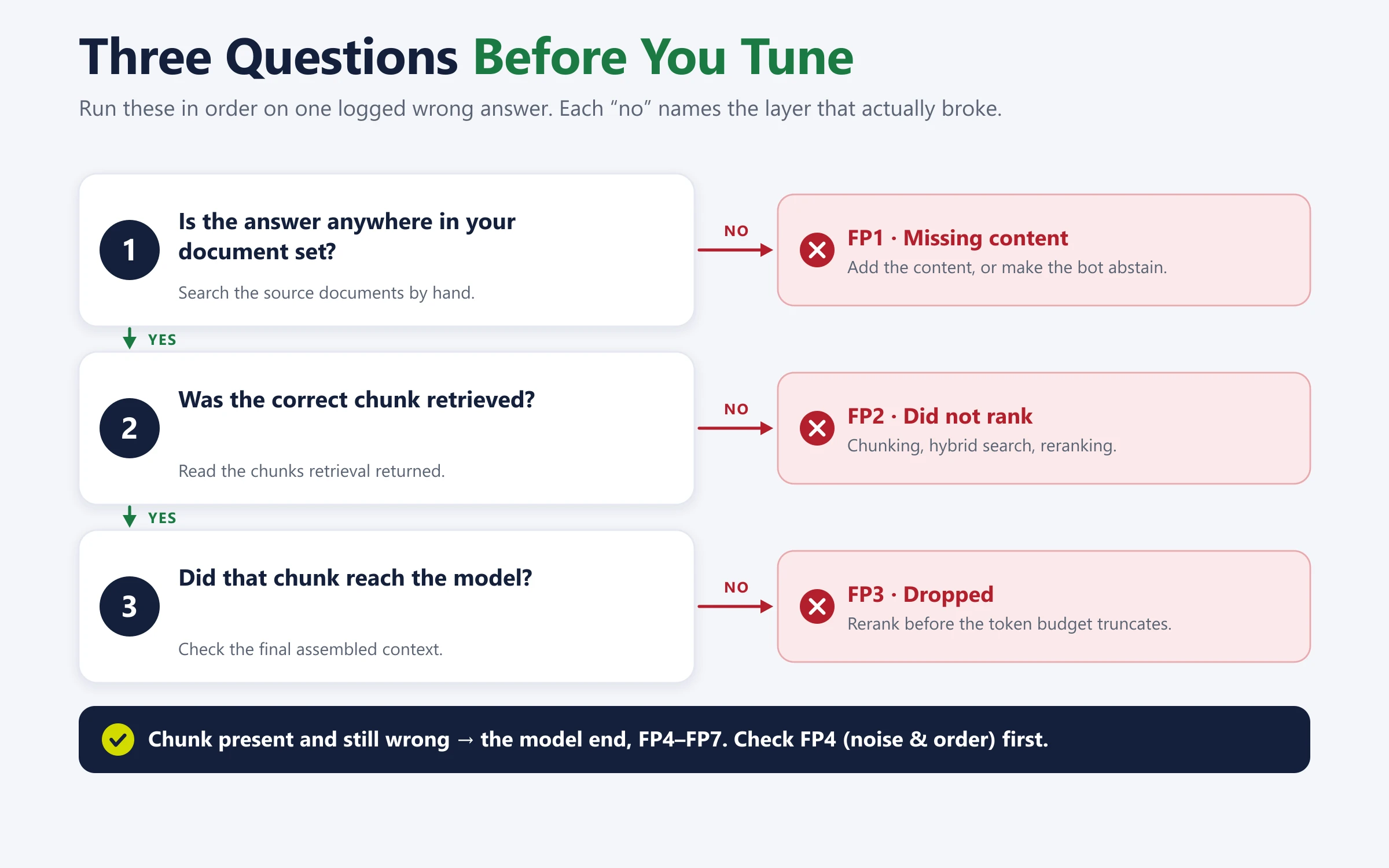
Take one wrong answer you have logged. Then ask three questions in order.
1. Is the correct answer anywhere in your document set? Search your source documents manually. If it is not there, you have FP1, and no amount of retrieval tuning will help. The fix is content, not engineering.
2. Was the correct chunk retrieved? Log the chunks your retrieval returned for that query and read them. If the chunk containing the answer is not in that list, you have FP2 and the problem is retrieval. If it is in the list, move to question three.
3. Did the correct chunk reach the model? Log the final assembled context sent to the model. If the chunk was retrieved but is missing from the context, you have FP3 and your consolidation or token budget is dropping it. If it is present in the context and the answer is still wrong, the failure is at the model end, FP4 through FP7. Check FP4 first: noise and ordering in the context are fixed on the retrieval side, even though the symptom shows up in the answer.
Build this logging before you need it: Retrieved chunks, final context, and the answer, stored against every query. Without those three artifacts you are guessing, and most teams guess wrong because generation failures are the most visible and the least common.
How to Improve RAG Chatbot Accuracy
Everything from here answers the second half of the question. The fixes are grouped by layer, because the layer your diagnosis pointed at is the only one worth working on.
Four of the seven failure points are fixed on the retrieval side: FP1 to FP3 directly, and FP4 mostly, because it is caused by what retrieval sends. That is where most accuracy is recovered. The last three are generation problems. They are cheaper to fix but move the number less.
Improving Retrieval Accuracy: Where Most RAG Accuracy Is Lost
Fix FP1: Missing content
The answer is not in your documents. Your options are narrow and none of them are technical.
Add the missing content. Or, more importantly, make the system say it does not know.
A RAG chatbot that invents an answer when retrieval returns nothing relevant is the most damaging version of this failure, because the output looks identical to a correct one. Set a retrieval relevance threshold, and when nothing clears it, do not generate. Return an explicit "insufficient information" state and route the question to a human.
That single change turns your worst failure mode into a visible, fixable gap in your content.
Then close the related gap, where retrieval found something but the model fills in details that are not there. Require every claim to cite the chunk identifiers it came from, and check in code that every cited identifier was actually in the retrieved set. An answer that cites a chunk that was never retrieved is invented, and you can block it before the user sees it.
Fix FP2: The right chunk did not rank
This is the most common RAG retrieval failure and it has three usual causes.
Your chunking strategy split the answer: Fixed-size chunking cuts documents at arbitrary token boundaries, which means a clause and the exception that modifies it can end up in different chunks. Neither chunk alone answers the question.
Chunk by document structure instead: sections, clauses, headings, paragraphs. A chunk should be a complete thought, not a fixed word count. For contracts, chunk by clause. For manuals, by procedure. For tickets, by conversation.
What this looks like in practice: Take a supplier agreement containing this text:
12.3 Termination for Convenience. Either party may terminate this Agreement on ninety (90) days written notice.
12.4 Exception. Where the Agreement covers Managed Services, the notice period under 12.3 shall be one hundred and eighty (180) days.
Chunked at a fixed 256 tokens, with 12.3 falling at the end of one chunk and 12.4 at the start of the next, retrieval for "what is the notice period" returns the chunk containing 12.3. That chunk is relevant, scores well, and the answer it produces is ninety days.
It is wrong for every managed services contract, and nothing in the pipeline flags it. The model answered correctly from what it was given.
Chunked by clause with the parent section carried in metadata, 12.3 and 12.4 either stay together as one unit or both surface because both carry the heading "12. Termination". The model now sees the rule and its exception, and the answer is conditional rather than confidently wrong.
That is the whole argument for structural chunking in one example. The failure was never the model's.
Semantic search alone is missing exact terms: Vector search finds conceptually similar text, which is exactly wrong when the user searches for a product code, an error number, a policy reference or a person's name. The embedding does not distinguish ERR-4471 from ERR-4417.
Hybrid search solves this by running keyword search alongside vector search and combining the results. If your users search with identifiers of any kind, hybrid search is not optional.
Your top-k is too small, or the ranking is weak: Retrieving the top five when the answer sits at rank eight is a silent failure. Retrieve more candidates, then use a reranker to reorder them before passing the top few to the model. Reranking costs latency and usually buys more accuracy than any prompt change. Index configuration matters here too, which is why we treat vector database development as part of the retrieval layer rather than infrastructure plumbing.
Metadata helps more than people expect: The production RAG study cited above found that adding metadata such as filenames and chunk numbers to the retrieved context helped the model extract answers. Metadata also gives retrieval something to filter and rank on beyond raw text similarity: document title, section heading, date and source type.
Most of what we fix in RAG development engagements lands here, in FP2, not in the model layer. The architectural choices behind these decisions are covered in more depth in our guide to RAG architecture patterns.
Fix FP3: Retrieved but dropped before generation
The chunk was found and then lost on the way to the model. Usually a token budget: you retrieved twenty chunks, the context window fits eight, and the ranking that decided which eight survived was not the ranking that mattered.
Retrieve fewer, better chunks rather than many mediocre ones. Apply the reranker before truncation, not after. And log the final assembled context so you can see what was dropped, which is the only way to notice this failure at all.
Fix FP4: In the context but not extracted
The answer was in front of the model and it did not use it. Two causes.
Too much noise: Fifteen chunks of loosely related text, one of which contains the answer. More context is not better context. Sending the right five chunks beats sending fifty.
Position in the context: Where the relevant information sits inside a long context measurably affects whether the model uses it. Research into long-context behavior found performance is highest when relevant information appears at the beginning or end of the input and degrades significantly in the middle, producing a U-shaped accuracy curve that holds even for models built for long contexts.
The practical consequence: do not assume a large context window means every token carries equal weight. Order your chunks deliberately, put the most relevant material at the edges rather than buried in the middle, and keep the context lean.
An extract-then-reason pattern helps on hard cases. Step one pulls the specific fields or facts out of the retrieved chunks into a structured form with source spans. Step two reasons over that structure instead of the raw text. The model stops having to find the needle and the haystack at the same time.
Improving Generation Accuracy: The Last Three Failure Points
Fix FP5 and FP6: Wrong format and wrong level of detail
These two are presentation failures rather than accuracy failures, and both are fixed in the same place.
For format, do not ask more firmly in the prompt. Use structured output with a defined schema so the format is enforced, then validate in code and retry on failure.
For specificity, give the model explicit instruction about audience and depth with examples of the level you want. If different user types need different depths, route to different prompts rather than trying to satisfy everyone with one.
Fix FP7: Incomplete answers
The model answered part of the question and dropped the rest. Most common on questions that require synthesizing across several documents: "which of our three contracts with this supplier has the shortest notice period?"
Two fixes. Decompose multi-part questions into separate retrievals, one per sub-question, then synthesize. And include the question's structure in the prompt, so the model knows it owes three answers rather than one.
How to Measure Whether RAG Accuracy Improved
You cannot improve what you do not measure, and a RAG chatbot is measured in two places, not one.
Retrieval metrics
Recall@k: For each test question, record which chunk contains the answer, then measure how often that chunk appears in the top k retrieved. This is the single most useful number in RAG evaluation, because FP2 is the most common failure and recall@k is the only thing that detects it.
Mean reciprocal rank: Where in the ranking the correct chunk lands. Useful for tuning top-k and judging whether a reranker helped.
Generation metrics
Groundedness: What share of claims in the answer are supported by the retrieved context. This is how you catch invention.
Abstention rate: On questions that cannot be answered from your documents, how often does the system correctly decline? This should be close to 100%, and testing it requires deliberately including unanswerable questions in your test set.
Answer correctness: Judged against known-correct answers, by a human for a sample and by an LLM judge at scale, with the judge calibrated against human labels first.
Build the test set before you build the pipeline
Most teams build retrieval, demo it, then write a test set afterwards. By then the questions get written to match what the system already does, which is a system passing its own exam. Write the questions first, including the ones your documents cannot answer, and tune against them.
Collect 50 to 100 real user questions with known correct answers and the chunk each answer comes from. Include:
- Straightforward lookups
- Questions requiring synthesis across documents
- Questions with exact identifiers in them
- Questions that cannot be answered from your documents at all
That last category is the one teams skip, and it is the only way to measure abstention.
Testing has to continue after launch
The research on deployed RAG systems is blunt about this: testing performance characteristics is only possible at runtime, and offline evaluation is insufficient without labeled question and answer pairs. The same work found that RAG systems need continuous calibration of chunk size, embedding approach and retrieval strategy, and that robustness evolves through operation rather than being designed in at the start.
Treat your evaluation set as a living artifact. Every production failure becomes a new test case, and the set runs on every change to chunking, embeddings, retrieval or prompts. Designing that loop deliberately is its own discipline, which we cover in chatbot feedback loops and learning systems.
Three RAG Accuracy Mistakes Not Covered Above
Measuring only the final answer: Without retrieval metrics you cannot tell a retrieval failure from a generation failure, which means you cannot reliably fix either.
Letting the index drift: Documents change and the index does not. The system then answers accurately from a version of the truth that no longer exists, which is harder to spot than an obviously wrong answer. A particular risk in AI document processing pipelines where source files update frequently.
Never re-embedding after a model change: Changing the embedding model without re-indexing leaves you comparing vectors from two different spaces, and retrieval quality falls without any obvious cause.
When the Wrong Answer Means RAG Is the Wrong Tool
Two cases where no amount of retrieval tuning will help, because the question should never have gone to RAG.
The answer requires computation, not lookup: "How many contracts expire in the next 90 days" is a database query. Retrieval will return contract text and the model will attempt arithmetic over it, which is a reliable source of confident wrong answers. Route structured questions to structured systems, which usually belongs in an agent layer as covered in AI agent development. If that structured system is your ERP, our guide to connecting AI agents to your ERP with MCP covers how to do it safely.
The knowledge is small and stable: If everything the chatbot needs fits comfortably in a prompt and rarely changes, retrieval adds failure points for no benefit. Where retrieval does earn its place is covered in our roundup of RAG use cases delivering real business value.
Conclusion: Diagnose Before You Tune
A RAG chatbot giving wrong answers is a pipeline problem, and the pipeline has seven places to break. Most of them have nothing to do with how good your model is.
The teams that improve RAG accuracy quickly do one thing differently. Before changing anything, they establish which layer failed, by logging the retrieved chunks and the final context for every failing query. That takes an afternoon to build and it is the difference between fixing the problem and rotating through plausible fixes until one appears to work.
Start there. Take ten questions your chatbot got wrong this week, run the three diagnostic questions on each, and see where they cluster. The answer will tell you what to fix, and it is usually not the model.
If your chatbot also writes to your CRM, accuracy has a second half: the records it creates. That is covered in how to connect an AI chatbot to your CRM without breaking your data.
If you want that diagnosis done properly, or the retrieval layer rebuilt around it, that is the core of our RAG development services, and it runs through every AI chatbot development project we take on.
I am the founder and CEO of Bitontree, where I lead embedded AI engineering teams that build and run production AI: agents, RAG and knowledge systems, document AI, and workflow automation for healthcare, logistics, legal, and SaaS companies. I write about what it actually takes to ship AI that survives contact with production.
Frequently Asked Questions
Why does my RAG chatbot give wrong answers even though the information is in my documents?

Most often because the correct chunk was never retrieved, or was retrieved and then dropped before reaching the model. Log the retrieved chunks and the final assembled context for the failing query. If the answer chunk is missing from either, the problem is retrieval, not the model.
Will a better model improve RAG accuracy?
Rarely by much. Three of the seven RAG failure points occur before the model sees anything, and a fourth is caused by what retrieval sends it. A stronger model is mostly being asked to fix problems upstream of it. Improve retrieval first, then revisit the model.
What chunking strategy gives the best RAG accuracy?
The one that matches your documents. Chunk by structure rather than fixed token counts: by clause for contracts, by procedure for manuals, by section for policies. A chunk should contain a complete idea, and the right size has to be calibrated against your own evaluation set.
Does hybrid search improve RAG accuracy?
Significantly, when your users search with exact terms. Vector search alone struggles with product codes, error numbers and policy references, because semantic similarity does not distinguish near-identical identifiers. Combining keyword and vector retrieval covers both.
How do I stop my RAG chatbot from making things up?
Set a retrieval relevance threshold and refuse to generate when nothing clears it. Add an explicit "insufficient information" state to the output, require citations as chunk identifiers, and verify in code that every cited identifier was actually retrieved.
How do I measure whether my RAG system is working?
Measure retrieval and generation separately. Recall@k for retrieval, groundedness and abstention rate for generation, against a test set of 50 to 100 real questions that includes questions your documents cannot answer.
Why does my RAG chatbot miss information in long documents?
Partly chunking, partly position. If the chunk was never retrieved, it is a chunking and ranking problem. If it was retrieved but ignored, context position matters: models use information at the start and end of a long context more reliably than information buried in the middle.


