July 25, 2026
AI Returns Management for Ecommerce: Automate Returns and Exchanges Safely

Yash Vibhandik
CEO


Key Takeaways
-
AI returns management for ecommerce connects the return conversation to live order, inventory, policy, payment, and fulfillment data. Its value comes from coordinating an approved action, not simply answering a question.
-
The strongest commercial lever is often refund-to-exchange conversion, not forcing the overall return rate down. A relevant exchange can retain a customer and more contribution than a cash refund, but only when the full logistics and incentive costs work.
-
Self-service portals, rules engines, and AI agents solve different parts of the problem. Most mature implementations use all three rather than replacing the returns stack with a language model.
-
Low-risk returns can be automated within explicit limits. High-value, damaged-item, cross-border, fraud-indicated, and policy-exception cases should trigger inspection or human review.
-
Measure refund rate, exchange conversion, contribution retained, cost per return, resolution time, containment, customer satisfaction, and human override rate together.
A return request is not automatically the end of a customer relationship. The shopper wanted the product enough to buy it. Something changed after the purchase: the size was wrong, the color looked different, the item arrived damaged, the product did not meet an expectation, or the customer simply changed their mind.
Many stores answer that moment with the same sequence for everyone: choose a reason, download a label, wait, and receive a refund. That process may be efficient, but it often misses the customer's actual problem. If the size was wrong and the right size is available, the better outcome may be an exchange completed in the same conversation.
AI returns management for ecommerce uses an AI agent to interpret the request, check the relevant systems, and coordinate the next action within your policy. It can offer an in-stock replacement, generate a label, schedule a pickup, route an inspection, or process an approved refund. It should not improvise policy, move money without limits, or replace human judgment in every case.
This guide explains where an AI agent adds value, where rules-based software remains the better tool, how to model exchange economics, and what controls a production returns system needs. For the wider context, see how AI agents support ecommerce operations across discovery, service, and post-purchase workflows.
What Ecommerce Returns Cost in 2026
Returns are large enough to affect margin, customer experience, inventory planning, and support capacity at the same time. Ecommerce is already a material share of retail: U.S. Census Bureau data via FRED put ecommerce at 16.9% of total retail sales in Q1 2026 (FRED ECOMPCTSA).
The National Retail Federation and Happy Returns projected that US retailers would receive $849.9 billion in returns during 2025, representing 15.8% of annual retail sales. Online sales had an estimated 19.3% return rate. The same research found that 82% of consumers consider free returns important when shopping online and estimated that 9% of returns are fraudulent (NRF, 2025 Retail Returns Landscape).
The refund is only one part of the cost. A complete returns calculation can include:
-
Original outbound fulfillment and shipping
-
Return shipping or pickup
-
Support and handling time
-
Inspection and restocking
-
Lost value when an opened or seasonal item cannot be resold at full price
-
Exchange fulfillment and any incentive offered
-
Payment-processing and platform costs
-
Fraud loss and manual-review overhead.
The customer impact matters too. A restrictive return policy may reduce return volume while also reducing conversion. A slow or confusing experience may save one refund but lose the next purchase. This is why return rate by itself is an incomplete measure.
What Is an AI Agent for Ecommerce Returns?

An AI returns agent is a controlled software system that interprets a return or exchange request and uses approved tools to act across the ecommerce stack.
Depending on the integration and permissions, it can:
-
Read the order, item, variant, delivery date, payment status, and customer history
-
Understand a free-text explanation such as "the shoulders are too tight" rather than relying only on a dropdown code
-
Check the return window and category-specific policy
-
Query live inventory for a better size, color, or replacement product
-
Present an exchange, store-credit, repair, replacement, or refund option
-
Create a return authorization and shipping label
-
Schedule a pickup or route the item to the correct return location
-
Trigger an approved refund or exchange after the required scan or inspection event
-
Escalate ambiguous or high-risk cases with a reason and supporting context.
The distinction is execution. A chatbot may explain the return policy. An agent can take an approved action in the order, inventory, payment, and fulfillment systems. That action layer is also why production controls matter more than conversational polish.
Bitontree treats this as one workflow within a broader AI agent development system: the model interprets language and selects an allowed path, while policies, limits, permissions, audit logs, and reconciliation remain enforceable outside the model.
Returns Portal vs Rules Automation vs AI Returns Agent
These tools are complementary, not mutually exclusive.
| Capability | Self-Service Returns Portal | Rules-Based Automation | AI Returns Agent |
|---|---|---|---|
| Primary job | Collect a request and offer standard options | Apply predefined conditions and workflows | Interpret the request and coordinate an allowed action |
| Input | Forms and reason codes | Structured events and fields | Structured data plus natural-language explanations |
| Decision logic | Fixed interface choices | Deterministic rules | Model-assisted interpretation bounded by deterministic policy |
| Live inventory | Available on some platforms | Available when integrated | Can query it as part of the decision when integrated |
| Exceptions | Usually creates a support case | Routes cases outside configured rules | Can summarize and route exceptions; should not invent policy |
| Money movement | Platform-dependent | Safe for explicit approved conditions | Appropriate only with limits, confirmation, idempotency, and auditability |
| Best fit | Straightforward self-service | High-volume predictable decisions | Unstructured reasons and multi-system coordination |
A portal remains the most efficient interface for many customers. Rules remain the safest way to enforce return windows, non-returnable categories, refund limits, and inspection triggers. The AI agent adds value where language or context must be interpreted before those rules can be applied.
How AI Can Reduce Avoidable Ecommerce Returns Before They Happen
The cheapest return is still the one that never starts. Many avoidable returns begin before checkout, when the shopper lacks enough information to choose confidently.
Size and fit guidance: A shopping assistant can use product measurements, brand-specific fit notes, size charts, and a customer's stated preferences to explain tradeoffs before purchase. It should be honest about uncertainty rather than promising a perfect fit.
Compatibility checks: For electronics, parts, furniture, and accessories, the agent can verify model numbers, dimensions, material constraints, or installation requirements against structured product data.
Expectation setting: Product images and short descriptions can leave gaps around color, texture, assembly, care, subscription terms, or delivery timing. An agent grounded in the catalog and policy content can answer those questions before they become return reasons.
Return-reason analysis: Free-text return explanations can be clustered by SKU, variant, supplier, reason, and customer segment. If one product repeatedly comes back because it runs small, the durable fix is a sizing and merchandising change - not a faster refund.
This connects returns management to conversational product recommendations. Better pre-purchase guidance should reduce avoidable mistakes, while the returns workflow handles the cases that remain.
Return vs Exchange: Where an AI Agent Can Protect Margin
The goal is not to hide the refund button or pressure every customer into store credit. That damages trust and may conflict with consumer-protection requirements; the FTC's online-shopping guidance emphasizes honoring shipping promises, tracking, and charge-dispute rights (FTC online shopping). The goal is to make a genuinely relevant exchange as easy as the refund.
An AI returns agent can do that in five steps:
-
Understand the actual reason: "Too tight in the shoulders" contains more useful information than "wrong size."
-
Map the reason to a possible remedy: The next size, a different cut, a replacement part, or another product may solve the problem.
-
Check live availability: The agent should not offer an exchange it cannot fulfill.
-
Apply approved commercial rules: Free exchange shipping or a small bonus credit may be appropriate when the expected contribution supports it.
-
Keep the customer's choice clear: Show the exchange and refund options with accurate timing, fees, and conditions.
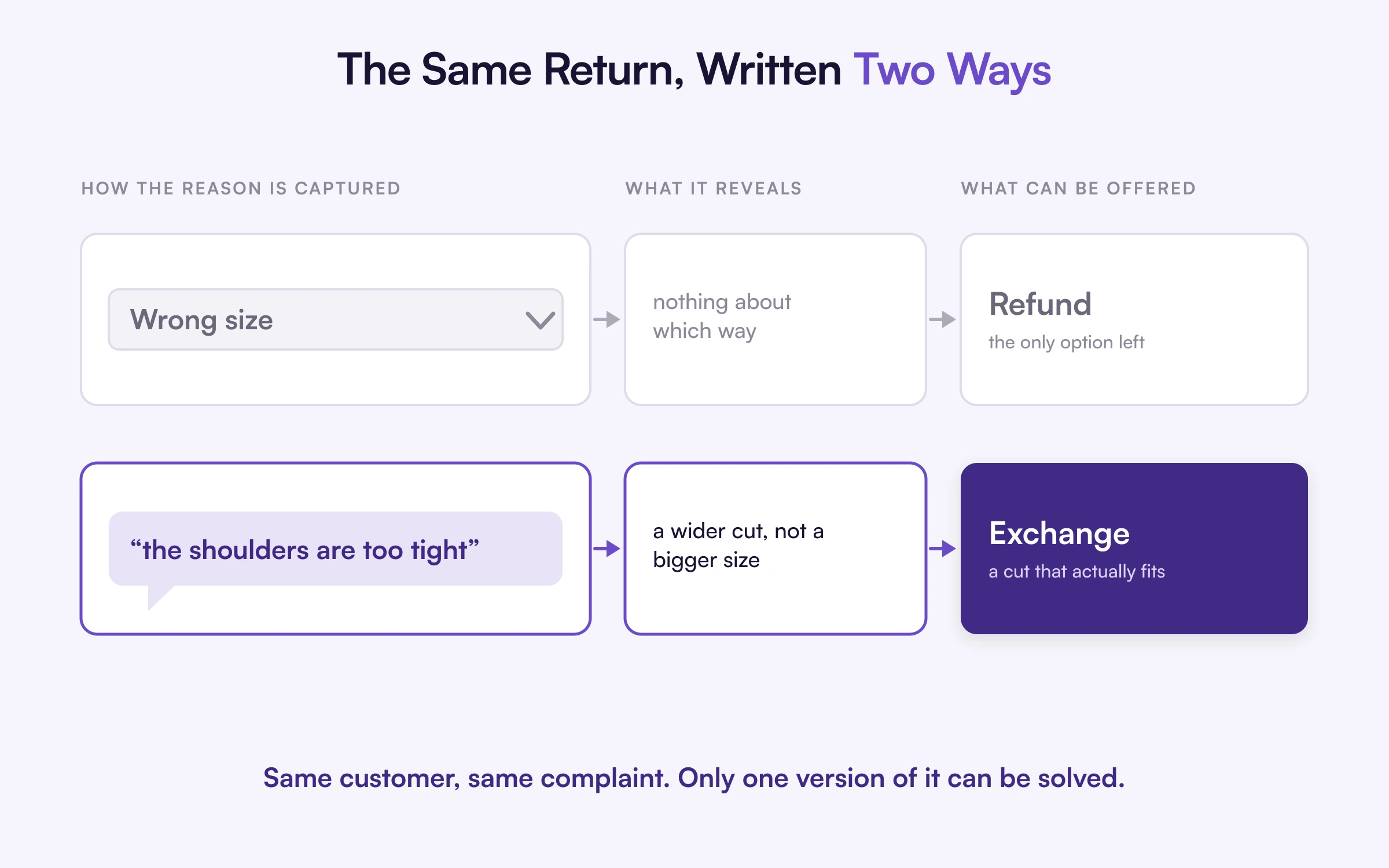
The agent's advantage is not persuasion alone. It can bring reason, stock, customer context, policy, and economics into the same controlled decision.
The Exchange Economics: An Illustrative Scenario
Consider a customer returning a product sold for $60. These figures are illustrative; a merchant should replace them with its own costs.
Assumptions:
-
Original product cost: $24
-
Original outbound fulfillment and shipping: $7
-
Return shipping and processing: $8
-
Returned item resale recovery: $18 after inspection and markdown
-
Replacement product sells for $72 and costs $29
-
Exchange fulfillment and shipping: $7
-
Exchange incentive: $6
-
Payment fees and taxes excluded for simplicity.
Refund path:
-
Cash refunded: $60
-
Return cost: $8
-
Resale recovery: $18
-
The merchant also already incurred the original $24 product cost and $7 outbound cost.
Exchange path:
-
Customer selects the $72 replacement
-
After the $6 incentive, the customer pays an additional $6 above the original $60
-
Replacement product and fulfillment cost: $36
-
Return processing remains $8
-
Resale recovery remains $18.
The exchange retains the relationship and may preserve more contribution than the refund, but it is not "saving $60." The correct comparison includes the replacement cost, both logistics legs, incentive, fees, and resale recovery.
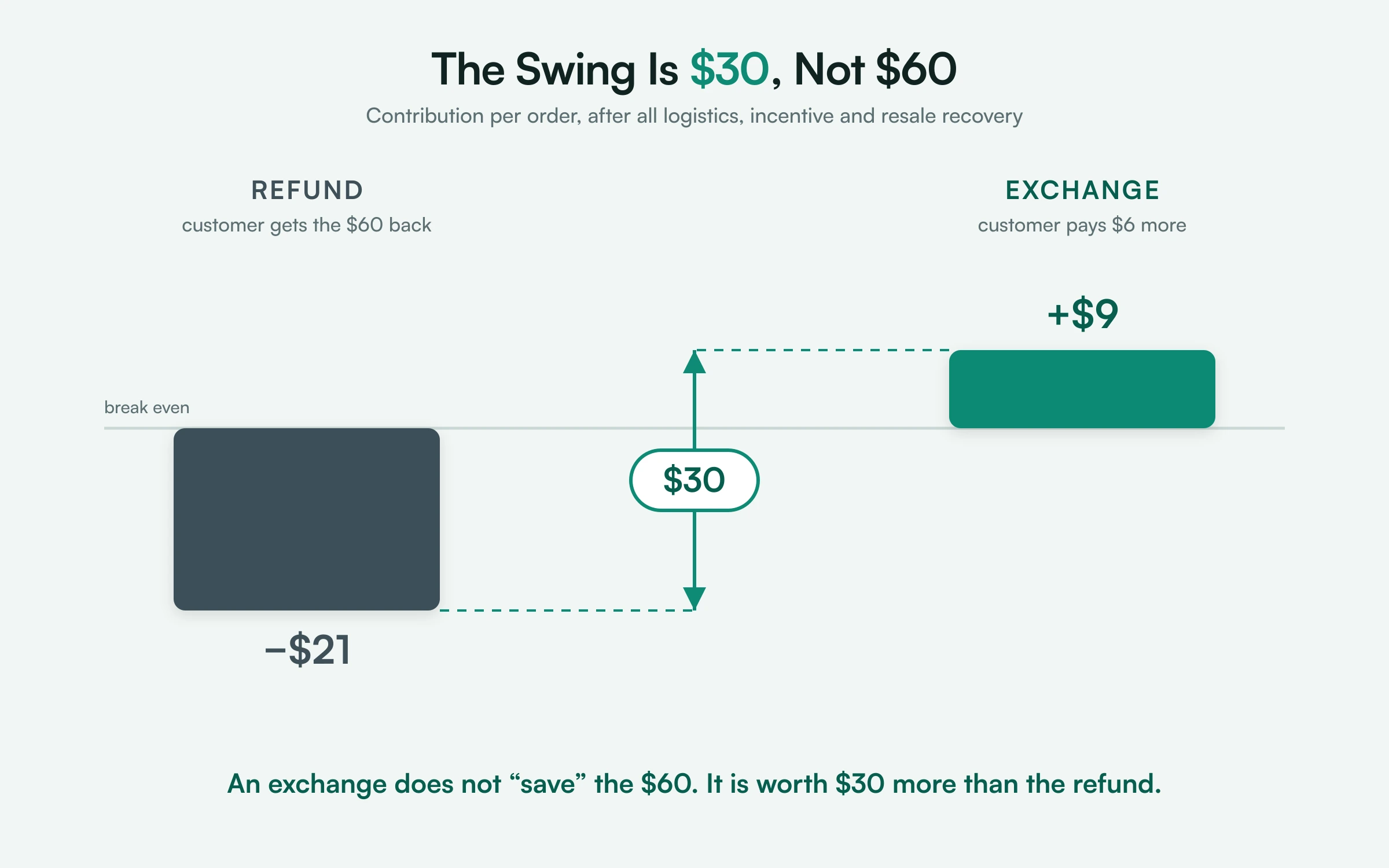
Use this decision formula:
Incremental exchange contribution = additional payment + avoided refund + resale recovery - replacement COGS - exchange fulfillment - return cost - incentive - additional fees
If the exchange does not produce a better commercial and customer outcome, the refund is the right action. The agent should calculate within merchant-defined rules, not chase exchange conversion at any cost.
7 Returns and Exchange Workflows an AI Agent Can Automate
The original opportunity is broader than the refund decision. Seven workflows typically carry the most operational value:
-
Return eligibility checks: Read the delivery date, item category, condition declaration, and policy, then approve, decline, or route the request with a clear reason.
-
Size and variant exchanges: Check live stock and offer the relevant size or color without sending the customer back to browse.
-
Replacement before receipt: For approved low-risk customers and items, ship a replacement before the original arrives, using value limits and a payment hold where appropriate.
-
Store-credit and exchange incentives: Apply category- and margin-specific rules rather than offering the same incentive to every customer.
-
Label generation and pickup scheduling: Create the return authorization, choose the correct route, generate the label, and track the first carrier scan.
-
Refund processing and reconciliation: Trigger the approved refund after the required scan or inspection event, prevent duplicate execution, and reconcile it with the original payment.
-
Post-return follow-up: Confirm that the replacement arrived, capture whether it solved the problem, and feed the result into customer-retention workflows.
Start with the workflow that has high volume, clear policy, dependable data, and low exception risk. Do not begin with the most autonomous workflow merely because it makes the best demo.
How to Reduce Refund Rate Without Tightening the Return Policy
Return rate and refund rate are different.
-
Return rate measures how many orders or items enter the return process.
-
Refund rate measures how many sales end with cash returned.
-
Exchange conversion rate measures how many eligible return requests become an exchange or store credit.
A store can improve refund-to-exchange conversion without making the policy hostile:
-
Show a relevant, in-stock exchange before - but not instead of - the refund
-
Explain why the replacement may fit better using product data
-
Make exchange shipping faster or less expensive when the economics allow it
-
Offer a transparent bonus credit within category-level margin limits
-
Preserve the customer's right to choose and show accurate processing times
-
Feed return reasons back into product pages, size guidance, and quality control.
The policy still does marketing work. NRF found that free returns are important to 82% of consumers. Raising friction everywhere may reduce both returns and purchases. Improve the decision at the return moment before changing the promise that helped win the sale.
AI Return Fraud Detection Without Punishing Good Customers
NRF estimated that fraudulent activity represented 9% of returns in 2025 and reported that 85% of surveyed retailers were using AI to detect or prevent return fraud (NRF press release). That makes risk detection relevant, but not automatically fair or accurate.
A safer returns-risk workflow can consider permitted signals such as:
-
Order and return history
-
Item value and category
-
Duplicate or conflicting claims
-
Delivery and carrier events
-
Serial-number or item-identity mismatches
-
Repeated policy exceptions
-
Inspection evidence where appropriate.
It should also include:
-
A clear reason code for every adverse decision
-
Manual review for ambiguous or high-impact cases
-
A customer appeal path
-
Minimum necessary data rather than unlimited customer profiling
-
Monitoring for false positives and unequal outcomes
-
Documented retention and access controls.
Customer lifetime value should not become a license to treat two valid claims unfairly. Segmentation can determine service options or review depth, but the underlying policy and consumer rights must remain consistent.
Returns Management Software vs a Custom AI Returns Agent
Not every store needs a custom agent.
Use returns management software when:
-
Your policy is straightforward
-
Most requests fit a standard portal flow
-
You primarily need labels, tracking, and basic exchanges
-
Transaction volume does not justify custom integration and monitoring;
-
The existing platform already supports the rules you need.
Consider a custom AI returns agent when:
-
Free-text explanations and exceptions create substantial manual review
-
The decision requires context from orders, inventory, product data, payments, loyalty, and fulfillment at once
-
Category, margin, customer, or risk rules exceed the platform's configuration model
-
Your team repeatedly moves data between disconnected tools
-
You need one controlled agent across returns, order tracking, and post-purchase support
-
The measurable value exceeds build, operating, monitoring, and change-management costs.
A custom agent often sits on top of the existing portal, order system, and payment tools. It does not need to replace the stable infrastructure that already works; for example, Shopify's returns tooling already covers return creation, return shipping information, exchanges, and app-based extensions for many merchants (Shopify returns guide).
Bitontree's Zyberon ecommerce case study shows this layered pattern: return-window checks, approval routing, status tracking, and audit history remain explicit parts of the system, while AI supports classification and orchestration.
How to Implement AI Returns Management Safely
The model is only one component. A production implementation needs a policy and control layer around it.
1. Start with return-reason data: Review at least several months of request volume, reason codes, free-text explanations, refund outcomes, exchange outcomes, handling time, and exception categories. Identify where the current process actually stalls.
2. Choose one bounded workflow: A size exchange in one market is safer to validate than autonomous coverage of every product, country, and payment method.
3. Connect read access before write access: Verify order, catalog, inventory, policy, payment, and fulfillment data quality. Confirm webhook behavior, rate limits, permissions, and failure modes.
4. Encode policy outside the model: Return windows, non-returnable categories, refund limits, inspection triggers, and authorization rules should be deterministic and versioned.
5. Define risk tiers: For example:
| Tier | Example | Default action |
|---|---|---|
| Low risk | Unworn size exchange within policy and under the value limit | Automate after customer confirmation |
| Controlled | Refund after first carrier scan | Automate only after the required event |
| Review required | Damaged high-value item, inconsistent claim, cross-border exception | Collect evidence and route to a person |
6. Run in shadow mode: Let the agent evaluate real requests without acting. Compare its proposed decisions with the team, including agreement rate, false approvals, false declines, escalation quality, and policy violations. This is where production AI evaluation and monitoring becomes operational, not theoretical.
7. Add transaction safety: Use least-privilege credentials, refund caps, confirmation steps, idempotency keys, immutable audit events, reconciliation, and a kill switch. These controls become more important as agents participate in commerce and payment workflows.
8. Launch narrowly and review overrides: Human overrides are training and policy data. A rising override rate is a signal to pause expansion, not merely tune the prompt. If the workflow touches refunds, customer data, or fraud flags, review the same access-control and audit patterns covered in AI security and compliance.
Returns Management KPIs: What to Measure After Launch
Measure the commercial result and the customer result together.
| KPI | Definition |
|---|---|
| Return rate | Returned orders or items / eligible orders or items |
| Refund rate | Orders ending in a cash refund / eligible orders |
| Exchange conversion rate | Return requests converted to exchange or store credit / eligible return requests |
| Contribution retained | Incremental contribution from exchange/credit outcomes after product, logistics, incentive, and processing costs |
| Cost per return | Total return-handling cost / completed returns |
| Resolution time | Median time from request creation to final approved outcome |
| Containment rate | Requests completed without human intervention / total requests |
| Human override rate | Automated recommendations changed by staff / reviewed recommendations |
| Customer satisfaction | Post-resolution CSAT segmented by refund, exchange, and escalation outcome |
| Repeat purchase after return | Customers purchasing again within the selected period / customers with a resolved return |
Do not optimize containment alone. A system that handles more returns automatically while increasing complaints, false fraud flags, or repeat contacts has moved cost rather than removed it.
Turning Returns Into a Better Customer Relationship
Returns are not disappearing from ecommerce. The practical choice is whether the process treats every request as an identical refund transaction or responds to the problem the customer actually has.
Sometimes the right answer is an immediate refund. Sometimes it is the next size, a replacement for a damaged item, store credit, a repair, or a human who can resolve an exception. AI returns management for ecommerce is useful when it helps make that distinction quickly, consistently, and within rules the business can explain.
The opportunity is not to automate judgment away. It is to automate predictable work, surface better options, and give people the context they need for the decisions that remain.
At Bitontree, we build production AI systems that connect to the real operational stack, enforce permissions and limits, and stay measurable after launch. Start with your own return reasons, refund rate, exchange conversion, and exception queue. Those numbers will tell you whether an agent is the right next step - and which workflow should come first.
I am the founder and CEO of Bitontree, where I lead embedded AI engineering teams that build and run production AI: agents, RAG and knowledge systems, document AI, and workflow automation for healthcare, logistics, legal, and SaaS companies. I write about what it actually takes to ship AI that survives contact with production.
Frequently Asked Questions
What is AI returns management for ecommerce?
AI returns management uses an AI agent connected to order, inventory, policy, payment, and fulfillment systems to interpret a return request and coordinate the next approved action. It can automate low-risk cases, while high-value, ambiguous, or fraud-indicated cases remain subject to inspection or human review.
How is an AI returns agent different from returns management software?
A self-service portal collects return details, while rules-based software applies predefined workflows. An AI agent adds the ability to interpret unstructured explanations, choose tools, and coordinate exceptions within explicit policies. It should complement the returns platform and policy engine rather than bypass them.
Can AI reduce ecommerce returns?
AI can help prevent avoidable returns by improving size, fit, compatibility, and product guidance before purchase. After a return begins, its more direct impact is usually reducing the share that ends in a cash refund by offering a relevant in-stock exchange or store-credit option without hiding the refund choice.
Can an AI agent process refunds automatically?
It can process approved low-risk refunds when the necessary platform permissions and controls are available. Production systems should enforce refund limits, idempotency, audit logs, reconciliation, and human review for high-value orders, policy exceptions, damaged goods, fraud signals, or low-confidence decisions.
Will returns automation increase return fraud?
Automation without controls can increase exposure. A safer system combines explicit policy rules, risk signals, inspection triggers, transaction limits, reason codes, human review, and a customer appeal path. Fraud decisions should also be monitored for false positives and unfair outcomes.
Which ecommerce platforms can support an AI returns agent?
An AI returns agent can be integrated when the store, order, inventory, payment, and fulfillment systems expose the required APIs, webhooks, and permissions. Shopify, WooCommerce, BigCommerce, Magento, and custom platforms can support different levels of integration, but available actions and implementation effort vary by stack.
What should we measure after launch?
Track refund rate, exchange conversion rate, contribution retained, cost per return, resolution time, containment rate, customer satisfaction, repeat purchase rate after a return, false-positive risk flags, and human override rate. Review commercial and customer outcomes together.