


An AI agent for healthcare handles patient intake, appointment scheduling, insurance verification, prior authorization, clinical documentation, care coordination, prescription management, and medical billing - across your patient portal, phone, SMS, and EHR. Our HIPAA-aware healthcare AI deployments reduce administrative workload by 60% within the first 90 days and cut claim denial rates by half.
Your clinical staff spend roughly half their day on paperwork. They are toggling between your EHR, your scheduling system, your insurance portal, and your billing platform to complete tasks that follow the same pattern every time. A nurse spends 15 minutes on intake documentation that could be pre-populated. A front-desk coordinator spends 45 minutes chasing a prior authorization that could be submitted and tracked automatically. A billing specialist resubmits the same denied claim three times because the coding was wrong on the first pass. Hospital administrative costs reached $687 billion in 2023 - nearly double the $346 billion spent on direct patient care.
An AI healthcare agent does not tell your patient to call back during business hours. It verifies their insurance at 11 PM, schedules their appointment, sends prep instructions, pre-populates the intake form from their record, and confirms everything before the patient walks through the door - without a staff member touching it.
This guide covers what an AI agent for healthcare actually does, the specific use cases it handles in production, the measurable benefits it delivers, and how we implement one that reduces admin burden without compromising patient safety or HIPAA compliance. We also build custom AI agents and AI chatbots for teams that need a different scope.
What Is an AI Agent for Healthcare?
An AI agent for healthcare is an autonomous system that receives a patient interaction - an appointment request, an insurance inquiry, a prescription refill, a post-discharge follow-up - reasons about what needs to happen, retrieves live data from your EHR and administrative systems, executes the appropriate workflow, and confirms the outcome with the patient or staff member - without waiting for a human to process routine tasks.
Unlike a chatbot that answers patient questions from an FAQ, a healthcare agent takes action. A patient sends a message: "I need to reschedule my MRI and check if my insurance covers it." The agent pulls the patient’s record from your EHR, checks the insurance portal for MRI coverage under their plan, finds available slots that match the referring physician’s order requirements, reschedules the appointment, sends the patient updated prep instructions, and confirms the new date - all within a single interaction. The patient did not get transferred. They did not wait on hold. They got it done.
Modern AI healthcare agents are built on three core technologies:
Large language models (LLMs) like GPT-4o, Anthropic Claude, or Meta Llama that understand patient requests in natural language, reason about the right workflow, and generate clear, empathetic responses - not robotic scripts.
Retrieval-augmented generation (RAG) pipelines built on LangChain with Pinecone or Weaviate that search your clinical protocols, formularies, insurance policies, and care guidelines in real time - so the agent answers from your verified medical data, not from its general training.
Tool calling and system integration via HL7 FHIR APIs, Model Context Protocol (MCP), and custom connectors that let the agent read from and write to your EHR (Epic, Cerner, Allscripts), scheduling system, insurance verification portal, pharmacy management system, and billing platform - taking real actions in your production systems.
The result is a 24/7 healthcare operations engine that processes patient requests end to end, reduces the majority of administrative burden, and hands your clinical staff only the tasks that genuinely require medical judgment - all within HIPAA-aware infrastructure. This is what AI in healthcare looks like when it is built for operations, not for demos.
Why Healthcare Needs AI Agents
Healthcare automation through an AI agent is not about replacing clinicians. It is about clinical workflow automation that eliminates the administrative work keeping them from patient care - the 50% of their day consumed by tasks that follow documented procedures a system should handle. The AI in healthcare market is projected to reach $187.95 billion by 2030, driven heavily by administrative automation.
Your clinicians spend two hours on paperwork for every one hour with patients
Physicians spend an average of 15.6 hours per week on administrative tasks and EHR documentation. Nurses spend 25% of their shift on charting and care coordination paperwork. Front-desk staff spend their entire day toggling between scheduling, insurance verification, and patient communication. The administrative burden is the #1 cause of clinician burnout - and it is almost entirely composed of tasks that follow repeatable patterns an AI agent can execute.
Prior authorization takes 45 minutes per request and delays patient care
Your staff spend an average of 45 minutes per prior authorization - gathering clinical documentation, completing payer-specific forms, submitting through the portal, and following up on status. A single physician practice processes 40+ prior auth requests per week. That is 30 staff hours weekly on a process that is 80% data retrieval and form submission. Meanwhile, the patient waits days or weeks for a procedure their doctor already approved. An AI agent automates the entire prior auth workflow: retrieves clinical data from the EHR, completes the payer-specific form, submits electronically, and tracks the status with automated follow-up.
Patient no-shows cost your practice $200 per empty slot
The average no-show rate across healthcare is 18-23%. For a practice with 200 appointments per week, that is 40 empty slots - $8,000 per week in lost revenue. The root cause is not patient negligence. It is poor communication: reminders sent too early, no easy way to reschedule, prep instructions buried in a portal nobody checks. An AI agent sends multi-channel reminders (SMS, email, phone) at optimized intervals, handles rescheduling instantly when a patient cannot make it, and fills cancelled slots from the waitlist within minutes - recovering revenue that currently walks out the door.
Claim denials cost you 10-15% of revenue and take 25 minutes each to rework
The average claim denial rate is 10-15%, and each denied claim costs $25-30 to rework. For a mid-size practice billing $5M annually, that is $500K-$750K in denied claims and $50K-$100K in rework costs. The majority of denials are preventable: wrong codes, missing modifiers, eligibility lapses, incomplete documentation. An AI agent catches these errors before submission, validates codes against documentation, and verifies eligibility in real time - preventing denials rather than reworking them.
Your patients wait 3 days for a callback that should take 30 seconds
A patient calls after a procedure to ask about post-op care instructions. The call goes to voicemail. Someone calls back 1-3 days later. By then, the patient has already Googled their symptoms, visited urgent care unnecessarily, or simply not followed the care plan. An AI agent responds instantly with verified clinical guidance from your protocols, escalates to the care team when the situation requires medical judgment, and follows up proactively at the intervals your physicians specify.
In short: the problem is not that your staff is too small. The problem is that your staff spends most of their time on administrative tasks that follow documented workflows a system should handle. AI agents do not replace your clinical team. They give your clinicians, nurses, and coordinators back the hours they are currently burning on paperwork, phone calls, and portal navigation - so every hour goes into patient care.
Key Use Cases of AI Agents for Healthcare
An AI agent for healthcare goes far beyond answering patient questions. Here are the specific use cases that production deployments handle - each one combines high administrative volume, documented clinical workflows, and multi-system execution.
Patient Intake and Registration Automation
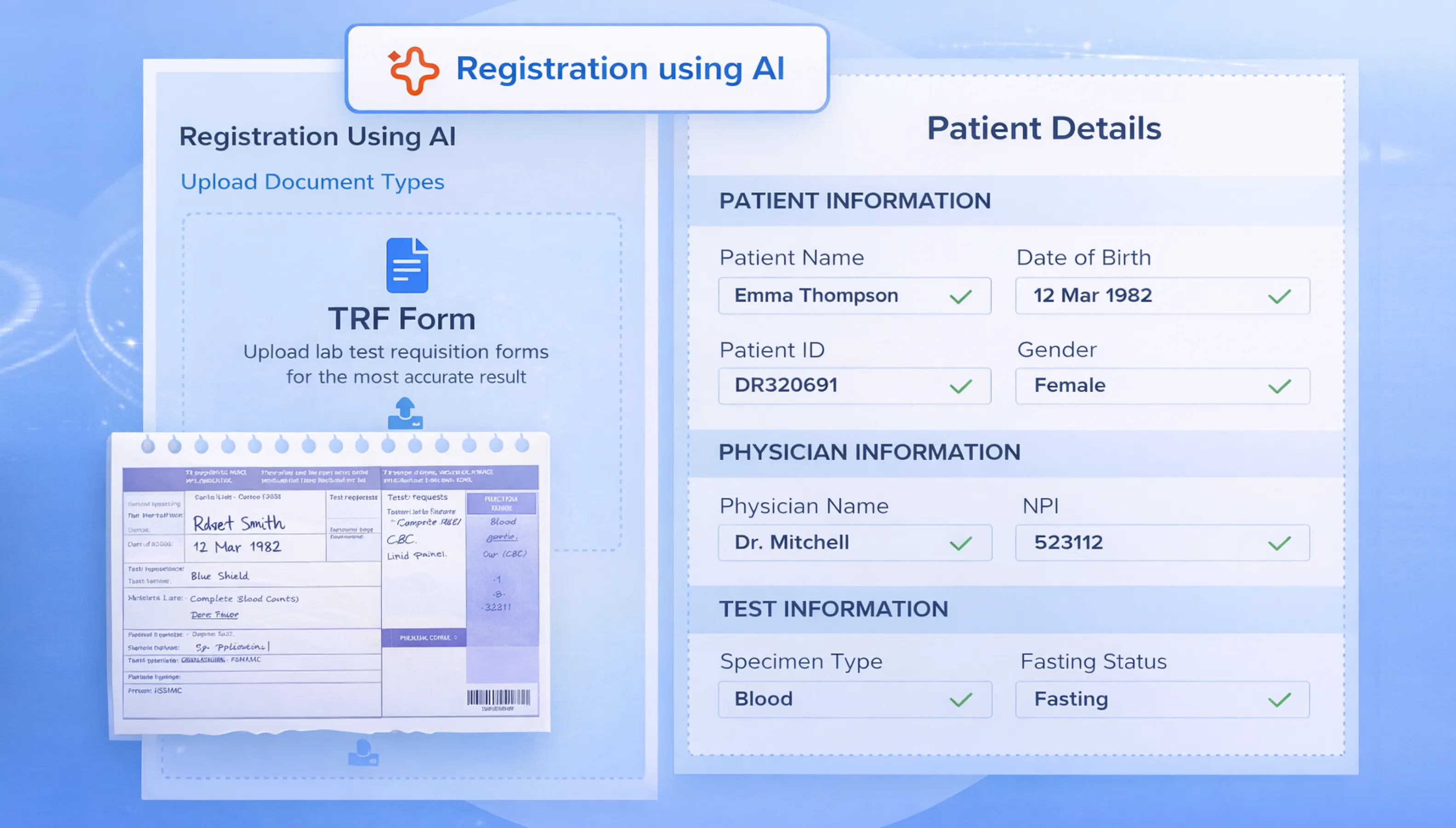
The agent pre-populates intake forms by pulling demographics, insurance information, medication lists, and medical history from the patient’s existing EHR record. New patients complete digital intake before arrival - the agent validates entries in real time, flags missing fields, and verifies insurance eligibility before the patient walks in. Check-in time drops from 15-20 minutes to under 3 minutes. Staff stop manually entering data that already exists in the system.
Best for: Any practice or hospital where front-desk staff spend 30-40% of their day on intake paperwork and patients wait 15+ minutes to check in.
Appointment Scheduling, Rescheduling, and Waitlist Management
The agent handles appointment requests 24/7 across phone, SMS, patient portal, and web chat. It checks provider availability, matches appointment type to the right physician and time slot, respects referral requirements, sends confirmation with prep instructions, and executes reminders at optimized intervals. When a patient cancels, the agent fills the slot from the waitlist within minutes - recovering revenue that would otherwise be lost. Multi-channel reminders reduce no-show rates by 30-40%.
Best for: Practices with 500+ appointments per week where scheduling complexity and no-shows directly impact revenue and patient access.
Insurance Verification and Prior Authorization
The agent verifies patient eligibility in real time at booking and again before the visit. For procedures requiring prior authorization, it gathers the clinical documentation from the EHR, completes the payer-specific submission form, submits electronically through the appropriate portal, and tracks the status with automated follow-up until approval or denial. Staff no longer spend 45 minutes per authorization manually gathering documents and navigating payer portals. Approval turnaround drops from days to hours.
Best for: Specialty practices (orthopedics, radiology, cardiology) processing 30+ prior auth requests per week where authorization delays directly impact patient care timelines.
Clinical Documentation and Note Assistance
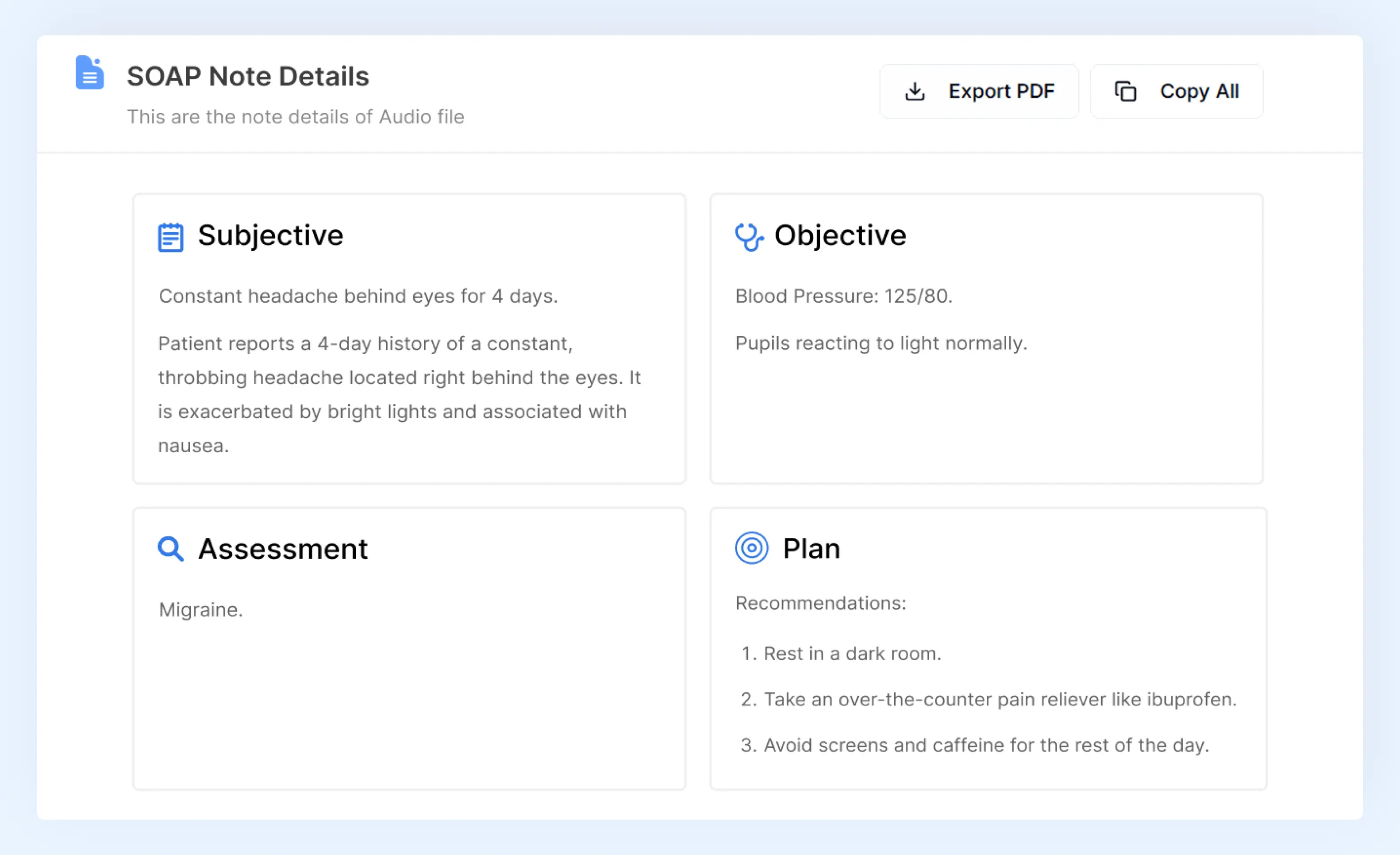
The agent listens to or reads the clinical encounter and generates structured documentation: SOAP notes, progress notes, procedure notes, and discharge summaries. It pulls relevant patient history, current medications, and lab results from the EHR to pre-populate the note. The physician reviews, edits, and signs - instead of spending 10-15 minutes writing from scratch after every encounter. Documentation time drops by 50-70%, and notes are completed the same day instead of accumulating into a weekend documentation backlog. See how this works in practice: our AI Medical Scribe solution.
Best for: Physicians spending 2+ hours daily on EHR documentation and practices where note completion lag exceeds 24 hours.
Patient Follow-Up and Care Coordination
The agent executes post-visit and post-discharge follow-up sequences: sends care instructions at the right time, checks in on symptom progression, confirms medication adherence, schedules follow-up appointments, and escalates to the care team when patient responses indicate a concern. For chronic disease management, it monitors patient-reported outcomes at intervals defined by the care plan and alerts the clinical team when values fall outside parameters. When lab results arrive, the agent cross-references them against the patient’s baseline and care plan thresholds - see our AI Lab Report Analysis platform for how this works in production. No patient falls through the cracks because a coordinator forgot to call. This is what real patient engagement looks like - proactive, continuous, and sourced from the care plan.
Best for: Health systems with high readmission rates, chronic disease populations, or post-surgical patients where follow-up consistency directly impacts outcomes and CMS quality scores.
Prescription Refill and Medication Management
The agent processes prescription refill requests by verifying the prescription is active, checking for drug interactions against the patient’s current medication list, confirming the pharmacy on file, and routing the refill to the prescribing physician for approval. For controlled substances, it enforces your refill policies and flags early refill requests. Patients get their refills processed in minutes instead of playing phone tag for days. Pharmacy calls to your office drop by 40-60%. See our AI-powered medication calling system case study for how this works at scale.
Best for: Primary care and chronic disease practices where refill requests consume 20-30% of nursing staff phone time daily.
Medical Coding and Claims Optimization
The agent reviews clinical documentation and suggests appropriate CPT, ICD-10, and HCPCS codes based on the encounter record. It validates codes against payer-specific rules, checks for missing modifiers, verifies medical necessity documentation, and flags claims likely to be denied before submission. When a claim is denied, the agent analyzes the denial reason, retrieves the supporting documentation, and prepares the appeal. First-pass claim acceptance rates increase from 85% to over 95%.
Best for: Practices and billing companies where claim denial rates exceed 10% and rework consumes 15-20% of billing staff time.
Patient Triage and Symptom Assessment
The agent conducts structured symptom intake using clinically validated protocols. When a patient contacts your practice with a concern, the agent asks targeted questions based on the presenting symptoms, cross-references with the patient’s medical history and current medications, and classifies the urgency: self-care with guidance, schedule an appointment within a defined timeframe, or escalate immediately to the clinical team. The triage is documented in the EHR with the clinical rationale. This is not diagnosis - it is structured intake that ensures every patient reaches the right level of care at the right speed.
Best for: Primary care practices and nurse triage lines handling 100+ patient calls daily where triage accuracy and speed directly impact patient outcomes and liability.
Agent Assist Mode for Clinical Staff
Not ready for patient-facing autonomy? Agent-assist mode runs alongside your clinical and administrative staff. During patient calls, it surfaces relevant clinical history, insurance status, medication lists, and care plan details in a sidebar. After calls, it generates summaries, updates the EHR, and queues follow-up tasks. For physicians, it drafts documentation during the encounter for review and signature. The clinician stays in control of every decision. The agent handles the information retrieval and documentation that slows them down.
Best for: Healthcare organizations that need AI productivity gains but require human oversight on every patient-facing interaction during the initial deployment phase.
How an AI Healthcare Agent Works: The Patient Journey
Here is what happens when a patient interacts with your practice and an AI healthcare agent is running.
Step 1: Patient reaches out and the agent activates instantly
A patient calls, sends a text, submits a portal message, or fills out a web form. The agent activates within seconds - at 2 PM or 2 AM, on a Tuesday or a holiday. There is no voicemail, no hold queue, no "we will return your call within 24-48 hours." The patient gets an immediate, intelligent response the moment they reach out.
Step 2: Agent identifies the patient and pulls their full context
The agent matches the patient against your EHR using name, date of birth, MRN, or phone number. It pulls their complete context: demographics, insurance on file, upcoming appointments, recent visits, current medications, active referrals, and care plan details. Every subsequent interaction is informed by the patient’s actual medical record - not a cold start.
Step 3: Agent understands the request and classifies urgency
Using natural language understanding, the agent interprets what the patient needs: scheduling, refill, billing question, symptom concern, test result inquiry, or care instructions. It classifies urgency based on clinical protocols. A symptom concern that matches red-flag criteria routes immediately to the care team. A routine scheduling request processes autonomously. The agent does not treat every request the same - it triages.
Step 4: Agent retrieves relevant clinical and administrative data
The agent searches your protocols, formulary, insurance policies, and scheduling rules through the RAG pipeline. For a prior auth request, it pulls the clinical documentation supporting medical necessity. For a medication question, it retrieves the relevant drug information and the patient’s allergy list. For a billing inquiry, it pulls the claim status and explanation of benefits. Every response is grounded in your verified data, not the model’s general medical knowledge.
Step 5: Agent executes the workflow and completes the task
This is where an AI agent differs from a chatbot. The agent does not just answer - it acts. It schedules the appointment, submits the prior auth, processes the refill request, updates the EHR record, sends the patient confirmation, and queues any follow-up steps. For actions above its configured authority - medication changes, clinical decisions, exceptions to protocol - it packages the request with full context and routes to the appropriate clinician for approval.
Step 6: If the patient needs clinical judgment, the handoff is seamless
When the agent encounters a situation requiring medical judgment - an abnormal symptom pattern, a complex medication interaction, or a request that falls outside documented protocols - it escalates to the clinical team with everything attached: patient profile, conversation history, relevant clinical data, actions already taken, and a recommended next step. The clinician reviews the complete picture instead of starting from scratch. Handling time drops because the context is already assembled.
Step 7: Every interaction feeds your quality improvement engine
Every patient request, agent action, escalation reason, and outcome is logged and analyzed. You can see which request types generate the most volume, where patients drop off, which escalations could have been handled autonomously, and where your protocols have gaps. This is operational intelligence that drives continuous improvement - not just agent analytics, but a real map of where your administrative processes break down.
Benefits of AI Agents for Healthcare
Here is what actually changes when you deploy an AI agent for healthcare - measured as operational outcomes, not chatbot metrics.
Your clinical staff spend time on patients, not on screens
More than half of your administrative workload disappears within the first 90 days. Intake forms pre-populate from existing records. Prior auths submit automatically. Follow-up sequences execute without coordinator intervention. Prescription refills process in minutes instead of hours. Your physicians spend 2 fewer hours per day on documentation. Your nurses spend their shift on patient care instead of phone calls and charting. The work that caused burnout becomes the work a system handles.
Your patients get responses in seconds, not days
Sub-30-second first response. The agent is already pulling the patient’s record and processing their request before they finish reading the first reply. No hold queue. No voicemail. No "we will call you back within 48 hours." A patient requesting a refill at 10 PM gets it routed for approval by 10:01 PM. A patient asking about post-surgery care instructions gets them immediately with a source citation from your clinical protocol. Patient engagement stops being a metric you measure and starts being an experience your patients actually feel.
Your claim denial rate drops and stays down
Pre-submission validation catches coding errors, missing modifiers, eligibility lapses, and documentation gaps before the claim goes out. First-pass acceptance rates increase from 85% to over 95%. Denied claims that do occur get automatically analyzed, documented, and queued for appeal with supporting evidence attached. For a practice billing $5M annually, that is $300K-$500K in recovered revenue and $50K+ in reduced rework costs.
Your no-show rate drops by 30-40%
Multi-channel reminders sent at optimized intervals. One-tap rescheduling when a patient cannot make it. Cancelled slots filled from the waitlist within minutes. Prep instructions delivered through the channel the patient actually uses, not buried in a portal they check once a month. For a practice with 1,000 appointments per month, a 10-percentage-point reduction in no-shows recovers $80,000+ in monthly revenue.
Your care coordination happens automatically
Post-discharge follow-up sequences execute at the intervals your physicians specify. Chronic disease check-ins happen on schedule. Referral loops close because the agent tracks whether the patient scheduled and attended the referred visit. Medication adherence improves because the agent checks in and escalates non-adherence to the care team. Nothing falls through the cracks because a coordinator had too many patients to track manually.
Your compliance documentation generates itself
Every patient interaction, every action taken, every escalation decision, every clinical reference used - logged with timestamps, user identity, and the specific data sources accessed. HIPAA audit trails are built into the system, not bolted on. Quality reporting data populates automatically from documented interactions. When a regulator or auditor asks for records, the documentation already exists - complete, timestamped, and traceable.
In short: AI agents do not replace your clinical team. They eliminate the administrative half of your staff’s day - the intake paperwork, the prior auth chasing, the phone tag, the claim rework, the follow-up calls that never happened. Your clinicians care for patients. Your coordinators coordinate care. And your operations run at the speed your patients actually expect.
Healthcare Segments Deploying AI Agents
AI agents for healthcare look different in a multi-specialty clinic than in a telehealth platform. Here is what production deployments handle across key segments.
Hospitals and Health Systems
Your call center handles 3,000+ calls per day. Your schedulers are booking across 200 providers. Your prior auth team is drowning in fax-based workflows that should have been automated a decade ago. An AI healthcare agent handles the volume without adding headcount - and integrates directly with your Epic or Cerner environment.
- Cross-department scheduling with provider preference matching, equipment availability, and referral requirements
- Prior authorization automation across 50+ payer portals with clinical documentation assembly from Epic/Cerner
- Emergency department follow-up - post-discharge instructions, medication reconciliation, PCP appointment scheduling
- Patient financial counseling - eligibility screening, payment plan setup, charity care application assistance
- One regional health system: 55% reduction in scheduling call volume, prior auth turnaround from 4 days to 6 hours
Private Clinics and Group Practices
Your front desk is the bottleneck. Two coordinators handle intake, scheduling, insurance verification, phone calls, and patient communication for 15 providers. When one calls in sick, the queue backs up by noon. An AI agent absorbs the routine volume so your staff handles only the exceptions.
- Digital intake with pre-populated forms from existing EHR records - check-in time under 3 minutes
- Automated appointment reminders with one-tap rescheduling and waitlist backfill
- Prescription refill processing with formulary checks and physician routing
- After-hours patient communication - symptom triage, appointment requests, and refill processing at 2 AM
- One multi-specialty group: the majority of patient requests resolved without staff intervention, phone hold time dropped from 8 minutes to zero
Telehealth and Digital Health Platforms
Your platform scales patients, but your operations do not. Every new patient creates intake work, insurance verification, provider matching, and post-visit follow-up that your team handles manually. An AI agent makes your operations as scalable as your technology.
- Patient onboarding with automated insurance verification, intake completion, and provider matching based on condition and availability
- Pre-visit preparation - symptom intake, medication list updates, and relevant medical history surfaced for the provider
- Post-visit follow-up automation with care plan delivery, prescription coordination, and outcome tracking
- Chronic care management with scheduled patient check-ins, adherence monitoring, and clinical team alerts
- One telehealth platform: 45% more patients served per provider with same operational staff count
Pharmaceutical and Life Sciences
Your medical affairs team answers the same drug information questions from HCPs and patients every week. Your clinical trial coordinators spend hours on participant screening that follows documented criteria. An AI agent handles the repeatable portions so your PhD-level staff focus on the science, not the admin.
- Medical information responses for HCPs and patients - sourced from approved labeling, prescribing information, and clinical data
- Clinical trial participant pre-screening against inclusion/exclusion criteria from the protocol
- Adverse event intake with structured reporting and regulatory routing
- HCP engagement tracking and medical education follow-up based on interaction history
- One pharma company: medical information response time dropped from 72 hours to 4 hours with 100% source citation
Health Insurance and Payers
Your member services team handles 10,000+ calls per month, and 70% are the same questions: coverage verification, claim status, provider search, and benefit explanations. An AI agent resolves those questions instantly - so your team handles the complex cases that actually need human judgment.
- Member benefit inquiries resolved from plan documents with specific coverage details and cost-sharing calculations
- Claim status lookup and explanation of benefits delivered conversationally instead of through incomprehensible EOB letters
- Provider directory search with network status verification and appointment scheduling integration
- Prior authorization status tracking with proactive member updates when decisions are rendered
- One regional payer: 65% of member inquiries resolved autonomously, average handle time for remaining calls dropped by 40%
Common Challenges in Healthcare AI Agent Deployment - and How We Solve Them
Healthcare AI deployments face unique risks that do not exist in other verticals. Patient safety, regulatory compliance, and data privacy are non-negotiable. Here are the five most common failure modes and how Bitontree prevents them.
Challenge 1: The agent provides incorrect clinical guidance
A patient asks about medication interactions and gets a wrong answer. In healthcare, a wrong answer is not an inconvenience - it is a patient safety risk. This is the #1 fear that blocks healthcare AI deployment.
How Bitontree solves this: Retrieval-augmented generation grounds every response in your verified clinical documentation - formularies, protocols, care guidelines, prescribing information. The agent never generates medical advice from its general training data. When it cannot find a relevant source, it acknowledges uncertainty and escalates to the clinical team. Configurable authority levels - the agent can share published care instructions but cannot modify treatment plans, adjust medications, or make diagnostic statements. Sub-1% error rate on clinical information in production. Read our guide: [LINK: /prevent-ai-chatbot-hallucinations | How to prevent AI agent hallucinations].
Challenge 2: Patient data is exposed in violation of HIPAA
Patient health information (PHI) flowing through an AI system without proper controls creates regulatory exposure that can shut down a deployment - and cost $50K-$1.5M per violation.
How Bitontree solves this: HIPAA-aware infrastructure from day one. Business Associate Agreements (BAAs) with every subprocessor. PHI encryption at rest and in transit. Minimum necessary access - the agent retrieves only the specific data elements needed for the current task. Audit logging on every PHI access. De-identification before any data reaches the language model when full PHI is not required for the task. SOC 2 Type II compliant infrastructure. Your patient data never trains models for other clients.
Challenge 3: Integration with EHR systems fails or creates data conflicts
The agent writes to the wrong patient record, creates duplicate appointments, or overwrites clinical notes. In healthcare, data integrity is not a convenience - it is a patient safety requirement.
How Bitontree solves this: Integration via HL7 FHIR APIs with Epic, Cerner, and Allscripts - the same standards your other systems use. Patient matching algorithms with multiple verification factors before any write operation. Field-level permission controls - the agent can update scheduling and administrative fields but cannot modify clinical notes or medication orders without physician authorization. Conflict detection for simultaneous updates. Full audit trail with rollback capability on every EHR modification.
Challenge 4: The agent handles situations it should escalate
A patient describes chest pain symptoms and the agent tries to schedule an appointment instead of flagging an emergency. Inappropriate autonomy in clinical situations creates serious liability.
How Bitontree solves this: Red-flag symptom detection trained on emergency medicine triage protocols. When the agent detects keywords or patterns associated with emergent conditions, it immediately breaks the workflow, directs the patient to call 911 or go to the nearest ED, and alerts the clinical team. Configurable escalation boundaries - the agent knows exactly which situations it can handle and which require immediate human clinical judgment. Zero tolerance on safety-critical misclassification.
Challenge 5: No audit trail for regulatory compliance
A regulator requests documentation of how the AI system made a specific decision about a patient interaction. Without comprehensive logging, you cannot demonstrate compliance, and the deployment becomes a liability.
How Bitontree solves this: Every patient interaction, every data access, every action taken, every escalation decision, and every clinical source referenced - logged with timestamps, user/patient identifiers, and the specific reasoning path. Audit trails meet HIPAA, HITECH, and state-specific privacy requirements. Compliance dashboards show system performance, escalation patterns, and exception handling. When regulators or auditors request records, the documentation is already complete and exportable.
How We Implement an AI Agent for Healthcare
Here is how we implement an AI healthcare agent - the process that consistently delivers measurable operational improvement within 90 days, with HIPAA compliance built in from day one.
Step 1: Healthcare operations audit and use case mapping
We analyze your patient volume data, call center metrics, scheduling patterns, denial rates, no-show rates, and staff time allocation. Identify the top 10 administrative workflows by volume and time impact. Map which can run autonomously, which need clinical oversight, and which must stay with staff. Define success metrics: admin time saved, denial rate reduction, no-show improvement, patient response time. We also review your EHR environment, integration landscape, compliance requirements, and existing clinical workflow automation gaps.
Step 2: Agent reasoning design, clinical boundaries, and permissions
We design the decision logic for each workflow. Define autonomous actions (scheduling, reminders, insurance verification, refill routing), oversight-required actions (clinical documentation, symptom triage classifications), and prohibited actions (diagnosis, treatment modification, medication changes without physician authorization). Map every system integration. Set clinical escalation boundaries with your medical leadership. This is where patient safety is engineered - not as an afterthought, but as the foundation.
Step 3: EHR integration and RAG pipeline
We connect the agent to your EHR (Epic, Cerner, Allscripts) via HL7 FHIR APIs, your scheduling system, insurance verification portals, pharmacy management system, and billing platform. Build the RAG pipeline for clinical protocol and formulary grounding using LangChain with Pinecone or Weaviate. Every integration includes HIPAA-aware data handling, error recovery, and fallback behavior. Test against your actual patient interaction data (de-identified).
Step 4: Build, test, and parallel run
Build in 2-week sprints. Clinical accuracy testing against verified protocols. Patient safety scenario testing with red-flag symptom detection. HIPAA compliance verification on every data pathway. PHI handling audit. Load testing at 3x your peak patient volume. Then 2-4 weeks of parallel run - the agent processes real patient interactions alongside your staff for validation before going live. Clinical leadership reviews every edge case before autonomous deployment.
Step 5: Phased deployment and continuous improvement
Launch with the 2-3 highest-volume administrative workflows - scheduling, reminders, and insurance verification are the most common starting point. Monitor performance daily for the first 30 days. Tune escalation thresholds, response quality, and workflow accuracy based on real patient interactions. Expand to additional use cases (prior auth, documentation, billing) in 30-day cycles. The agent improves every month from production feedback while maintaining the clinical safety boundaries established in Step 2.
The Conclusion
Your clinical team is not the bottleneck. The administrative burden is. Your physicians spend 2 hours on documentation for every 1 hour with patients. Your coordinators spend their day chasing prior authorizations and returning phone calls. Your billing team reworks denied claims that should have been clean on the first pass. An AI agent for healthcare eliminates that administrative work end to end: intake pre-populated in seconds, appointments scheduled around the clock, prior auths submitted and tracked automatically, follow-ups executed without coordinator intervention, and claims validated before submission. Your team gets back the hours they are currently burning on admin - and your patients get the responsive, coordinated care they expect.
Bitontree builds AI agents for healthcare that automate operations - not clinical judgment. We analyze your workflows, identify the highest-impact automation opportunities, integrate with the systems your team already uses (Epic, Cerner, Allscripts, and your custom platforms), and deploy a HIPAA-aware agent that improves every week from production data. AI in healthcare works when it is built around clinical safety and compliance from day one - not bolted on later. Whether you are starting with scheduling automation or deploying across intake, prior auth, documentation, billing, and follow-up - we engineer the reasoning, the integrations, the clinical safety boundaries, and the compliance infrastructure so your agent works in production, not just in a demo.
Start with a free healthcare operations audit. We analyze your patient volume data, administrative workflows, and compliance requirements, then deliver a deployment plan with architecture, timeline, and projected cost savings - before you commit to anything.
Frequently Asked Questions
What is an AI agent for healthcare?

An AI agent for healthcare is an autonomous system that handles administrative workflows - patient intake, scheduling, insurance verification, prior authorization, clinical documentation, prescription management, billing, and care coordination - by connecting to your EHR and operational systems, executing tasks end to end, and handing clinical staff only the work that requires medical judgment.
Is it HIPAA aligned?
Yes. HIPAA compliance is built into the architecture from day one. Business Associate Agreements with every subprocessor. PHI encryption at rest and in transit. Minimum necessary access on every data retrieval. De-identification before data reaches the LLM when full PHI is not required. SOC 2 Type II compliant infrastructure. Comprehensive audit logging on every patient data access.
What EHR systems does it integrate with?
Epic, Cerner (Oracle Health), Allscripts, athenahealth, and eClinicalWorks via HL7 FHIR APIs. Also integrates with scheduling platforms, insurance verification portals, pharmacy management systems, billing platforms, and patient communication tools. Custom integrations via API for proprietary systems.
How much does an AI healthcare agent cost?
Cost depends on scope: the integrations, channels, data sources, and compliance requirements involved. We scope every engagement against your stack and give you a clear plan and timeline after a free AI fit assessment, before any commitment.
How long does deployment take?
Focused pilot with scheduling and reminders: 6-8 weeks. Full deployment with prior auth, documentation, billing, and follow-up: 10-14 weeks. Enterprise health system deployments with multi-facility integration and compliance infrastructure: 12-16 weeks.
Will it replace our clinical staff?
No. AI healthcare agents eliminate the administrative 50-60% of your staff’s day - intake paperwork, phone calls, prior auth chasing, claim rework, and follow-up coordination. Clinicians spend more time on patient care. Coordinators focus on complex cases. The agent makes your team more effective, not smaller.
What happens when the agent encounters a clinical situation?
The agent has configurable clinical boundaries. It can share published care instructions, process administrative requests, and conduct structured symptom intake. It cannot diagnose, modify treatment plans, or adjust medications. When it encounters a situation requiring medical judgment, it escalates immediately with the patient’s full context, conversation history, and a recommended routing to the appropriate clinician.
How does it handle patient emergencies?
Red-flag symptom detection trained on emergency triage protocols. When the agent detects keywords or patterns associated with emergent conditions (chest pain, difficulty breathing, severe bleeding, suicidal ideation), it immediately breaks the workflow, directs the patient to call 911 or go to the nearest ED, and alerts the clinical team. Zero tolerance on safety-critical misclassification.
Can I start with administrative automation before patient-facing deployment?
Yes. Most healthcare organizations start with back-office automation - scheduling, insurance verification, claims validation, and documentation assistance - before deploying patient-facing capabilities. Agent-assist mode lets the agent work alongside your staff, with every patient-facing action requiring human review. Most teams move to selective patient-facing autonomy within 60-90 days.
How do you measure ROI?
Admin hours saved per week. No-show rate reduction and revenue recovered. Claim denial rate reduction and rework elimination. Prior auth turnaround time. Patient response time improvement. Staff overtime reduction. Dashboard showing all metrics with weekly optimization reports. Direct comparison: workflows processed by the agent vs manually-processed workflows by time, cost, and error rate.
Related AI Agent Use Cases

AI Agent for Customer Support
Handles customer queries, resolves issues, and scales support operations with instant, consistent responses.

AI Agent for Logistics
Automates shipment workflows, document processing, and real-time operational decision-making.

AI Agent for Sales
Qualifies leads, engages prospects, and accelerates pipeline conversion with intelligent interactions.