


Your logistics coordinators are spending their day looking up tracking numbers. Customers call asking where their shipment is. Sales reps ping for ETAs. Warehouse staff need inbound schedules. Carrier partners want load details. Every inquiry costs 5-12 minutes of staff time - open the TMS, search by tracking number, check carrier status, relay the update. Multiply that across hundreds of shipments per day and your most experienced people are working as human search engines for data that already exists in your systems.
An AI chatbot for logistics handles those inquiries in under two seconds. It pulls real-time tracking data from your TMS, WMS, and carrier APIs, answers the question, and moves on to the next one - without a single coordinator lifting a finger. And shipment tracking is just the starting point.
Logistics operates on thin margins and high volume. Every minute a coordinator spends answering a tracking question is a minute they are not solving an exception, optimizing a route, or managing a carrier relationship. According to McKinsey, 45% of logistics activities can be automated with current technology. Yet most logistics companies still rely on email, phone calls, and spreadsheets to manage customer and partner communication.
This guide covers what an AI chatbot for logistics actually does, the specific use cases it handles across shipment management, warehouse operations, and customer communication, the measurable benefits it delivers, and how we implement one that resolves the majority of routine logistics inquiries without human involvement. We also build AI chatbots for customer support, ecommerce chatbots, and healthcare chatbots but logistics is where operational efficiency gains are fastest because the queries are high-volume, repetitive, and data-driven.
What Is an AI Chatbot for Logistics?
A logistics chatbot is a conversational AI system that handles shipment tracking, freight quoting, proof of delivery retrieval, inventory inquiries, dispatch coordination, and customer delivery notifications using your actual TMS, WMS, carrier data, and operational policies as its knowledge base.
Unlike a basic tracking page where the user enters a number and gets a static status, a supply chain chatbot holds a real conversation. A customer asks “when will my order arrive?” and the bot pulls the tracking data from FedEx, UPS, or your in-house fleet, calculates the real-time ETA based on current transit status, and responds with a specific delivery window all in under two seconds. If there is a delay, it proactively explains why and offers resolution options.
Modern logistics chatbots are built on three core technologies:
Large language models (LLMs) like GPT-4o, Anthropic Claude, or Meta Llama that understand natural language queries from customers, partners, and internal staff handling slang, abbreviations, and the kind of frustrated phrasing that comes with a late shipment.
Retrieval-augmented generation (RAG) pipelines built on LangChain with Pinecone or Weaviate that ground every response in your actual shipping policies, SLAs, rate cards, carrier rules, and operational documentation preventing hallucination.
TMS, WMS, and carrier API integration with Oracle TMS, SAP TM, MercuryGate, Blue Yonder, Manhattan Associates, FedEx, UPS, DHL, USPS, and custom logistics platforms that lets the bot pull live shipment data, inventory levels, and carrier status in real time not from a cached copy.
The result is an always-available logistics assistant that handles the repetitive inquiry volume, frees your ops team for exception management and strategic work, and gives every stakeholder customer, carrier, warehouse instant access to the information they need.
Why Logistics Needs AI Chatbots
Logistics automation is not about replacing your operations team. It is about freeing them from being human search engines for data that already exists in your systems.
Your phone rings all day with questions your systems already answer
Tracking inquiries account for 40-50% of all inbound calls at most logistics operations (Convey/project44). Customers want ETAs. Sales reps need status updates for client calls. Receivers want delivery windows. Carriers need load confirmations. The answer to every one of these questions is sitting in your TMS but instead of pulling it themselves, everyone calls your ops team. Each lookup takes 5-12 minutes. For a 3PL handling 500 shipments per day, that adds up to 40-60 hours per week spent reading data off a screen to people on the phone.
Your customers hear about delays only when they call to complain
A shipment gets held at customs. A carrier misses a pickup. Weather reroutes a truck. These things happen every week in logistics. The problem is not the exception itself it is that your customer finds out only when they call asking why their freight has not arrived. By then they are already frustrated. The best logistics operations tell customers about delays before they need to ask. Most do not have the bandwidth to do that manually across hundreds of shipments.
Nobody can get answers after your team logs off
Trucks run overnight. Containers clear customs on weekends. Warehouse receiving operates second and third shifts. But your customer service team works 8 to 5. A customer checking on a time-sensitive shipment at 9 PM gets voicemail. A carrier needing to confirm a Monday morning pickup on Sunday evening gets no response. Every unanswered after-hours inquiry is either a frustrated customer who starts Monday angry or a carrier who does not show up because nobody confirmed the load.
Every new client adds more calls but you cannot keep hiring
When you onboard a new client, shipment volume goes up and so does call volume. More tracking inquiries. More POD requests. More rate questions. But you cannot hire a coordinator for every 50 new shipments. During peak season holiday, produce, promotional surges inquiry volume can triple while your team stays the same size. Hiring temporary staff takes weeks, training takes longer, and undertrained temps give wrong answers that create more problems than they solve.
Your best people are doing work that does not need them
You hired your logistics coordinators to manage exceptions, negotiate with carriers, optimize routes, and build client relationships. Instead, they spend the majority of their day on tracking lookups and POD requests. The high-value work resolving a customs hold, handling a damaged freight claim, renegotiating a lane rate gets pushed to the end of the day or does not happen at all. Your operation runs on reactive firefighting instead of proactive management because the people who should be managing are stuck answering phones.
In short: Your phone rings all day with questions your systems already answer, your customers only hear about delays when they call to complain, nobody can get answers after 5 PM, every new client adds calls without adding staff, and your best people are doing work that does not need them. A logistics chatbot solves all five.
Key Use Cases of AI Chatbots in Logistics
An AI chatbot for logistics goes far beyond basic tracking lookups. Here are the specific use cases that production deployments handle across shipment management, warehouse operations, and customer communication.
Real-Time Shipment Tracking and ETA Updates
The chatbot pulls live tracking data from your TMS and carrier APIs (FedEx, UPS, DHL, USPS, regional carriers, and in-house fleet systems), calculates real-time ETA based on current transit status, and responds with the shipment’s exact location, carrier, and expected delivery window. Customers, sales reps, and internal staff all get the same accurate answer in under two seconds.
Best for: 3PLs, freight brokers, and any logistics operation where WISMO inquiries consume 40%+ of support volume.
Automated Freight Quote Requests
The freight chatbot collects shipment details through conversation origin, destination, weight, dimensions, commodity type, service level, and special requirements and generates an instant rate quote from your rate engine or TMS. For standard lanes, the customer gets a quote in 60 seconds instead of waiting 2-4 hours for an email response. Complex quotes are routed to your pricing team with all details pre-collected.
Best for: Freight brokers and 3PLs where quote response time directly impacts win rate.
Proof of Delivery Retrieval
Customers and accounts receivable teams need PODs for billing reconciliation, insurance claims, and dispute resolution. The chatbot retrieves the signed POD document from your TMS or carrier system by shipment number, BOL, or PO number and delivers it as a downloadable file within the conversation. No email request. No 24-hour wait. No coordinator pulling documents manually.
Best for: 3PLs and carriers where POD requests account for 10-15% of inbound inquiry volume.
Warehouse Inventory and Inbound Visibility
The chatbot connects to your WMS (Manhattan Associates, Blue Yonder, SAP EWM, or custom systems) and answers inventory questions in real time: current stock levels by SKU and location, inbound shipment ETAs, available warehouse capacity, and receiving dock schedules. Warehouse managers and customer service reps get instant answers without calling the warehouse floor.
Best for: 3PLs with warehousing operations and e-commerce fulfillment centers managing inventory for multiple clients.
Carrier Dispatch and Load Assignment
The chatbot notifies carriers of available loads, collects acceptance or rejection through conversation, captures driver details and equipment confirmation, and updates your TMS automatically. For dedicated carriers, it handles routine dispatch confirming pickup time, providing load details, and sending BOL documents without a dispatcher making a phone call.
Best for: Freight brokers and carriers managing 50+ daily loads where dispatch communication is a bottleneck.
Delivery Scheduling and Appointment Booking
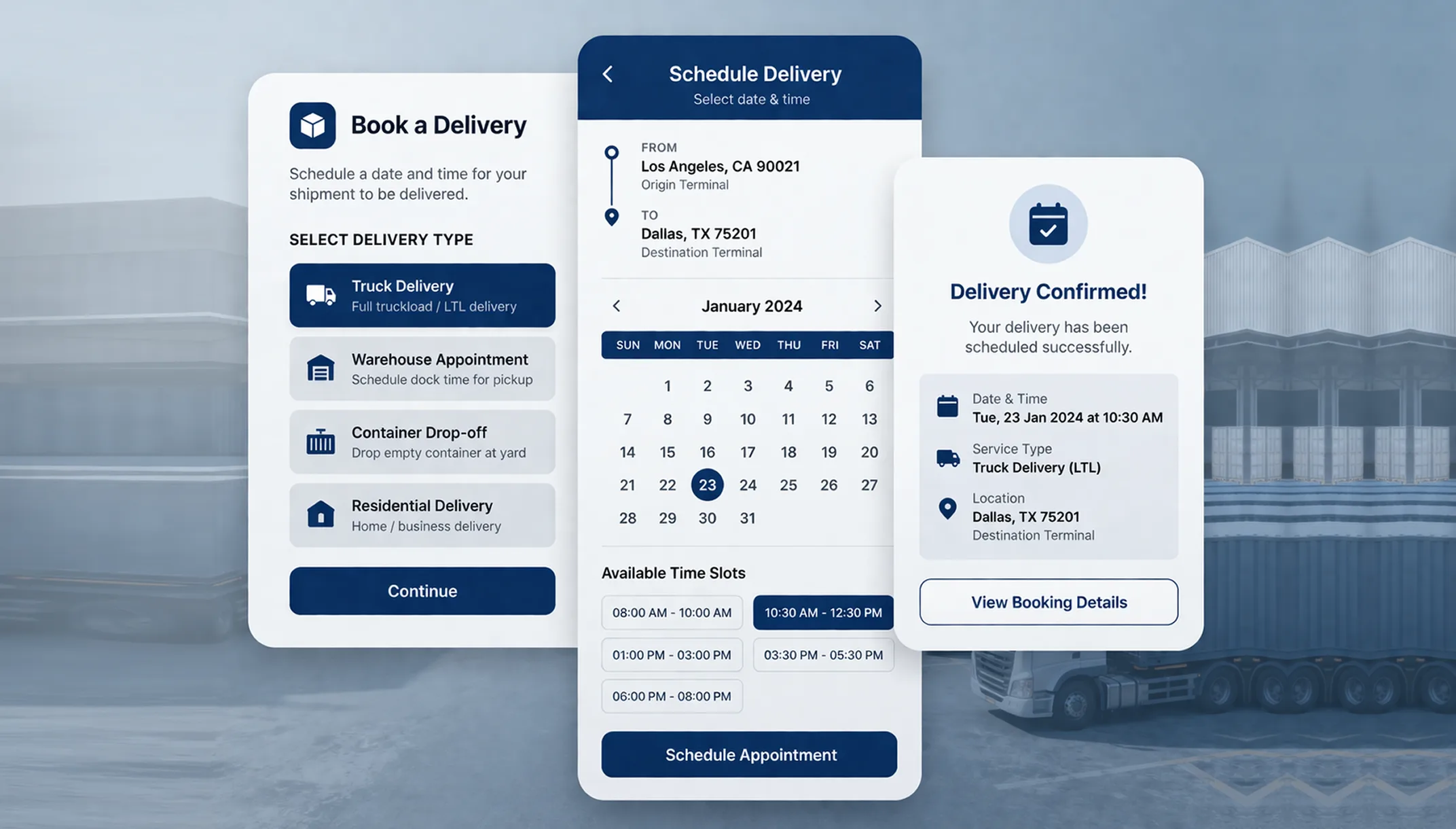
Receivers schedule delivery appointments through conversation: preferred date, time window, dock availability, and special requirements (liftgate, inside delivery, appointment notification). The chatbot checks your scheduling system, confirms the slot, and sends confirmation to both the receiver and the carrier. No phone tag between three parties.
Best for: LTL carriers and 3PLs where delivery appointment scheduling involves multi-party coordination.
Claims and Damage Reporting
When a shipment arrives damaged, the chatbot guides the customer through the claims process: captures damage description, collects photo evidence, pulls shipment and carrier details from your TMS, and creates a structured claim in your system for review. This replaces the typical 5-email chain and reduces claims processing initiation from 3-5 days to under 15 minutes.
Best for: Carriers and 3PLs with claim volumes above 50 per month where processing speed impacts customer retention.
Proactive Shipment Exception Notifications
The chatbot does not wait for customers to ask about delayed shipments. When it detects an exception in your TMS weather delay, customs hold, missed pickup, carrier capacity issue it proactively notifies affected customers with the updated ETA, the reason for delay, and available resolution options. Proactive communication reduces inbound WISMO inquiries by 25-35% because customers get the update before they need to ask.
Best for: Any logistics operation handling time-sensitive or high-value shipments where customer communication during exceptions is critical.
Rate and Invoice Inquiries
Customers ask about accessorial charges, fuel surcharges, detention fees, and invoice discrepancies. The chatbot pulls the invoice from your billing system, explains line items in plain language, and routes disputes to accounts receivable with full context. This handles 60-70% of billing inquiries without involving your finance team.
Best for: 3PLs and carriers where billing disputes and invoice questions create significant accounts receivable workload.
Customs and Compliance Documentation
International shipments require commercial invoices, packing lists, certificates of origin, and customs declarations. The chatbot guides shippers through documentation requirements by country and commodity, collects the necessary information, and generates pre-filled documents for review. It also answers compliance questions from your trade compliance documentation using RAG.
Best for: Freight forwarders and customs brokers handling international shipments with complex documentation requirements.
How a Logistics AI Chatbot Works: The Stakeholder Journey
Logistics chatbots are unique because they serve multiple stakeholders not just customers. Here is how a logistics chatbot works from the perspective of the people who actually use it.
Step 1: Stakeholder reaches out on their preferred channel
A customer checks shipment status via your website widget. A carrier confirms a load via SMS. A warehouse manager checks inbound schedules via Slack. A sales rep gets a tracking update via Microsoft Teams. Every stakeholder uses the channel they already work in. The chatbot picks up instantly across all channels from a single backend.
Step 2: Chatbot identifies who they are and what they need
“Where is shipment 4523?” “I need a quote for 2 pallets Chicago to Miami.” “What’s the ETA on PO-78901?” The chatbot figures out the intent tracking, quoting, POD request, inventory check, claim, scheduling and identifies the stakeholder type (customer, carrier, internal staff) to determine access permissions and response format.
Step 3: Chatbot pulls live data from your logistics systems
The bot queries your systems in real time: shipment status from your TMS (Oracle TMS, SAP TM, MercuryGate, or custom), inventory from your WMS (Manhattan Associates, Blue Yonder), carrier tracking from FedEx, UPS, DHL APIs, and rate data from your pricing engine. For policy questions, the retrieval-augmented generation pipeline retrieves answers from your operational documentation using LangChain with Pinecone or Weaviate.
Step 4: Chatbot responds with actionable information
The response is not just data it is context. A tracking inquiry gets the current location, carrier, ETA, and any exceptions. A freight quote gets the rate, transit time, and service options. An inventory check gets stock levels, inbound ETAs, and available capacity. Every response is formatted for the stakeholder: customers get plain language, carriers get load details, warehouse teams get operational data.
Step 5: Chatbot takes action when needed
The bot does not just answer it acts. It books delivery appointments, creates claims, confirms carrier loads, generates shipping documents, sends proactive delay notifications, and routes exceptions to the right coordinator. Every action includes confirmation, error handling, and audit logging in your TMS.
Step 6: Complex issues route to the right team member
Customs holds, carrier disputes, high-value shipment exceptions, pricing negotiations, and any issue the chatbot cannot resolve get routed to the appropriate team member with the full conversation transcript, shipment context, and issue classification. The coordinator picks up mid-conversation without the customer repeating a single detail.
Benefits of AI Chatbots for Logistics
Here is what actually changes when you deploy an AI chatbot for logistics not in theory, but in the first 90 days of production.
Your coordinators stop being human tracking APIs
Right now, your best logistics coordinators spend the majority of their day looking up tracking data and relaying it via email or phone. That is not what you hired them for. When the chatbot handles WISMO inquiries, your coordinators work on what actually drives operational performance: exception management, carrier negotiations, route optimization, and customer relationship building. The team shifts from reactive answering to proactive problem-solving.
Your customers get shipment updates at 2 AM, not 2 PM tomorrow
Supply chains run around the clock but customer service does not. A time-sensitive pharmaceutical shipment delayed at 11 PM? A perishable load rerouted at 4 AM? Your customer finds out when your team logs in at 8 AM hours after the exception happened. The chatbot provides real-time visibility 24/7 and proactively notifies customers when exceptions occur. Customer satisfaction scores rise 20-30% after deployment because the experience shifts from “I have to chase my logistics provider” to “they keep me informed automatically.”
Your quote response time drops from hours to seconds
In freight brokerage, the first quote wins. Industry average response time for a spot quote is 2-4 hours via email. The chatbot generates standard-lane quotes in under 60 seconds through conversation. For a broker handling 200 quote requests per day, that is the difference between winning 15% of quotes and winning 30%. Complex quotes still go to your pricing team but with all details pre-collected, so they respond in minutes instead of going back and forth.
Your peak seasons stop being staffing emergencies
Holiday surges, produce season, promotional events when shipment volume spikes 2-3x, inquiry volume spikes 3-5x. Hiring temporary logistics coordinators takes weeks and training takes longer. The chatbot handles the surge instantly. No hiring. No training. No temporary staff giving wrong answers from incomplete knowledge. One 3PL handled their entire holiday peak at 3x normal volume without adding a single coordinator.
Your claims process stops taking weeks
Damage claims typically take 3-5 days just to initiate because customers email photos, coordinators request shipment details, and the back-and-forth drags on. The chatbot collects everything in a single conversation: damage description, photos, shipment details from the TMS, and carrier information. Claims initiation drops from days to minutes. Faster claims resolution means faster customer recovery and fewer escalations.
Every inquiry becomes operational intelligence
When customers email or call, the data disappears into inboxes and call logs. When they ask the chatbot, every inquiry is logged, categorized, and analyzed. You can see which lanes generate the most tracking inquiries (and therefore likely have the most exceptions), which customers ask the most questions (and may need proactive communication), which carrier has the highest delay rate, and which hours produce the most after-hours demand. This data feeds operational improvements, carrier scorecards, and customer success strategy.
Logistics Segments Using AI Chatbots
A logistics chatbot looks different at a 3PL than it does at a last-mile carrier. Here is what deployments handle across logistics segments.
Third-Party Logistics (3PL) Providers
- Multi-client shipment tracking with customer-specific portal access and branded responses
- Warehouse inventory inquiries across multiple client accounts with role-based data visibility
- Automated freight quoting for standard lanes with complex quote routing to pricing team
- POD retrieval and invoice inquiry handling for accounts receivable reconciliation
- Proactive exception notifications to affected customers before they need to call
- One mid-size 3PL: 55% reduction in inbound customer service calls within 60 days of deployment
Freight Brokers
- Instant spot quote generation for standard lanes with automatic rate engine integration
- Carrier load matching and confirmation through conversational dispatch
- Shipper-facing tracking portal with real-time ETA and exception alerts
- Document collection for new shipper onboarding: MC numbers, insurance certificates, credit applications
- Lane history and rate trend queries for sales team during customer negotiations
- One freight brokerage: quote response time dropped from 3 hours to 45 seconds, win rate increased 18%
Last-Mile Delivery and Courier Services
- Real-time delivery ETA with GPS-based tracking for end recipients
- Delivery window scheduling and rescheduling through customer conversation
- Driver communication: route updates, delivery instructions, and customer contact details
- Failed delivery resolution: reschedule, redirect to pickup point, or update delivery instructions
- Post-delivery feedback collection and satisfaction surveys via chat
- One last-mile carrier: customer support call volume reduced 45%, same-day reschedule rate increased 35%
Warehousing and Distribution
- Inventory availability checks by SKU, lot number, and warehouse location in real time
- Inbound shipment visibility: ETA, dock assignment, and receiving schedule coordination
- Outbound order status tracking from pick to pack to ship with carrier handoff confirmation
- Returns processing: RMA generation, receiving instructions, and disposition tracking
- Cycle count discrepancy reporting and resolution workflow automation
- One distribution center: 70% of client inventory inquiries handled without warehouse staff involvement
Freight Forwarders and Customs Brokers
- International shipment tracking across ocean, air, and ground legs with multi-carrier visibility
- Customs documentation guidance by country and commodity with pre-filled template generation
- Duty and tariff estimates based on HS codes with landed cost calculations
- Regulatory compliance Q&A grounded in trade documentation using RAG
- Port congestion and transit delay notifications with alternative routing suggestions
- One freight forwarder: documentation preparation time reduced 40%, customs clearance inquiries handled 60% faster
E-commerce Fulfillment
- Order status tracking from warehouse pick to carrier handoff to doorstep delivery
- Multi-carrier shipping option comparison at checkout: speed, cost, and delivery date
- Return label generation and reverse logistics tracking through conversational flow
- Inventory allocation queries for marketplace sellers managing stock across multiple channels
- Peak season communication: automated delay notifications, updated ETAs, and proactive customer outreach
- One fulfillment provider: Black Friday inquiry volume handled at 4x normal with zero additional staff
AI Chatbot vs. Customer Portal vs. Email Support vs. Phone
| Feature | Customer Portal | Email Support | Phone Support | AI Logistics Chatbot |
|---|---|---|---|---|
| Tracking response | Self-service (if user finds it) | 2-24 hour reply | 5-12 min per call | Under 2 seconds, any shipment |
| Quote generation | Not available | 2-4 hour turnaround | Phone quote (slow) | 60 seconds for standard lanes |
| POD retrieval | Download if login works | Email request, 4-24 hrs | Coordinator pulls manually | Instant retrieval by shipment/BOL/PO |
| Availability | 24/7 (login required) | Business hours reply | Business hours only | 24/7, no login, any channel |
| Multi-stakeholder | One portal per user type | Separate email chains | One call at a time | Single bot serves all stakeholders |
| Exception handling | Static alerts (if configured) | Reactive (after customer asks) | Reactive | Proactive notification + resolution |
| Cost per inquiry | Low (self-service) | $5-15 per email | $8-20 per call | $0.10-0.50 per conversation |
| Scalability | Static | Requires headcount | Requires headcount | Unlimited concurrent inquiries |
In summary: A logistics chatbot is not a replacement for your customer portal or your operations team - it is the conversational layer that sits in front of both. It handles what the portal makes too complicated and what email and phone make too slow. The optimal setup: chatbot for routine inquiries and proactive communication, human team for exceptions and relationship management.
Common Challenges in Logistics Chatbot Deployment and How We Solve Them
Deploying an AI chatbot for logistics involves complex system integrations and multi-stakeholder requirements. Here are the five most common challenges and how Bitontree addresses each one.
Challenge 1: The chatbot gives outdated tracking information
Tracking data in logistics moves fast. A shipment that was “in transit” 30 minutes ago may now be “out for delivery.” If the chatbot pulls from a cached or batch-synced data source, it gives customers stale information - which is worse than no information because it creates false expectations.
How Bitontree solves this: We integrate directly with your TMS and carrier APIs for real-time data pulls. Every tracking query triggers a live API call - not a database lookup from last night’s sync. For carriers that rate-limit their APIs, we implement intelligent caching with sub-5-minute refresh intervals and clearly timestamp every response so the customer knows exactly when the status was last updated.
Challenge 2: Multiple systems with no unified data layer
Logistics companies run on fragmented tech stacks. TMS from one vendor, WMS from another, carrier APIs from a dozen providers, billing from a separate system. The chatbot needs data from all of them, but they do not talk to each other natively.
How Bitontree solves this: We build a unified data orchestration layer that normalizes data from Oracle TMS, SAP TM, MercuryGate, Manhattan Associates, Blue Yonder, FedEx, UPS, DHL, and any system with a REST or EDI interface. The chatbot queries this layer instead of individual systems. When a customer asks about a shipment, the bot pulls TMS status, carrier tracking, and delivery confirmation from three different systems and presents a single coherent answer.
Challenge 3: Different stakeholders need different access levels
A customer should see their shipments but not another customer’s. A carrier should see their assigned loads but not your margins. An internal sales rep should see client data but not financial details. If the chatbot does not enforce access controls, it becomes a data leak.
How Bitontree solves this: We implement role-based access controls for every stakeholder type. Customer authentication (account number, API key, or SSO) determines which shipments they can see. Carrier authentication limits access to their assigned loads. Internal staff access is governed by your existing role hierarchy. The chatbot applies these rules on every query - technically enforced, not policy-dependent.
Challenge 4: The chatbot cannot handle logistics terminology and abbreviations
Logistics has its own language: BOL, POD, LTL, FTL, FCL, LCL, demurrage, detention, accessorial, deadhead, drayage. A general-purpose chatbot does not understand “what’s the ETA on my FCL from Shenzhen?” or “I need the BOL for load 4523.”
How Bitontree solves this: We train the chatbot on logistics-specific vocabulary through custom system prompts and domain-specific fine-tuning. The bot understands that BOL means Bill of Lading, POD means Proof of Delivery, and “my container” and “my FCL shipment” refer to the same thing. We test against 200+ real logistics queries with industry terminology before deployment to ensure comprehension accuracy above 95%.
Challenge 5: You cannot measure operational impact
Many companies deploy a chatbot and cannot tell whether it is actually reducing coordinator workload or just having conversations. Without proper measurement, you cannot justify the investment or optimize the experience.
How Bitontree solves this: Every deployment ships with an operational analytics dashboard tracking: inquiry deflection rate (what percentage resolved without human involvement), top inquiry categories by volume, average resolution time, coordinator hours saved per week, customer satisfaction scores, and after-hours coverage. We run weekly performance reviews for the first 90 days. You see exactly how many coordinator hours the chatbot is saving and where to optimize next.
How We Implement an AI Chatbot for Logistics
Here is how we implement a logistics chatbot - the process that turns concept into operational system within 8-10 weeks.
Step 1: Operations and inquiry audit
We analyze your inbound inquiry volume across all channels: email, phone, portal, and chat. We categorize the top 20 inquiry types by volume and coordinator time consumed. We map which inquiries can be fully automated, which need live system integration, and which must always involve a human. We define measurable success metrics: inquiry deflection rate, coordinator hours saved, response time reduction.
Step 2: System integration architecture
We map integrations with your TMS, WMS, carrier APIs, billing system, and any other data source the chatbot needs. We design the data orchestration layer that normalizes data across systems. Every integration includes authentication, error handling, rate limiting, fallback behavior, and logging.
Step 3: Knowledge base and RAG pipeline
We ingest your shipping policies, SLAs, rate cards, carrier rules, claims procedures, and operational documentation into the retrieval-augmented generation pipeline. Document chunking, embedding generation, and vector storage in Pinecone or Weaviate with retrieval logic in LangChain. Test accuracy against 200+ real logistics queries.
Step 4: Conversation design and stakeholder personas
We design different conversation flows and tones for each stakeholder type. Customers get clear, non-technical language. Carriers get operational details. Internal staff get data-dense responses. We design tracking flows, quoting flows, claims flows, scheduling flows, and escalation paths. Voice and tone match your brand - professional but efficient, matching the pace logistics operators expect.
Step 5: Testing and deployment
We test against real logistics scenarios: tracking inquiries with active shipments, quote requests for standard and complex lanes, POD retrieval, inventory checks, claims initiation, and exception handling. Load testing at peak inquiry volume. Role-based access verification. Integration testing end-to-end across all connected systems. Deploy on the highest-volume use case first (typically WISMO), monitor for 2 weeks, expand to additional use cases. Weekly performance reviews for 90 days.
Frequently Asked Questions
What is an AI chatbot for logistics?

A logistics chatbot is a conversational AI system that handles shipment tracking, freight quoting, POD retrieval, inventory inquiries, dispatch coordination, and customer communication, using your actual TMS, WMS, carrier data, and operational policies as its knowledge base. It resolves 50-65% of routine logistics inquiries without human involvement.
Which logistics systems does it integrate with?
We integrate with Oracle TMS, SAP TM, MercuryGate, Blue Yonder, Manhattan Associates, and custom TMS/WMS platforms. Carrier APIs include FedEx, UPS, DHL, USPS, and regional carriers. We also connect to billing systems, rate engines, and ERP platforms (SAP, Oracle, NetSuite) through REST, EDI, or custom API interfaces.
How does it handle shipment tracking?
The chatbot pulls real-time tracking data from your TMS and carrier APIs. It provides current location, carrier, transit status, and calculated ETA based on live data. Customers, sales reps, and internal staff all get the same accurate answer in under 2 seconds. When exceptions occur, it proactively notifies affected stakeholders.
How much does a logistics chatbot cost?
Cost depends on scope: the integrations, channels, data sources, and compliance requirements involved. We scope every engagement against your stack and give you a clear plan and timeline after a free AI fit assessment, before any commitment.
Can different stakeholders use the same chatbot?
Yes. We implement role-based access controls. Customers see their shipments only. Carriers see their assigned loads. Internal sales reps see client data. Warehouse teams see inventory and receiving schedules. Each stakeholder type gets a different access level, response format, and conversation tone all from a single chatbot.
Does it work during peak season surges?
Yes. The chatbot handles unlimited concurrent inquiries with zero marginal cost. When shipment volume doubles and inquiry volume triples during peak season, the chatbot absorbs the entire surge. No hiring. No training. No temporary staff giving wrong answers.
Can it generate freight quotes?
Yes. The chatbot collects shipment details (origin, destination, weight, dimensions, commodity, service level) through conversation and generates instant quotes from your rate engine for standard lanes. Complex quotes are routed to your pricing team with all details pre-collected. Response time drops from hours to seconds, which directly impacts quote win rate.
How long does deployment take?
A starter deployment for tracking and FAQ takes 6-8 weeks. Multi-function with TMS/WMS integration takes 8-12 weeks. Enterprise with multi-stakeholder access and proactive notifications takes 10-14 weeks. Every engagement starts with a free logistics audit.
Will it replace our customer service team?
No it handles the routine 50-65% (tracking, PODs, basic quotes, scheduling) so your team focuses on what matters: exception management, carrier negotiations, complex pricing, and customer relationship building. Most clients reallocate coordinator time rather than reduce headcount.
How do I measure the ROI?
Every deployment ships with an operational dashboard tracking: inquiry deflection rate, coordinator hours saved per week, average resolution time, customer satisfaction scores, after-hours coverage, and quote response time improvement. We run weekly reviews for the first 90 days with clear before-and-after metrics.
Want an AI Chatbot for Your Logistics Operation? Let’s Start With Your Inquiry Data.
Book a free logistics audit. We analyze your inquiry volume, top question categories, and system landscape, then deliver a roadmap with timeline, integration plan, and projected coordinator hours saved within 48 hours.
Related AI Chatbot Use Cases

AI Chatbot for Ecommerce
Helps customers discover products, track orders, and complete purchases seamlessly.

AI Chatbot for HR & Onboarding
Automates employee queries, onboarding steps, and HR requests efficiently.

AI Chatbot for Healthcare
Assists patients with queries, appointments, and basic healthcare support automatically.