June 28, 2026
WhatsApp AI Agents for Customer Support: Answer Every Customer in Seconds, 24/7

Yash Vibhandik
CEO
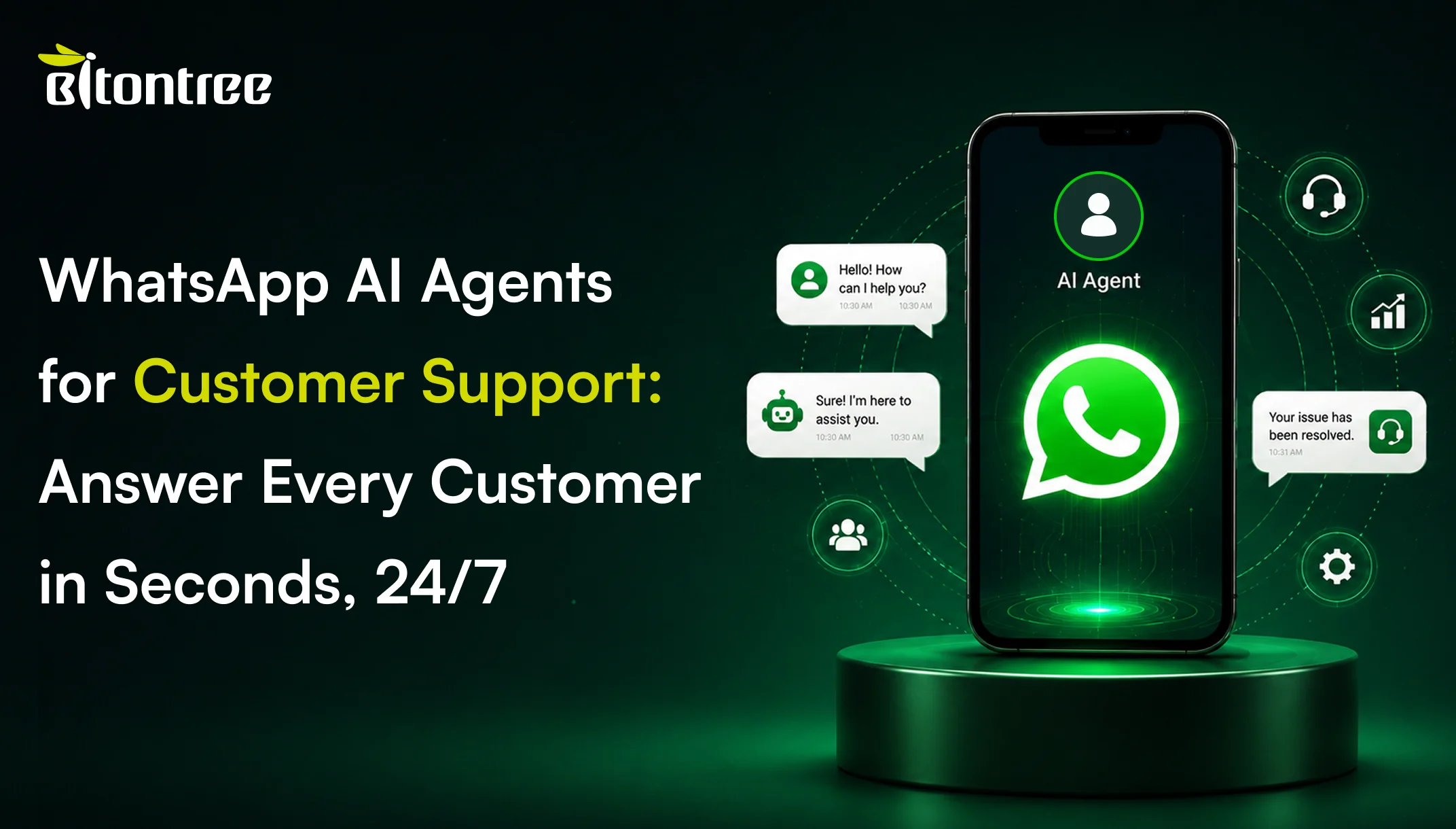


A WhatsApp AI agent for customer support answers and resolves routine queries (order status, returns, bookings, FAQs) on its own, 24/7, and escalates everything else to your team with the full conversation attached. Whether it delights customers or infuriates them comes down to one thing: is it actually connected to your order, helpdesk, and CRM systems, or is it just deflecting people with links? Judge any AI support tool on verified resolution, never on deflection.
It is 11:40 on a Saturday night. A customer opens WhatsApp and types, "Hi, my order was meant to arrive today. Where is it?" On most business WhatsApp numbers that message sits unread until Monday. By then the customer has messaged a competitor, left a one-star review, or simply moved on. Speed has quietly become the whole game in customer service, and WhatsApp is where the game is played.
A WhatsApp AI agent changes what happens at 11:40 that night. It reads the message, checks the real order status, replies in seconds, and if something has genuinely gone wrong, pulls in a human with the full history attached. This guide covers what these agents can and cannot resolve, how to measure whether one is working, and where you still want a person in the conversation.
What is a WhatsApp AI agent for customer support?
A WhatsApp AI agent for customer support is an AI-powered assistant that runs on your WhatsApp Business account, understands customer messages in natural language, and resolves support queries automatically: order status, returns, account questions, FAQs. Routine cases never need a human. Complex ones get escalated with context.
The key word is resolve. An older WhatsApp chatbot could only reply with a menu or a link. A modern agent understands what the customer actually wants, pulls the answer from your real data, and acts on it, which is why it can finish a support conversation instead of just holding it open. If you want the deeper technical picture of what separates the two, our AI agent development page and our comparison of AI agents vs chatbots cover it in full.
How does it work under the hood? Briefly: an official WhatsApp Business API connection, a language model that reads intent, retrieval over your own help content and policies so answers are grounded rather than invented, and integrations into your order system, helpdesk, and CRM so it can take real action. We break down each of those four parts, plus the full agent vs chatbot vs human comparison, in our pillar guide to WhatsApp AI agents for business. The one line from that comparison worth repeating here: resolution rates differ by integration depth, not by how good the chat window looks.
Why customer support is moving to WhatsApp
Your customers are already there. WhatsApp is the most-used messaging app in the world, with billions of users across 180+ countries, and in markets like India it is the default way people talk to businesses. Support that lives where customers already are removes the friction of email threads, hold music, and app downloads.
Meta is building for this directly. On June 3, 2026, Meta launched its Business Agent globally, an AI agent built into WhatsApp Business that answers questions and handles routine queries. It was tested in India and Mexico first, and Meta says over a million businesses are already using it. When the platform owner pushes AI support this hard, it tells you where service is heading.
What can a WhatsApp AI support agent do?
The highest-value jobs are the high-volume, repetitive ones your team spends most of its day on.
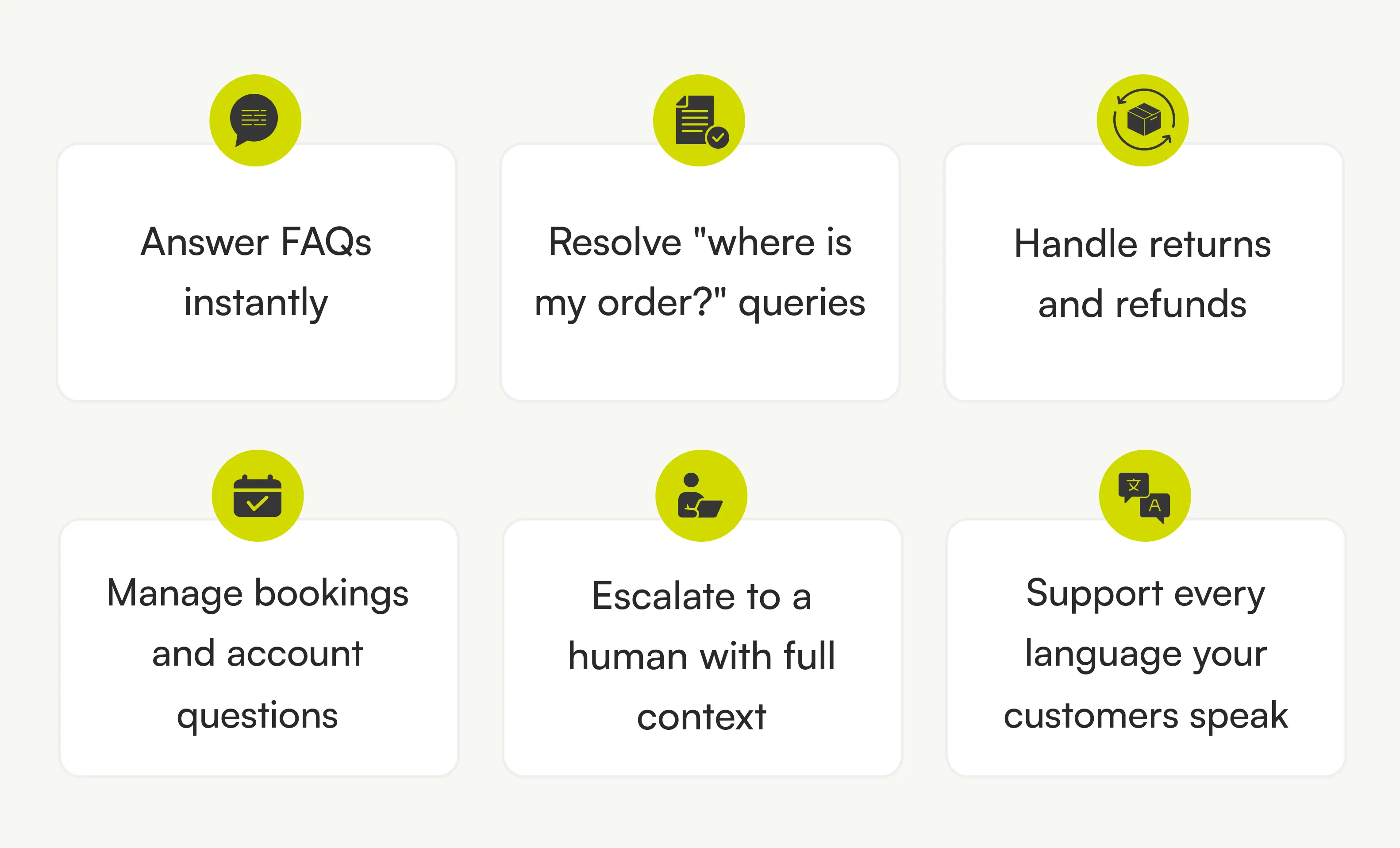
- Answer FAQs instantly: Business hours, pricing, availability, policies, how-tos. All answered the moment they are asked, in your brand voice, day or night.
- Resolve "where is my order?" queries: WISMO is widely cited across the industry as the single largest slice of e-commerce support volume, often estimated at a third or more of all tickets, and it is the most automatable question there is. Connected to your order system, the agent gives a live, accurate status instead of a tracking link the customer has to chase.
- Handle returns and refunds: For standard policy cases the agent explains the rules, starts the return, and confirms it.
- Manage bookings and account questions: Reschedule an appointment, confirm a time, check a balance, get a document resent, all inside the same thread.
- Escalate to a human with full context: When a query is complex, emotional, or high-value, the agent hands off to a person and passes the entire conversation, so the customer never repeats themselves.
- Support every language your customers speak: Modern agents switch languages automatically. Serving a customer just as fluently in Hindi, Gujarati, or English removes a real barrier in multilingual markets.
For the sales side of these same conversations, see our guide to qualifying and closing leads with a WhatsApp AI agent. And if your support runs on calls as much as chats, the same resolution logic applies to an AI voice chatbot.
Deflection vs resolution: the metric that actually matters
This is the single most important idea in AI customer support, and most vendor pitches skip it.
Deflection means the customer did not reach a human. That is all it means. A bot that answers "Where's my order?" with a link to your tracking page has deflected the ticket. Whether the customer was helped, gave up, or left angry does not show up in the number. Plenty of tools quietly count every one of those outcomes as a win.
Resolution means the problem is actually solved. To resolve that same question, the agent has to look up that specific customer's order and tell them where it genuinely is. That requires a connection to your order system, which is exactly what a deflection-first tool does not have.
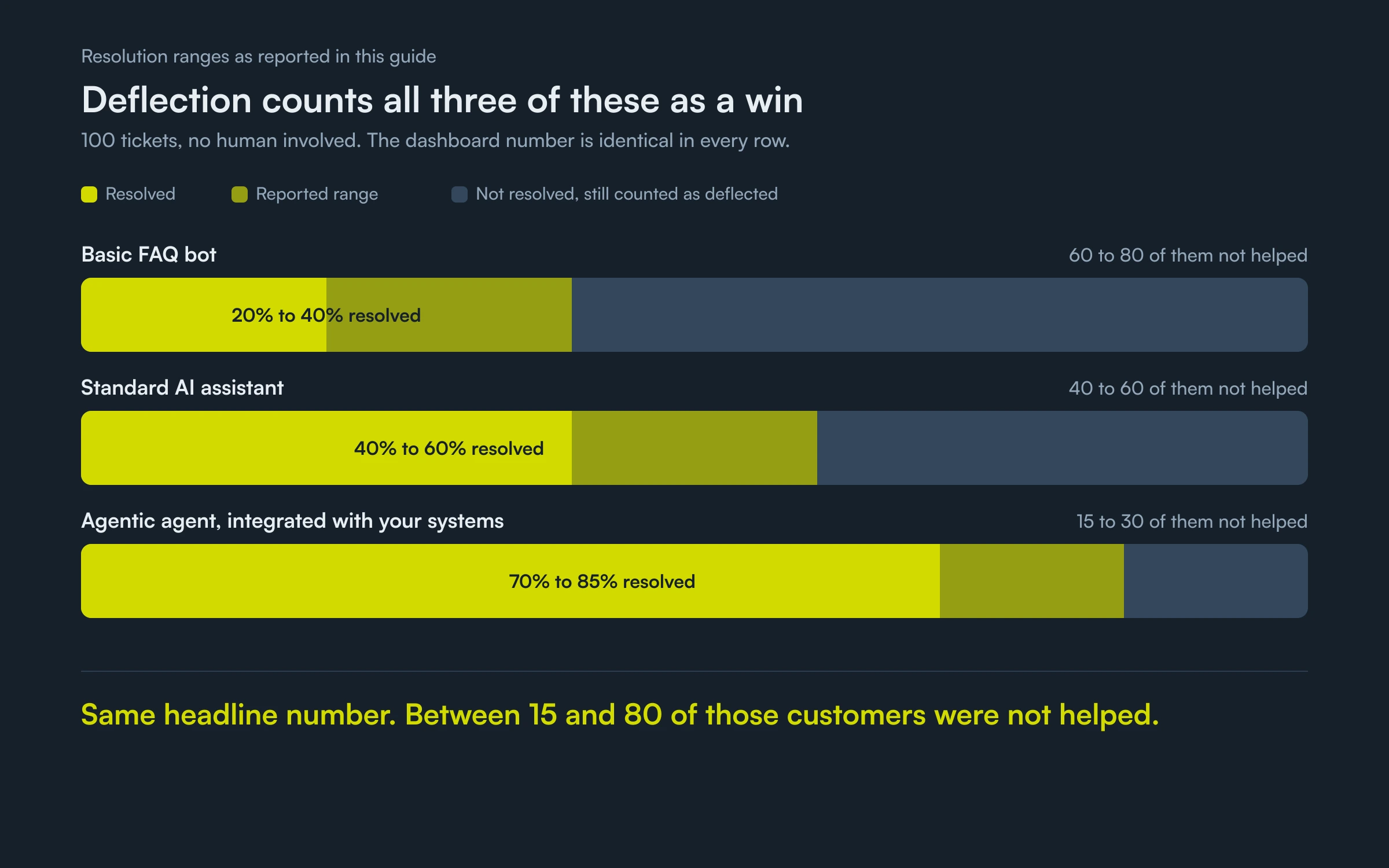
The gap between those two words is why the same "AI support" label hides wildly different results:
| Type of agent | Typical end-to-end resolution |
|---|---|
| Basic FAQ bot | 20-40% |
| Standard AI assistant | 40-60% |
| Agentic agent, integrated with your systems | 70-85% |
Treat these as typical ranges reported across vendor benchmarks, not precise measurements; definitions of "resolution" vary a lot from one report to the next. The pattern they agree on is the one that matters: resolution follows integration depth. A bot that can only talk sits at the bottom of the table. An agent that can look things up and act sits at the top.
So when you evaluate any WhatsApp AI support tool, ask one question first: what counts as resolved, and can you verify it? If the honest answer is "the customer stopped messaging," you are buying deflection.
What AI customer support delivers
A few numbers hold up well enough to plan around.
The clearest public case study is Klarna. Klarna reported that its AI assistant took on two thirds of customer service chats in its first month, cut average resolution time from 11 minutes to under 2, and matched human agents on customer satisfaction. That last part is the one worth sitting with: speed did not come at the cost of satisfaction.
On direction, Gartner projects that agentic AI will autonomously resolve about 80% of common customer service issues by 2029. A projection, not a measurement, but it comes from the firm most enterprises use to set their service roadmaps, and it matches what integrated deployments already show on routine tickets.
And on speed, the shift is simple to state: first response goes from hours to seconds, at any hour, in any language. That alone changes what "good support" means to a customer who messaged at 11:40 on a Saturday.
Treat all of it as benchmarks rather than guarantees. Results vary by ticket mix and by how each team defines resolution. The strongest number you can ever publish is your own, once your agent is live and measured honestly.
How to tell if your AI support is working
Once the agent is live, ignore the vanity number most dashboards show first, which is deflection rate. Watch these four instead.
1. Verified resolution rate: Tickets fully solved with no human involved, confirmed by a follow-up question or by the customer not returning within a day or two. This is the number that maps to actual value. If a customer asks the same question again six hours later, the first answer did not resolve anything, whatever the dashboard says.
2. Escalation quality: When the agent hands off, does the human get the full conversation, the customer's details, and what the agent already tried? Or does the customer start over from "Hi, my order was meant to arrive today"? Handoffs that lose context are the fastest way to turn a neutral experience into an angry one.
3. Accuracy: Are the answers correct? Hold this bar high. One confident wrong answer about a refund policy undoes the goodwill of fifty instant correct ones, and it creates a second ticket that a human now has to untangle.
4. CSAT on AI-handled chats: Measured separately from human-handled ones. Blending the two hides problems. If AI-handled satisfaction trails human-handled by a wide margin, the agent is answering questions it should be escalating.
The healthy pattern looks like this: resolution is high, escalations are clean, accuracy holds, and satisfaction on AI-handled chats sits near the human number. The unhealthy pattern is a great-looking deflection rate with customers who keep coming back. That agent is hiding a problem, not solving one.
Where you still want a human
A good WhatsApp AI agent is not trying to replace your team. It clears the repetitive majority of tickets so your people can handle the ones that need a person. Keep humans in the loop for:
- Emotional or high-stakes moments. A complaint, or a delayed order that ruined an occasion. Tone matters more than speed here, and customers can tell the difference.
- Complex or non-standard cases. A return that falls outside policy, a billing dispute, a fault with no clean workflow. These need judgement, and judgement is what you pay your team for.
- High-value customers, where the relationship alone justifies a human touch.
- Anything the agent is not sure about. A well-built agent escalates instead of guessing, and it passes full context so the customer does not repeat themselves to the human.
That last point deserves emphasis, because escalation quality is where cheap builds fall apart. An agent that resolves confidently but hands off badly is worse than no agent at all: the customer has now spent ten minutes with a bot and still has to repeat everything to a person. The handoff is part of the build, never an afterthought. Design it, test it, and measure it with the same care as the happy path.
Meta's built-in agent or a custom one?
Meta's Business Agent gives every business a free, capable starting point: it answers common questions from your business profile and catalog, and it routes conversations. What it cannot do is reach into your systems. It will not look up a specific customer's order, start a refund, update a helpdesk ticket, or follow your escalation rules. Meta's agent answers and routes; a custom agent, wired into your order system, helpdesk, and CRM, resolves. Start with the built-in one if you mainly need fast FAQ replies, and go custom the moment you need the agent to actually do something in your systems. We compare the two options in detail, including data and control tradeoffs, in the pillar guide.
Want an agent that resolves tickets instead of deflecting them? The difference is whether it is wired into your order, helpdesk, and CRM systems. See what a custom build involves on our WhatsApp AI agents page, or book a Free AI Fit Assessment and we will tell you honestly whether your ticket mix justifies one.
Which businesses benefit most
The fastest returns show up where support is high-volume and repetitive. Three stand out:
- E-commerce and retail: The highest-volume support there is: order tracking, returns, exchanges, and product questions. WISMO alone can dominate the queue, and an agent connected to your store resolves most of it without a human ever touching it. Our AI chatbot development work started here for a reason.
- Clinics and healthcare: Patients book, reschedule, and get reminders around the clock, plus instant answers on timings and pre-visit instructions. Fewer no-shows, and real pressure off a busy front desk.
- SaaS and technology: Tier-1 troubleshooting, password and account issues, billing questions, and how-to guidance, all kept away from your engineers so they stay on genuine bugs.
Real estate, travel, finance, education, and local services all have their own version of this story; the pillar guide walks through all eight industries. The honest test is simpler than any industry list: if your team spends its day answering the same ten questions, a WhatsApp AI support agent usually pays for itself quickly. If every query is bespoke and volume is low, the case is weaker, and that is worth knowing before you invest.
The bottom line
Customer support is now a contest of speed and accuracy, and your customers are already holding it on WhatsApp. A well-built WhatsApp AI agent gives every one of them an instant, correct answer, resolves the routine questions on its own, and hands your team only the conversations that truly need a person, at any hour. The whole outcome hinges on integration: measure resolution, demand clean escalations, and be skeptical of any tool that leads with its deflection rate.
At Bitontree we design and build custom WhatsApp AI support agents that connect to your order, helpdesk, and CRM systems, so they close tickets instead of bouncing them. If you want to know whether your support queue is a good fit, book a Free AI Fit Assessment and we will map an agent around your real workflows.
I am the founder and CEO of Bitontree, where I lead embedded AI engineering teams that build and run production AI: agents, RAG and knowledge systems, document AI, and workflow automation for healthcare, logistics, legal, and SaaS companies. I write about what it actually takes to ship AI that survives contact with production.
Frequently Asked Questions
Can a WhatsApp AI agent really resolve tickets, or does it just deflect them?

It depends on integration. Connected to your order system, helpdesk, and CRM, an agent can resolve most routine tickets end to end. A basic FAQ bot mostly deflects. Measure verified resolution, not deflection, to know which one you have.
Won't customers get annoyed talking to an AI?
Not when it resolves their issue. Customers are generally satisfied when a simple problem is solved instantly on first contact. The frustration people associate with bots comes from tools that block them from a solution instead of providing one, and that is a build quality problem, not something inherent to AI support.
What support questions can a WhatsApp AI agent handle?
Routine, high-volume ones: order status, returns and refunds, bookings and reschedules, account queries, and FAQs, all 24/7. Complex, emotional, or high-value cases escalate to a human with the full conversation attached.
Do I need the WhatsApp Business API?
Yes. Automated, scalable WhatsApp AI customer support runs on the official WhatsApp Business Platform (API), which enables compliant two-way messaging for businesses at scale. The consumer app and the basic Business app are not built for it.
Will a WhatsApp AI agent replace my support team?
No. The model that works in practice is hybrid: the agent handles the repetitive majority of tickets, and your team focuses on complex, emotional, and high-value cases. Most teams end up handling more volume overall without adding headcount.
Is Meta's built-in Business Agent enough, or do I need a custom one?
Meta's built-in agent is a good free start for basic FAQ answering and routing. You need a custom agent once you require real resolution across your own systems: live order lookups, refunds started and confirmed, helpdesk tickets updated, and control over escalation behaviour.
What languages can a WhatsApp AI support agent handle?
Modern agents handle many languages and switch automatically mid-conversation. A customer can write in Hindi, Gujarati, or English and get an equally fluent answer, which is a real advantage in multilingual markets like India.
How do I measure whether my AI support is working?
Track verified resolution rate, escalation quality, answer accuracy, and CSAT on AI-handled chats measured separately from human-handled ones. Do not rely on deflection rate. Deflection only tells you a human was not involved, not that the customer's problem was solved.
Related Blogs
Read more guides on WhatsApp automation, AI agents, and commerce workflows.