Hermes Agent Development for Production-Safe Autonomous Agents

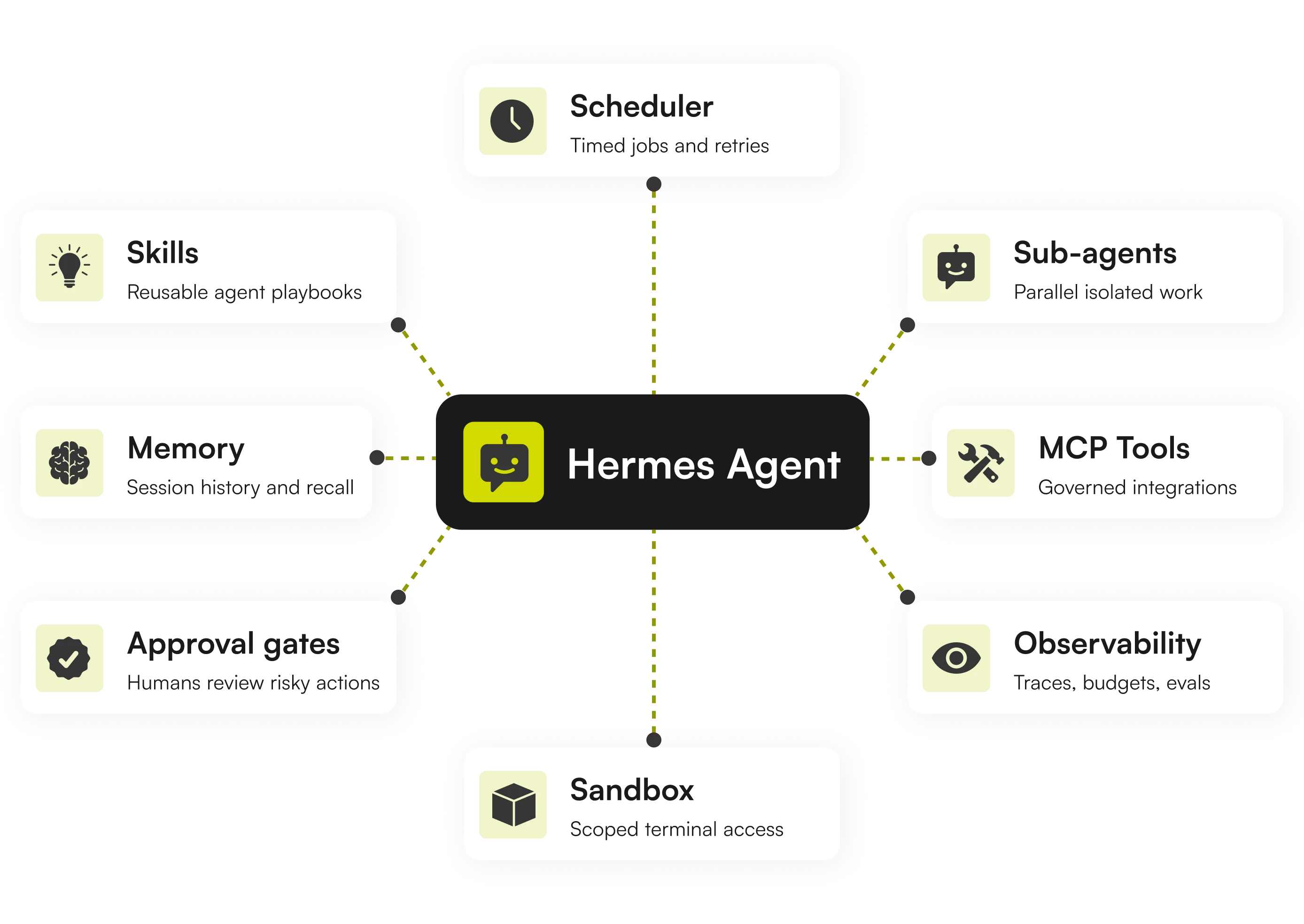
Hermes Agent workflow showing scheduler, skills, memory, approval gates, sandbox, sub-agents, MCP tools, and observability

Hermes Agent is the self-hosted, MIT-licensed autonomous runtime from Nous Research. The clone-and-run part takes an afternoon. The real work is keeping a long-running process with a terminal, your credentials, and a cron scheduler from doing something you cannot undo. We scope the job, harden the sandbox, put governed tool access and human approval gates around irreversible actions, gate launch behind evals, and stay on to operate it. Bitontree has built production AI since 2019 from Ahmedabad with US-overlap hours, including a nightly medication-adherence voice system and SOAP-note automation, so we treat an autonomous agent as a system to run, not a demo to ship.

Hermes Agent Development Services We Provide

Hermes Agent is a long-running daemon you host yourself, not a model or a library you import. It wakes on a schedule, keeps searchable memory across restarts, writes its own skills, spawns sub-agents, and acts through a real terminal. That power is also the risk, so our work is the engineering and governance that sits around the runtime. We scope, harden, govern, and operate it so an autonomous process with your credentials does only what it should.

Scope and fit assessment icon

Scope and Fit Assessment

We match the runtime to the shape of the work before any build starts. A self-hosted runtime fits long-running, private jobs that need memory across days and a real terminal. A framework or a plain script fits the rest. If Hermes Agent is the wrong tool, we say so first.

Sandboxing and isolation icon

Sandboxing and Isolation

We run the agent in a hardened container or remote sandbox, never the local backend, with gVisor or Firecracker underneath for higher-risk work. The file system stays scoped to the working directory and egress is restricted to the endpoints a task actually calls, so a bad command stays in the box.

Least-privilege access icon

Least-Privilege Access

Privilege is earned, not granted by default. The agent starts read-only or on low-stakes work and widens only as it proves itself on reversible tasks. Credentials are issued per environment, so a staging token can never reach into production.

Governed tool access icon

Governed Tool Access With MCP

We put an MCP layer between the agent and your systems, so it calls named, permissioned tools like create_ticket or read_account instead of raw SQL or open HTTP. The server enforces policy, validates arguments, and logs every call, which makes review and incident response possible after the fact.

Human-in-the-loop gates icon

Human-in-the-Loop Gates

A person sits exactly where reversibility runs out, and nowhere else. Customer messages, payments, deletes, and writes to systems of record route to an approver who sees the action and its inputs. Recoverable work runs unattended. If a job cannot reach an approver, it waits.

Observability, budgets, and evals icon

Observability, Budgets, and Evals

Every run produces structured traces of prompts, tool calls, and outcomes, so you can answer what the agent did and why. Per-run token and action budgets with loop detection stop a runaway, and an eval suite of real and adversarial tasks gates launch the way CI gates a deploy.

What an Autonomous Agent Actually Does

Hermes Agent earns its keep on work that runs unattended, holds context across days, and would otherwise burn skilled hours. These are the jobs we see it fit, each scoped so the autonomy buys something real and the blast radius stays contained.

Internal Operations Automation icon

Internal Operations Automation

The agent runs recurring back-office work end to end: reconciling records across systems, chasing follow-ups, and keeping internal trackers current. Memory across runs means it picks up where it left off instead of starting cold, and writes to systems of record stay behind an approval gate.

Research and Reporting icon

Research and Reporting

Scheduled jobs gather information, synthesize it, and produce briefs on a cadence you set. The scheduler handles the timing and the terminal handles the gathering, while prompt-injection guardrails sit on anything the agent reads from the open web so a hostile page cannot redirect the run.

Support and Ticket Triage icon

Support and Ticket Triage

The agent reads incoming tickets, classifies and routes them, drafts replies, and pulls the context an agent needs to resolve faster. Drafts and internal notes go out automatically because they are reversible, while any customer-facing send waits for a human to approve it.

Developer and DevOps Workflows icon

Developer and DevOps Workflows

With a real terminal, the agent handles the toil around a codebase: triaging failures, drafting fixes, running checks, and preparing changes for review. It works inside a sandboxed container with scoped access, so it can touch code and tooling without touching anything it should not.

Multi-Step Jobs With Sub-Agents icon

Multi-Step Jobs With Sub-Agents

For work that fans out, the agent spawns isolated sub-agents to run pieces in parallel and pulls the results back together. Each sub-agent gets its own least-privilege scope and a budget, so parallel work cannot quietly expand past what the parent job was allowed to do.

Knowledge-Grounded Actions icon

Knowledge-Grounded Actions

When the agent has to act on your policies and data rather than guess, we ground it with retrieval over approved sources. Answers and decisions trace back to the documents behind them, which keeps an autonomous worker anchored to what your organization actually says is true.

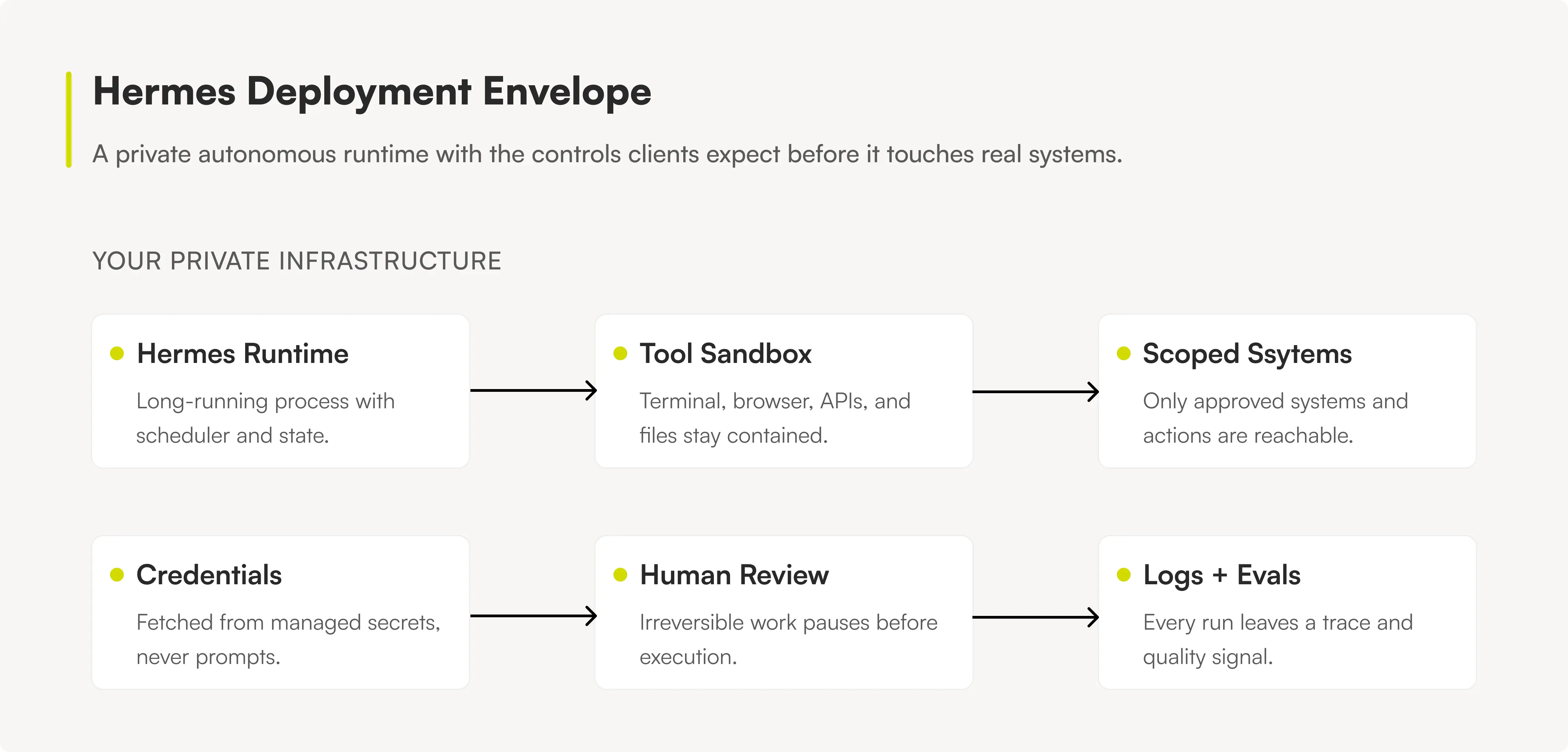
Where Hermes sits in your production stack

This is the control envelope we design before Hermes Agent touches real systems: private runtime, sandboxed tools, scoped credentials, human review, and traceable quality signals.

Diagram showing a self-hosted Hermes deployment envelope with runtime, tool sandbox, scoped systems, credentials, human review, and logs plus evals.

Why Choose Bitontree for Hermes Agent Development?

We have built and run production AI since 2019 from Ahmedabad with US-overlap delivery hours, including a nightly medication-adherence voice system and SOAP-note automation. The operating model is what sets the work apart: we embed senior engineers, build the system, and stay on to run it. An autonomous agent with nobody accountable for it is a liability, so we do not hand over a demo at go-live and walk away.

We Treat It as a System to Operate

A clone-and-run demo is not the project. The project is a long-running process with credentials and a schedule that someone has to monitor, patch, and answer for at 3am. We build for that reality from day one and stay on to run it after launch.

Security-First by Default

Sandboxing, least-privilege credentials, governed tools, and prompt-injection guardrails go in before the agent touches anything real. The failure mode that catches teams out, untrusted input becoming an executed command, is the one we design against first rather than discover in production.

Honest About Fit

We start from the job, not the tool. If a framework, a managed platform, or a plain script is safer and cheaper for what you need, we tell you before you build on the wrong foundation. We have talked teams out of autonomy they did not need.

Real Production Track Record

Our engineers have shipped AI into environments where failure has consequences, including a nightly voice system that calls patients about medication and automation that drafts clinical SOAP notes. That experience shows in the unglamorous parts: evals, fallbacks, secrets, and incident response.

Model-Agnostic and Pinned

Because the runtime is model-agnostic, we pick the model on tool-call reliability and unit economics for your task, not leaderboard rank, then pin the version. Evals re-run before any change, so a silent upgrade cannot degrade behavior without tripping the gate first.

Industries We Build Autonomous Agents For

industy

Healthcare

We run AI in healthcare today, including a nightly medication-adherence voice system and SOAP-note automation. Autonomous agents here stay HIPAA-aware, with approval gates on anything patient-facing and audit trails on every action, and we support BAAs where they apply.

Ecommerce industry icon

E-commerce

Agents handle the repetitive operations behind a storefront: order and exception triage, catalog upkeep, and follow-ups that run on a schedule. Governed tools connect them to your store and fulfillment stack, so an autonomous job acts through named, logged calls rather than raw access.

Logistics industry icon

Logistics

High-volume document and exception work suits an unattended agent: reading paperwork, reconciling against rules, and escalating the cases that need a person. The terminal does the processing inside a sandbox while writes to your TMS or ERP route through approval and an audit log.

SaaS and Product Companies icon

SaaS Product Companies

Product teams use agents for internal operations, support triage, and developer workflows that run alongside the product rather than inside it. We embed with your engineering org, adopt your stack and release cadence, and wire the runtime in behind the same controls you apply to anything in production.

Manufacturing

Finance and Operations

Reconciliation, reporting, and recurring back-office jobs are a natural fit for a scheduled agent. Least-privilege credentials and human gates on anything that moves money or touches a system of record keep an automated process from making an irreversible call on its own.

Real Estate industry icon

Professional Services

Research, drafting, and client follow-up that run on their own free skilled people for the judgment calls. Grounding the agent in approved knowledge keeps its output anchored to your firm's actual positions instead of whatever the model guessed from training data.

Thinking About Running an Autonomous Agent?

Start with a readiness audit. We assess your intended setup against the safe-deployment architecture (sandboxing, least privilege, governed tools, secrets, approval gates, observability, budgets, evals) and hand you a risk report with a prioritized plan. The audit stands alone: you walk away with a clear path either way.

Our Hermes Agent Development Process

We move Hermes Agent from a powerful self-hosted runtime to a governed production worker through a structured build path. Each step has a clear deliverable, risk controls, and a named owner so the agent is safe to run after launch.

01

Readiness Audit

We map the job, where Hermes would run, what systems it touches, who approves risky actions, and whether a self-hosted runtime is the right fit. You leave with a clear risk report and build path.

Workflow and risk mapping

Runtime fit assessment

System access review

Approval gate map

Remediation plan

02

Architecture and Control Design

We design the deployment envelope before the agent touches production: sandbox backend, scoped file system, egress controls, secrets, tool contracts, budgets, and audit requirements.

Sandbox architecture

Least-privilege access model

MCP tool contract design

Secrets and budget controls

Audit trail requirements

03

Build and Integration

We stand up the Hermes runtime, connect approved tools, wire governed access through MCP, add human-in-the-loop gates, and integrate the agent into the workflows it is meant to run.

Runtime setup

Governed tool access

Workflow integration

Human review queues

Trace instrumentation

04

Evals and Safe Launch

We build evals from real tasks and adversarial cases, run launch checks, and start narrow on reversible work. The agent widens only when traces and outcomes show it is ready.

Real-task eval suite

Adversarial test cases

Launch readiness gates

Reversible-work rollout

Production monitoring setup

05

Operate and Improve

After launch we monitor runs, review agent-created skills and memory, respond to incidents, tune prompts and budgets, and re-run evals before every meaningful runtime or model change.

Run monitoring

Skill and memory review

Incident response

Prompt and budget tuning

Model-change eval gates

Business Benefits of a Production-Safe Hermes Agent

Always-On Work Without Always-On Staff

The scheduler runs unattended jobs overnight and on cadence, so recurring work happens without someone watching the clock. The catch is doing it safely, which is why budgets and approval gates ship with it rather than after the first 3am surprise.

Compounding Competence Over Time

Self-improving skills and memory across runs mean the agent gets better at your specific workflows over weeks instead of staying static. Reviewing those skills like code keeps the compounding pointed at competence rather than a confidently repeated mistake.

Control and Data Residency

Self-hosting keeps prompts and tool outputs on infrastructure you control, which matters for regulated and privacy-sensitive teams. There is no per-seat runtime fee and no vendor holding your agent hostage, in exchange for owning the operations yourself.

No Vendor Lock-In

MIT licensing and a model-agnostic design mean you can read the code, fork it, and swap the driving model without a rewrite. The architecture stays yours, so a better or cheaper model later is a config change rather than a migration project.

A Contained Blast Radius

Done right, an autonomous agent's mistakes stay recoverable. Sandboxing, scoped egress, least privilege, and approval gates turn a serious error into a contained one, so the value of automation does not come with an open-ended risk attached.

Decisions You Can Audit

Run tracing and per-call logs mean you can answer what the agent did and why, after the fact. That visibility is what makes an autonomous worker reviewable, supports incident response, and gathers the evidence that helps you meet your own compliance requirements.

Self-hosted Hermes Agent vs a managed agent platform

Self-host when control, data residency, and avoiding lock-in matter more than offloading operations. A managed platform trades that control for someone else owning the hard parts.

Managed agent platformHermes Agent with Bitontree
Control and data residencyData flows through the vendorStays on infrastructure you control
Licensing and lock-inPer-seat fees, vendor-lockedMIT-licensed, no lock-in
Who owns operationsVendor operates it for youWe set it up and operate it
Sandboxing and isolationWhatever the vendor providesHardened sandbox, scoped egress
Accountability after launchBounded by the vendor SLAA named team is accountable

Want Hermes Agent run safely in production?

Talk to our engineers about the job you want an autonomous agent to do. You will get a straight answer on whether a self-hosted runtime is the right fit, the controls to put in place first, and what it takes to operate it after launch.

Production AI systems we already run

Bitontree built these systems and runs them in production today: agent pipelines that process invoices, nightly voice calls to patients, and automated lead handling for real clients.

Smart AI Invoice Processing System
LogisticsSingapore: Singapore

Smart AI Invoice Processing System

AI-powered invoice processing for a Singapore-based logistics enterprise. OCR and ML automate data extraction, validate against business rules, and process invoices end-to-end across multiple formats and currencies.

PythonLangGraphCrewaiStreamlitAzure
AI-Powered Medication Calling System
HealthcareUSA:USA

AI Voice Calling for Medication Adherence

AI voice reminder system for hospitals - automating patient calls, tracking medication adherence, and enabling smart follow-ups.

N8NReact jsPythonVapiTwilioGPT
Sales AI workflow Automation Tool
ManufacturingUSA:USA

B2B Lead Qualification Chatbot

Conversational lead qualification chatbot with BANT-framework questions, real-time scoring, and HubSpot integration for automatic routing.

N8NReact jsPythonSalesforceZapmail

Frequently Asked Questions

What is Hermes Agent, and how is it different from the Hermes models?

Hermes Agent is Nous Research's open-source, MIT-licensed autonomous runtime: a long-running daemon you host yourself that drives a language model through a real terminal and file system. The Hermes models (Hermes 3, Hermes 4) are a separate thing, Nous Research's open-weight LLMs. The runtime is the engine, a model is the fuel.

It is model-agnostic, so it runs on a Hermes model or on OpenAI, NVIDIA NIM, OpenRouter, or your own endpoint. What makes the runtime distinct is the combination it ships with: searchable memory that survives restarts, self-improving skills on the agentskills.io standard, isolated sub-agents, a built-in cron scheduler, and a sandboxed terminal across six backends. People conflate the two names constantly, so if someone says they use Hermes, first ask whether they mean the runtime or the model.

Is Hermes Agent a runtime or a framework, and why does that matter?

Hermes Agent is a runtime you operate, not a framework you build with, and that distinction changes the whole nature of the project.

  • A framework (LangGraph, CrewAI) is a library you import: you write the workflow in code, own the process, and the agent logic lives inside something you already deploy.
  • A runtime is a standalone process that wakes on a schedule, holds its own state, writes its own skills, and acts on its own.

With a framework, deployment is mostly your existing app's deployment. With a runtime, deployment is a separate engineering and governance problem: where it runs, what it can touch, how it is isolated, who approves irreversible actions, and who is on call when a 3am job misbehaves. Choosing a runtime means signing up to operate an autonomous worker, the part most teams underestimate.

Hermes Agent vs OpenClaw vs LangGraph vs CrewAI: how do you choose?

Pick by the shape of the work, not by which project is trending.

  • Hermes Agent or OpenClaw (self-hosted runtimes): the job is long-running and private, needs memory across days, runs on its own schedule, and wants a real terminal on infrastructure you control. OpenClaw is the better operational fit in some setups, which a readiness audit settles.
  • LangGraph or CrewAI (frameworks): you need code-level control over a bounded, product-embedded workflow inside your own application.
  • A script or workflow tool: the steps are deterministic enough to write as plain code.

Autonomy you do not need is just added cost and blast radius. We make this call up front and recommend against Hermes Agent when something simpler is safer.

Which model should drive Hermes Agent, and why not just pick the top benchmark model?

Pick the model with the highest tool-call reliability at acceptable latency and cost per call for your task, which is rarely the one topping a leaderboard. An agent acts through structured tool calls, so its real output is choosing the right tool with valid arguments, not eloquent prose. A model that reasons beautifully but malforms a function call one time in twenty is a flaky worker, whatever its reasoning score.

Latency compounds because a task can chain dozens of calls, and cost is per call rather than per month, so cost per successful action is the number that matters once sub-agents and retries are in play. Because Hermes Agent is model-agnostic, we test candidates against your real tasks, pick on reliability and unit economics, pin the version, and re-run evals before any change so a silent upgrade cannot degrade behavior unnoticed.

What is the blast radius of Hermes Agent, and what is the prompt-injection-to-execution risk?

The blast radius is everything the runtime can reach: its terminal, file system, injected credentials, scheduled jobs, and any tools or systems it can call. The specific danger is the path from untrusted input to executed action.

The moment an agent both reads attacker-controlled content (a page, an email, a ticket, a document) and holds a terminal with credentials, an injection becomes a command it can run, like exfiltrating data or deleting records. This failure mode is unique to autonomous agents, and it is why we never run the local backend in production with secrets in a dotfile. We shrink the radius with a hardened sandbox, scoped file system and network egress, least-privilege per-environment credentials, governed tools through MCP, and human approval on irreversible actions, so even a successful injection runs into a wall instead of your systems.

How do you govern memory and skill drift?

We treat agent-written skills and self-curated memory exactly like code: snapshotted, versioned, diffed, reviewed, and revertable. Drift is the quiet risk with a self-improving agent.

A skill that learned a wrong shortcut, or a memory that absorbed a one-off exception as a standing rule, gets applied confidently on every future run until a human catches it, because the agent's own past output becomes the prior for its next decision. Hostile content it reads can also poison memory if nothing reviews it. So we snapshot what the agent writes, review changes like a pull request before they become standing behavior, and keep the ability to roll a bad lesson back to a known-good state. Compounding competence is the upside and a compounding mistake is the failure mode, and the same review discipline handles both.

Should we self-host Hermes Agent or use a managed platform?

Self-host when control, data residency, and avoiding vendor lock-in matter more than offloading operations. Use a managed platform when you would rather not own isolation, secrets, observability, upgrades, and incident response.

Because the runtime is MIT-licensed and self-hosted, there is no per-seat runtime fee and your prompts and tool outputs can stay on infrastructure you control, which matters for regulated and privacy-sensitive teams. The trade is that everything a managed platform abstracts away becomes yours to operate. Self-hosting does not remove the operational burden, it transfers it to you, and an autonomous agent with nobody accountable for it is a liability. That is the gap we fill: we set up and harden the self-hosted runtime so you keep control, and we can stay on to operate it so that control does not become an unowned risk.

When is Hermes Agent the wrong choice?

Hermes Agent is the wrong choice when the autonomy adds cost and blast radius for no real benefit. A few clear cases:

  • Deterministic steps: if you can express them as an if/else, write a script. A self-hosted runtime is overkill and a larger attack surface.
  • Product-embedded logic: if it belongs inside your application with code-level control, a framework like LangGraph or CrewAI fits better.
  • No owner: with nobody to run monitoring, upgrades, incident response, and skill and memory review, it drifts into a liability.
  • No hardened sandbox: if you cannot run it with isolation and least-privilege access, it should not run autonomously at all.

We say this plainly during the readiness audit, not after you have built on the wrong foundation.

What does a Hermes Agent readiness audit include?

A readiness audit reviews the job you want to automate, where the agent would run, what data and systems it can touch, and who owns operations after launch, then scores that setup against the safe-deployment architecture.

Concretely, we map the workflow and its risk, review tool and data access, assess the sandbox and hosting plan, and check it against sandboxing, least privilege, governed tools, approval gates, secrets management, observability, budgets, and evals. We also weigh whether Hermes Agent is even the right tool versus a framework, a managed platform, or a plain script. The deliverable is a risk report and a prioritized remediation plan you can act on with us or hand to your own engineers. The audit stands alone: you get a clear, honest plan whether or not you continue with Bitontree afterward.

What controls do you implement before production?

Before Hermes Agent touches a production system, we put a full layer of controls in place, each closing a specific failure mode rather than serving as a checkbox.

  • Sandbox: a Docker or remote backend (Modal or Daytona), never local, with file system and egress scoped to the job, plus gVisor or Firecracker underneath for higher-risk work.
  • Access: least-privilege per-environment credentials, with secrets in a managed store injected at runtime, never in a file the agent or a sub-agent can read.
  • Tools: MCP-style governed tools and prompt-injection guardrails on untrusted input.
  • Approval: irreversible or externally visible actions (a send, a payment, a delete, a write to a system of record) route to a person, while reversible work runs unattended.
  • Visibility: run tracing, token and action budgets with loop detection, and an eval suite the agent must pass to launch.

Can Hermes Agent work with our existing tools and data?

Usually yes, but through explicit governed interfaces rather than raw access. We connect Hermes Agent to your systems behind a Model Context Protocol (MCP) layer, so the agent calls named, typed, permissioned tools (for example create_ticket or read_account) instead of holding open database access or unrestricted HTTP.

The MCP server enforces what is allowed, validates arguments, and logs every call, which makes after-the-fact review and incident response possible. We start with read-only or reversible workflows, add audit trails and run tracing from day one, and widen access only as the agent proves reliable under evals and human review. For grounded answers we connect approved knowledge through retrieval (RAG) so the agent acts on your policies and data rather than guessing. The result is integration you can list, reason about, and revoke, not an agent wired straight into your raw systems.

Can Bitontree deploy and operate Hermes Agent for us?

Yes. Bitontree deploys Hermes Agent as a production service and stays on to run it: runtime setup, sandbox hardening, governed tool access, approval gates, secrets management, observability, and evals, then monitoring, upgrades, incident response, budget tuning, and review of what the agent has learned.

This is how we work in general. We embed senior AI engineers with your team to build the system and then operate and improve it, rather than handing over a demo at go-live. We have built and run production AI since 2019 from Ahmedabad with US-overlap delivery hours, including a nightly medication-adherence voice system and SOAP-note automation, so we treat an autonomous agent as something to operate, not just install. We are also candid about fit: if a framework, a managed platform, or a plain script would be safer, we tell you before you build on it.

Related Services and Work

Book a Hermes Agent readiness audit

Answer a few quick questions about the job, where it would run, and the controls that matter to you. We use them to recommend a deployment path, the risk controls to put in place first, and the scope of a next-step audit, including whether Hermes Agent is the right tool for what you are trying to do.

1. What do you want Hermes Agent to do first?

2. Where would the agent need to run?

3. What systems or controls matter most?

4. How soon do you want a production-safe path?

Let's scope your autonomous agent project

Connect with senior AI engineers who choose the runtime, harden it, and operate it after launch. We have built production AI since 2019 from Ahmedabad with US-overlap delivery, including a live nightly medication-adherence voice system and SOAP-note automation, so we know what it takes to keep an autonomous agent safe to run.

Years of experience

6+

Years Of Experience

Skilled Professionals

40+

Skilled Professionals

Projects Delivered

105+

Projects Delivered

Global Clientele served

35+

Global Clientele Served

Tell us what you want to automate, and we'll tell you the safest way to do it.