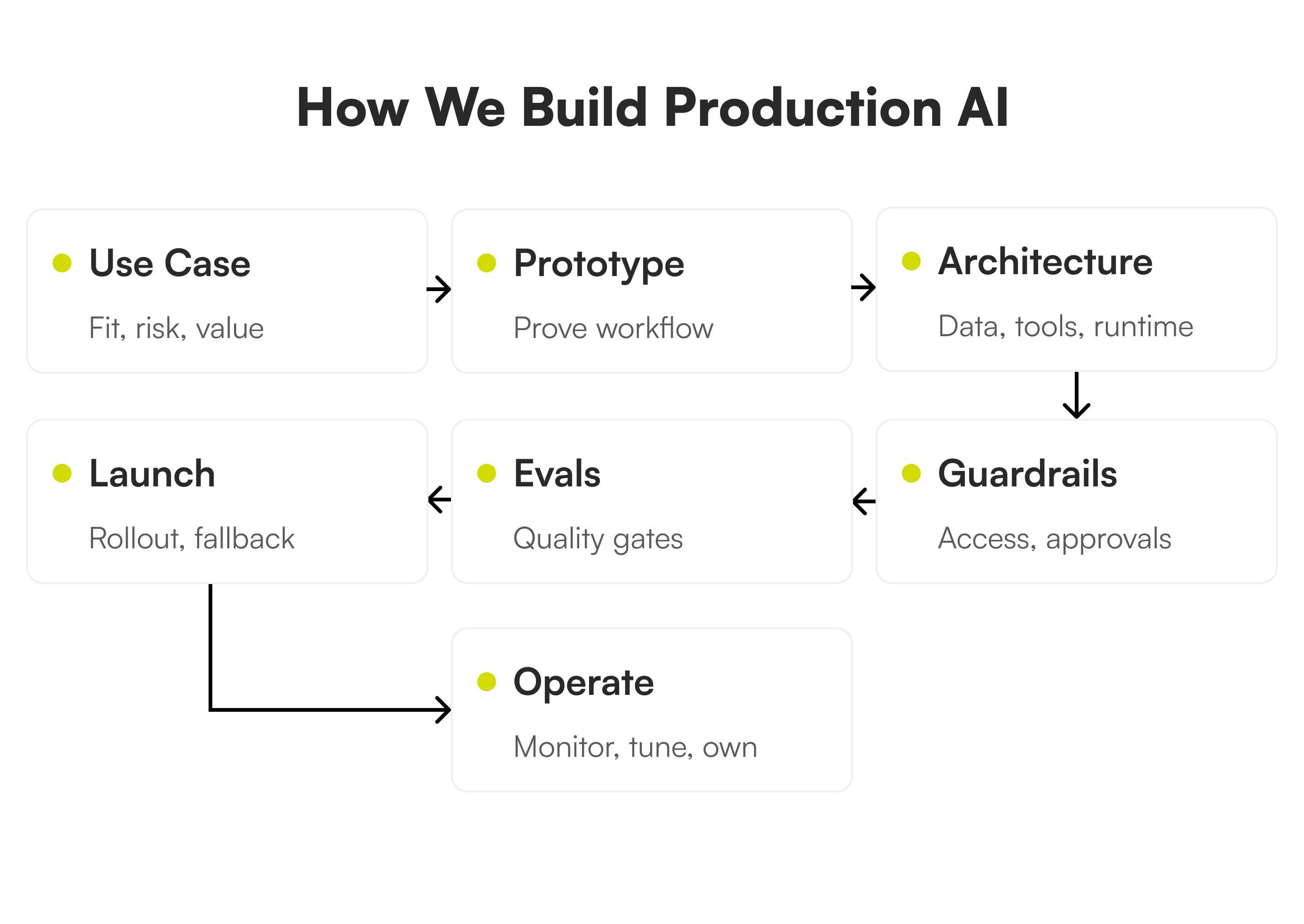
How We Build Production AI

How we build production AI workflow with use case, prototype, architecture, launch, evals, guardrails, and operate stages

A demo that wows a room is the easy part. Keeping an AI system reliable, secure, and observable once real users and messy data arrive is the work most teams underestimate, and it is where most prototypes quietly stall. This is the process Bitontree uses to take an AI idea or prototype to a production system we then help operate: an honest build-vs-buy decision, architecture with security settled up front, building against evals, governance wired in from day one, a gated launch with a rollback path, and ongoing operation. Bitontree has built and run production AI since 2019 from Ahmedabad with US-overlap hours, including a nightly medication-adherence voice system and SOAP-note automation, so we treat AI as software to operate, not a demo to hand over.

What We Do to Get AI Into Production

Getting an AI prototype to production is its own discipline, separate from the prototype that proved the idea. Our work is the engineering and governance that turns a promising run into a system someone can trust and operate. We scope it honestly, design the architecture and data, build against evals, govern what it can touch, gate the launch, and stay on to run it.

Discovery and scoping icon

Discovery and Honest Scoping

We separate the job to be done from the tech someone hoped to use, map the real inputs and constraints, and make the build-vs-buy-vs-no-AI call before any code exists. If a script, a query, or an off-the-shelf product is cheaper and safer, you get that in writing first.

Architecture and data icon

Architecture and Data Design

We decide how the system works end to end, with reliability and security as design inputs rather than afterthoughts. Model and approach, grounding and sources of truth, data residency, and failure behavior all get settled while they are still cheap to change, then written down so your team can challenge them.

Building with evals icon

Building With Evals

We measure AI quality instead of sensing it. Before chasing a better score, we build an eval harness from your real cases plus adversarial ones, so every change to prompts, retrieval, tools, or model is scored. A tweak that helps one case and breaks five gets caught the same day.

Security and governance icon

Security and Governance

We wire in least-privilege access, governed tools through a controlled interface like an MCP server, human approval gates on anything irreversible, and managed secrets. The aim is least access the job requires, with a person sitting exactly where reversibility runs out and nowhere else.

Gated launch icon

Gated Launch

Launch is a gate, not a celebration. The system goes live only when evals pass at the agreed bar, observability is flowing, a tested rollback path exists, and runbooks cover the predictable failures. Where risk warrants it, we roll out gradually behind flags or to a limited audience first.

Operate and improve icon

Operate and Improve

Most of an AI system's life is operation, where value compounds or quietly leaks away. We monitor quality, latency, and cost against launch metrics, turn real mistakes into new eval cases, handle upgrades and incidents behind re-run evals, and tighten governance as usage shows where it should.

The Gap Between a Demo and Production

Most AI projects stall in the same few places, and the model is rarely the problem. The things production needs (measured quality, a defined security posture, visibility into behavior, someone accountable) were never built, because the demo did not require them. These are the gaps we close before launch, not after the first incident.

It Works Until It Does Not icon

It Works, Until It Does Not

A demo is tuned on happy-path inputs, so it looks finished. Production brings malformed inputs, odd phrasing, edge cases, and users trying to break it. Quality that was never measured has no floor, so it drifts and surfaces as complaints. An eval set on every change turns behavior into a number you watch.

No One Owns the Risk icon

No One Owns the Risk

Prototypes run on broad credentials and whatever access was convenient, and nobody decided what the model may send, pay, or delete. Without a governance model, the first incident becomes the design review. We settle least-privilege access, managed secrets, and approval gates before launch instead.

Nobody Can See What It Is Doing icon

Nobody Can See What It Is Doing

With no tracing or evals, the system is a black box that reveals nothing about how it answered. You cannot tell whether last week's change helped or why one output went wrong, so it drifts and trust erodes. End-to-end traces and ongoing evals make a bad output something you can actually debug.

It Was Built to Impress Not to Survive icon

It Was Built to Impress, Not to Survive

A prototype is judged by how good its outputs feel, which rewards a polished happy path over reliability. Production is judged by the full distribution of real and adversarial inputs. We build for that distribution from the start, which is why the work looks slower early and holds up far longer.

No Plan for Failure icon

No Plan for Failure or Recovery

Demos never have to fail gracefully, so timeouts, retries, fallbacks, and a way back to a known-good state get skipped. In production a dependency goes down or a model changes, and improvisation becomes the incident response. We design failure behavior and a tested rollback path before go-live.

Confident Wrong Answers icon

Confident Wrong Answers

A model that invents an answer sounds exactly as sure as one that is right, and a demo rarely probes the difference. Left unchecked, fabricated confidence is what erodes user trust fastest. We ground answers in real sources and make the system signal uncertainty and escalate rather than guess.

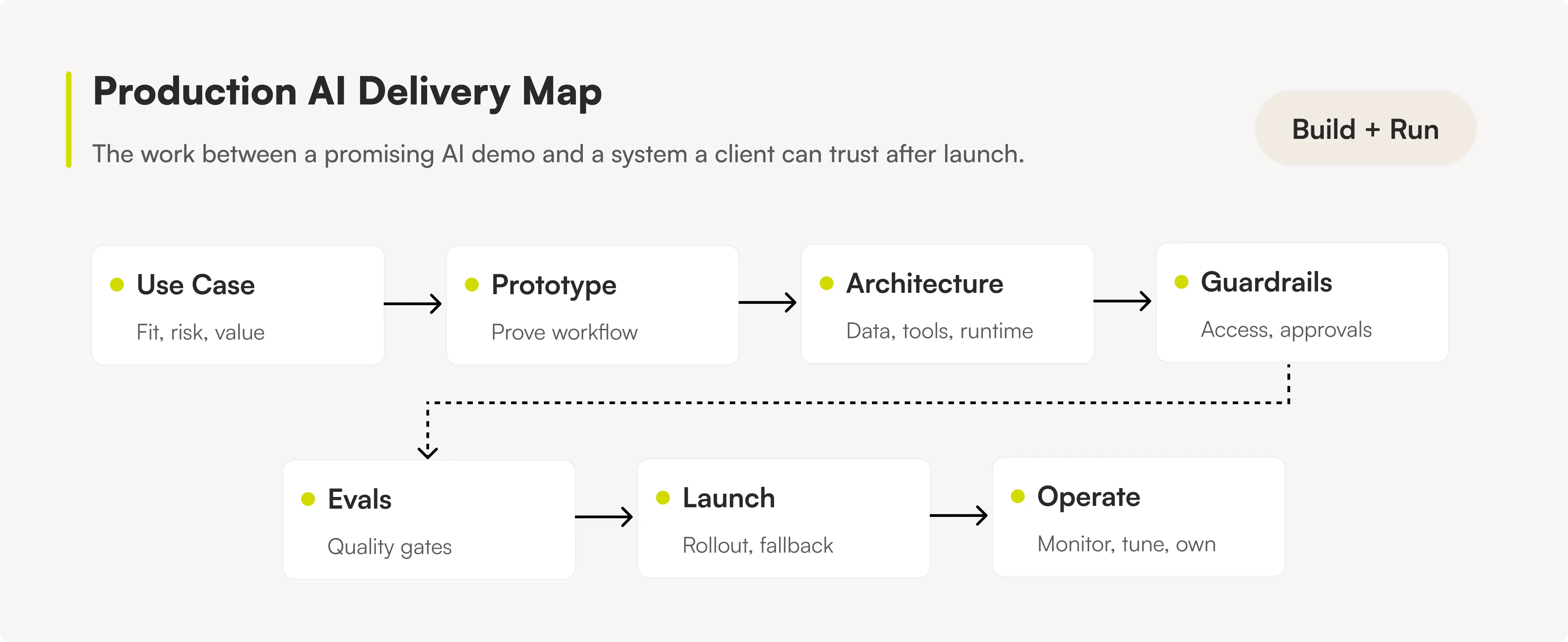
The path from AI demo to operated system

The work is not finished when the demo works. We move from use-case fit to architecture, guardrails, evals, launch, and ongoing operation so the system can survive real use.

Production AI delivery map from use case through prototype, architecture, guardrails, evals, launch, and operation

Why Teams Bring This Process to Bitontree

We have built and run production AI since 2019 from Ahmedabad with US-overlap delivery hours, including a nightly medication-adherence voice system and SOAP-note automation. The operating model is what sets the work apart: we embed senior engineers, build the system, and stay on to run it. An AI system in production with nobody accountable is a liability, so we do not hand over a demo at go-live and walk away.

We Treat AI as Software to Operate

A demo that ran once is not the project. The project is a system with credentials, real inputs, and a quality floor that someone has to monitor, patch, and answer for. We build for that reality from day one and stay on to operate it, because the part the demo never shows is where AI keeps or loses its value.

Security Designed In, Not Reviewed at the End

Least-privilege access, governed tools, managed secrets, and approval gates go into the architecture conversation, not an audit before launch. The failure mode that catches teams out, broad access plus an irreversible action, is the one we design against first rather than discover in production.

Honest About Fit

We start from the job, not the technology someone was hoping to use. If a script, a query, a search index, or an off-the-shelf product is cheaper and safer, we say so in writing before you build on the wrong foundation. We have talked teams out of AI they did not need.

Real Production Track Record

Our engineers have shipped AI into environments where failure has consequences, including a nightly voice system that calls patients about medication and automation that drafts clinical SOAP notes. That experience shows in the unglamorous parts: evals, fallbacks, secrets, and incident response.

Embedded Engineers Who Stay Accountable

We embed senior engineers into your team and work in your stack and cadence, so knowledge transfers as the work happens rather than in a handover document. Because we also operate what we build, the people who wrote the code are the ones who understand it when something breaks at 3am.

Industries We Build Production AI For

industy

Healthcare

We run AI in healthcare today, including a nightly medication-adherence voice system and SOAP-note automation. Systems here stay HIPAA-aware, with approval gates on anything patient-facing and audit trails on every action, and we support BAAs where they apply.

Ecommerce industry icon

E-commerce

We build AI into the operations behind a storefront: support and order triage, catalog work, recommendations, and recovery flows. Each system connects to your store, fulfillment, and payment stack through governed, logged calls rather than raw access it could misuse.

Manufacturing

Manufacturing

Quality inspection, forecasting, and document-heavy back-office work suit a production AI system that runs against your ERP, MES, and sensor data. We design failure behavior and gates so an automated decision on the floor stays measurable and recoverable rather than a surprise.

Logistics industry icon

Logistics

High-volume document and exception work is a natural fit: reading paperwork, reconciling against rules, and escalating the cases that need a person. Writes to your TMS or ERP route through governed tools and an audit log, so the automation stays both fast and accountable.

SaaS and Product Companies icon

SaaS Product Companies

We build AI features inside products: copilots, in-app assistants, semantic search, and RAG over customer data. We embed with your engineering org, adopt your stack and release cadence, and ship the feature behind the same evals and controls you apply to anything in production.

Real Estate industry icon

Real Estate

Lead qualification, document processing, and client follow-up that run on their own free skilled people for the judgment calls. Grounding the system in approved data keeps its output anchored to your actual listings and policies rather than whatever the model guessed.

Have an AI Prototype That Needs to Become a Product?

Start with a production review. We map your prototype against this process and hand you a prioritized plan to get it production-ready: where the evals, the security model, the observability, and the operating plan are missing, and what to do first. You walk away with a clear path either way.

Our Build Process

Six stages take an idea to an operated system. Each produces a concrete artifact you keep, so you can stop or change direction at any stage with something useful in hand. The order matters: decide whether to build before we design, design security before we write code, prove quality before we launch.

01

Discovery and Scoping

We separate the job to be done from the tech someone hoped to use, map the real inputs and constraints, and make the build-vs-buy-vs-no-AI call. You get a scoped risk and fit assessment, and if AI is the wrong tool, you get that in writing before anyone builds.

Use-case fit review

Input and workflow mapping

Build-vs-buy decision

Risk and success criteria

Scoped delivery plan

02

Architecture and Data

We decide how the system works end to end, with reliability and security as inputs: model and approach, grounding and sources of truth, data residency, and failure behavior. You get an architecture document covering data design, trust boundaries, and tradeoffs your team can challenge first.

Data and source design

Trust boundary mapping

Model and retrieval choices

Failure behavior

Architecture document

03

Build With Evals

We build the eval harness that defines a good answer before chasing a higher score, drawing on real cases, adversarial and edge cases, and known-hard examples. Every change gets scored, so a regression is caught at once. You get a versioned harness that travels into production.

Golden test set

Adversarial cases

Prompt and retrieval scoring

Regression checks

Versioned eval harness

04

Security and Governance

Built alongside the system, not reviewed at the end: least-privilege access, governed tool access through a controlled interface, human approval gates on the irreversible, and managed secrets. You get an access and threat model written to support HIPAA-aware and SOC 2-aware requirements.

Least-privilege access

Governed tool access

Managed secrets

Human approval gates

Threat model

05

Launch Behind a Gate

The system goes live only when evals pass at the agreed bar, observability is flowing, a tested rollback path exists, and runbooks cover predictable failures. Where risk warrants it, we roll out gradually. You get a launch you can defend, with evidence it was ready and a way to undo it.

Eval pass gate

Observability setup

Rollback plan

Runbooks

Gradual rollout

06

Operate and Improve

Most of a system's life is operation. We monitor quality, latency, and cost against launch metrics, turn real mistakes into new eval cases, handle upgrades and incidents behind re-run evals, and tighten governance as usage shows where it should. You get living runbooks and engineers who know it.

Quality monitoring

Cost and latency tracking

Incident response

Eval set expansion

Continuous tuning

Principles We Build By

The process changes shape from project to project. These principles do not. They are why a Bitontree build looks slower at the start and holds up longer in production.

Measure Before You Ship

Quality you do not measure is quality you cannot defend. We build the eval set first and make it the unit of progress, so changes are judged by what they do to the score, not how the output reads. Launch is gated on the evals, and the set grows in operation so every mistake becomes a permanent regression test.

Least Privilege by Default

An AI system should hold the least power that lets it do its job, and no more. Broad credentials handed over for convenience are how a small mistake becomes an incident. Scoped credentials per capability, governed tool access, and access earned by reversibility keep security in the architecture, not the audit.

Humans Gate the Irreversible

The system can decide; a person decides the things you cannot take back. Reversible, low-stakes actions run automatically, while sending money, deleting a record, or publishing in public routes to a human with the context to decide fast. Relaxing a gate is an explicit choice backed by eval evidence, never a default.

No Fabricated Confidence

A confident wrong answer is worse than an honest I do not know, and that applies to the system and to us. The system grounds answers in real sources, signals uncertainty, and escalates instead of inventing. For us it means saying when AI is the wrong tool and reporting what the evals actually show.

Artifacts You Keep at Every Stage

You are never paying for motion without proof. Discovery produces a fit assessment, architecture a design document, the build a versioned eval harness, security an access and threat model, launch the evidence and a rollback path. Because the deliverables are tangible, you can pause or change direction with something useful in hand.

Someone Owns It After Launch

An AI system degrades quietly as the world shifts, inputs change, and providers update models. So operation is part of the work, not an add-on: monitoring, re-run evals before any change, and a named team accountable for what runs. The point is that someone owns the system on purpose, not by accident.

A prototype vs a production-grade AI system

A prototype only has to work once on chosen inputs. A production system has to hold up across real and adversarial cases, stay secure and observable, and have someone accountable for it.

A prototype or demoProduction AI with Bitontree
Quality measurementJudged on how outputs feelAn eval set gates every change
Security and accessBroad, convenient credentialsLeast privilege, gated, governed
ObservabilityA black box, nothing tracedEnd-to-end traces and metrics
Failure and recoveryNo rollback, no runbooksTested rollback and runbooks
Who operates itNobody decidedA named team is accountable

Want AI that survives production?

Talk to our engineers about the system you want to build or the prototype that has stalled. You will get a straight answer on feasibility and approach, the gaps to close first, and what it takes to operate it after launch.

Production AI systems we already run

Bitontree built these systems and runs them in production today: agent pipelines that process invoices, nightly voice calls to patients, and automated lead handling for real clients.

Smart AI Invoice Processing System
LogisticsSingapore: Singapore

Smart AI Invoice Processing System

AI-powered invoice processing for a Singapore-based logistics enterprise. OCR and ML automate data extraction, validate against business rules, and process invoices end-to-end across multiple formats and currencies.

PythonLangGraphCrewaiStreamlitAzure
AI-Powered Medication Calling System
HealthcareUSA:USA

AI Voice Calling for Medication Adherence

AI voice reminder system for hospitals - automating patient calls, tracking medication adherence, and enabling smart follow-ups.

N8NReact jsPythonVapiTwilioGPT
Sales AI workflow Automation Tool
ManufacturingUSA:USA

B2B Lead Qualification Chatbot

Conversational lead qualification chatbot with BANT-framework questions, real-time scoring, and HubSpot integration for automatic routing.

N8NReact jsPythonSalesforceZapmail

Related Services and Work

Frequently Asked Questions

Why do most AI prototypes fail to reach production?

Most fail because they were built to impress in a demo, not to survive real conditions. A prototype is tuned on happy-path inputs and judged by how good its outputs feel. That hides the three things production needs: measured quality through evals, a defined security and access model, and observability into behavior. When real users and data arrive, quality drifts with nothing to catch it, no one has decided what the system may do, and a bad output cannot be debugged because nothing was traced. The model is rarely the problem; the missing engineering is. Our process closes those gaps on purpose, which is why it looks slower at the start and tends to ship a trustworthy system sooner, since the rework and incidents that usually stall a launch never happen.

What does production-grade actually mean for an AI system, as opposed to a demo?

Production-grade means the system is reliable on the inputs it will actually see, secure by design, observable in operation, and backed by a plan for who runs it and how it recovers. A demo only has to work once on chosen inputs. A production system holds up across the full distribution of real and adversarial cases, which is why it needs an eval set as a measured quality floor, not a good impression. It runs under least-privilege access, with irreversible actions gated behind a human and secrets managed. It is traceable, so a wrong output can be opened and explained, and drift shows up as a trend before it becomes a complaint. And it has a rollback path, runbooks, and someone monitoring it. The demo is the easy part. Production is everything that keeps the system trustworthy after the applause.

Do you only build new systems, or can you productionize an existing prototype or stalled feature?

We do both, and productionizing an existing prototype or stalled AI feature is one of our most common engagements. We meet the system where it is rather than insisting on a rebuild. It usually starts with a production review: we run your prototype against this process and find the gaps, typically missing evals, an undefined security and access model, no tracing, and no operating plan. From there we add an eval harness from your real and adversarial cases, wire in least-privilege access and approval gates, instrument the system with tracing and the metrics that matter, and set up monitoring and a rollback path before go-live. If parts of the prototype are sound, they stay. The goal is to get a system you already have over the line to something you can trust and operate, not to throw away working work for the sake of starting fresh.

How long does it take to get an AI system into production, and why won't you quote a generic timeline?

It depends on the data, the integrations, and the level of risk, so we scope it per project rather than quote a number that would be guesswork. A read-only assistant over clean data is a very different timeline from an agent that takes irreversible actions across several systems under privacy constraints. Pretending otherwise would set a date we could only hit by cutting the safety work that makes production work. What stays constant is the shape of the work: discovery and an honest build-vs-buy decision, architecture and data design, building against evals, security and governance, a gated launch, and ongoing operation. During scoping we size each stage to your system and constraints and give you a realistic plan, with the riskiest unknowns identified early so they do not surprise the schedule later.

What does each stage of your build process actually produce?

Each stage produces a concrete artifact you keep, so you are never paying for motion without proof. Discovery produces a scoped risk and fit assessment: the use case, the data and compliance constraints, the recommended build-vs-buy-vs-no-AI approach, and the failure modes worth worrying about. Architecture produces an architecture document covering model choice, retrieval and grounding, data flows, trust boundaries, and data-residency decisions. The build stage produces a versioned eval harness drawn from real and adversarial cases that becomes the quality gate. Security and governance produces an access and threat model naming every capability, what is gated behind a human, where secrets live, and how misuse is contained. Launch produces the evidence the gate was passed, plus a tested rollback path and runbooks. Operation produces living runbooks and an eval set that grows with the system. Because the deliverables are tangible, you can pause or change direction at any stage with something useful in hand.

How do you decide between building, buying, and using a framework?

We separate the job to be done from whatever technology someone was hoping to use, then choose the cheapest, safest option that actually solves it. We buy when a mature product already covers the need and the real work is integration, because reinventing a solved problem rarely pays off. We use an existing framework or model provider when it gives us the building blocks, retrieval, tool orchestration, governed tool access, without locking the design into something we cannot operate or secure. We build custom when the problem is specific to you and a tailored system earns its keep in reliability, control, or cost. Sometimes the honest answer is none of the above: a scripted workflow or a query beats AI on this problem. We make that call in discovery, in writing, with the tradeoffs visible, because the wrong foundation is expensive to unwind once code exists.

What happens after launch, and who operates the system?

After launch we stay and help operate the system, because operation is where AI keeps its value or quietly loses it. We monitor quality, latency, and cost against the metrics set at launch, so drift shows up as a trend rather than a wave of complaints. We review real output, including, for agents, what they actually did, and turn mistakes into new eval cases so the same failure cannot return unnoticed. We handle model upgrades and incidents using the runbooks and rollback path established at launch, and re-run evals before any prompt or model change reaches users. We also tighten governance as real usage shows where access can be narrowed or a new gate is needed. Staffing is set during scoping: our engineers embed alongside your team and can run the system, share the load, or hand it over with the knowledge and tooling to run it yourselves. The point is that someone owns it, on purpose.

What if AI turns out to be the wrong tool for the problem?

Then we tell you, and we would rather lose the build than ship a system that should not exist. Deciding honestly whether AI fits is part of discovery, not an afterthought. For plenty of problems a scripted workflow, a search index, a rules engine, or a straightforward integration is cheaper, more predictable, and easier to secure and operate than a language model, and forcing AI onto them just adds cost and a new failure mode. When that is the case we say so in the scoped assessment, explain why, and point you at the approach that serves the goal, even when that approach is not us. Sometimes AI is the right tool for one part of a system and the wrong tool for the rest, and the design reflects that split. The aim is a system that earns its place, not a project that exists because AI was in the brief.

How do you keep an AI system from silently degrading after it ships?

We keep a system from silently degrading by making its quality visible and treating every regression as something to catch, not discover later. AI systems decay quietly: the world shifts, input patterns change, a provider updates a model, and yesterday's good behavior slips without anyone touching the code. So the eval set built during development stays live in production as the quality floor, and we re-run it before any prompt, retrieval, or model change reaches users. We instrument the system with tracing and the metrics that matter, so drift in quality, latency, or cost shows up as a trend on a dashboard rather than a backlog of complaints. We review real output on a cadence, and when something goes wrong it becomes a new eval case so the same failure cannot return unnoticed. Degradation does not announce itself, so the only defense is continuous measurement plus a person paying attention.

How do your embedded engineers work with our existing team?

Our engineers embed into your team and work as part of it, rather than disappearing to build in a silo and handing back a black box. They sit in your workflow, use your tools and conventions, and build alongside your developers, so knowledge transfers as the work happens instead of in a handover document at the end. Bitontree was founded in 2019 and works US-overlap hours from Ahmedabad, so there is real working-time overlap for standups, reviews, and the fast back-and-forth production work needs. The level of embedding flexes to what you want: leading the build, augmenting a team that already has direction, or pairing closely so your engineers can own and operate the system afterward. Because we also operate what we build, the engineers writing the code are the ones who understand it in production, which is why the system stays maintainable by your team rather than dependent on ours.

How do you handle security, privacy, and compliance in a production AI build?

We treat security and privacy as design inputs from the first architecture conversation, not a review at the end. The defaults: least-privilege access with scoped credentials per capability, governed tool access through a controlled, logged interface rather than open keys, human approval gates on anything irreversible or externally visible, and secrets held in a secrets manager that never touches prompts, code, or logs. We decide data residency up front: where data lives, what is sent to which model provider, and what must stay inside your boundary. We produce an access and threat model that names every capability the system has and how misuse, including prompt injection, is contained. On compliance, we build HIPAA-aware and SOC 2-aware handling where it applies and design controls that help you meet your obligations, but we are careful with language: Bitontree does not claim to be certified or compliant on your behalf, and your own compliance posture remains yours. We have applied this in healthcare-adjacent systems, including a live nightly medication-adherence voice service and SOAP-note automation.

What does a production review include, and is it useful on its own?

A production review maps the AI prototype or feature you already have against this process and tells you, honestly, what it would take to make it production-ready. We look at the use case and data, the current architecture and its trust boundaries, how quality is measured today, what access and secrets the system holds, whether anything is traced, and who would own it after launch. The deliverable is a prioritized plan: where the evals, the security model, the observability, and the operating plan are missing, the risks that matter most, and what to do first. It is useful on its own. You walk away with a clear picture and an actionable plan whether you continue with Bitontree, hand the plan to your own engineers, or decide the system should not ship in its current form at all.

Build AI that survives production

Connect with our team to take an AI idea or prototype to a production system you can trust and operate.

Years of experience

6+

Years Of Experience

Skilled Professionals

40+

Skilled Professionals

Projects Delivered

105+

Projects Delivered

Global Clientele served

35+

Global Clientele Served

Tell us what you're building, and we'll tell you how we'd ship it.